Getting started with email marketing for small business in 2026 really comes down to three things: building a quality list, sending emails people want to open, and setting up automations to do the heavy lifting for you. In a world of ever-changing social media algorithms, email is still the most reliable way to reach your customers directly and build a predictable stream of revenue.
Why Email Still Runs the Show for Small Businesses in 2026

With all the noise about new marketing channels, it's easy to forget about email. But the numbers don't lie. It consistently delivers an incredible return, often bringing in $36 for every $1 spent. The reason is simple: you own your email list. It’s a direct line to your audience that no tech giant can suddenly change or take away.
For any small business, whether you're running a local boutique or a home services company, this isn't just a nice-to-have; it's a core pillar of sustainable growth. The very first step, even before you send your first campaign, is learning how to create a company email. It looks professional and immediately starts building brand trust.
A Real-World Strategy That Cuts Through the Clutter
I see so many business owners get bogged down by complicated marketing theories and a dizzying array of software. But the truth is, a powerful email strategy for a small business is built on a few fundamentals. This guide is your no-fluff playbook for turning subscribers into loyal customers.
We're going to skip the jargon and focus on what really moves the needle:
Growing Your First List: I’ll show you simple, honest ways to attract people who are interested in what you have to say. No tricks, just value.
Effortless Automations: We'll set up "set it and forget it" email sequences that welcome new leads and nurture them automatically, freeing you up to run your business.
Personalization That Matters: This goes way beyond just using someone's first name. It's about sending messages that feel like a real, one-to-one conversation.
Think of your email strategy as your digital handshake. It’s how you introduce your brand, build trust over time, and create a community around your business, one message at a time.
Tying Email Into Your Bigger Marketing Picture
Your email marketing shouldn't operate in a vacuum. It’s the glue that holds all your other efforts together. For example, maybe you're running ads on premium channels through a platform like Adwave. A potential customer sees your ad, clicks through to your site, and now what?
Your email signup form is that important next step. It captures their initial interest and brings them into your world. This is how you turn an expensive click into a long-term relationship. You can see how this fits into a larger plan in our complete guide on how to market your small business.
By connecting your top-of-funnel advertising with a solid email follow-up plan, you ensure you're getting the absolute most out of every dollar you spend. Following these practical steps will help you build a powerful marketing engine that will serve you for years to come.
Building Your Foundation for Lasting Success
Before a single email goes out, you need to get your foundation right. So many businesses jump straight to writing copy, but your long-term success really hinges on two things: the tools you choose and the quality of your email list.
Getting these right from the start saves you massive headaches down the road. It's the difference between building a marketing channel that prints money and one that just drains your time.
Choosing the Right Email Service Provider
Your Email Service Provider, or ESP, is the command center for your entire email operation. It's where you'll store your contacts, design emails, and see your results. For a small business launching in 2026, the goal isn't to find the platform with the most bells and whistles, it's to find one that's easy to use, affordable, and can grow with you.
Don't get bogged down in overly complex, enterprise-level systems. You simply don't need them yet. Instead, look for an ESP that nails the essentials:
A simple drag-and-drop editor: You should be able to create professional-looking emails without ever touching a line of code.
Basic automation capabilities: Setting up a "welcome" email for new subscribers is a non-negotiable. This feature is a huge time-saver.
Easy segmentation tools: You'll need to group subscribers based on their interests and how they interact with you. More on that in a bit.
Clear, simple reporting: At a glance, you should see your open rates, click-through rates, and other key metrics.
Compare email providers by subscriber limits, automation features, and the cost as your list grows.
Growing Your Email List Ethically
Your email list is one of the most valuable assets your business will ever own. It's a direct, unfiltered line of communication to your customers that isn't controlled by a third-party algorithm.
Growing this list is all about a fair trade: you provide something valuable, and in return, someone gives you their email address. Whatever you do, don't even think about buying an email list. It's a fast track to a damaged reputation, terrible results, and getting your domain blacklisted by email providers.
The right way to do it is with a compelling lead magnet. This is just a free, valuable resource you offer in exchange for an email.
A great lead magnet solves a specific, nagging problem for your ideal customer. It delivers a quick win and immediately positions you as a helpful expert, building trust from the first click.
Here are a few real-world ideas for different businesses:
Home Services Company: Offer a downloadable "DIY Home Maintenance Checklist for Spring."
Local Restaurant: Give new subscribers an exclusive "20% Off Your Next Meal" coupon.
Real Estate Agent: Create a free guide on the "5 Things to Look for When Buying Your First Home in [Your City]."
E-commerce Store: Provide early access to a new product launch or a subscriber-only sale.
Once you’ve created your lead magnet, make it easy for people to find. Add sign-up forms to your website, post about it on social media, and if you have a physical store, collect emails at the point of sale.
The Power of Segmentation and List Hygiene
By 2026, the world will see an estimated 392.5 billion emails sent every single day to 4.6 billion users. That’s an incredible amount of noise. To have any chance of standing out, your message has to be personal and relevant.
This is where segmentation saves the day. The data is clear: segmented and personalized emails are responsible for 58% of all revenue from email marketing. You can see more of the key 2026 email marketing data points that prove just how important this is.
Even basic segmentation is a useful option. You can start by grouping your subscribers based on:
Where they came from (e.g., a form on your homepage vs. A social media link)
Which lead magnet they downloaded
If they're a brand new subscriber or a loyal repeat customer
This is where modern platforms like Adwave really shine. Imagine you run a TV ad campaign. You can create a specific email segment for every person who visits your website from that ad, letting you send targeted follow-up messages that speak directly to what they just saw. If you're new to this concept, our guide explains what audience segmentation is and why it's so fundamental to success.
Review inactive subscribers periodically. Remove invalid addresses and respect opt-outs to protect deliverability.
Writing Emails That Get Opened (and Read)
You've got the tools and you're building your list. Great. Now comes the part that matters: writing emails that people want to open. This is where we shift from strategy to the actual craft of creating messages that feel like a genuine, one-on-one conversation.
The goal is to stop broadcasting at people and start communicating with them. It’s about moving beyond just dropping a first name into a template and really tailoring the content to what you know about their interests and past actions. This is the secret to building real trust and, ultimately, getting them to click.
The Three Make-or-Break Parts of Every Email
I've seen thousands of emails, and the successful ones always nail three key elements. Think of them as a three-legged stool, if one leg is weak, the whole thing topples over. Getting these right is how you'll cut through the noise of a packed 2026 inbox.
The Subject Line: This is your digital first impression. Its only job is to earn the open. Your subject line needs to be compelling, spark curiosity, or feel so personally relevant they can't ignore it.
The Body Copy: This is where you deliver on the promise of your subject line. It should provide immediate value, speak to the reader's needs, and feel conversational, not corporate.
The Call-to-Action (CTA): This is your finish line. It must be crystal clear and tell the reader exactly what you want them to do next, whether that’s “Shop the Sale,” “Read the Guide,” or “Book Your Appointment.”
Every word you write is an investment. That's why getting the messaging right is so important. Many of the core principles of great email copy are the same as in other advertising, which is why our guide on how to write compelling advertising copy is a great resource to sharpen your skills.
Personalization Is More Than a First Name
Let’s be blunt: for 2026, personalization isn't just a nice-to-have, it's essential. The numbers don't lie. A personalized subject line can increase open rates by a staggering 50%, and a tailored call-to-action can improve conversions by 42%. We also know from recent studies that consumers tend to spend 34% more when they have personalized experiences. It's a huge deal, especially when you consider that a full 10% of users say they actively dislike emails that feel generic.
This is a massive opportunity for the small businesses we work with at Adwave, from home service contractors to wellness clinics and local e-commerce shops. Imagine someone saw your latest TV campaign. Instead of sending them the same generic newsletter as everyone else, you can create a special segment just for them. Their follow-up email can then directly reference the ad they saw, making the message relevant and powerful.
Design for Thumbs, Not Just Eyeballs
More than half of all emails are now opened on a phone. If your email looks broken or is hard to read on a small screen, it's getting deleted in seconds. You have to design for mobile first.
Here’s what that means in practice:
Stick to a single-column layout. It’s the simplest way to ensure your content stacks cleanly and is easy to scroll through.
Write short, punchy paragraphs. Break up your text into digestible, 1-3 sentence chunks. White space is your friend.
Use large, readable fonts. Don’t make people squint. A font size of at least 14px for your body text is a good rule of thumb.
Make CTAs big and tappable. Your buttons need to be easy for a thumb to hit.
Compress your images. Use smaller file sizes so your emails load fast, even on a weak mobile connection.
Most modern email platforms, like the ones integrated with Adwave, provide mobile-responsive templates that do the heavy lifting for you. Your job is to fill those templates with clear, concise content that looks great no matter where it's being read. When you focus on readability and a smooth user experience, your message has a much better chance of hitting home.
Let Automation Do the Heavy Lifting
As a small business owner, you’re already wearing too many hats. Email automation is how you get some of your time back. It lets you send the right message to the right person at exactly the right moment, all without you having to be there to click "send" every time. It’s what allows a small shop to punch well above its weight.
You’re essentially building automated workflows, sometimes called “drip” campaigns, that run around the clock. These are triggered by something a person does, like signing up for your newsletter or leaving an item in their shopping cart. Building out effective email sequences helps you map these customer journeys from the start.
This shifts your email strategy from a series of one-off blasts into a self-sustaining system that nurtures leads and drives sales, freeing you up to run your business.
Where to Start? Your First Three Automated Campaigns
You don’t need a dozen complex workflows to make a difference. In my experience, focusing on just three core automated campaigns will give you the biggest bang for your buck right away. Let's get these essentials set up first.
Make a Killer First Impression with a Welcome Series
This is your single best opportunity to connect with a new subscriber. A welcome series, typically 3-5 emails sent over the first week, gets higher open rates than any other type of campaign. Don’t waste it!
Here’s a flow that works wonders:
Email 1 (Immediately): The instant gratification email. Deliver the discount code or guide you promised and say a genuine thank you.
Email 2 (Day 2): Tell your story. Who are you? What inspired you to start your business? People connect with people, not just brands.
Email 3 (Day 4): Showcase your best stuff. Point them to a popular blog post or a best-selling product to show them the value you offer.
Email 4 (Day 6): Start a conversation. Ask them what they're struggling with or what brought them to you. Their answers are pure gold for future segmentation.
Think of your welcome series as an automated onboarding process. It’s your chance to turn a curious visitor into an engaged member of your community before they forget who you are.
No matter the email, the core components are always the same: an intriguing subject line, valuable content in the body, and a clear action to take next.
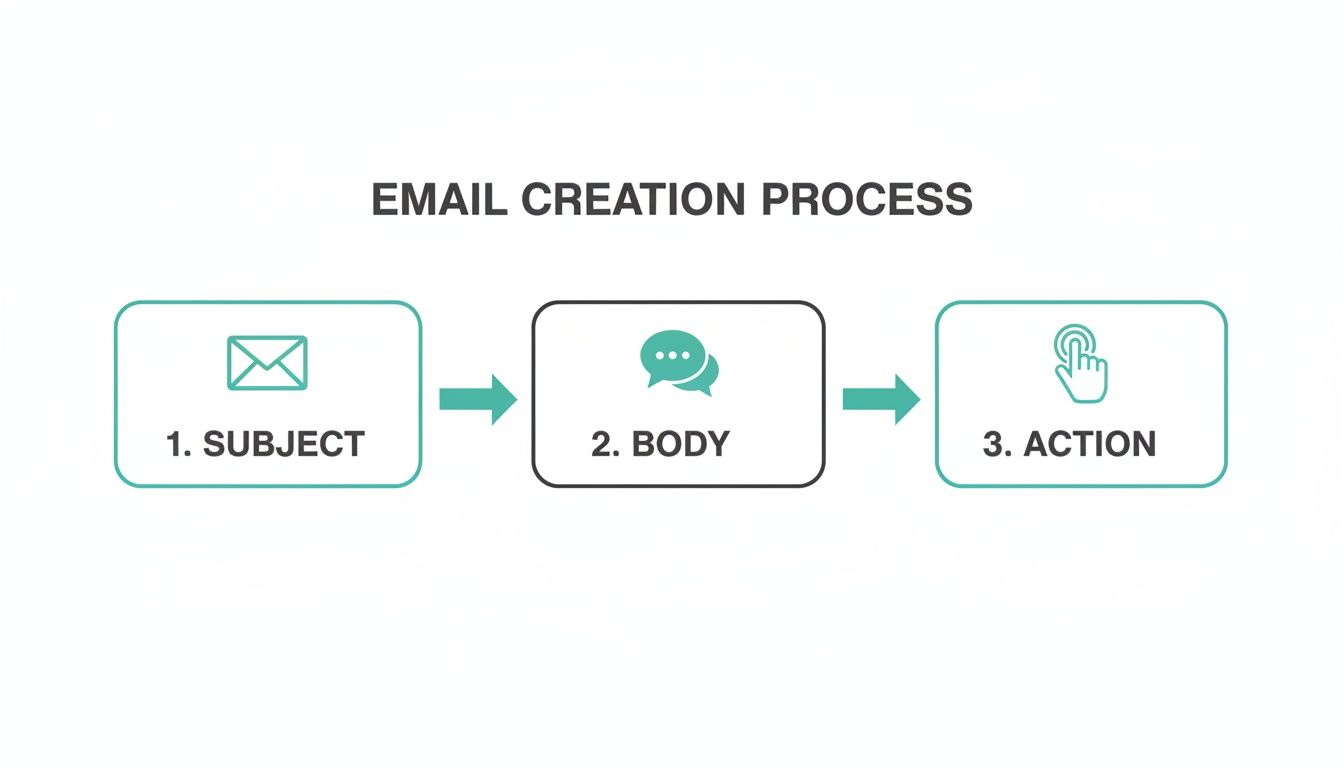
Give each email a clear purpose and a relevant link.
Recapture Lost Sales with Abandoned Cart Reminders
If you run an e-commerce store, this one is non-negotiable. People abandon carts for a million reasons, the dog started barking, they got sticker shock from shipping costs, or they just got distracted. A friendly, automated nudge is often all it takes to bring them back.
A simple two-email sequence is effective:
Email 1 (1-4 hours after abandonment): Send a gentle, low-pressure reminder. Something like, "Did you forget something?" with a picture of the item is perfect.
Email 2 (24 hours later): Create a little urgency or sweeten the deal. A small incentive, like a 10% discount, can be just the push they need to complete the purchase.
Reawaken Quiet Subscribers with a Re-Engagement Campaign
It's natural for some subscribers to go dark over time. A re-engagement campaign, or "win-back" flow, is your shot at reigniting their interest before you remove them from your list for good.
I recommend sending this to anyone who hasn't opened one of your emails in 90 days. You could offer a "We miss you!" discount, ask for feedback on why they've been quiet, or simply remind them of the awesome value they're missing out on.
Setting up these automations is straightforward with modern tools. Platforms like Adwave make building these flows simple, and you can get more ideas from our deep-dive guide to marketing automation for small businesses. By automating these important touchpoints, you build an efficient marketing engine that works tirelessly for your brand.
Combining Email and TV Ads for Maximum Impact
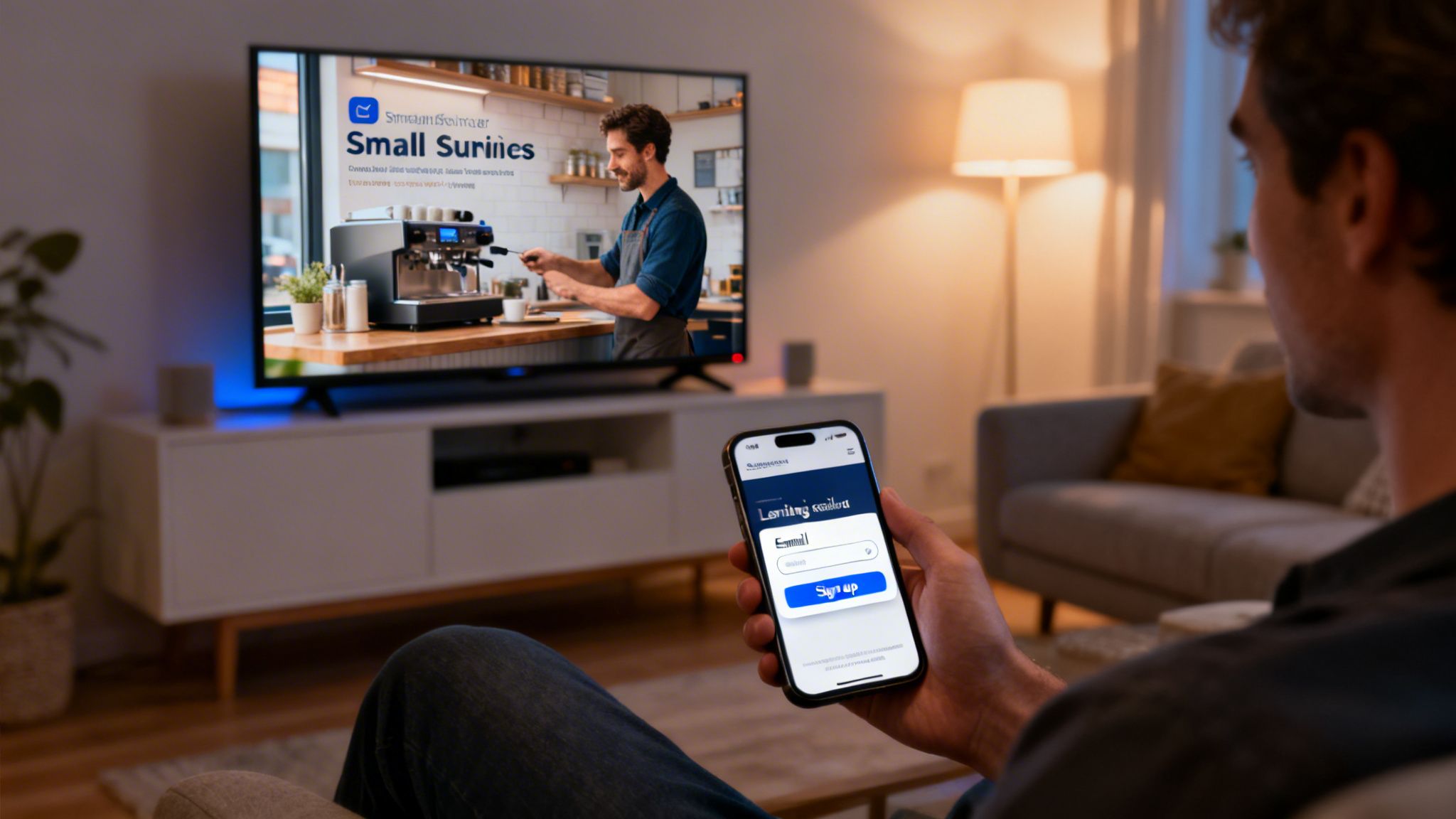
Let's be honest: by 2026, the best small business marketing isn't about doing one thing well. It's about making all your channels work together. When you connect your email strategy with something like TV advertising, you create a powerful one-two punch that turns general awareness into genuine, profitable relationships.
For years, TV advertising felt like a club only big brands could join, with budgets that made most small business owners’ eyes water. That's just not the case anymore. The game has completely changed, and premium TV is now well within reach.
The New Era of Accessible TV Advertising
Can you picture your business running ads on major channels like ESPN, Hulu, or NBC? It's not a daydream. Platforms like Adwave were built specifically for small and medium-sized businesses, letting you launch broadcast-quality TV ads without needing a film crew or a bottomless marketing budget.
Adwave has an AI-powered platform that can whip up a professional-looking video ad just from your website's URL. It then gets your ad on over 100 premium channels, targeting local viewers who are most likely to walk through your door or visit your site. This makes building your brand at the top of the funnel a realistic goal, even for a small operation.
A Powerful Workflow from TV to Inbox
Think of your marketing channels as a relay race. Your TV ad is the first runner, grabbing the baton and building momentum by getting your name out there. Email marketing is your anchor, taking that initial interest and sprinting across the finish line to a sale.
Here’s how that plays out in the real world:
A potential customer is relaxing at home and sees your Adwave TV spot. The ad is sharp and has a clear call-to-action, maybe a special discount for visiting your website.
Intrigued, they pull out their phone and head to your site. Right there on the homepage is a simple, can't-miss sign-up form where they can pop in their email to claim the offer.
When they hit "subscribe," they’re automatically entered into a welcome email series you designed specifically for people who came from that TV campaign.
This simple but effective process means you never waste the buzz your TV ad creates. You capture that fleeting moment of interest and turn it into a lasting asset: a brand new subscriber.
Turning Viewer Insights into Email Gold
The connection between TV and email goes way beyond just capturing a lead. Modern advertising platforms give you a goldmine of data about who is watching and engaging with your commercials. Adwave, for example, delivers detailed audience insights from your TV campaigns.
This is where you can get really smart. You can use this data to build laser-focused email segments that turn casual viewers into your best customers.
By seeing who responds to your TV ads, you get a crystal-clear picture of your most engaged audience. You can then write email content that speaks directly to their interests and motivations, which will dramatically boost your conversion rates.
Let's say you're a real estate agent and you notice your TV ad is a huge hit with millennials in a specific zip code. You can create an email segment for every new subscriber from that group. Your follow-up emails can then be packed with content tailored perfectly for first-time homebuyers in that exact neighborhood.
This integrated approach squeezes the maximum return out of every marketing dollar. The upfront investment in a TV spot gets a massive boost from the incredible ROI of a targeted email follow-up. For small businesses, email's return is still unbeatable in 2026, some studies show 30% of companies see a return between $36 and $50 for every $1 spent. When you combine an affordable TV ad with email's powerhouse returns, you've got a growth engine that leaves siloed strategies in the dust. You can explore the latest data on email marketing returns for 2026 to see just how potent this combination is.
By meshing the wide reach of TV with the personal touch of email marketing for small business in 2026, you build a complete journey that guides people from their first glance to becoming your most loyal fans.
Your Top Email Marketing Questions Answered
Whenever I talk to small business owners about getting started with email, the same few questions always seem to pop up. It's completely normal (and smart) to have questions before you jump in.
So, let's get you some straight answers. I've seen these concerns hold people back, and my goal here is to clear the path so you can start building your email program with confidence.
How Often Should I Really Email My List?
This is easily the most common question I hear. Everyone is worried about annoying their subscribers, but the answer isn't about finding a magic number. The real goal is consistency, not frequency.
A great place to start is with one solid, high-value email per week. Think a helpful newsletter, a compelling customer story, or even a quick update on what's new. This simple rhythm keeps your brand familiar without flooding anyone's inbox.
From there, you can start weaving in occasional promotional emails when you have a sale or a special event. The key is to pay close attention to your metrics.
Are your open and click rates holding steady? Great! Your audience is clearly finding your content useful.
Seeing a spike in unsubscribes or a dip in engagement? That's a signal to pull back a bit or rethink what you're sending.
I’ll say this again and again: it’s far better to send one fantastic email a week that people open than to send four mediocre ones they ignore. Always lead with value.
Can I Do Email Marketing on a Tiny Budget?
Yes, you absolutely can. In fact, its low cost is what makes email marketing for small business in 2026 such a no-brainer. You don't need a big war chest to get started and see a real return on your efforts.
Most of the top email platforms have free plans that are perfect for businesses just starting out. These aren't just stripped-down trials; they typically let you have up to 1,000 subscribers and send thousands of emails a month for free. You get access to professional templates, list management tools, and even basic automation right out of the box. Using a unified platform like Adwave can also provide exceptional value by bundling these email capabilities with broader advertising and analytics tools, helping you maximize a small budget.
How Do My Adwave TV Ads and Emails Work Together?
This is where things get really interesting. You can think of your Adwave TV ad and your email marketing as a perfect one-two punch that turns viewers into customers.
Your TV spot on channels like ESPN or Hulu does the heavy lifting, grabbing attention and making people aware of your brand. You run an ad with a clear call-to-action that sends interested viewers straight to your website.
That’s the handoff. On your site, a simple email signup form is waiting to capture their information. When they subscribe, your email marketing takes over. You can instantly send them that special offer from the TV ad and, more importantly, start them on a welcome email series that tells your brand’s story. This is how you turn a flicker of interest from a 30-second ad into a lasting customer relationship.
It gets even better. Adwave also gives you audience data from your TV campaign. You can use these insights to segment your new email subscribers. For example, if your ad did especially well with a certain demographic in your city, you can create a unique email follow-up just for them. This coordination transforms broad advertising into a targeted, profitable system.