When you send an email, what happens next? Two numbers hold the answer: your open rate and your click rate. Getting a handle on these metrics is the first step to turning your email list from a simple contact database into a powerful marketing engine.
Think of it this way: your open rate tells you how many people were curious enough to open the envelope. Your click rate tells you how many read the letter inside and decided to act on it.
Your Quick Guide to Core Email Metrics
Let's use a real-world analogy. Imagine you own a coffee shop. Your subject line is the witty sign on the sidewalk out front.
The open rate is the percentage of people who see that sign, smile, and decide to walk through your door. It’s your first impression, a measure of curiosity and brand recognition.
But the click rate? That’s the real prize. It represents the customers who don't just walk in, but who walk up to the counter and order a coffee. It shows that what you offered inside was just as compelling as the sign that drew them in.
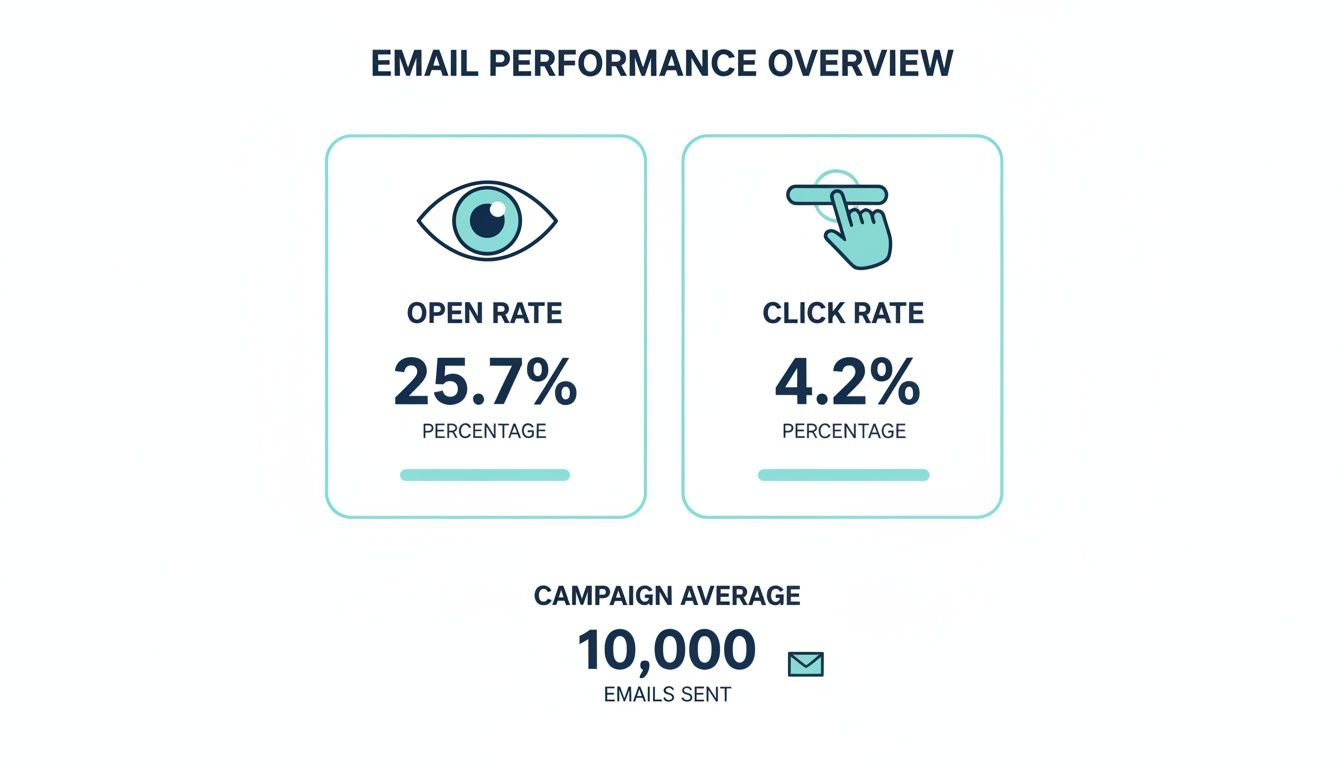
As you can see, a decent open rate doesn't automatically mean people will click. You have to nail both the invitation (your subject line) and the party inside (your email content).
Open Rate vs. Click Rate At a Glance
To make it even clearer, here’s a quick comparison of what these two metrics do and why they matter.
This table shows how each metric gives you a different piece of the puzzle. You need both to see the full picture of your campaign's performance.
Why These Metrics Create a Powerful Feedback Loop
Here's where it gets interesting. These numbers aren't just for email reports; they give you direct feedback on your entire marketing strategy.
Let’s say you run a TV ad campaign with Adwave. You notice a surge of new people signing up for your newsletter. By tracking the open and click rates from this specific group, you can instantly answer critical business questions:
Are these good leads? If they open and click, your TV ad attracted the right audience. If they ignore your emails, maybe the ad's message was off.
Is our welcome message working? High opens but low clicks on the first email might mean your welcome offer isn't compelling enough to this new audience.
This turns isolated data into a coherent story about your customer’s journey from awareness to action. It’s an essential skill, especially for small businesses trying to make every dollar count. If you're just getting started, our guide on email marketing for small businesses in 2026 is a great place to build that foundation.
By understanding what your open and click rates are telling you, you can move beyond guesswork. You can start making smart, data-backed decisions that build stronger customer relationships and drive real growth.
Decoding Your Email Open Rate
Think of your email open rate as the first handshake with your audience. It's when someone decides your brand is worth their attention. A good open rate tells you that your sender name is trusted and your subject line has successfully sparked curiosity. It's an invitation accepted.
But here in 2026, this handshake has gotten a bit complicated. Privacy features, especially Apple’s Mail Privacy Protection (MPP), have fundamentally changed how we measure opens. Apple now downloads email content in the background on its devices, which includes the tiny tracking pixel we use to count an "open." This means the email is marked as opened whether the subscriber ever looked at it or not.
The result? Your open rate might look artificially high. It’s no longer the rock-solid metric it once was. That’s why it’s more important than ever to look past the open and focus on what happens next.

So, What's a "Good" Open Rate in 2026?
With all that said, what numbers should you be aiming for? Across all industries, the average email open rate has now climbed to around 42.35%, largely due to those privacy changes. But a general average is a dangerous benchmark.
For our Adwave clients, we stress looking at industry-specific data. An e-commerce brand might see rates between 26.64% and 31.08%, while a retail business could hit a much healthier 38.58%. These differences show why context is king. You can explore more of these nuances with up-to-date email open rate statistics on mailmend.io.
If you’re a small business (like a real estate agent, restaurant, or auto dealer) your goal should be to beat your specific industry average. Aiming for a rate above 30-35% is a strong starting point. The secret weapon for small businesses is personalization, which can boost opens by as much as 50%.
Your welcome email is a golden opportunity. These emails boast an incredible average open rate of 83.63%. If a new subscriber just saw your TV ad and signed up, this is your single best chance to make a lasting impression.
How to Earn That Initial Engagement
A high open rate isn’t about luck; it’s earned through trust, relevance, and a dash of creativity. Even with MPP muddying the waters, getting that initial engagement still boils down to a few core principles.
Here are a few things we always tell our clients to focus on:
Write Subject Lines for Humans: This is your one-line pitch in a sea of noise. Forget clichés. Be clear, spark a little curiosity, and make it obvious what's in it for them.
Stop Batching and Blasting: Sending the same email to your entire list is a surefire way to get ignored. Segment your audience based on their past purchases, interests, or how they signed up. Relevant messages get opened.
Find Your Send-Time Sweet Spot: Don't just send emails on Tuesday at 10 AM because you read it in a blog post once. Test different days and times. See when your audience is most active and engaged.
These aren't just tricks to inflate a number. They're foundational steps to building a relationship with your subscribers, one email at a time. To get even more practical, check out our guide on email subject lines that get opened for templates and ideas you can start using right away.
Mastering the Email Click Through Rate
If getting someone to open your email is the first handshake, the click-through rate (CTR) is where the real conversation begins. This metric tells you how many people took action. A click means your subscriber wasn't just scrolling by; they found something valuable enough to engage with, be it a new product, a helpful article, or a can't-miss offer.
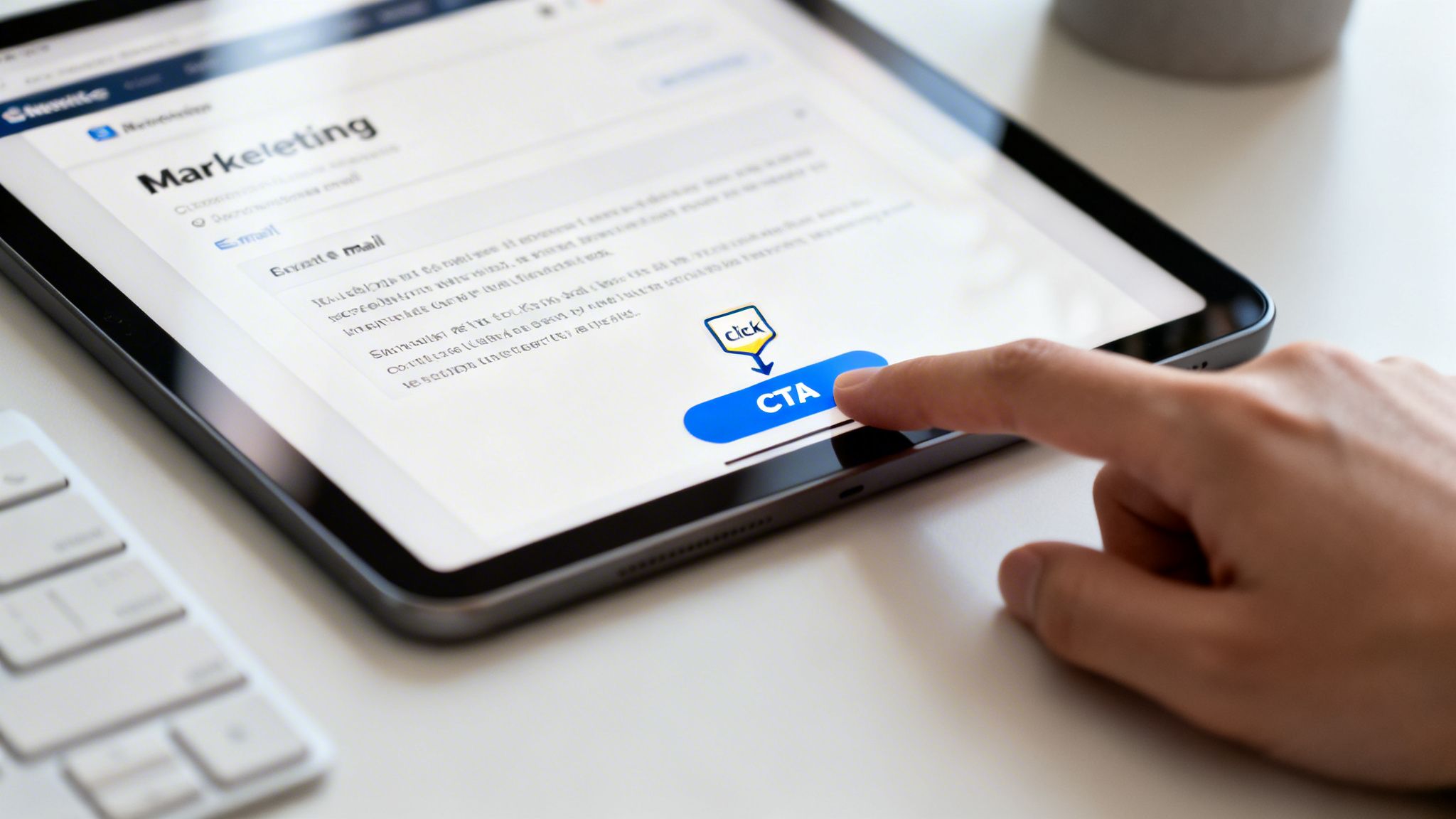
Ultimately, your CTR is a direct report card on your email's core message. Did your offer land? Was your call-to-action (CTA) obvious and compelling? Did the design, copy, and visuals all work in concert to guide your reader to that next step?
What Is a Good Email Click Through Rate
Pinning down a universally "good" CTR is tough. It shifts wildly based on your industry, audience, and the type of email you’re sending. What we can do, though, is look at the benchmarks to get our bearings.
Across all industries in 2026, the average email CTR hovers at a humble 1.69%. Even the top-tier performers are often only hitting 3.38%. These numbers underscore just how challenging it is to convert an open into a click. This is especially true for small businesses who need every click to count, whether it’s driving a sale or getting a customer in the door after seeing a TV ad. For a deeper dive into how your industry stacks up, check out these detailed email marketing benchmarks from Klaviyo.
For most small businesses, aiming for a CTR between 2-3% is a great starting point. But don't get hung up on that number alone. To get a clearer picture of your email's performance, you need to look at the click-to-open rate (CTOR).
The Click-to-Open Rate (CTOR) measures clicks only among the subscribers who opened your email. While the average CTR is low, a healthy CTOR is around 10-11%. This metric gives you a much truer sense of how compelling your content is to an already engaged audience.
Strategies for Inspiring More Clicks
If your click rates are lagging, it's not time for guesswork. It’s time to get strategic and focus on what motivates people to act.
Here are a few proven strategies to get more people clicking:
One Email, One Goal: Don't confuse your readers with a dozen different options. Every email should have a single, primary objective. Make your CTA button big, bold, and use action-oriented text that leaves no doubt what happens next, like "Shop the Collection" or "Get the Guide."
Make it Scannable: Let's be honest, people don't read emails; they scan them. Use short paragraphs, bullet points, and bold text to make your main points jump off the screen. A clean, mobile-first design isn't a luxury; it's a necessity.
Segment for Maximum Relevance: This is the big one. The single most effective way to boost clicks is to send the right message to the right person at the right time. When you send targeted offers to specific audience segments, you dramatically increase the odds that your content will resonate and earn that click. You can learn more about sending the right message to the right people in our dedicated guide on segmentation.
This is where email shines for Adwave clients. Imagine you run a TV ad that drives brand awareness and a flood of new email sign-ups. You can then use segmented email campaigns to send specific follow-up offers that are perfectly aligned with that ad's message, turning broad interest into direct, measurable action.
Turning Email Metrics into Actionable Results
Alright, you've got your open and click rates. Now for the fun part: making them better. This is where the real work (and the real results) happen. You don't need a huge budget or a complex plan to see a difference. A few smart, focused tweaks can boost your numbers almost immediately.
Let's walk through three core strategies that will turn those metrics into meaningful improvements for your business: A/B testing, list segmentation, and good old-fashioned email list hygiene.
Let Your Audience Guide You with A/B Testing
One of the most effective tools you have is A/B testing, sometimes called split testing. It’s a simple but powerful idea: let your audience tell you what they want.
Think of it as a friendly competition. You create two versions of one email element (say, the subject line) and see which one performs better. Their actions, like opens and clicks, tell you which version is the winner. It's that simple.
For instance, you could test two different subject lines to promote a sale:
Version A: "Save 20% On Your Next Order"
Version B: "A Special Treat Just For You"
You’d send Version A to a small slice of your list and Version B to another. Whichever one gets more opens wins, and you send that winning version to everyone else. This takes all the guesswork out of the equation and lets actual data guide your strategy.
You can A/B test just about anything:
Subject lines to see what drives more opens.
Call-to-action (CTA) buttons to find out what gets more clicks.
Email copy to test which tone or message connects with your audience.
Images and visuals to learn what catches their eye.
Send times and days to discover when your audience is most active.
Deliver Personalization at Scale with Segmentation
Sending the same generic email to your entire list is a surefire way to land in the trash folder. This is where email segmentation comes in. It’s the practice of splitting your main list into smaller, more focused groups based on what you know about them. This allows you to send relevant content that feels like a one-on-one conversation.
Just think about it. A brand-new subscriber who just found you through your Adwave TV ad needs a very different welcome than a loyal customer who’s already bought from you ten times.
One study found that marketers using segmented campaigns saw revenue increase by as much as 760%. That’s not a typo. Even basic segmentation can have a massive impact on your results.
You can slice your list in countless ways. Here are a few common starting points:
Demographics: Age, location, or gender.
Purchase History: What they've bought, when they bought it, and how much they spent.
Engagement Level: Grouping your most active fans or identifying those who haven't opened an email in a while.
Sign-up Source: For example, you can create a special segment for leads from your Adwave TV campaign and nurture them with a unique welcome series.
Boost Deliverability with Email List Hygiene
Of course, none of this matters if your emails aren't even making it to the inbox. That’s why email list hygiene is so critical. It’s the ongoing process of cleaning up your list by removing invalid email addresses, inactive subscribers, and anyone who just isn't engaged anymore.
It might feel strange to purposely shrink your email list, but trust me on this: a smaller, highly engaged audience is infinitely more valuable than a massive list of people who don't care. High bounce rates and low engagement can seriously damage your sender reputation, which tells email providers like Gmail and Outlook to send your messages straight to spam.
A simple way to start is by running a re-engagement campaign. Find subscribers who haven't opened your emails in the last few months and send them one last message asking if they'd like to stay. If they don't respond, it's time to say goodbye. This simple act ensures you’re only talking to people who want to listen, which will naturally improve both your open and click rates.
Connecting Email Data to Your Broader Marketing Strategy

It’s easy to get tunnel vision and see your email metrics as just, well, email metrics. But that’s selling them short. Your open and click rates are a direct line of feedback on your entire marketing effort. They don’t just tell you how an email performed; they give you a surprisingly clear picture of your lead quality and how well your brand message is landing, no matter where people first found you.
Think about it this way: say you launch a new TV ad campaign with a company like Adwave. Your commercials are running on NBC and Hulu, creating buzz and sending a wave of new visitors to your website. A good chunk of those people sign up for your newsletter. Suddenly, your email analytics become an invaluable tool for attribution, showing you the real-world impact of that big TV ad investment.
Bridging the Gap Between TV and Email
Your TV ad's job is to grab attention and spark initial curiosity. It's the top of your marketing funnel. Email, on the other hand, is where you take that flicker of interest and patiently nurture it into a real customer relationship. By tracking the subscribers who signed up right after your Adwave campaign went live, you get immediate, powerful insights.
It’s a classic one-two punch:
The TV ad builds the audience. It casts a wide net, pulling interested people toward your brand.
The email campaign nurtures that audience. It’s the warm welcome that greets them at the door and guides them toward a purchase.
When you create a special segment in your email platform for these new TV-driven subscribers, you can watch their behavior closely. Are they opening your welcome email at a higher rate than usual? That’s a great sign your ad resonated. Are they clicking on the offers inside? That tells you the leads are interested and your messaging is consistent from screen to inbox.
A sudden surge in email subscribers after an Adwave campaign launch is a fantastic signal. By analyzing the open rates and click rates of this specific segment, you're not just evaluating an email, you're getting real-time feedback on your TV ad's creative and targeting.
Using Email Metrics to Validate Ad Spend
Let’s get more specific. Imagine you’re testing two different TV ads with Adwave. One focuses on your product's innovative features, while the other tells an emotional customer story. By tagging the new email subscribers who sign up during each ad’s airtime, you can directly compare their engagement.
This data is gold. It helps you answer the big-picture questions about your marketing budget:
Which ad message works? If the "customer story" group has a significantly higher click rate, you know which creative inspires more action.
Are we attracting the right people? High engagement from a particular campaign's subscribers confirms your TV targeting hit the bullseye.
How good are these leads? If new subscribers from an ad have terrible open rates, it might mean the ad's call-to-action was confusing or attracted a less-qualified audience.
Tying your email data back to your broader strategy is how you understand what’s working. It turns isolated numbers into a story about your customer’s journey. If you’re looking for more ideas on this, a great guide on how to measure marketing performance offers a practical framework. When you connect top-of-funnel efforts like Adwave to your mid-funnel email marketing, you create a measurable, high-performance growth engine.
Building Your Simple Email Reporting Blueprint
For a busy small business owner, turning raw data into confident decisions can feel like a mountain you don't have time to climb. The secret isn't tracking every metric imaginable. It’s about creating a simple, sustainable reporting plan that focuses on what drives growth. Let's walk through how to interpret your email open and click rates without getting lost in the weeds.
The biggest mindset shift you can make is to stop obsessing over a single email's performance. Instead, your focus should be on tracking trends over time. One campaign might have a killer open rate, while the next one gets all the clicks. Neither tells the whole story on its own. Your real goal is to understand the long-term rhythm of how your audience engages.
Your Simple Reporting Checklist
A no-fuss reporting process is really about listening to what your audience is telling you with their actions. Rather than drowning in data, just run through a quick checklist after each campaign to spot the important patterns. This keeps your analysis sharp and actionable.
Your weekly or monthly review should answer a few core questions:
Which content drove clicks? Look for themes in the emails that earned the highest click rates. This is direct feedback on what your audience finds valuable.
What was the trend? Are your open and click rates generally inching up or sliding down over the last few months? A downward trend is your early warning signal to refresh your content or clean your list.
Did a promotion lift engagement? Compare how your promotional emails perform against your regular content. This helps you find that sweet spot between selling and nurturing your audience.
The goal of your reporting isn't just to collect numbers; it's to gather intelligence. Each metric is a piece of feedback from your audience. Your job is to listen carefully and adjust your strategy accordingly.
Integrating with Your Broader Marketing
By creating a specific segment of new subscribers who joined during your TV campaign, you can ask a vital question: Did our latest Adwave spot lead to a lift in subscriber engagement? If you see that this new group has higher-than-average open and click rates, you’ve got strong evidence that your TV ad brought in a high-quality, interested audience.
This integrated approach helps you make smarter decisions across your entire marketing plan. It connects the dots between building awareness on platforms like Adwave and the important mid-funnel nurturing you do with email. For a deeper look at connecting these dots, check out our guide on how to measure marketing ROI. When you listen to your email metrics and combine those findings with your other channels, you build a more effective and profitable marketing machine.