Your inbox is a battleground for attention, and a weak subject line is a guaranteed way to lose. Getting your email opened is no longer about just being clever; it's about applying a specific science. This guide provides a detailed playbook of Email Subject Lines That Get Opened: Formulas and Examples you can put to work immediately. We are moving beyond generic advice to deliver a strategic breakdown of 10 powerful, replicable formulas designed to capture interest and drive action.
Inside, you will find a complete toolkit for crafting high-performing subject lines. We will dissect the psychology behind curiosity gaps, the authority of social proof, and the urgency of scarcity. To master the art of email communication, understanding the core principles is key. Explore further insights into effective email subject line best practices to build a strong foundation for your campaigns.
The examples cover real estate, restaurants, retail, and automotive businesses. Adapt the wording to your offer and test which subject lines your subscribers respond to.
1. The Curiosity Gap Formula
The Curiosity Gap formula is a powerful psychological trigger that creates an “open loop” in your reader’s mind. It works by presenting an intriguing piece of information while withholding a key detail, making the recipient feel compelled to open the email to find the answer and close the loop. This method is especially effective for small business owners who are always looking for affordable and impactful ways to get ahead of their competition.

This formula is one of the most reliable when writing email subject lines that get opened. It moves beyond generic offers by creating a mini-story that starts in the inbox.
How It Works: Examples and Analysis
The magic lies in making a specific, believable claim that feels incomplete. Notice how the examples below create an information gap that sparks immediate interest.
Example 1: How [Local Competitor] Launched TV Ads for $50 (No Production Needed) Analysis: This subject line is ultra-specific. It names a competitor type, gives a shockingly low dollar amount ($50), and overcomes a common objection (production costs). The reader’s immediate question is, "How is that even possible?"
Analysis: Using "surprised us" suggests an unexpected outcome, either exceptionally good or bad. It frames the email body as the reveal of a valuable case study, perfect for a marketing manager or founder looking for proven data.
Analysis: This targets a specific profession (real estate agents) and contrasts a new, secret method with a traditional, expensive one (billboards). The curiosity is about the "this" that provides a better alternative.
Key Takeaway: Anchor your curiosity gap with specific numbers, competitor mentions, or comparisons to familiar tactics. The more concrete the mystery, the stronger the pull to open the email.
Actionable Tips for Your Campaigns
To apply this formula successfully, follow these guidelines:
Deliver on the Promise: Your email body must satisfy the curiosity you created. If you promise to reveal how to run TV ads for $50, the content should explain exactly that, perhaps by detailing a platform like Adwave that offers affordable, self-service TV advertising solutions.
Pair with Preheader Text: Use the preheader (the preview text following the subject line) to deepen the mystery. For example: Subject: 3 Things Your Competitors Know... Preheader: ...about getting on TV without a big agency.
Refine Your Ad Copy: The principles behind a great curiosity-driven subject line are similar to those for writing effective advertising copy. Mastering this skill can improve both your email opens and your ad performance. You can find more guidance on writing compelling advertising copy to support your campaigns.
2. The Social Proof + Specificity Formula
This formula builds immediate trust and credibility by combining social proof with concrete, specific data. It answers the recipient's silent question, "Why should I believe you?" before they even open the email. By showing quantifiable results achieved by relatable businesses, you prove your value upfront and make the offer feel less like a sales pitch and more like a documented success story.
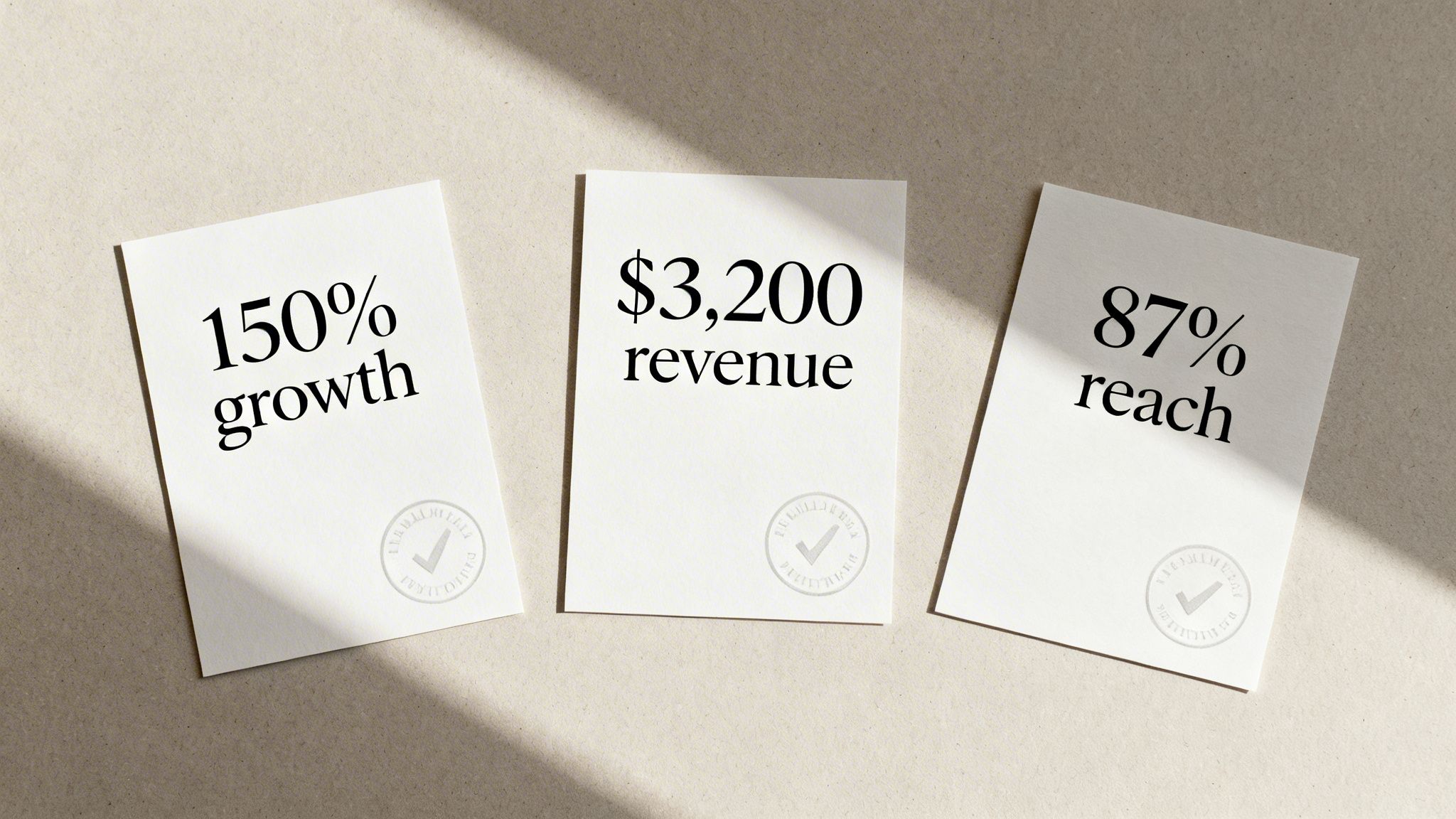
This method is essential for demonstrating the return on investment (ROI) of services like TV advertising, making it a go-to for email subject lines that get opened by data-driven small business owners and marketing managers.
How It Works: Examples and Analysis
The power of this formula comes from using real numbers and names to make abstract benefits tangible. Observe how the examples below use documented wins to create a compelling case.
Show the offer: Link to a service, explain who it helps, and give the reader one next step, such as viewing available appointments or requesting a quote.
Analysis: Here, the focus is pure ROI. It targets a specific professional (real estate agent) and presents an undeniable financial result. A $3,200 return on a tiny $50 spend is an almost irresistible hook for any agent looking for cost-effective marketing.
Analysis: This subject line speaks directly to a business owner's budget concerns. It uses industry-specific cost metrics (CPM) for a target vertical (home services), turning the email into a valuable piece of competitive intelligence.
Key Takeaway: Replace vague claims like "grow your business" with hard numbers. Specific metrics like ROI, client growth percentages, or actual costs are far more convincing and build instant authority.
Actionable Tips for Your Campaigns
To use this formula effectively in your own marketing, consider these tips:
Get Permission for Names: Always get client permission before name-dropping them in a subject line. If you can't, use their industry or location as a substitute, like "A Boston-area restaurant" or "A real estate brokerage."
Match Metrics to Your Audience: A founder might care most about ROI or market expansion, while a marketing manager might be more interested in CPM or customer acquisition cost. Tailor your specific proof point to what your audience values most.
Show the offer: Link to a service, explain who it helps, and give the reader one next step, such as viewing available appointments or requesting a quote.
3. The Question-Based Formula
The Question-Based formula directly engages your recipient's brain by posing a question they feel a natural urge to answer. This method works by framing a common pain point or a desirable opportunity as an open-ended query, prompting an immediate mental response. It’s a perfect strategy for audiences who are actively seeking solutions, such as small business owners wondering if premium advertising is within their reach.

Asking a direct question is a fundamental tactic for writing email subject lines that get opened. It shifts the dynamic from a one-way announcement to the start of a two-way conversation, making your email feel more personal and relevant.
How It Works: Examples and Analysis
The strength of this formula comes from asking specific, thought-provoking questions that resonate with your target audience’s challenges and aspirations. Observe how these examples make the recipient pause and consider the answer.
Example 1: Can Your Local Business Afford Premium TV Advertising? Analysis: This question hits a primary pain point for small businesses: budget constraints. It challenges the assumption that TV advertising is unaffordable and positions the email as a source of an accessible solution.
Analysis: This "what if" scenario paints a picture of an ideal outcome. It contrasts a slow, difficult process ("months") with a fast, easy one ("minutes"), creating a strong desire to learn how this transformation is possible.
Analysis: This question plants a seed of doubt and targets a specific industry's key performance indicator: audience accuracy. It speaks directly to real estate agents and brokers, who will open the email to validate their current strategy or find a better one.
Key Takeaway: Frame your question around a specific pain point or a compelling benefit. Using "you" and "your" makes the query feel personal and urgent, compelling the recipient to open the email for the answer.
Actionable Tips for Your Campaigns
To make this formula work for you, apply these proven guidelines:
Provide the Solution: The body of your email must directly answer the question posed in the subject line. If you ask about affordable TV ads, introduce a platform like Adwave that offers self-service TV advertising, making it fast and budget-friendly for local businesses.
Use a Benefit-Driven Preheader: Your preheader text should hint at the answer. For instance: Subject: Is your marketing budget working hard enough? Preheader: …Here’s how to get more reach for less spend.
Avoid Simple Yes/No Questions: A question like "Do you want more customers?" is too generic and has an obvious answer. Instead, ask questions that spark thought and imply a new, valuable insight is waiting inside the email.
4. The Time-Sensitive + Scarcity Formula
This formula taps into the fundamental human fear of missing out (FOMO). By combining a deadline with limited availability, it creates a powerful sense of urgency that encourages immediate action. This method is exceptionally effective for promoting opportunities with genuine constraints, such as limited advertising slots, seasonal campaigns, or exclusive access to new inventory.
This approach is one of the most direct ways to write email subject lines that get opened, as it gives the recipient a clear and compelling reason to act now rather than later. It moves the decision from "Should I open this?" to "Will I miss out if I don't?"
How It Works: Examples and Analysis
The effectiveness of this formula depends on being specific about both the time limit and what is scarce. Notice how the examples below clearly define the stakes and the deadline.
Example 1: 48-Hour Special: Launch TV Ads for $50 (Limited Slots) Analysis: This subject line combines three powerful elements: a tight deadline ("48-Hour Special"), a low-risk offer ("$50"), and scarcity ("Limited Slots"). It creates a sense of a flash sale, ideal for a small business owner who wants to test TV advertising without a large commitment.
Analysis: This appeals to the planning-oriented mindset of a marketing manager. "Last Week" creates a firm deadline tied to a business cycle (Q1), making the scarcity feel strategic rather than purely promotional. It implies that waiting will result in missing the entire quarter's opportunity.
Analysis: This subject line introduces competitive scarcity. The "market" could refer to a specific geographic TV ad zone or a target demographic. The urgency comes from the threat of a competitor claiming that valuable ad space first, making it highly relevant for businesses in crowded industries.
Key Takeaway: Be explicit with your deadline. Phrases like "48-Hour Special," "This Week Only," or "Ends Tonight" are much stronger than vague terms like "Limited Time." The more concrete the scarcity, the more powerful the urge to open.
Actionable Tips for Your Campaigns
To apply this formula without damaging trust, follow these guidelines:
Maintain Credibility: Only use scarcity claims that are true. If you say TV ad slots are limited on a platform like Adwave, make sure they are. When a deadline passes, the offer should expire. This builds trust for future campaigns.
Combine with a Strong Offer: Urgency works best when paired with a compelling value proposition. A deadline to claim an exclusive "$50 TV ad launch" is more effective than just a deadline alone.
Reinforce in the Email Body: Use the body of your email to visually reinforce the scarcity. This could include a countdown timer ticking down to the deadline or a map showing which advertising zones are still available.
5. The Benefit-Driven + Power Words Formula
This formula gets straight to the point by leading with a clear, tangible benefit. It appeals directly to your recipient's self-interest, answering the question, "What's in this for me?" before they even open the email. By adding emotionally resonant "power words," you add a layer of urgency and importance that separates your message from the rest.
This direct, value-first approach is perfect for busy small business owners who are constantly evaluating whether a service deserves their limited time and attention. It’s a core principle of direct response copywriting, made for modern inboxes.
How It Works: Examples and Analysis
The effectiveness of this formula comes from its clarity. It combines a desirable outcome with an action-oriented verb to create a compelling command.
Example 1: Unlock Premium TV Ads for Local Businesses in 60 Minutes Analysis: "Unlock" is a powerful verb that suggests gaining access to something exclusive or previously unavailable. The benefit, "Premium TV Ads," is combined with a specific, fast timeframe, "in 60 Minutes," which respects the business owner's time.
Analysis: "Discover" positions the email's content as a valuable insight or a secret. It creates a sense of discovery and implies the reader will learn something their competitors don't know yet, appealing to their strategic instincts.
Analysis: Starting with "Proven" immediately builds credibility and reduces skepticism. It frames the email as a factual, data-backed solution rather than a speculative pitch, making it a must-open for anyone focused on ROI.
Key Takeaway: Lead with the single biggest benefit for your target audience. Use power words to amplify the emotional impact and make the value proposition feel immediate and essential.
Actionable Tips for Your Campaigns
To make this formula work for you, follow these guidelines:
Match the Benefit to the Pain Point: The benefit you highlight must solve a primary problem for your audience. If your segment struggles with high advertising costs, a subject line like Get Broadcast-Quality Ads Without the $100K Production Bill will resonate deeply.
Use Power Words Strategically: Don't stuff your subject line with superlatives. One or two carefully chosen power words like "Unlock," "Discover," "Proven," or "Guaranteed" are far more effective.
Specify the Outcome: Pair the power word and benefit with a specific result. Platforms like Adwave allow businesses to launch TV campaigns quickly and affordably, so a subject line promising to get them on TV in minutes with a small budget is both powerful and truthful.
6. The Personalization + Segmentation Formula
This formula taps into the fundamental human desire to be seen and understood. By using recipient-specific data like their name, city, or industry, you create a subject line that feels less like a mass broadcast and more like a direct, one-to-one conversation. For small business owners in competitive local markets, this level of relevance can be the deciding factor between an open and a delete.
This method is essential for writing email subject lines that get opened because it immediately signals value. It tells the recipient, "This email was specifically chosen for you," which dramatically increases its perceived importance.
How It Works: Examples and Analysis
The effectiveness comes from merging personalization tokens with benefit-oriented language. See how the examples below speak directly to a specific audience segment, making the offer impossible to ignore.
Example 1: [Real Estate Agent Name], Your Market Has 2 New TV Opportunities Analysis: This subject line uses the agent's name and targets their profession. The mention of "2 New TV Opportunities" is specific and creates an immediate sense of exclusive, actionable information relevant to their business growth.
Analysis: Combining the business name, a specific metric (47%), and the business's location makes this hyper-relevant. The promise of "more foot traffic" addresses a core goal for any local restaurant owner.
Analysis: This subject line addresses the dealership by name and speaks to a common pain point: achieving high visibility on a limited budget. It frames the email's content as a direct solution to a known business challenge.
Key Takeaway: Move beyond basic first-name personalization. Segment your audience by industry, location, or business size, and combine that data with a compelling benefit to create an irresistible subject line.
Actionable Tips for Your Campaigns
To apply this formula with precision, follow these guidelines:
Ensure Data Accuracy: A misspelled name or incorrect industry tag instantly destroys credibility. Before launching, double-check your data sources and run a small test to verify your personalization fields are working correctly.
Combine with Benefits: Personalization alone isn't enough. Pair the recipient's data with a clear benefit. For instance, show a local business in Houston how a platform like Adwave can get them on TV in their specific advertising zone.
Use in Welcome Sequences: A personalized subject line is a perfect way to start a relationship. You can learn more about building effective welcome email sequences that turn subscribers into buyers to make a strong first impression.
7. The Pattern Interrupt + Unexpected Claim Formula
The Pattern Interrupt formula works by breaking the monotonous scroll-and-delete routine of your recipient's inbox. It introduces a surprising statement, a bold contradiction, or a claim that defies conventional wisdom. This disruption forces the brain to stop its pattern-matching and pay attention, making your email stand out from the dozens of predictable offers and newsletters surrounding it. This tactic is especially effective for grabbing the attention of busy small business owners.
This approach is one of the most direct methods for crafting email subject lines that get opened. It hijacks the recipient’s expectations and makes opening the email an almost reflexive action to understand the unexpected claim.
How It Works: Examples and Analysis
The power of this formula lies in its ability to present a claim that seems counterintuitive but is provably true. The examples below show how to challenge common assumptions to generate immediate interest.
Example 1: Why TV Ads Are Now Cheaper Than Google Ads Analysis: This directly confronts a widely held belief that TV advertising is prohibitively expensive compared to digital ads. The claim is so jarring that a marketing manager or founder will feel compelled to see the evidence.
Analysis: Combining a tiny budget ($50) with a massive outcome ("Broke the Internet") creates an irresistible paradox. It promises an underdog story with a valuable lesson, making it a must-open for anyone seeking high-impact, low-cost marketing wins.
Analysis: This subject line creates intrigue by showing a professional result achieved without the usual resources (a production crew). It speaks directly to a small business owner's pain point of limited resources and promises a clever shortcut.
Key Takeaway: The strongest pattern interrupts are rooted in a surprising truth. Challenge a common industry belief, a budget assumption, or a process standard to make your audience stop and question what they know.
Actionable Tips for Your Campaigns
To use this formula without appearing like clickbait, follow these guidelines:
Justify the Surprise: Your email content must immediately and convincingly back up your bold claim. If you state TV ads are cheaper, your email should explain how platforms like Adwave make this possible by eliminating high production costs and offering targeted, affordable ad placements.
Know Your Audience's "Patterns": A successful interrupt depends on understanding what is normal for your audience. What works for real estate agents might not work for restaurant owners. Proper audience segmentation is key to identifying the beliefs you can challenge.
Use It Sparingly: The novelty of a pattern interrupt wears off quickly if used too often. Reserve this powerful formula for your most useful announcements or valuable insights to maintain its impact.
8. The Objection-Handling Formula
The Objection-Handling formula directly confronts a reader's potential doubts or hesitations within the subject line itself. By anticipating and neutralizing common concerns like budget, experience, or time, you build immediate trust and credibility. This approach is especially effective for small business owners who are often skeptical of new services and need reassurance before they invest their time or money.
This method turns a potential negative into a powerful reason to open the email. It shows you understand your audience's challenges and have a solution prepared, making it a key strategy for writing email subject lines that get opened.
How It Works: Examples and Analysis
The strength of this formula comes from identifying and addressing the biggest barrier to entry head-on. Observe how these examples disarm skepticism right in the inbox.
Example 1: No Marketing Background? Here's How You Launch TV Ads Anyway Analysis: This subject line speaks directly to the business owner who wears multiple hats and feels unqualified for marketing. It removes the "lack of expertise" objection and promises an accessible path forward.
Analysis: It targets the common fear of complex, time-consuming creative work. The line separates the difficult task (production) from the desired outcome (results), positioning the service as a turnkey solution.
Analysis: This example tackles the most significant objection in advertising: cost. It contrasts a prohibitively high number with a surprisingly affordable one, immediately qualifying the offer as realistic for a local business budget.
Key Takeaway: Lead with your audience's biggest "but..." and flip it into a benefit. Addressing their primary concern first proves you understand their reality and have tailored your solution accordingly.
Actionable Tips for Your Campaigns
To use this formula effectively, integrate these practices into your email strategy:
Find the Real Objections: Uncover your audience’s true concerns by reviewing sales call notes, customer service logs, or running simple surveys. Don't guess what their hesitations are; use real data.
Use Reassuring Language: Phrase your subject line with confidence, not defensiveness. Words like "Stop worrying," "No experience needed," and "Forget [common problem]" create a sense of relief and security.
Provide Immediate Proof: The email body must instantly validate the claim made in the subject line. If you promise TV ads are possible without a big budget, your content should guide them directly to a platform like Adwave, which allows businesses to launch targeted campaigns for a fraction of traditional costs.
9. The Numbers + Data-Driven Formula
The Numbers and Data-Driven formula grounds your subject line in hard facts, creating immediate authority and trust. By leading with specific statistics, metrics, or performance data, you move beyond subjective claims and trigger analytical processing in your reader’s mind. This approach is especially effective for B2B audiences and skeptical small business owners who value proven results over vague promises.
How It Works: Examples and Analysis
Success with this formula comes from using specific, compelling data that directly relates to your audience's goals or pain points. Observe how the examples below use numbers to build credibility and spark interest.
Example 1: $15-$35 CPM: Here's Exactly What You'll Pay for TV Ads Analysis: This subject line tackles the biggest question for any advertiser: cost. It provides a concrete cost-per-mille (CPM) range, making TV advertising seem transparent and accessible. The phrase "Here's Exactly What You'll Pay" promises a straightforward explanation inside.
Analysis: This uses a powerful growth metric (150%) and a short timeframe (5 weeks) to showcase a dramatic result. Naming a specific local business type adds a layer of relatability, making the recipient think, "If they can do it, so can I."
Analysis: This subject line brilliantly combines a large viewer count (3,847) with a surprisingly small budget ($50). It directly answers a common question about the ROI of small-scale advertising, making the email a must-read for anyone with a limited marketing budget.
Key Takeaway: Use numbers to demystify complex topics like advertising costs or to quantify success in a way that feels both impressive and attainable for your target audience.
Actionable Tips for Your Campaigns
To apply this data-driven formula effectively, follow these guidelines:
Provide Context for the Data: A number without context is meaningless. Your email body must explain the "how" behind the metric. If you claim a $15 CPM is possible, the email should detail how a platform like Adwave achieves that efficiency through its self-serve model and targeted ad placements.
Use Rounded Numbers for Impact: While 147% is precise, 150% is often more memorable and easier to process in a quick inbox scan. Rounding can make your data point punchier without sacrificing credibility.
Combine Numbers with a Benefit: Don’t just state a fact; connect it to a reader benefit. Instead of 100+ Channels Available, try Reach New Customers on 100+ Channels This Week. This frames the data as an opportunity.
10. The FOMO (Fear of Missing Out) + Exclusivity Formula
This formula uses urgency and social proof to encourage opens. Only claim limited availability or customer demand when you can support it.
This approach is especially potent for small business owners who are constantly looking for an edge. It’s one of the most effective formulas for creating email subject lines that get opened because it speaks directly to a business owner's ambition and fear of being outmaneuvered.
How It Works: Examples and Analysis
The key is to hint at a secret or an advantage that others have already discovered, making the recipient feel they are about to be left out. The exclusivity must feel genuine to be effective.
Example 1: Real Estate Agents in [City]: Your Competitors Already Know About This Analysis: This subject line is a direct challenge. It personalizes by location ([City]) and creates immediate FOMO by stating that competitors have a knowledge advantage. The "This" becomes an important piece of information the agent must learn to keep up.
Analysis: Using words like "Selected" and "Beta" makes the recipient feel special and chosen. Adding "Limited Spots Remaining" introduces genuine scarcity, pressing for an immediate open to secure a spot before it’s gone.
Analysis: This is social proof in action. It provides a specific number (12) of peers who have already adopted a solution, making it seem tested and valuable. The question at the end is a direct call to action, urging the dealer to find out what "this" is.
Key Takeaway: Base exclusivity on real factors like early access, limited capacity, or geographic targeting. The more believable the "in-group" you're creating, the more a recipient will want to join.
Actionable Tips for Your Campaigns
To use this formula without sounding deceptive, follow these tips:
Be Authentic: Your claim of exclusivity must be real. If you say spots are limited for a beta program, ensure they are. For instance, you could offer early access to Adwave’s self-service TV ad platform for a select group of businesses in a new market.
Reference Real Peer Actions: When possible, base your FOMO on actual data or trends. Mentioning that other local businesses are successfully running TV ads creates a powerful incentive for others to investigate how they can do the same.
Combine with a Benefit: Don't just create FOMO; give them a reason to want in. Subject: While Your Competitors Sleep... Preheader: ...new broadcast TV ad access is helping businesses in your area grow. This connects the exclusivity to a clear benefit (growth).
10 Email Subject Line Formulas Compared
From Open Rates to Growth: Turning Clicks Into Customers
You’ve now explored the anatomy of Email Subject Lines That Get Opened: Formulas and Examples that work. From creating a curiosity gap that’s impossible to ignore to using social proof that builds instant trust, you are equipped with the templates and strategic thinking needed to fundamentally improve your email marketing performance. The goal was never just to inflate open rates with cheap tricks; it was to attract the right people, with the right intent, at the right moment.
The true power of these formulas is their adaptability. A real estate agent can swap the Time-Sensitive + Scarcity Formula from "24-hour flash sale" to "Offers due by 5 PM tomorrow" to drive immediate action on a listing. A restaurant owner can use the Personalization + Segmentation Formula to send "We miss you, [First Name]! Here’s a free appetizer" to a specific list of inactive diners. These are not rigid rules but flexible frameworks for communication.
From Your Inbox to the Living Room
The strategic principles we've covered don't just stop at email. The core concepts of capturing attention, demonstrating value, and creating urgency are universal marketing truths. They apply just as effectively to a TV commercial as they do to an email subject line. Think about it: a powerful TV spot often uses the same triggers.
Pattern Interrupt: An unexpected visual or sound that stops you from looking away.
Benefit-Driven Messaging: Clearly showing how a product solves a problem or improves your life.
Social Proof: Featuring customer testimonials or showing a busy storefront to build credibility.
The challenge for most small and medium-sized businesses has been accessing this powerful medium. High production costs and complex media buys have historically kept television advertising out of reach. But that barrier is disappearing.
Platforms like Adwave are making it possible for SMBs, real estate agents, and marketing managers to apply these proven messaging strategies to television. By using AI to generate a broadcast-ready TV ad directly from your website's URL, it takes the same benefit-driven language and visuals you’ve perfected for your digital campaigns and puts them on premium channels like NBC, ESPN, and Hulu. This allows you to A/B test messages and offers across multiple channels, creating a consistent and compelling brand story that turns initial interest into lasting customer loyalty.
Your Action Plan for Subject Line Mastery
Mastering the craft of writing Email Subject Lines That Get Opened is an ongoing process of testing and refinement. Your journey doesn't end here; it begins.
Here are your next steps:
Choose One Formula to Test: Don't try to implement everything at once. Select one formula from the article that feels most aligned with your next campaign, like the Question-Based Formula, and create two different subject lines based on it.
Run a Simple A/B Test: Send Version A to 10% of your list and Version B to another 10%. After 24 hours, send the winning subject line to the remaining 80%.
Document Everything: Track your open rates, click-through rates, and conversions for each test. This data is your roadmap to understanding what resonates with your audience.
By continuously applying and testing these formulas, you move beyond guesswork and start building a predictable engine for growth. Each email you send becomes a new opportunity to learn, optimize, and connect more deeply with your customers, turning every open into a meaningful interaction and every click into a potential long-term relationship.