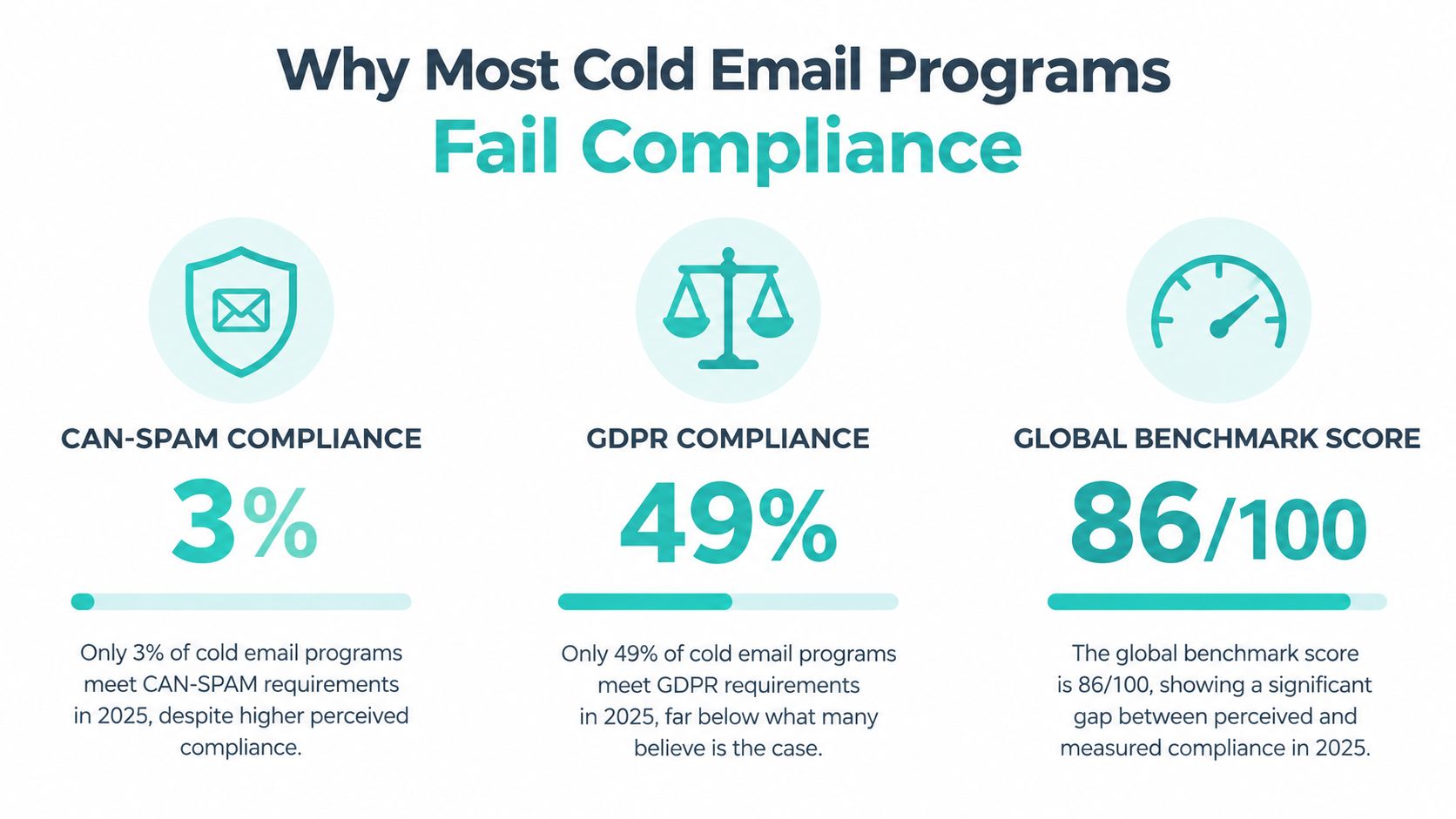
Only 3% of emails met all CAN-SPAM requirements in a 2025 benchmark, while 49% complied with GDPR, even though global deliverability health scored 86/100. Cold email compliance is therefore less about whether your message can technically leave the server and more about whether your entire outreach system can prove lawful targeting, honest identity, effective opt-outs, and responsible data handling.
A compliant campaign can still land in spam. An authenticated campaign can still expose an SMB to regulatory complaints. The practical answer is to treat compliance as a controls workflow that connects jurisdiction rules, message construction, domain authentication, list hygiene, suppression, and ongoing monitoring.
Why Most Cold Email Programs Fail Compliance
The gap between perceived and measured compliance is unusually wide. The 2025 Unspam deliverability benchmark reported that only 3% of emails met all CAN-SPAM legal requirements, while 49% complied with GDPR. The same benchmark gave global deliverability health a score of 86/100, which shows that technical performance can look healthy while legal controls remain weak.
That distinction changes how an outbound manager should diagnose failure. A campaign may have SPF configured, attractive copy, and a respectable domain reputation, yet still send to people who previously opted out, lack a documented lawful basis, or receive messages with incomplete sender information. Deliverability tools generally won’t tell you whether your legitimate interest assessment is documented or whether an unsubscribe request was honored across every sending platform.
Compliance is a workflow, not a footer
Teams often over-invest in copy and under-invest in control ownership. They review the subject line, publish SPF, and then assume the campaign is safe. The harder work sits elsewhere:
- List provenance: Each contact needs a documented source and a defensible reason for inclusion.
- Jurisdiction logic: The recipient’s location and market determine which rules apply.
- Suppression: Opt-outs must flow into a central list before another tool can re-enroll the address.
- Message controls: Headers, identity, address, subject line, and unsubscribe mechanism need pre-send validation.
- Technical delivery: SPF, DKIM, DMARC, complaint signals, and reputation determine whether a lawful email reaches the inbox.
A useful guide to building an email list without buying lists belongs at the beginning of this process, not after a campaign has produced complaints. List quality is both a legal issue and a delivery issue.
Practical rule: If nobody owns the suppression list, the program isn’t compliant. It only contains compliance features.
Sales teams also need to distinguish email outreach from other prospecting channels. A structured hire cold callers resource can help teams compare channel roles, but changing from email to calling doesn’t remove the need for lawful data handling or clear ownership of contact preferences. The control system should follow the prospect record, not just the sending channel.
Laws That Govern Cold Email Across Markets
The recipient’s jurisdiction matters more than the sender’s headquarters. A U.S. company emailing a European professional still needs to assess European data-protection and marketing rules, while a campaign aimed at Canada needs to account for CASL rather than defaulting to the more permissive U.S. model.
In the United States, CAN-SPAM uses an opt-out model. Prior consent isn’t generally required for commercial email, but the sender must use truthful headers, a non-deceptive subject line, a valid physical postal address, and a working unsubscribe mechanism. Violations can reach $50,120 per email, according to the CAN-SPAM and cold email law guidance, and opt-outs must be honored within 10 business days.
The EU requires a more deliberate assessment. GDPR fines can reach €20 million or 4% of global annual turnover, whichever is higher, and a discovered breach must be reported to regulators and affected individuals within 72 hours where the reporting conditions apply. For B2B outreach, legitimate interest is commonly considered, but it requires relevance, proportionality, documented reasoning, and a clear opt-out. GDPR doesn’t operate alone, because national ePrivacy and marketing rules can impose stricter requirements in particular countries.
Canada’s CASL generally requires express consent or narrowly defined implied consent before a commercial electronic message is sent. Publicly visible business contact details may support implied consent only in limited situations, and each message still needs sender identification and an unsubscribe mechanism. The CASL guidance for cold outreach explains why treating every public business address as universally available is unsafe.
CAN-SPAM vs GDPR vs CASL at a glance
| Rule | CAN-SPAM (US) | GDPR (EU/UK) | CASL (Canada) |
|---|---|---|---|
| Default model | Opt-out | Lawful basis and market-specific marketing rules | Express or narrowly defined implied consent |
| Prior consent | Generally not required for commercial email | Consent may apply, but B2B legitimate interest is commonly assessed | Generally required unless implied consent applies |
| Core message controls | Truthful headers, honest subject, physical address, unsubscribe | Transparency, relevance, lawful basis, data minimization, opt-out | Sender identification, contact details, consent basis, unsubscribe |
| Opt-out timing | Within 10 business days | Promptly, with stronger handling expected for objections | Within 10 business days |
| Maximum exposure cited in the guidance | $50,120 per email | €20 million or 4% of global annual turnover | Varies by enforcement provision and case |
| Recordkeeping focus | Sender identity and suppression handling | Lawful basis, processing records, data source, rights requests | Consent or implied-consent evidence and suppression |
For a small team, the safest operating model is to tag every prospect by country, business context, and consent status before enrollment. The CAN-SPAM and GDPR guide for small business owners is useful for translating those obligations into campaign-level decisions. Don’t use the loosest rule as a global default.
Required Message Elements and Opt-Out Language
The email itself should make compliance visible. A recipient shouldn’t need to search through a hidden footer, create an account, or reply to an unmonitored inbox to understand who sent the message and how to stop future contact.
Start with identity. The From name, From address, and Reply-To address should describe the sender accurately and route replies to a monitored inbox. The subject line should accurately represent the message. A first-touch email shouldn’t imply an existing conversation, use a misleading “Re:” prefix, or create false urgency.

Build the footer around action
A compliant footer normally includes the sender’s business identity, a valid physical postal address, and a conspicuous unsubscribe option. The mechanism should work without a login and should lead to a simple confirmation page or immediate suppression action. Keep the link readable, visible, and usable on mobile.
A weak version looks like this:
“Sent by Growth Team. Manage preferences.”
That wording creates uncertainty. It doesn’t clearly identify the business or tell the recipient what will happen after the click.
A stronger version is direct:
“You’re receiving this because we believe your role may be relevant to this business service. If you don’t want further emails from us, unsubscribe here. We’ll remove this address from future outreach.”
The explanation should match your actual workflow. Don’t promise immediate removal if the system only processes requests in a later batch. CAN-SPAM requires opt-outs to be honored within 10 business days, and a practical workflow should aim to suppress the address as soon as the request arrives. The HumanInbox sign off tips can help teams make the closing feel personal without obscuring sender identity or the opt-out path.
Add one-click unsubscribe where providers expect it
Mailbox providers increasingly evaluate unsubscribe behavior as part of sender quality. One-click unsubscribe through the message’s list-unsubscribe mechanism makes the recipient’s action easier and gives the sending system a clearer suppression event than a reply that a salesperson may miss.
Before launch, test four paths:
- Header click: The one-click action creates a suppression event.
- Visible link: The footer link works without authentication.
- Reply request: A message such as “remove me” reaches a monitored queue.
- Cross-tool suppression: The address is blocked in the CRM, sequencing platform, and any enrichment or list-building workflow.
A footer isn’t compliant merely because it contains a link. The link must work, the request must reach the right owner, and the address must not re-enter a later sequence.
Technical Authentication That Makes Compliance Stick
Legal compliance answers whether you may send. Authentication helps mailbox providers decide whether they should trust the message. An email can contain an honest subject, a physical address, and a working unsubscribe link, then disappear into spam because the sending domain fails authentication or has a weak reputation.
Publish the core authentication controls
SPF tells receiving systems which services are authorized to send for your domain. Keep the record controlled and make sure every legitimate sending platform is represented. Multiple conflicting SPF records create avoidable failures, so the DNS owner should maintain one authoritative configuration.
DKIM adds a cryptographic signature to outgoing messages. Generate the selector in your email service, publish the corresponding public key, and confirm that the signature passes on a real test message. The selector is tied to the sending service, which means an ESP migration requires a deliberate review rather than a copy-and-paste assumption.
DMARC connects authentication to the visible From domain and gives you reporting. Start with a monitoring policy while reviewing the reports, then tighten enforcement once legitimate traffic passes consistently. The goal is alignment between the domain recipients see and the domains authorized through SPF or signed by DKIM.
The SPF, DKIM, and DMARC guide is a practical reference for assigning these tasks between marketing operations and whoever manages DNS.
Treat tracking domains as part of identity
A custom tracking domain keeps click and redirect infrastructure closer to the brand domain instead of making every message depend on an unrelated vendor hostname. It doesn’t replace authentication, but it reduces identity confusion and gives the team another asset to review during a domain migration or reputation investigation.
Validate the setup with Google Postmaster Tools, mailbox-provider feedback, and an independent DNS testing service such as MXToolbox. Check alignment, not only whether an isolated SPF or DKIM test passes. If the visible From address belongs to one domain while the authenticated envelope and signing domains belong to unrelated domains, the message may fail alignment even when individual records look valid.
Technical rule: Authentication is not a legal substitute. It is the delivery control that gives a legally constructed message a chance to reach the recipient.
A Repeatable Compliance Checklist for SMBs
A one-time audit won’t protect a program that changes every week. New lists arrive, salespeople duplicate sequences, and opt-outs appear in different systems. Assign each control to a person, define when it runs, and preserve evidence of the decision.
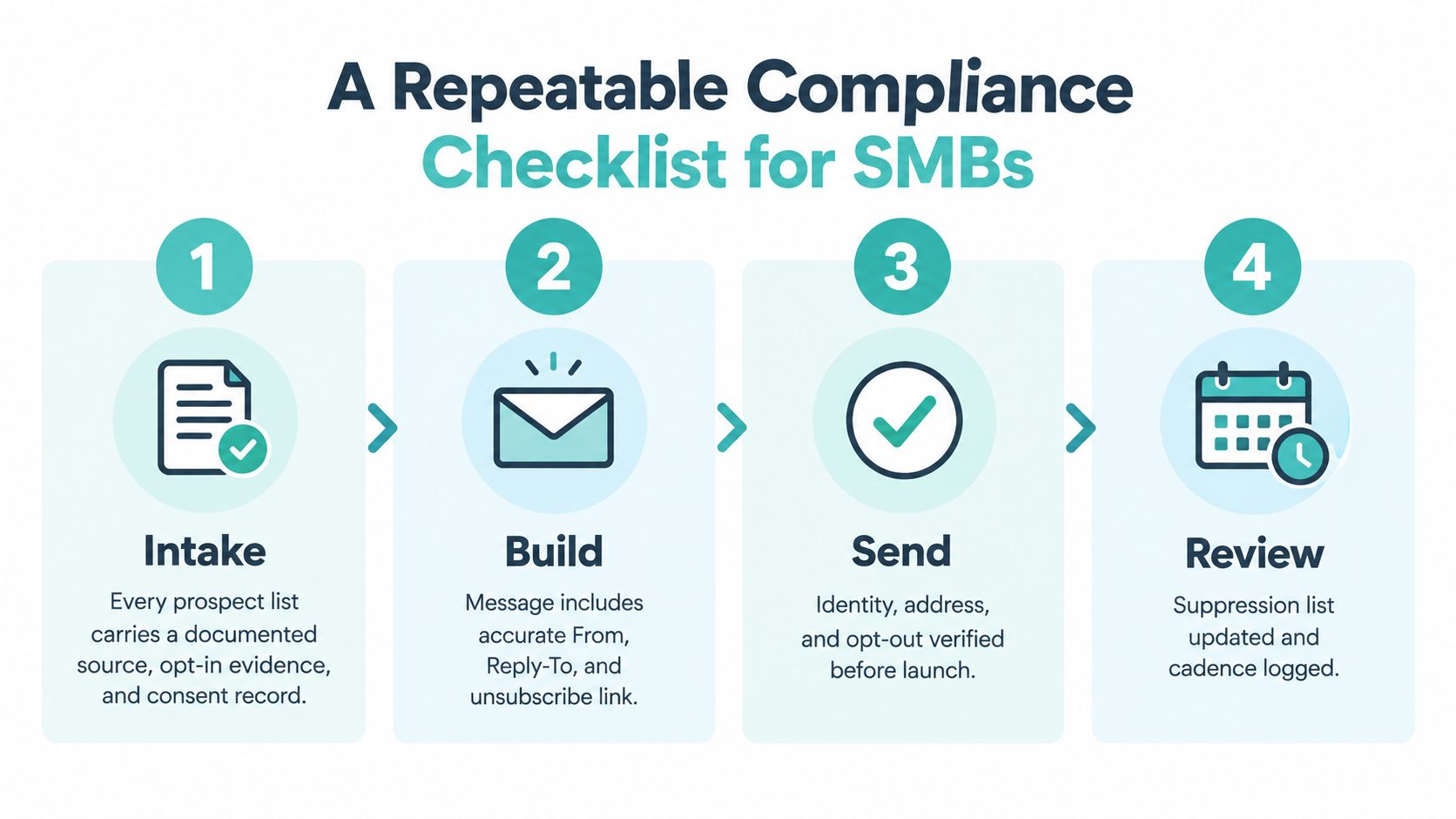
Intake comes before copy
The list owner should record the source of every segment, the recipient’s jurisdiction, and the basis for outreach. For EU B2B contacts, that may include a written legitimate interest assessment covering the purpose, necessity, relevance, and balancing decision. For Canadian contacts, preserve the evidence supporting express or implied consent.
A prospect record should also carry a suppression status that survives exports. Don’t rely on a salesperson remembering that someone asked not to be contacted. The system needs a durable field that every sending tool reads before enrollment.
Build and validate the message
The campaign owner should confirm:
- Identity: From and Reply-To fields match the actual business and a monitored mailbox.
- Content: The subject line reflects the body and doesn’t suggest a relationship that doesn’t exist.
- Address: A valid physical postal address appears in the message.
- Opt-out: The visible unsubscribe link and one-click mechanism both work.
- Relevance: The offer matches the recipient’s role and professional context.
- Data use: The message doesn’t expose personal details that aren’t necessary for the outreach purpose.
Use a test segment before activating the full sequence. Test the unsubscribe event from a personal inbox, then confirm that the address is blocked in every downstream tool.
Send only after suppression checks
Before launch, compare the audience against the master suppression list. Include role addresses such as generic departmental inboxes only where your legal and operational policy supports that use, and remove records with uncertain ownership or poor provenance. The sender should sign off on identity, address, opt-out, and jurisdiction filters, not just copy quality.
Review the evidence
Store the source, lawful basis or consent evidence, message version, send date, and opt-out action. GDPR-oriented programs also need records of processing and a process for handling data-subject requests. A documented review gives a new team member something concrete to follow and lets an owner identify where a control failed.
Monitoring, Reporting, and Deliverability Feedback
Monitoring turns compliance into a controls workflow. Complaint signals, bounces, authentication failures, and unsubscribe events show whether the audience, message, or sending configuration is creating legal and delivery risk. A compliant email still needs the technical conditions that let it reach the inbox.
Connect the sending infrastructure to Gmail Postmaster Tools, Microsoft SNDS, and Yahoo feedback-loop reporting where available. Bring those signals into one dashboard or review document instead of checking providers separately. DMARC aggregate reports expose unauthorized sending and alignment failures across SPF and DKIM, while bounce and unsubscribe data test list hygiene and one-click opt-out handling.
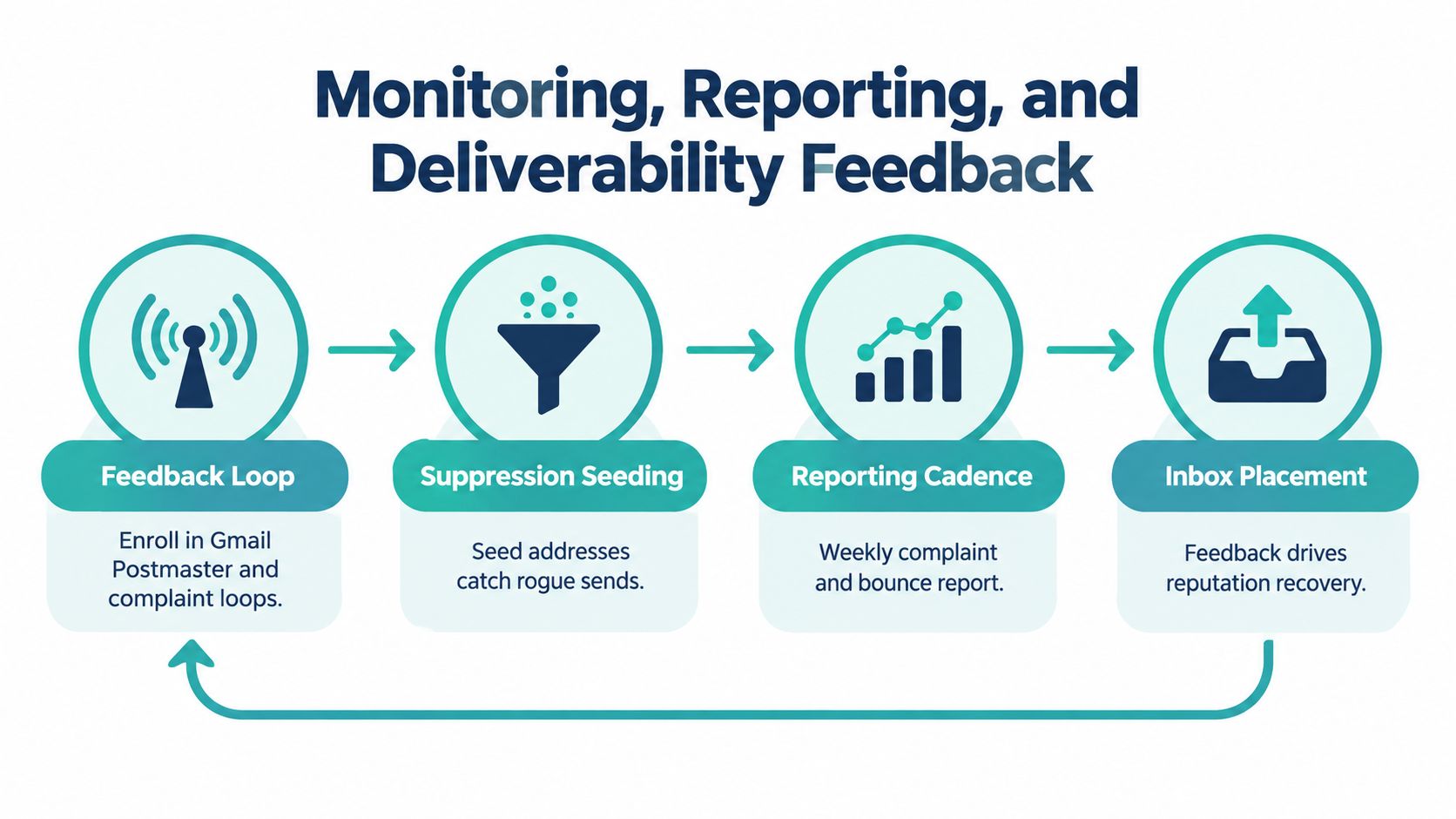
Seed the workflow with controls
Use suppression test addresses or internal decoy records where your process allows it. A test address should never receive a campaign. If it does, investigate the list import, synchronization, suppression rule, or one-click unsubscribe event before sending again.
Review performance on a regular cadence, but do not treat open rate as proof of compliance or inbox placement. Focus the review on:
- Complaints: A rise should pause the campaign and trigger a content and targeting review.
- Bounces: A rise should prompt an investigation of the data source, verification process, and list hygiene.
- Unsubscribes: A sudden increase may signal poor relevance, unclear expectations, or an overly broad segment.
- Authentication: DMARC reports and provider dashboards should confirm SPF and DKIM alignment and expose unauthorized traffic.
- Replies: Positive engagement can support a relevance diagnosis, but it does not override legal or suppression controls.
Teams facing persistent placement problems can use a practical resource to fix email deliverability issues, then connect each technical change to its corresponding audience or message control. See why your emails go to spam and how to fix deliverability for a diagnostic checklist that complements this monitoring workflow. A compliant email that never reaches the inbox fails commercially, while a well-delivered email with weak suppression creates avoidable exposure.
Building a Sustainable Compliance Program
Compliance needs an operating rhythm. Assign one owner for DNS and authentication, another for the master suppression process, and another for templates and jurisdiction review. Marketing can own relevance and messaging, while sales operations owns enrollment and removal, but the handoffs must be explicit.
Use quarterly reviews and event-based triggers
A quarterly review should examine authentication records, suppression synchronization, recent complaints and bounces, active templates, and changes in mailbox-provider expectations. Re-train SDRs when rules or workflows change, especially around legitimate interest, Canadian consent, and the difference between a professional address and a personal one.
Reopen the program sooner when any of these events occur:
- A new country or market is added.
- The team migrates to a new ESP or sequencing tool.
- Spam complaints rise unexpectedly.
- A domain or authentication configuration changes.
- A regulator or mailbox provider announces an enforcement change.
- An adjacent company or sector faces enforcement that exposes a previously ignored practice.
The review should produce actions, owners, and deadlines. “We checked compliance” isn’t an operational record. “The suppression owner verified synchronization, the template owner approved the footer, and the DNS owner reviewed alignment” is.
Connect controls to pipeline outcomes
Good compliance reduces wasted outreach, prevents repeat contact after an objection, and improves the relevance of the audience reaching the sales team. It also protects the domain that carries future conversations. The trade-off is that careful segmentation and review can reduce the number of contacts available for a sequence, but indiscriminate volume creates legal and deliverability risk that no copy improvement can solve.
For SMB teams without a dedicated compliance hire, Adwave can fit as a structured option for managing role-relevant outreach workflows, centralized suppression, and jurisdiction-aware templates. The important question isn’t whether a platform has an unsubscribe button. It’s whether the team can assign ownership, preserve records, and stop a message from re-entering the system after an objection.
Adwave provides structured marketing workflows that help SMB teams organize audience targeting, campaign execution, and performance measurement while keeping operational controls visible. Visit Adwave to evaluate how its centralized approach can support more disciplined, measurable outreach alongside your cold email compliance process.