
A campaign goes live. The phone starts ringing. Website visits pick up. A few leads fill out your form after seeing your ad, and you feel like your marketing is pulling its weight.
Then the less exciting part shows up.
You now have email addresses, form submissions, browsing data, and follow-up automations. That means legal obligations. Not just big-company obligations. Yours.
For a small business owner, this is the uncomfortable gap between “marketing is working” and “marketing is compliant.” It gets wider when you use modern tools that make reach easier. A local TV ad can drive someone to your site in minutes. An email sequence can keep that lead warm. A retargeting audience can keep your brand visible. All of that is useful. All of that also touches privacy and consent.
Owners do not ignore compliance because they are reckless. They ignore it because they are busy, and the rules sound like they were written for legal departments instead of normal businesses. That is exactly why CAN-SPAM and GDPR trip people up. They are not abstract policy issues. They shape what you can collect, what you can send, and how you must let people opt out.
This guide takes the legal language out of the way and focuses on what a practical operator needs to know. If you are sending promotions, collecting leads, or trying to improve deliverability after noticing email issues, Adwave’s guide on why your emails go to spam and how to fix deliverability is a useful companion to the compliance side of the conversation.
Your Marketing Is Working But Are You Breaking the Law
A common scenario looks harmless at first.
A real estate agent runs a local campaign. A retailer starts a newsletter. A home services company sends a follow-up offer after someone requests a quote. Nothing about that feels like risky behavior. It feels normal.
Where small businesses get caught
The problem is not the ad itself. The problem starts when the business handles the response carelessly.
A lead fills out a form, and that email address gets added to a general list. A promotional email goes out without a proper unsubscribe option. The footer is missing a real postal address. Someone opts out, but the request sits in a shared inbox and no one updates the mailing tool. None of that sounds dramatic. It is still the kind of thing that creates exposure.
Small businesses also mix systems. They may use one tool for the landing page, another for email, and a spreadsheet for manual follow-up. That patchwork setup makes it easy to lose track of what a person consented to and when.
Success creates responsibility
Growth creates legal surface area.
The more effective your campaign is, the more important your list practices become. If you are collecting more leads, sending more messages, and learning more about your audience, you need a reliable compliance process, not just a privacy policy buried in your site footer.
Good marketing gets attention. Compliant marketing keeps that attention from turning into liability.
Disciplined operators separate themselves from frantic ones by treating compliance as part of the campaign build, not a cleanup task after launch.
Understanding the Two Giants of Data Privacy
A small business can follow every good marketing instinct and still miss the legal difference between these two rules.

CAN-SPAM governs commercial email conduct
CAN-SPAM is a U.S. law focused on commercial email. Its job is to regulate how a business sends promotional messages, not to govern every way that business collects or stores customer data.
For a small business owner, that means email execution matters. Sender information must be accurate. The message must accurately identify itself. Recipients need a real way to opt out. Opt-out requests also need to be processed promptly, which is where many smaller teams run into trouble when email platforms, forms, and manual follow-up are spread across different systems.
This law is narrower than many owners expect.
It does not ask whether every piece of personal data in your business has a documented legal basis. It asks whether your commercial emails follow specific rules. That distinction matters because a company can run a clean newsletter process and still have broader privacy gaps elsewhere.
GDPR governs personal data use more broadly
GDPR starts from a different premise. It is about whether a business has a valid reason to collect, use, store, and share personal data in the first place.
That changes the conversation fast. Instead of focusing only on the message, GDPR pushes businesses to examine consent, lawful basis, transparency, retention, and security across the full customer journey. A lead form, remarketing audience, CRM entry, and follow-up campaign can all fall in scope if they involve data from EU residents.
The law took effect on May 25, 2018, and its penalty structure is severe. A 2019 survey cited by Mailforge found that over 50% of European small businesses felt uncertain about key compliance requirements in its article on GDPR vs. CAN-SPAM email compliance.
Why small businesses need to separate these rules clearly
Owners often lump CAN-SPAM and GDPR together because both show up in conversations about email marketing. That shortcut creates bad processes.
CAN-SPAM is about compliant promotional email behavior. GDPR is about lawful data handling across channels. If you treat them as interchangeable, you end up solving the wrong problem. I see this often with smaller teams using affordable, modern tools to grow faster. They set up lead capture, retargeting, and automated follow-up, but they do not document what the person agreed to, how that data will be used, or whether each vendor fits the business's privacy process.
That is why vendor review is part of compliance work, not a separate IT task. If you use platforms that touch customer information, check the platform's policies, data practices, and role in your workflow. For example, reviewing the Adwave privacy policy helps confirm how a modern AI-powered TV advertising tool fits into a compliant marketing setup.
CAN-SPAM sets rules for the message. GDPR sets rules for the data behind the message.
CAN-SPAM vs GDPR A Side-by-Side Comparison
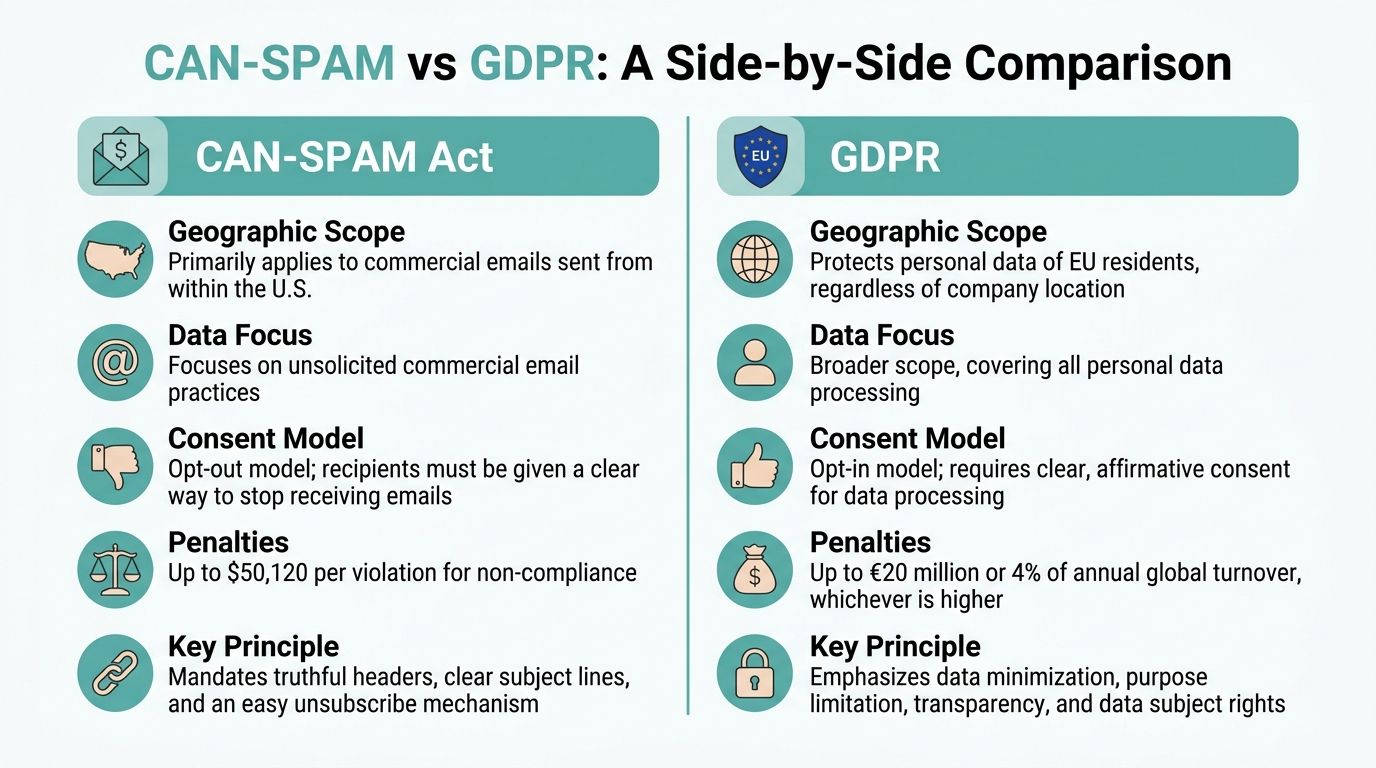
A small business can send the same promotion to 500 contacts and face two very different compliance questions at once. Did the email itself follow U.S. commercial email rules? And did the business have a lawful, documented reason to collect and use that person’s data in the first place?
The practical difference
Here is the cleanest distinction.
CAN-SPAM regulates how you send commercial email. GDPR regulates how you collect, store, use, and share personal data across your marketing operation.
That difference matters in real workflows. A campaign can include a valid unsubscribe link and still create GDPR problems if the contact was added without proper notice or a lawful basis. The reverse is also true. A contact may have signed up properly, but the email can still violate CAN-SPAM if the sender details are misleading or the opt-out process is broken.
For small teams, that means compliance has two checkpoints. One sits at data collection. The other sits at message execution.
CAN-SPAM vs. GDPR Key Differences at a Glance
Where owners get tripped up
The usual mistake is treating GDPR as a stricter email law. It is broader than that. It reaches the form, the CRM, the audience sync, the analytics setup, and the vendors touching the data.
CAN-SPAM is narrower, but it is not casual. It expects discipline in every promotional email you send.
That is why I usually advise owners to build one repeatable process that can stand up to both rules. Use clear signup language. Store consent records. Separate newsletters from transactional messages. Keep suppression lists accurate. Review the tools in your stack, including ad platforms, with the same care you apply to email software. If a business uses a tool like Adwave alongside email and web forms, the compliance question is not just whether the ad performs. It is whether the surrounding data flow is documented and handled consistently.
Penalties are serious enough to change behavior
CAN-SPAM can carry penalties on a per-email basis, as noted earlier. For a small business, the more practical point is not the maximum fine calculation. It is that one sloppy campaign can create legal exposure far beyond the value of the promotion.
GDPR uses a different enforcement model and looks closely at how a business handles personal data over time. Documentation, consent quality, and internal process matter more there than any one subject line.
Owners should treat that as an operational issue, not just a legal one. If your process is messy, your risk is higher.
The smartest standard for a small team
Running one loose standard for domestic contacts and another stricter standard for everyone else sounds efficient. In practice, it breaks down. Staff reuse old forms. Contacts get imported without source notes. Automations fire based on assumptions no one can verify later.
A better setup is boring on purpose:
Ask for consent in plain language
Record what the person agreed to
State what messages they will receive
Make opting out easy and fast
Limit access to customer data to the tools and people who need it
This takes more care at setup.
It usually saves time later. It also gives small businesses a real advantage. Cleaner consent produces better lists, fewer complaints, and stronger trust. That matters whether you are sending newsletters, running remarketing, or using accessible tools like AI-powered TV to reach new customers without creating privacy confusion behind the scenes.
The better question is not how little compliance you can get away with. It is whether your current process would still make sense if a customer, regulator, or platform partner asked you to explain it tomorrow.
How These Global Rules Apply to Your Local Business
Owners still assume privacy rules only matter if they run a large ecommerce brand or sell internationally. That assumption falls apart fast.

Local business does not mean local data
A local restaurant can have a newsletter signup on its site. A real estate broker can collect inquiry forms from people planning a move. A retail shop can run a digital campaign that sends traffic to a promo page. A contractor can capture quote requests from people researching before relocation.
None of those businesses has to “target Europe” in some formal way for data issues to appear. If the data belongs to an EU resident, GDPR can become relevant.
This catches small operators off guard because their own business footprint feels local. Their data footprint is not.
Everyday marketing activities that trigger compliance issues
Most compliance exposure comes from ordinary habits:
Lead forms that do not explain what follow-up the person is signing up for
Newsletter boxes that bundle updates, promotions, and partner communications together
CRM imports where no one knows how the contact was originally collected
Audience retargeting tied to website visits without clear disclosures
Automated email sequences that continue after someone has tried to opt out
The core issue is not sophistication. It is data handling discipline.
Why traffic sources matter
Modern advertising shortens the path between attention and data collection. A TV ad sends a viewer to a landing page. The landing page offers a download, quote request, coupon, or booking prompt. The visitor enters an email address. From there, the compliance burden moves to your forms, notices, storage, and follow-up workflow.
That is why business owners should stop thinking about compliance as “an email issue” or “a website issue.” It is a campaign issue. The ad, the page, the form, the CRM, and the email sequence all connect.
The location rule that surprises owners
The most important practical point is simple. For GDPR, the relevant question is “Whose data am I processing?”
That means a one-location business can still face cross-border obligations through a very ordinary website form.
What a sensible owner does
You do not need to panic every time an out-of-market visitor lands on your site. You do need to stop assuming that local branding protects you from global privacy rules.
A safer operating posture is to build consent and transparency into all your marketing paths by default. That means your forms explain what happens next, your policies reflect reality, and your tools support opt-outs and recordkeeping without manual guesswork.
Small businesses that do this discover a side benefit. Their operations become cleaner. Sales follow-up becomes more consistent. Fewer contacts enter the database with fuzzy permission status.
Your Actionable Small Business Compliance Checklist
Owners do not need a lecture. They need a list they can work through this week.
Start with your website
Your website is where compliance problems begin, because that is where data collection starts.
Review every form: Check contact forms, quote forms, newsletter popups, checkout fields, and gated downloads. Each one should clearly explain what the person is signing up for.
Match the form to the follow-up: If the form promises a response to an inquiry, do not add that person to a broad promotional list unless your wording covers that.
Update your privacy policy: It should describe your data practices, not generic language copied from a template.
Check consent language: Avoid vague statements that lump every possible use of data into one sentence.
If you want a broader legal operations view beyond marketing, this detailed small business compliance checklist is a useful cross-functional reference.
Clean up your email setup
Email is where CAN-SPAM errors become visible fast.
Add a valid physical postal address to every marketing email footer.
Make the unsubscribe option easy to find. It should not require hunting through tiny text or logging into an account.
Honor opt-outs promptly. Do not keep unsubscribed contacts in a side spreadsheet for “possible reactivation.”
Use honest sender details and subject lines. The message should accurately reflect who sent it and what it is about.
A simple but important list-building rule belongs here too. Do not buy lists. Do not scrape lists. Build permission-based lists you can defend. Adwave’s guide on how to build an email list from zero without buying lists aligns with that approach.
The easiest compliance fix is removing people you should never have emailed in the first place.
Tighten your consent process
Many small businesses find improvement in both legal footing and list quality at this stage.
Use clear opt-in wording: Say what type of communication the person will receive.
Separate service updates from promotions: Transactional communication and marketing communication should not blur together.
Keep proof of consent: Your system should retain when and how someone subscribed.
Use double opt-in when risk is higher: It adds friction, but it creates cleaner records and stronger proof.
Get your internal process under control
Compliance fails when ownership is fuzzy.
Assign responsibility
One person should own email list hygiene. One person should own privacy policy updates. One person should check forms before campaigns launch. In a tiny business, that may be the same person. The point is clarity.
Audit your tools
List every platform that touches lead data. Website forms, CRM, email service, analytics tools, ad platforms, booking systems. If you do not know where data flows, you cannot manage consent or deletion properly.
Remove old workarounds
Shared spreadsheets, manual exports, and duplicate contact lists are where opt-out failures happen. If your process depends on someone remembering to “also update the other list,” you do not have a reliable process.
Protect the data you collect
GDPR is not only about consent. It also expects responsible handling of data.
Limit access: Not every employee needs the full customer list.
Store only what you need: If you are collecting fields you never use, remove them.
Review retention: Old contacts with unclear consent should not sit in your system forever.
Check vendor settings: Your tools should support suppression lists, consent tracking, and privacy requests.
Use this checklist before every campaign
Before launch, ask:
If you cannot answer yes to most of that quickly, your campaign is not ready.
Using Adwave for Compliant TV Advertising Growth
Small businesses do not need to become privacy lawyers to advertise well. They do need a workflow that reduces unnecessary risk.

Compliance starts after the ad gets attention
TV advertising feels separate from email law until the viewer takes action.
A viewer sees an ad, visits your landing page, fills out a form, books an appointment, or signs up for updates. At that point, the question is no longer just “Did the ad perform?” It becomes “What did your business do with the data that came in?”
A modern platform can help here by keeping the advertising side efficient while letting the business focus on compliant lead handling.
Where Adwave fits
Adwave is an AI-powered TV advertising platform built for small businesses that want to create, launch, and measure TV campaigns without a traditional production workflow. In a compliance context, the practical value is straightforward. It allows a business to expand awareness through TV while keeping its direct compliance work centered on the parts it controls most closely, such as the landing page, lead form, consent language, email follow-up, and internal data handling.
That is the right division of attention.
Owners waste time obsessing over the wrong layer of the stack. They worry about the ad format while leaving the form wording untouched. They debate targeting while ignoring unsubscribe flow. A tool can simplify campaign launch, but it does not replace the need for a compliant conversion path.
What compliant use looks like in practice
A sound setup includes:
A landing page with clear disclosure about what happens after submission
A consent mechanism that fits the audience you may attract
An email workflow that separates confirmations from promotions
A CRM process that records subscription status
A suppression process so opt-outs stop future sends
A modern platform can help here by keeping the advertising side efficient while letting the business focus on compliant lead handling.
What does not work
These patterns create trouble quickly:
Sending all ad-generated leads straight into a promotional newsletter by default
Using one broad checkbox to justify every future communication
Letting sales reps export leads into personal contact lists
Treating TV-driven traffic as “top of funnel” and therefore exempt from privacy discipline
Good campaign measurement and good compliance support each other. Both require clean data and clear attribution.
When owners treat compliance as a design input, not a legal afterthought, growth becomes easier to sustain.
Answering Your Toughest Compliance Questions
A common small business scenario looks like this. A campaign starts producing leads, a salesperson follows up fast, and the owner assumes the legal risk is low because the list is small. That is often the mistake.
Are we too small to worry about this
No. Small businesses get into trouble because their processes are informal, not because they send at enterprise volume.
Projections for 2025 to 2026 point to more enforcement against smaller companies, including over 500 small entities fined by GDPR authorities in 2025 for inadequate consent in automated tools, according to Hustler Marketing’s article on email marketing compliance in 2026. If you collect personal data and send marketing messages, your size does not remove the obligation.
What is the first thing I should do today
Start with the places where mistakes show up fastest. Review every form a prospect can submit and every footer in your outbound marketing emails.
The form should clearly say what the person is signing up for. The footer should identify your business and make opting out simple. If those basics are weak, do not spend the afternoon editing policy pages. Fix the live points of contact first.
If I only have one EU contact, does GDPR matter
Yes, it can.
GDPR follows the data of EU residents. It does not wait until you have a large European customer base. One contact is enough to expose a weak process if that person asks what you collected, why you collected it, or how to unsubscribe from future messages.
Can I just copy another company’s privacy policy
That creates more risk than it removes.
A copied policy often describes tools, retention periods, or data uses that do not match your business. Then the public-facing language says one thing while your actual workflow does another. If I am advising a small business on cleanup, this is one of the first shortcuts I tell them to reverse.
Your policy should match your forms, CRM, ad tools, follow-up emails, and internal handling of opt-outs.
Is stricter consent bad for marketing performance
Not always. In many cases, it improves performance.
Hustler Marketing’s article on email marketing compliance in 2026 notes that stricter GDPR-style opt-in consent can improve email open rates by 20% to 30%. That result makes sense operationally. A smaller list with clear permission usually produces better engagement than a larger list filled with weak or outdated contacts.
That is the trade-off. You may collect fewer names at the top of the funnel, but the names you keep are easier to market to and easier to defend if questions come up.
Do I need double opt-in
Consent requirements depend on the situation. Check the applicable rules before sending.
Double opt-in gives you a stronger record that the person meant to subscribe. It also cuts down on fake addresses, typos, and signups entered by someone else. For businesses selling across borders, working in regulated categories, or relying heavily on email revenue, the extra step is often worth the drop in raw signups.
What if a lead comes in through a campaign and my salesperson emails them directly
Set rules before that happens.
A direct one-to-one reply to a clear inquiry is different from adding that person to a broader promotional sequence. Sales reps need to know what the lead requested, what consent was captured, and when follow-up shifts from expected contact to marketing. If that line is blurry inside your company, fix the process now, not after a complaint.
Are unsubscribe links enough for compliance
No.
They help satisfy a core CAN-SPAM requirement, but they do not solve consent, disclosure, retention, or internal suppression problems. A business can have a working unsubscribe link and still mishandle personal data in three other places.
What usually fails first in a small business setup
I see the same breakdowns repeatedly:
Form language is too broad or too vague
Opt-out status does not sync across email, CRM, and sales tools
Old contacts remain in the database without clear proof of permission
Those are process failures. Legal exposure usually starts there.
How should I think about this going forward
Treat compliance as part of campaign operations, not as a document you finish once and forget.
That is where modern tools can help without pretending to solve the legal side for you. If you use Adwave to run AI-powered TV campaigns, keep the ad execution efficient and keep your attention on the handoff points that matter. The landing page, the consent language, the CRM field that stores subscription status, and the follow-up workflow determine whether growth stays clean.
Small businesses do not need a heavy compliance department. They need documented decisions, consistent handling, and systems that make the right action easier than the sloppy one.


