“Reply to every comment” is popular advice, but it’s a poor operating strategy for a small business. Clearing notifications can consume the same attention you need to understand why prospects hesitate, what customers misunderstand, and which promises your advertising should make.
Comments as content marketing means treating customer language as research, not just something to acknowledge. The useful output isn’t a tidy inbox. It’s better answers, sharper creative, and a measurable path from public conversation to a qualified inquiry.
Why Replies Are the Least Valuable Part of a Comment Program
Replies are the least valuable part of a comment program when the only objective is clearing the queue. A thoughtful answer to a buying question matters. A hundred interchangeable thank-you messages tell you little about what to change in your marketing.
Consider a hypothetical plumbing business whose posts repeatedly attract questions about evening availability. A hygiene-only program answers each person individually. A research-driven program recognizes an availability objection, confirms the actual scheduling policy, updates the booking page, and tests advertising that makes the service hours clear.
The difference isn’t friendliness. It’s whether someone turns the conversation into a decision.
Give the program distinct jobs
- Intelligence: Identify customer questions, objections, misconceptions, and unmet needs.
- Trust signaling: Answer substantive questions visibly and handle criticism without defensiveness.
- Creative input: Carry recurring customer language into ads, FAQs, and sales scripts.
- Conversion workflow: Give interested people an appropriate next step and record the outcome.
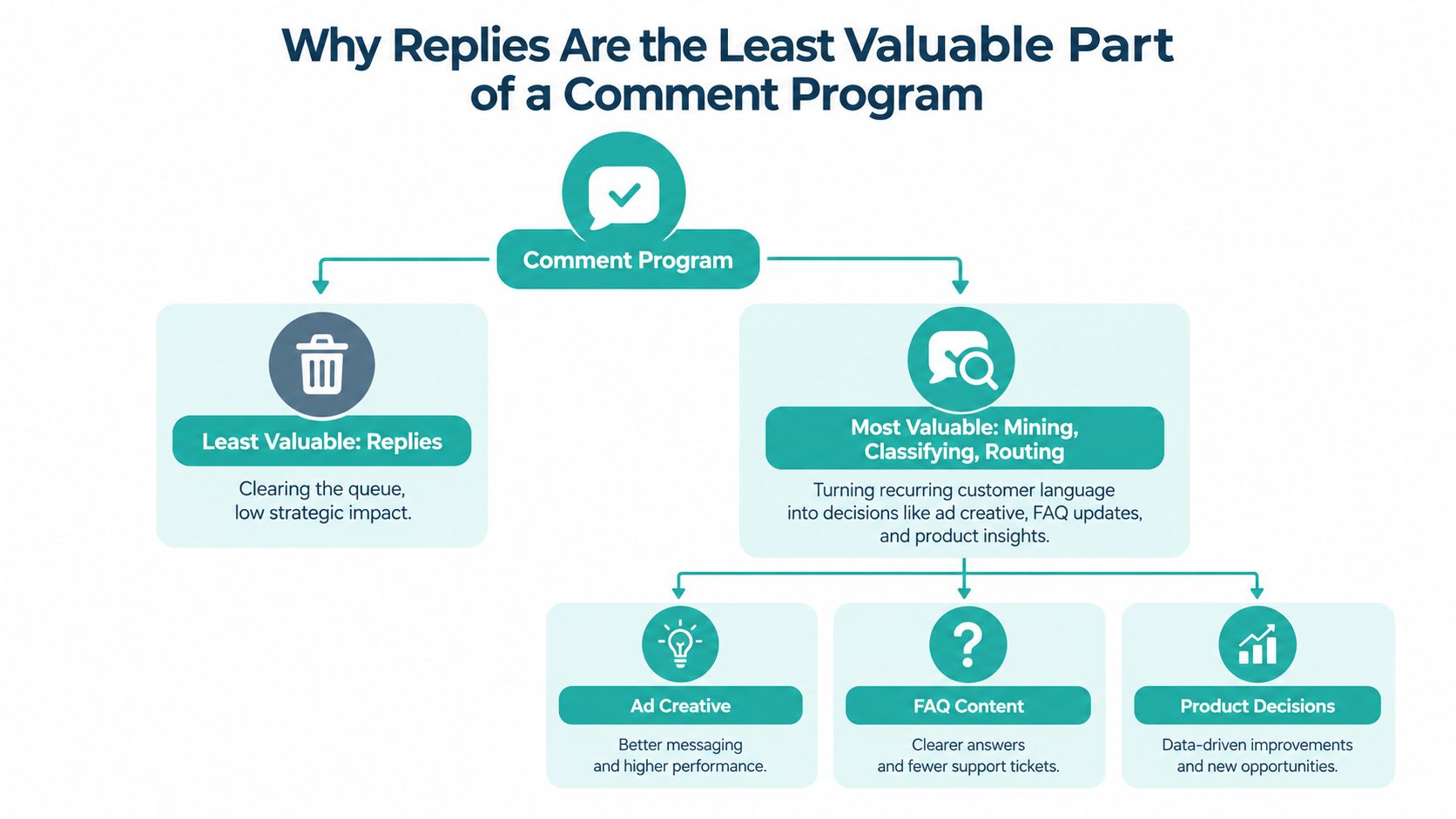
To diagnose your current setup, open a recent comment thread. Can you identify who owns the reply, where its underlying theme gets recorded, and which business decision it might inform? If you can find only the reply, you have a service queue, not a complete marketing program.
Practical rule: Don’t evaluate a comment program by how empty the inbox looks. Evaluate what the business learned and changed.
Response capacity is the constraint most advice skips. Historical analysis of more than 160 million inbound messages across 20,000 brand profiles found response rates below 20%, while a separate large-scale benchmark reported an average of 11%, according to Sprout Social’s social-media business guidance.
Those benchmarks aren’t targets to imitate. They’re a reason to plan realistically: prioritize purchase intent and service risk, assign ownership, and stop spending scarce staff time on replies that add no information.
Mining Comments for Market Intelligence
Start with a spreadsheet, not a complicated listening stack. Export available comments from organic posts, paid placements, and review sites, or manually record a manageable rolling sample when exports aren’t available.
Keep the original wording beside the post context, channel, date, and any eventual outcome. Remove unnecessary personal information. A paraphrase such as “price concern” loses the useful distinction between someone asking whether financing exists and someone disputing a bill.
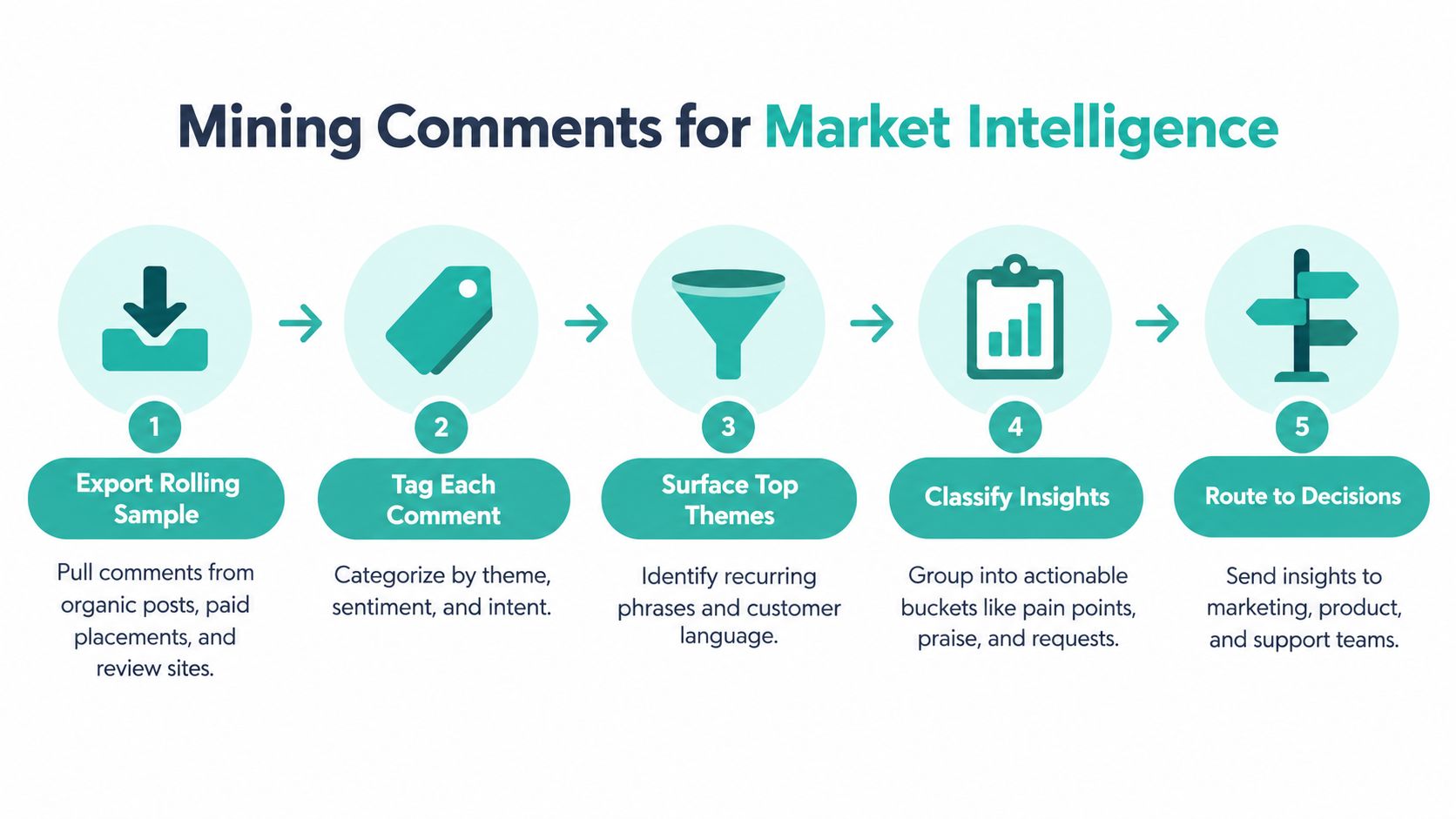
Classify intent before sentiment
A negative-sounding question can still signal strong purchase intent. “Why can’t I find your service area anywhere?” deserves a different response from an unrelated insult.
Use consistent intent labels:
- Buying question: Availability, eligibility, booking, pricing, or payment.
- Objection: A reason someone might delay or reject the purchase.
- Service-area request: Whether the business serves a location.
- Competitor comparison: How alternatives differ.
- Misconception: An incorrect assumption about the offer.
- Post-purchase problem: Something that needs support rather than promotion.
Then rank themes using a simple qualitative rubric:
| Criterion | Higher priority | Lower priority |
|---|---|---|
| Frequency | Reappears across independent conversations | Isolated wording with no repetition |
| Urgency | Blocks a purchase or involves an unresolved issue | General curiosity |
| Revenue potential | Concerns an eligible customer and an available service | Falls outside the business’s offer |
Treat this as editorial judgment, not a mathematically precise forecast. A serious service problem deserves escalation even if it appears only occasionally.
Turn a question into an answer
For example, a hypothetical customer asks: “Can I book an estimate without committing to the work?” Tag it as a buying question with a commitment objection.
After confirming the policy with the business, draft an FAQ answer: “An estimate doesn’t commit you to the work. We’ll explain the proposed scope and price before you decide.” Publish that wording only if it accurately describes the process.
For topics that remain ambiguous, use customer-feedback survey questions designed to get honest answers to investigate rather than guessing.
Don’t restrict discovery to your own accounts. Brands initiate only about 1.11% of discussions about themselves, according to Brandwatch’s State of Social reporting. Monitor public business-name mentions, neighborhood discussions, and relevant service questions where access and community rules permit.
Keep the weekly mining session bounded. Capture repeated questions and consequential exceptions, route them to an owner, and stop collecting when you have enough evidence to make the next content decision.
Soliciting Comments Across Blog, Social, Reviews, and Forums
A local dental practice shouldn’t ask the same question everywhere. Someone reading an appointment-preparation article needs a different invitation from someone discussing local accessibility in a neighborhood forum.
Match the prompt to what the person just experienced. Don’t ask readers to invent a topic for your marketing calendar, and don’t demand public participation where a private answer would feel more appropriate.
Comment Solicitation by Channel
| Channel | Best Prompt Type | Realistic Volume | Primary Use |
|---|---|---|---|
| Blog | A narrow question about the article | Sporadic unless readers already participate | Find missing explanations |
| Post-purchase email | A neutral invitation to share an experience | Uneven, dependent on customer willingness | Gather feedback |
| Review platform | An honest, policy-compliant review request | Gradual rather than campaign-like | Understand experience and reputation |
| Social | A relevant choice or practical question | Variable by audience and topic | Test language and concerns |
| Community forum | A useful contribution followed by an optional question | Selective, not scalable on demand | Learn local priorities |
Ask something people can answer
At the end of a dental preparation article, try: “Which part of preparing for an appointment still feels unclear?” Use it when the article answers a practical question and comments are actively moderated.
A post-appointment email can say: “What should we explain more clearly before your next visit? You can reply privately.” If you also request a public review, keep that invitation neutral and follow the platform’s rules. Don’t make positive feedback the condition for receiving the review link.
For social, use a concrete planning question: “Which appointment information would help you most before booking: accessibility, payment options, or what to expect?” Only offer choices the practice can address.
In a community forum, contribute an answer before asking for attention. For example: “Our entrance information is available from reception. What accessibility details would be most useful for local practices to publish?” Identify your connection to the practice and respect restrictions on commercial participation.
Contribute beyond your own posts
Hootsuite reports that 41% of brands are experimenting with proactive outbound comments, and that comments receive an average of 1.6 times more engagements when the original poster replies, in its social-media statistics analysis. That’s an engagement observation, not a promise of appointments.
Choose relevant conversations and add something specific. If LinkedIn is part of your research workflow, Fetchin’s resource to compare LinkedIn comment extraction tools can help you evaluate collection options before committing to a process.
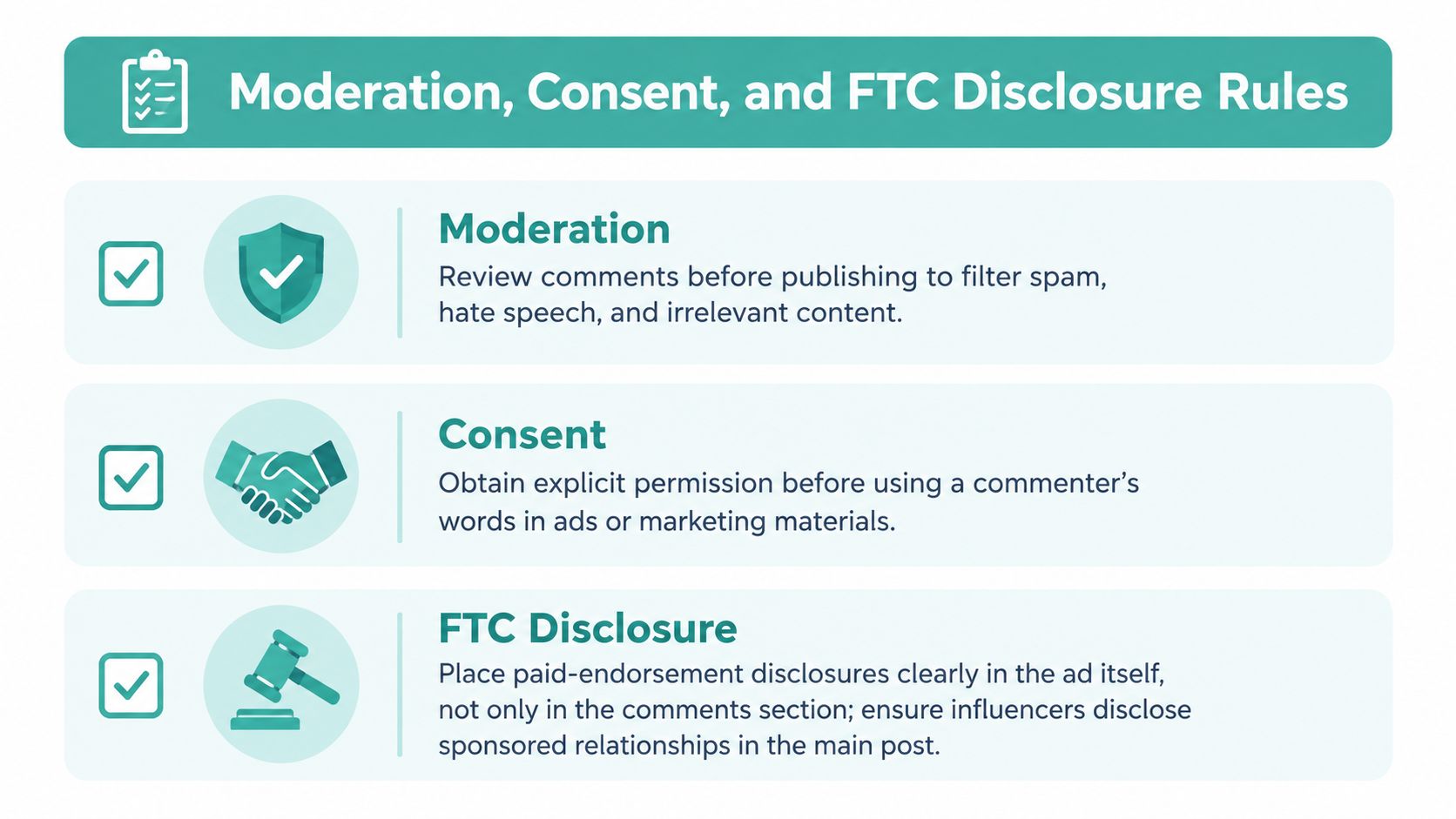
Moderation, Consent, and FTC Disclosure Rules
Useful comment marketing requires boundaries. Staff need to know what they can answer publicly, what belongs with a manager, and what should never become promotional material.
The FTC says a paid-endorsement disclosure placed only in a post’s comments is inadequate, because users can easily avoid seeing it. Material relationships should be disclosed within the endorsement or in an immediately visible location, as explained in the FTC’s endorsement disclosure guidance.
Choose the appropriate response route
| Situation | Recommended action |
|---|---|
| General purchase or service question | Answer publicly with verified information |
| Account details, health information, or a billing dispute | Acknowledge publicly, then offer a secure private channel |
| Material factual error | Correct it briefly and provide the relevant explanation |
| Legitimate criticism | Respond to the substance and assign follow-up |
| Spam, threats, or prohibited content | Apply the published moderation policy |
| Repetitive provocation without a substantive issue | Log if useful, then leave unanswered |
Moving a conversation privately shouldn’t become a way to hide criticism. Explain why the handoff is necessary, identify who will handle it, and avoid asking the customer to repeat sensitive details in public.
Separate permission from enthusiasm
“I saw this and loved it” expresses appreciation. Don’t treat it as permission to use someone’s name, photograph, or words in a paid advertisement.
As an operating policy, obtain explicit written permission that identifies the material, intended channels, attribution, and permitted edits. A signed release can document that agreed scope, but don’t assume it grants rights the document never addresses. Get appropriate legal advice for sensitive or ambiguous uses.
Permission to reuse a comment and disclosure of a commercial relationship are separate checks. Completing one doesn’t complete the other.
For a testimonial carousel, customer reel, or television spot, preserve the meaning of the original statement. Don’t remove qualifications that would change how a reasonable viewer understands it, and don’t turn a personal experience into an unsupported general promise.
Use a truth-in-advertising review before publication. Check the claim, permission, disclosure, and final presentation, not just the original comment.
Repurposing Comments Into Ads, FAQs, Reels, and TV Spots
A recurring question isn’t automatically an advertising idea. First establish whether the business can answer it clearly, whether the answer matters to a likely customer, and whether the promised experience is consistently available.
Take the strongest themes from your mining sheet and develop educational, proof-oriented, and offer-led treatments. The educational version explains; the proof-oriented version substantiates; the offer-led version gives an eligible prospect a concrete next step.

Follow one question across formats
Consider a hypothetical thread asking, “Do you serve our neighborhood?” Before writing creative, confirm the service boundary, exclusions, and booking availability.
| Format | Suggested execution |
|---|---|
| Landing-page block | State the verified service area and explain how to check an address |
| Paid social variant | Lead with the location question, then direct visitors to the eligibility check |
| FAQ | Explain boundaries and what happens if an address falls outside them |
| Customer reel | Use a permitted comment screenshot, followed by a clear explanation |
| Testimonial carousel | Pair a verified, permitted customer statement with relevant service context |
A draft 30-second TV spot could open with the neighborhood question on screen, show the actual service in progress, explain the verified coverage area, and close with an address-checking invitation. Time the finished narration rather than assuming the draft fits, and replace every location or operational claim with approved information.
You don’t need to display the original commenter to use the insight. Often the strongest approach is a fresh script that answers the question without exposing anyone’s identity.
Test the message before expanding distribution
Keep audience, budget, placement, and campaign duration constant while changing the message theme. Define success around qualified inquiries or completed next steps, not which version attracts the longest argument.
Academic experimental evidence found participants more likely to comment on Facebook and Twitter than Instagram, with modeled comment rates of 1.83% for informational posts versus 1.60% for sales posts, in the cited message-content and engagement study. Those are experimental findings, not universal platform benchmarks or proof that educational creative always sells better.
For execution guidance, use a structured process for repurposing customer reviews into marketing content. If the concept requires a live-action shoot or custom visual treatment, Moonb’s commercial video production services are another resource to evaluate against the production brief.
Expand a promising message into television only after checking the claim, audience relevance, and tracking plan. The broadcast creative should retain the customer’s clarity of language, not the clutter of the original thread.
Metrics That Tie Comments to Local SMB Goals
A high comment count can mean interest, confusion, or a service failure. Without classification and outcome tracking, those situations look deceptively similar on a social dashboard.
A meta-analysis covering 1,240 effect sizes from 40 publications and 1,880,154 observations found a positive relationship between social-media engagement and sales, but that relationship varied by content, product, brand, platform, and advertising context, according to the engagement-and-sales meta-analysis. That supports measuring engagement, not treating every interaction as revenue.
Use a weekly operating scorecard
Copy these fields into a spreadsheet and keep definitions consistent:
| Metric | Working definition |
|---|---|
| Eligible comments | Substantive comments that warrant a response under your policy |
| Response coverage | Eligible comments answered divided by eligible comments received |
| Median first-response time | Typical delay before the first useful human answer |
| Qualified conversations | Exchanges involving a relevant need, eligible location, and plausible next step |
| Next-step routing | Qualified conversations offered an appropriate tracked action |
| Booked appointments | Confirmed bookings associated with the conversation |
| Store visits or scans | Recorded visits, coupon use, or QR-code activity where observable |
| Assisted revenue | Revenue associated with a comment touchpoint under your attribution rules |
| Recurring objections | Themes tracked consistently across review periods |
Response rate is a floor, not the goal. It tells you whether the team is handling the work it agreed to handle. It doesn’t tell you whether the answers were useful or whether the business earned a customer.
Use campaign-specific UTM parameters, lead-source fields, or offer codes where appropriate. Ask staff to record outcomes in the CRM rather than leaving the marketing manager to infer them from screenshots.
Count a booking once. A comment, tracked visit, and phone call may belong to the same customer journey, not separate wins.
Test replies without overclaiming attribution
Randomly assign eligible, comparable purchase questions to informational, offer-led, or proof-oriented responses. Maintain the same service standard, define an attribution window beforehand, and compare qualified outcomes rather than reactions.
Small samples won’t justify sweeping conclusions. Keep results directional until you have enough consistent evidence, and distinguish assisted conversions from purchases that can reasonably be attributed to a specific interaction.
For dashboard discipline, use social-media analytics focused on meaningful metrics. Review whether recurring objections are becoming less common, but also check whether a change in posting topics stopped attracting those questions.
A Weekly Cadence That Actually Fits a Small Team
Use short scheduled work blocks for analysis and production, with a separate escalation route for urgent service issues. Don’t confuse a weekly content routine with permission to leave a serious complaint unattended.
Assign work to the calendar
- Monday: Mine the rolling sample, tag intent, and select the themes that deserve action.
- Midweek: Publish a relevant prompt, handle substantive replies, and send unresolved issues to their owners.
- Creative block: Turn the strongest theme into an FAQ update or a controlled ad test.
- Friday: Review qualified actions, unresolved problems, and what the team should stop doing.
Choose the destination deliberately. Put a straightforward recurring explanation into the FAQ. Consider paid creative when the question blocks purchases, the answer is commercially relevant, and the claim is supportable. Leave irrelevant bait alone.
Before expanding into broadcast, repeat the endorsement review. The FTC’s advertising endorsement principles apply across television, online advertising, podcasts, reviews, and social media; seemingly independent comments shouldn’t create a misleading impression of consumer neutrality.
The sustainable program isn’t the one that answers everything. It’s the one a small team can maintain while producing useful decisions, protecting customer trust, and connecting better messaging to observable business outcomes.
Adwave offers AI-assisted TV ad creation and campaign measurement, making it a good choice for small businesses ready to turn validated customer questions into broadcast-ready creative. Visit Adwave to build a campaign around your strongest comment-derived message and track its performance beyond the original conversation.