Your latest promotion is ready. The offer is clear, the creative looks professional, and the company page has published it. Then the post disappears beneath a stream of larger brands with bigger audiences and bigger budgets. For many local businesses, the problem isn’t a lack of good stories. It’s that those stories are being distributed through one limited corporate channel.
Employee advocacy social media gives small teams another route to market. Employees, salespeople, account managers, and customer-facing staff can share useful company content with their own context and professional relationships. Done properly, it isn’t a demand to turn everyone into an influencer. It’s a voluntary, measurable way to help good marketing travel further.
Why Employee Advocacy Matters for Small Businesses
A neighborhood café posts about a new seasonal menu. The owner expects regular customers to see it, but the update reaches only a fraction of the people who follow the page. Meanwhile, the barista who helped develop the drink shares a photo with a short personal note. Friends, local professionals, and nearby customers respond because they know her, recognize the shop, or trust her recommendation.
That difference captures the value of employee advocacy. A company account communicates as the business. An employee can communicate as a person with local knowledge, experience, and a reason to care. The strongest posts don’t read like copied advertisements. They explain why a service matters, show how a team works, or share a customer problem the business knows how to solve.

The local advantage
Small businesses often have an asset large brands struggle to manufacture: genuine proximity. A real estate agent knows the neighborhoods they serve. An automotive technician can explain a repair in plain language. A restaurant manager can show what happens before the doors open. Those perspectives make a post more relevant than a generic brand announcement.
This doesn’t mean every employee should promote every offer. It means the business can give willing participants useful material and room to add their own voice. A salesperson might share a practical buying tip. A creative employee might explain how a campaign came together. A store associate might highlight a product that solves a common local need.
Practical rule: Ask employees to share knowledge they already have, not to imitate a brand account.
A simple program can also strengthen brand awareness beyond the company page. Businesses beginning with the fundamentals can use this guide to brand awareness in marketing to connect employee sharing with broader visibility goals.
The shift is important because the employee isn’t merely another distribution point. They can provide context, answer questions, and make the business feel accessible. For a local company competing with national advertisers, that human layer can turn an ordinary update into a community conversation.
The Data Behind Personal Reach and Engagement
A local retailer can post a product update from its company page and see limited distribution. The same update, shared by willing employees with relevant contacts, may reach people the business page never reaches. Research published in the academic journal Zer cites a benchmark that employees connect with approximately 10 times more people than their organizations’ official channels, while brand messages may be shared 24 times more frequently through employees than through official channels alone (academic research in Zer).
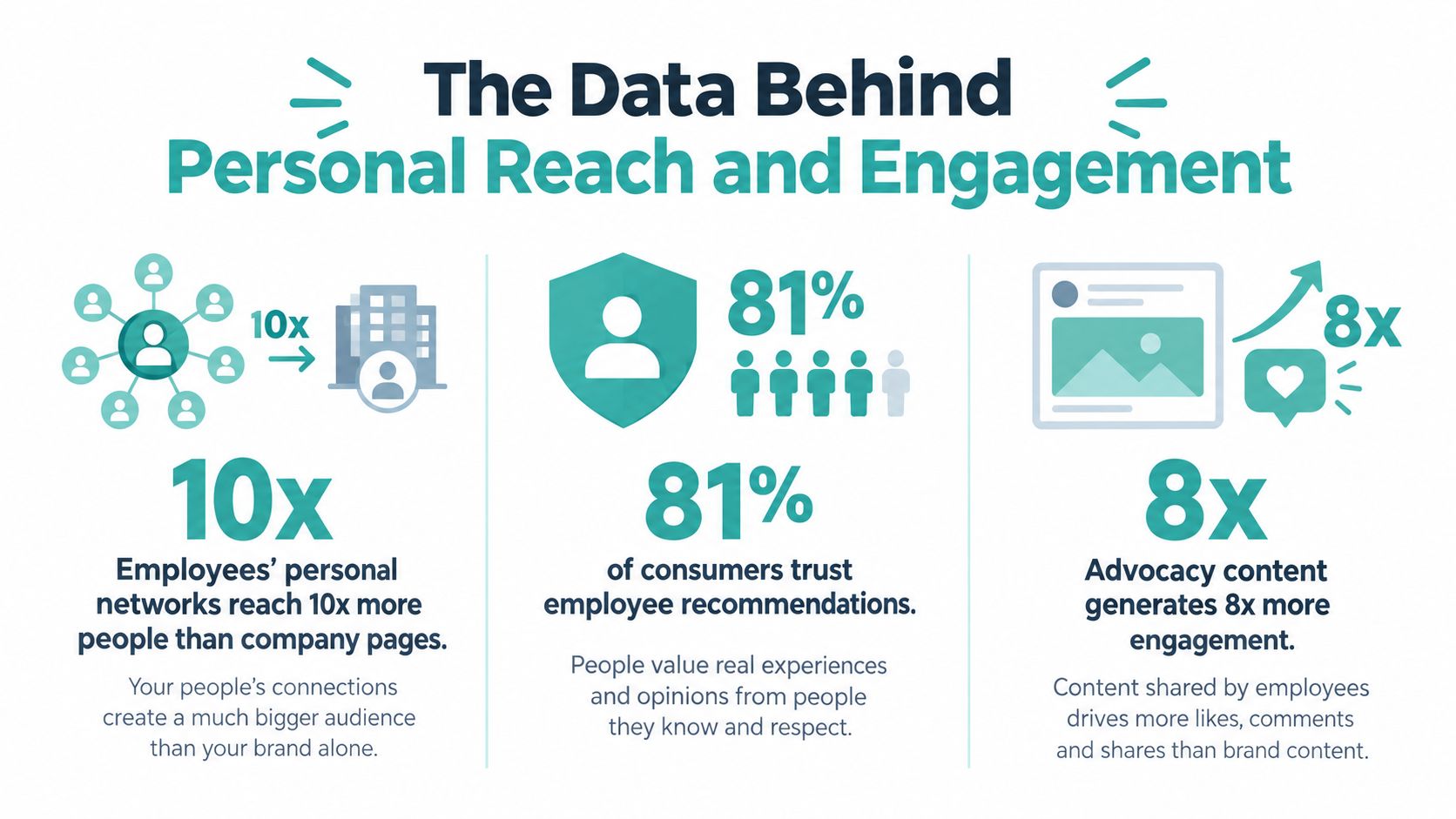
These figures describe potential distribution, not guaranteed reach. Networks overlap, algorithms determine visibility, and followers do not respond equally to every topic. For an SMB, the practical point is simple: the company page represents one audience, while employees can introduce the message to several connected local communities.
Why engagement can improve
A cited employee advocacy white paper reports roughly eight times the engagement for employee-shared content compared with identical content posted through a brand channel (employee advocacy white paper). The result may reflect personal context, stronger audience relevance, or different platform distribution. It is a directional benchmark, not a forecast for every business.
LinkedIn’s official guide reports that employee networks average 10 times more connections than a company’s follower base. It also associates employee-shared content with approximately twice the click-through rate of the same content shared by the company, and connects sharing by 3% of employees with about a 30% increase in total engagement (LinkedIn employee advocacy guide).
Treat those benchmarks as reasons to test, not targets to promise. A local service company should compare employee-attributed visits, meaningful clicks, inquiries, and conversions with results from its corporate account. A smaller number of employee posts may produce fewer impressions yet generate more relevant conversations and local leads.
Use social media analytics metrics that matter to connect advocacy activity with business outcomes instead of judging the program by an attractive engagement screenshot.
Building a Scalable Advocacy Infrastructure
A small-business program doesn’t need an enterprise platform on day one. It needs clear ownership, safe content, and a workflow employees can understand without a training department.
Start with a narrow operating model
-
Choose one business objective. Decide whether the first test supports local awareness, website visits, event attendance, lead generation, recruitment, or another specific outcome. A single objective makes content and reporting easier to manage.
-
Recruit willing participants. Begin with people who already communicate confidently online or regularly speak with customers. Early volunteers can identify confusing policies and show colleagues what useful sharing looks like.
-
Create a permission-based content library. Include approved links, images, short explanations, and several caption options. Employees should be able to personalize language without changing regulated claims, pricing, product details, or disclosures.
-
Write a short policy. Cover confidentiality, customer information, intellectual property, respectful conduct, disclosure, and what to do when someone asks a difficult question. Keep the document practical. Employees should know what they can share and when to send a question back to marketing.
-
Tag every destination. Use UTM parameters or platform-native tracking to identify the employee, campaign, market, and content variant. Avoid collecting unnecessary personal data. The purpose is to understand business activity, not monitor private accounts.
A foundational study by the Hinge Research Institute and Social Media Today surveyed 588 professionals who used social media for business purposes. It found that nearly 31% of high-growth firms had a formal employee advocacy program, more than twice the proportion reported among other firms (Hinge Research Institute and Social Media Today study). The finding supports formal structure, but formal doesn’t have to mean complicated.
Assign ownership and review
One person should maintain the library, approve updates, review performance, and answer employee questions. A weekly content check is usually more useful than a large launch meeting. Remove outdated offers quickly, label content by market, and give employees a way to report concerns.
If your growth plan includes a dedicated outbound function, guidance on how to hire SDRs can help clarify role ownership between sales development and marketing advocacy. That distinction matters. Employees can distribute and contextualize content, while SDRs may handle qualification and follow-up.
For a lean team, marketing automation for small businesses can help connect content distribution with forms, notifications, and lead-management routines. The technology should remove friction, not replace judgment. If sharing requires too many steps, participation will fade.
Amplifying Broadcast Campaigns Through Your Team
A polished broadcast campaign can build recognition, but local customers still need reasons to discuss it. Employees can carry the message from the screen into the conversations where people ask questions, compare providers, and seek recommendations.
A home-services company might launch a television spot about seasonal maintenance, then publish the ad on its social accounts. A technician can explain the problem behind the campaign. A dispatcher can share a preparation checklist, while a local account manager can clarify which neighborhoods the team serves. The creative stays consistent, but each post offers a practical entry point.

For SMBs, production and distribution address different problems. A strong video gives the business a credible campaign asset. Employee advocacy adds context and personal reach without requiring the marketing team to create separate campaigns for every audience.
A focused pilot with five to ten willing volunteers is a better first test than a company-wide mandate. Select people who already speak with customers, understand the service, and can add useful context in their own voice. Track responses, questions, visits, and enquiries from the pilot before expanding participation. A small team also makes it easier to spot unclear claims, weak calls to action, or content that feels forced.
Keep the asset, change the voice
Employees should not imply that they produced the advertisement or make claims they cannot support. They can explain what the campaign means, why the service matters, or how customers can learn more. Give them the video, landing page, approved facts, and several angles. Let each person choose the option that fits their experience.
The method suits real estate, automotive, retail, restaurants, and professional services. Broadcast content creates a shared identity. Employee posts make that identity relevant to specific local questions and can move low-touch attention toward a conversation, visit, or enquiry.
Practical Templates and Governance for Authentic Sharing
Employees share more readily when they understand what a useful post looks like. Give them flexible starting points, not a fixed script that makes every account sound identical. For an SMB, this keeps coordination manageable while preserving the personal context that gives advocacy its value.
Caption formulas that leave room for personality
The personal takeaway: “I’ve been working with [customer type] on [problem]. One point people often overlook is [useful insight]. Our team created [resource or service] to help.”
The behind-the-scenes note: “Our team recently worked on [project or campaign]. My role was [role]. The most useful part for me was [specific observation].”
The local relevance post: “If you’re in [area] and dealing with [problem], here’s a practical place to start: [advice]. You can find more details at [tracked link].”
The educational share: “This explains [topic] clearly. I’d recommend the section on [specific point] to anyone considering [service or decision].”
These formulas give employees room to add an experience, explanation, or local detail instead of copying corporate language. Rotate promotional posts with educational content, team updates, customer-safe observations, and relevant industry material. Personal feeds should not become repetitive sales channels.
Governance must protect people and the brand
The FTC treats employee social-media endorsements as endorsements that may require disclosure, even when employees receive no separate payment. If an employee mentions the employer’s products or services, the post should clearly disclose that employment relationship when it could affect how audiences assess the endorsement and would not reasonably be expected by them (FTC endorsement guidance).
A disclosure in the profile biography may not provide enough context. Depending on the post, wording such as “I work with the team at [company]” or “I’m an employee of [company]” can make the relationship clear. Employees should share truthful statements based on their actual opinions or experiences.
Governance principle: Approve the facts, not a fake personality.
Use a short review checklist:
- Check claims: Confirm product, service, location, and offer details.
- Protect privacy: Do not include customer names, images, health information, or private conversations without permission.
- Use the employee’s voice: Invite edits that make the post sound natural.
- Provide a response path: Identify who handles complaints, corrections, and media questions.
A content calendar template for planning three months can coordinate campaign moments without sending employees last-minute requests. For local businesses amplifying AI-generated broadcast content, schedule the asset, suggested angles, disclosure reminders, and response owner together. Employees then choose a relevant perspective, while the business retains control of claims, privacy, and follow-up.
Measuring Impact Beyond Vanity Metrics
A post can collect reactions and still fail to produce a useful customer action. Local businesses need a measurement system that separates attention from commercial progress and recognizes that advocacy may influence more than the final click.
A recent benchmark summary reports that 77% of teams track key performance indicators, while only 44% benchmark results against peers. It also reports that commonly used measures include earned media value or cost per click at 67%, follower growth at 43%, website traffic and conversions at 43%, and engagement at 36% (employee advocacy measurement benchmarks). These figures describe measurement habits, not proof that any particular metric predicts revenue.
Compare the signal with the outcome
| Vanity-oriented measure | Business-centric measure |
|---|---|
| Likes on an employee post | Qualified website visits from tagged links |
| Total comments | Calls, form submissions, or booking requests |
| Follower growth | New prospects from the target local market |
| Gross impressions | Unique reach after accounting for overlapping audiences |
| Earned media value | Assisted conversions and qualified pipeline |
| Participation volume | Active advocates whose posts generate useful actions |
The left column can help diagnose content quality. It shouldn’t carry the whole business case. A post with strong engagement may attract existing employees and friends but fail to reach buyers. Conversely, a post with modest visible interaction may influence a prospect who later calls directly.
Build attribution that admits uncertainty
Use employee-level or cohort-level tracking where privacy and platform rules allow. Tag links by campaign, employee, market, and creative variant. Record employee-attributed impressions, clicks, landing-page behavior, leads, qualified opportunities, and revenue when the sales process makes that connection possible.
Last-click attribution can undervalue advocacy if a person first encounters the business through an employee and later returns through search or direct traffic. Earned media value can overvalue exposure that never leads to a business result. A stronger test compares advocacy-active and inactive employee cohorts, or uses holdout periods, while keeping the landing page and offer consistent.
For a local business with limited data, the comparison can remain simple:
- Establish a baseline for the corporate channel and direct traffic.
- Run a defined advocacy period with tagged links.
- Compare qualified actions, not only engagement.
- Ask new leads how they heard about the business.
- Review assisted conversions and offline outcomes with the sales team.
Report incremental lift where it can be demonstrated, and label correlation as correlation. That honesty makes the program more credible at budget time.
Navigating Common Pitfalls and Ethical Considerations
Many owners assume that more employee posts automatically produce a better program. That assumption fails when participation becomes compulsory, captions sound scripted, or employees feel forced to connect personal profiles with work.
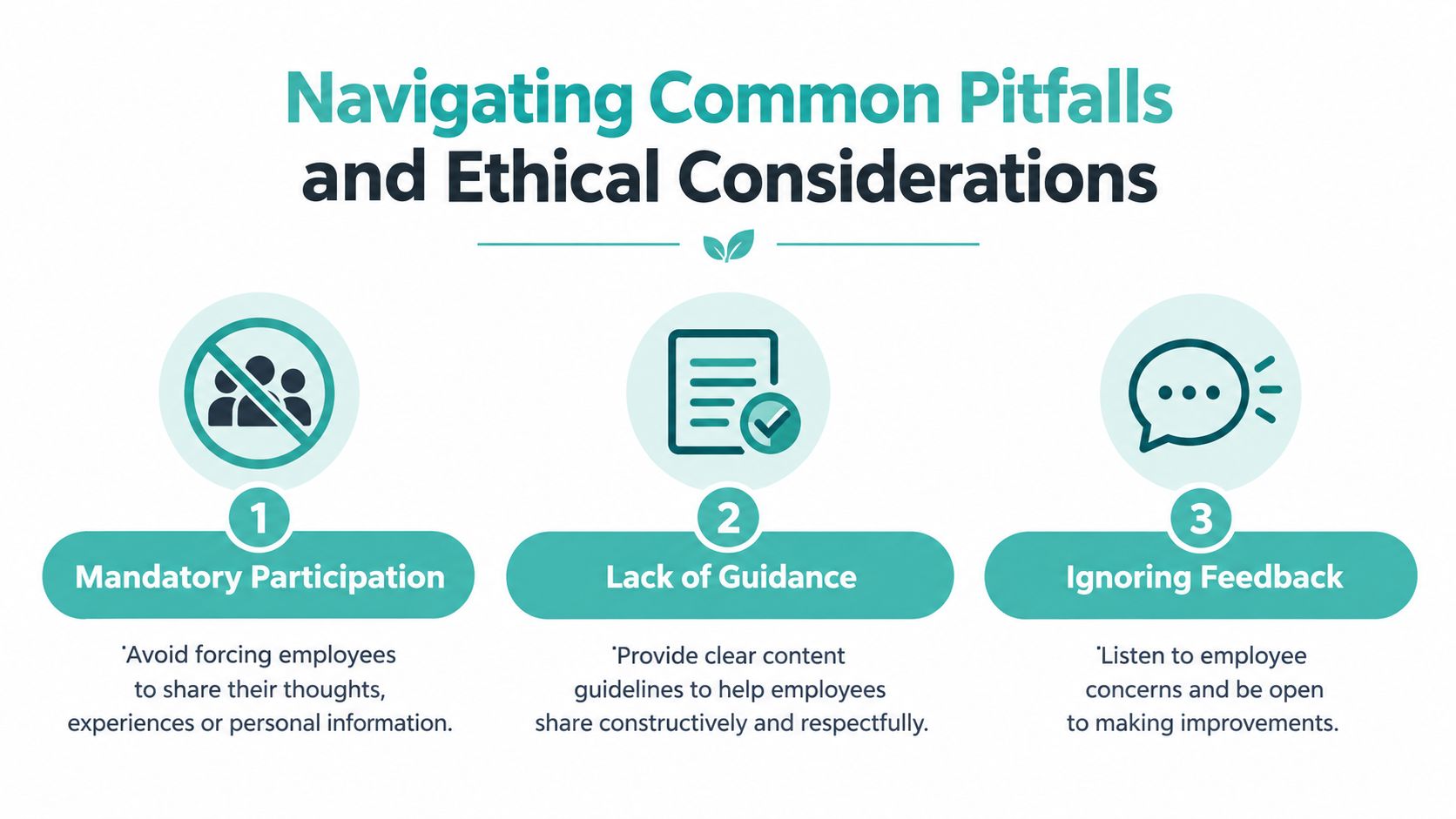
A benchmark result cited in available coverage reports that 40% of respondents viewed privacy concerns as at least a minor challenge (employee advocacy benchmark coverage). Employees may worry about accidental disclosure, privacy violations, or having to merge their personal and professional identities. Excessive advocacy can also weaken perceived authenticity.
Replace pressure with choice
Participation should be voluntary, and declining shouldn’t affect an employee’s standing. Offer separate opt-in channels, such as a professional account, an internal content-sharing group, or a company-managed profile for employees who want to contribute without using a personal account.
Keep incentives transparent. If an employee receives a reward or another benefit for posting, disclose that relationship where relevant. Don’t ask staff to praise a service they haven’t used or make claims outside their knowledge.
Make feedback part of the system
Ask volunteers what feels uncomfortable, which content they want, and where approval takes too long. Review those answers before expanding the program. A receptionist may know that a proposed post creates confusion for callers. A technician may spot a technical claim that sounds polished but isn’t accurate in practice.
Avoid these shortcuts:
- Mandatory posting: It creates compliance activity, not credible advocacy.
- Unclear boundaries: Employees hesitate when they don’t know whether a customer story or workplace photo is safe.
- Ignoring corrections: A program loses trust when staff flag a problem and nobody responds.
- Repetitive promotion: Audiences disengage when every post is an offer.
- Personal-data collection: Track campaign outcomes, not unnecessary details about employees’ private networks.
The best program optimizes for relevance and trust, not maximum volume. An employee who shares one useful explanation can contribute more than several forced posts that sound like advertisements.
Local Success Stories and Strategic Next Steps
A real estate team can have agents explain neighborhood questions around a listing. An automotive dealership can let service advisors share maintenance education alongside a broadcast campaign. A retailer can give store associates a choice of product stories that fit their actual customer conversations. In each case, the advantage comes from combining a consistent brand asset with a credible local voice.
Start with a small volunteer group, choose one commercial objective, create approved content variants, and tag every link. Review qualified actions with the people who handle calls and sales, then improve the library based on what employees and customers say.
The right system doesn’t turn staff into billboards. It helps knowledgeable people share useful information while the business measures whether that attention reaches the right local market.
Adwave helps small businesses create, launch, and measure broadcast-ready TV ads using an AI-powered workflow, so your team has polished campaign assets worth discussing and sharing. Visit Adwave to explore how a local broadcast campaign can support a practical employee advocacy social media program.