You’re probably in a familiar spot. You run a solid business, your customers like what you do, and referrals come in when people remember to mention you. But in a crowded local market, being good isn’t the same as being known.
That’s where brand awareness matters.
In plain English, brand awareness is this: when someone needs what you sell, do they think of you? Not after a long search. Not after comparing ten tabs. First, or at least early enough that you make the shortlist.
For many small business owners, this topic feels fuzzy. It sounds important, but hard to measure. That frustration is real. Agility Ads notes that small businesses often struggle to connect awareness metrics to revenue, especially in competitive local markets where every dollar has to be justified.
Brand awareness also isn’t just a logo exercise. It’s memory, familiarity, trust, and repetition working together. If your name shows up consistently, your visuals are recognizable, and your message is easy to grasp, customers start treating your business as the safer choice.
A lot of owners also confuse awareness with immediate lead generation. They’re related, but they’re not the same. Awareness fills the top of the pipeline so your other marketing works better. If you need help sharpening the narrative behind that visibility, this guide on how to craft compelling brand stories is useful because it helps you put words to what makes your business memorable.
Your Brand from a Face in the Crowd to the Talk of the Town
A local customer usually doesn’t wake up wanting “marketing.” They wake up with a need.
They need a roofer after a storm. A dentist after putting off a cleaning too long. A real estate agent when life changes and a move becomes urgent. In that moment, the businesses that win aren’t always the cheapest or even the closest. They’re often the ones the customer already knows.
That’s the practical meaning of what is brand awareness in marketing. It’s not a vanity metric. It’s the difference between being one more option and being the name that feels familiar.
What brand awareness looks like in real life
Think about three common situations:
A homeowner needs help fast. They search, but one company name already feels familiar because they’ve seen it before.
A shopper compares similar products. They lean toward the brand that looks recognizable and established.
A family asks for a recommendation. Someone mentions the business they keep seeing around town.
None of those moments starts with a sales pitch. They start with recognition.
Brand awareness works before the click, before the call, and often before the customer realizes they’re narrowing their options.
For a small business, that matters because most markets are noisy. You’re not just competing against one rival. You’re competing against distraction, forgetfulness, and habit.
Why SMBs often get stuck
Small businesses usually understand they need visibility. What they don’t get is a practical way to build it without wasting budget. That’s why brand awareness has often felt like something “bigger brands” can afford while local businesses stick to short-term tactics.
Understanding this concept is straightforward. Awareness increases when you maintain a consistent presence, deliver a core message clearly, and provide sufficient exposure for people to recall your brand. A national budget is not required for this process. Instead, you need repetition, consistency, and channels that align with how your local audience spends time.
Understanding Brand Awareness and Your Marketing Funnel
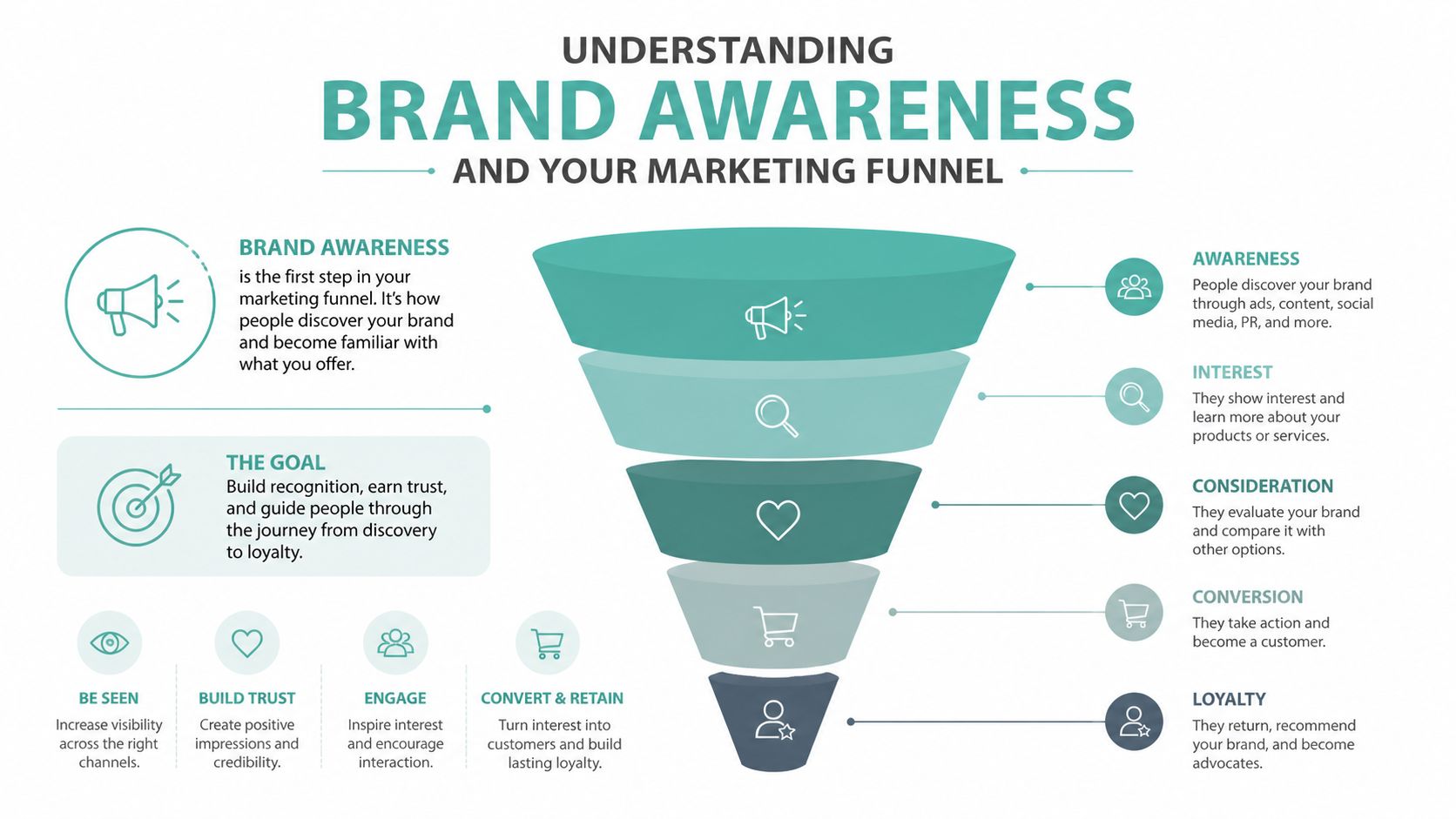
Brand awareness sits at the top of your marketing funnel. It’s the point where people move from not knowing you exist to recognizing your business as a real option.
Here’s a simple way to think about the funnel. At the top, people discover you. In the middle, they compare you. At the bottom, they buy. After that, they come back and refer others.
The top of funnel job
Awareness doesn’t close the sale by itself. Its job is to earn a place in the customer’s mind early enough that later marketing has something to work with.
If nobody knows your name, lower-funnel tactics have to do too much heavy lifting. Your search ads cost more effort. Your retargeting feels colder. Your sales conversations start from zero.
A useful way to compare these stages is in Adwave’s guide to upper-funnel vs lower-funnel marketing, which helps clarify why awareness and conversion need different tactics.
Aided awareness and unaided awareness
These two terms confuse a lot of business owners, but the distinction is straightforward.
Aided awareness means someone recognizes your brand when prompted.
Unaided awareness means they think of your brand without being prompted.
Here’s a coffee shop example.
If someone asks, “Have you heard of Oak Street Coffee?” and the customer says yes, that’s aided awareness.
If someone asks, “Where would you grab coffee nearby?” and the customer says “Oak Street Coffee” on their own, that’s unaided awareness.
Those are different levels of mental availability. Recognition is good. Recall is stronger.
Why the distinction matters
Aided awareness tells you your business is becoming familiar. Unaided awareness tells you you’re becoming memorable.
Repeated exposure can help people recognize your business when they are ready to buy.
Practical rule: If your business is rarely mentioned unless someone sees your logo or name first, your awareness is growing, but you still need more repetition and stronger positioning.
For small businesses, the goal usually isn’t to become famous. It’s to become easy to remember in the exact situations where customers need you.
Why Brand Awareness Is Your SMBs Greatest Asset
If you run a local business, brand awareness does more than help people recognize your name. It protects your position in the market.
That matters most in places where customers see several similar options. Salesforce’s discussion of brand awareness makes this point clearly. In saturated local markets, awareness is a defensive strategy. It helps your business become the preferred and trusted choice when a customer is comparing several nearly identical providers.
It creates trust before the sales conversation
Customers rarely evaluate local businesses from scratch. They bring assumptions with them.
If they’ve seen your name repeatedly, your business feels more established. If your visuals are consistent and your message is clear, you feel more credible. That’s useful even before they visit your website or call your office.
Brand awareness shortens the distance between “Who are you?” and “Tell me what you offer.”
It makes your business harder to replace
A competitor can copy a price. They can copy an offer. They can’t easily copy familiarity.
That’s why awareness functions like a moat. If your market has several service providers with similar reviews, similar pricing, and similar websites, the remembered brand often gets the first call. That early advantage matters because many buyers don’t evaluate every option. They contact one or two and move forward.
Here’s where the business outcome becomes tangible:
More direct inquiries because people search for you by name
Better lead quality because prospects already have some trust
Stronger referral performance because your name is easier to remember and repeat
It improves the return on your other marketing
Awareness doesn’t replace conversion tactics. It supports them.
A search ad works better when the customer already recognizes the business name. A social post performs better when the brand looks familiar. A salesperson has an easier conversation when the prospect has seen the company before.
That’s one reason TV has stayed relevant for awareness. Adwave explains some of those mechanics in its resource on the advantages of advertising on TV, especially for businesses trying to build familiarity across a local audience rather than just capture existing demand.
A real example of awareness connecting to growth
For a real campaign, examine ad exposure, website activity, and completed actions separately. Use documented data and an appropriate comparison period before attributing a business outcome to advertising.
A known business gets considered faster. A remembered business gets chosen more often.
For a small business owner, that’s the asset you’re building. Not attention for its own sake. Familiarity that turns into trust, consideration, and revenue.
Actionable Strategies to Build Your Brand
Brand awareness grows when customers see the same business, expressed the same way, in enough places to remember it. That’s the operating principle.
The details matter, though. We Are Tenet’s branding statistics report that consumers are 81% more likely to remember a brand's color than its name, and it often takes 6-7 impressions for a brand to become memorable. For a small business, that means consistency and repetition aren’t optional.
Start with the assets you control
Before spending on reach, tighten the basics.
Your visual identity should look the same everywhere. Use the same logo treatment, colors, fonts, and tone across your website, social profiles, email signatures, print materials, and ads.
Your core message should be easy to repeat. A customer should quickly understand what you do, who you help, and why you’re different.
Your local presence should be complete and current. That includes your website, business listings, and social profiles.
If your branding shifts from channel to channel, each impression works less hard.
Build repeated exposure, not random activity
Many businesses post inconsistently, try a few ads, then conclude awareness “doesn’t work.” Usually the problem isn’t the idea. It’s the lack of repetition.
A better approach is to choose a handful of channels and show up steadily:
Local SEO and branded content help you appear when people research your category.
Social media reinforces familiarity, especially if your business has a recognizable visual style.
Email keeps existing contacts warm so they remember you later.
Customer-created content can extend your reach with real-world credibility. Adwave’s article on user-generated content and getting customers to create marketing for you is a practical way to think about this.
For companies selling into other businesses, the same principle applies. The tactics may look different, but the goal is still distinct positioning and repeated exposure. This overview of B2B branding and positioning strategies is useful if your audience is more niche or relationship-driven.
Use channels that make repetition realistic
Many SMBs have changed their thinking on this matter. Brand-building used to sound like a luxury because major channels felt expensive or hard to produce for.
That’s no longer true in the same way. Adwave is an AI-powered TV advertising platform that lets a business enter its website URL, generate a broadcast-ready ad, and place it across 100+ premium channels including NBC, Hulu, and ESPN, with campaigns starting at $50 and estimated pricing of $15 to $35 CPM, according to the company background provided for this article. For a local business, that makes TV and streaming a more accessible option for repeated local exposure than many owners assume.
Match strategy to what customers remember
People rarely remember every word in an ad. They remember patterns.
Focus on these elements:
A clear category cue so viewers instantly know what you do
A strong visual signature like consistent colors and logo use
A simple promise that can survive a short attention span
A local angle so your message feels relevant to the market you serve
If a customer only remembers one thing from your marketing, make sure it’s your name attached to the problem you solve.
Brand awareness isn’t built by doing everything. It’s built by doing a few memorable things often enough that your market starts to recognize you on sight.
How to Measure Brand Awareness without a Huge Budget
A lot of owners assume brand awareness can’t be measured unless they hire a research firm or run expensive surveys. That’s not true.
You can track awareness with a small set of practical indicators. None is perfect alone, but together they show whether more people are noticing, remembering, and seeking out your business.
Start with behavior, not guesses
The most useful low-cost signals usually come from what people do:
Direct traffic suggests people typed in your URL or used a saved path to reach your site.
Branded search volume shows whether more people are searching for your business name.
Social mentions and engagement help you see whether your business is entering conversations.
Share of Voice shows how much of the category attention your brand captures relative to competitors.
If you’re new to media metrics, Adwave’s explainer on what reach means in advertising is a helpful companion because reach and awareness often get mixed together.
Why Share of Voice matters
Share of Voice, often shortened to SOV, is one of the clearest technical metrics for awareness. It measures your share of advertising presence or conversation within your market.
DeveloperMedia’s technical explanation of brand awareness metrics notes that increasing SOV by 10% can drive a 12-18% lift in awareness among key demographics. For small businesses, that’s useful because it gives a bridge between visibility and business outcomes like website traffic and inquiries.
You don’t need a perfect category-wide dataset to start thinking this way. Even a simple comparison helps. Are you showing up more often than a few core competitors in local search, social chatter, and ad presence? Or are they owning more of the mindshare?
Key Brand Awareness KPIs for SMBs
A simple measurement routine
You don’t need a complex dashboard. A monthly check is enough to start.
Record direct traffic.
Note branded searches.
Review mentions and engagement.
Compare visibility with a few named competitors.
Ask a few customers how they heard of you and whether they recognized your business before contacting you.
Watch for trend direction, not perfection. Awareness measurement is most useful when you compare your own baseline over time.
That’s how small businesses make this manageable. Start with signals you can access now, then layer in better tracking as your campaigns scale.
Common Brand Awareness Mistakes Small Businesses Make
The biggest mistake isn’t ignoring brand awareness. It’s treating it like a one-time project.
A lot of small businesses redesign the logo, post actively for two weeks, maybe run a short campaign, then stop. Awareness doesn’t build that way. Customers need repeated exposure over time, and they need to recognize the same business each time they see it.
Mistake one: inconsistent branding
If your website feels corporate, your Instagram feels casual, and your ads look like a different company entirely, you’re weakening memory.
People don’t store brands as long essays. They store quick cues. Name, colors, message, offer, category. If those cues keep changing, the market has to relearn who you are every time.
Mistake two: expecting awareness to act like instant lead gen
Owners often ask, “If I spend money on visibility, where are the sales this week?”
That’s fair, but it’s the wrong test. Awareness often shows up first as more recognition, more direct traffic, more branded searches, easier sales conversations, and warmer referrals. If you judge it only by immediate conversions, you’ll shut off useful activity too early.
Mistake three: measuring nothing
Some businesses avoid awareness campaigns because they think the impact is impossible to track. Others run them and never check whether direct traffic, branded search, or mentions improve.
Both approaches create the same problem. You spend without learning.
A simple baseline solves more than most owners realize. If you know what your visibility looked like before a campaign, you can spot whether the market starts responding differently after it runs.
Mistake four: assuming powerful channels are out of reach
This belief lingers because TV used to feel reserved for national brands with agency budgets and long production cycles.
That assumption is outdated. Local businesses can now access channels that once felt too complex, especially when ad creation, targeting, and reporting are simplified through newer tools. The actual mistake isn’t failing to chase every channel. It’s dismissing channels based on an old picture of cost and complexity.
Frequently Asked Questions About Brand Awareness
How long does brand awareness take to work
Usually longer than direct response campaigns, but that doesn’t mean you have to wait blindly. Early signals often show up in branded search, direct traffic, social engagement, and easier customer conversations before they fully show up in closed sales.
Should I focus on awareness or leads
Most businesses need both. Awareness makes lead generation more efficient because the customer already recognizes your name. If budget is tight, don’t think in terms of either-or. Think in terms of balance. Keep some effort on immediate demand capture while consistently investing in visibility.
Can service businesses benefit from brand awareness
Yes. In fact, they often benefit more than product-heavy businesses because trust matters so much. A homeowner choosing a roofer, a patient choosing a dentist, or a seller choosing an agent is often looking for a business that feels familiar and credible, not just available.
What’s the difference between awareness and reputation
Awareness is whether people know you exist. Reputation is what they think once they know you. You need both, but awareness comes first. A business can’t benefit from a strong reputation if too few people know to consider it.
Is TV really useful for local brand awareness
It can be, especially when your goal is repeated local exposure rather than just clicks. TV and streaming place your business in a setting that many customers still associate with established brands. For local companies, that can help create familiarity faster than channels that rely only on active search behavior.
What should I do first if my brand awareness is low
Start with consistency. Tighten your message, visuals, and local presence. Then choose a few channels you can sustain. The goal isn’t to appear everywhere. It’s to become easy to remember where your audience already spends attention.
If you want a practical way to build local brand awareness through TV and streaming without a traditional production process, Adwave offers a straightforward option. It uses your website to help generate a broadcast-ready ad, supports local targeting, and gives small businesses a way to test awareness campaigns with controlled spend.