The most popular advice about founder led content marketing is also the least useful: post every day, manufacture a personal brand, and chase viral hooks. That turns a founder into a full-time publisher while leaving the business with little more than impressions.
A better model treats the founder as the source of proprietary evidence, not as an influencer. The founder’s customer conversations, campaign decisions, failed tests, pricing trade-offs, and operating principles become useful content. That content then moves through channels where different stakeholders can evaluate it, share it internally, and eventually act on it.
The result is an evidence-to-distribution system. It builds trust with visible prospects, equips hidden buyers who influence decisions behind the scenes, and extends the founder’s point of view beyond a social feed.
Rethinking the Founder as a Trust Engine
A founder doesn’t need to publish daily to become credible. They need to make their thinking visible at the moments when buyers are trying to understand a difficult problem.
That distinction matters because B2B purchases rarely involve one person. Finance stakeholders question cost. Operators assess implementation risk. Marketing managers compare alternatives. Internal champions need material they can forward to colleagues without adding their own explanation. A founder post that speaks only to the person who first discovers the company leaves much of the buying group unsupported.
The 2025 Edelman–LinkedIn study of nearly 2,000 management-level professionals found that more than 40% of B2B deals stall because of internal misalignment, while 63% of hidden decision-makers consume thought leadership for more than an hour per week. That makes founder content a practical sales asset, not merely a visibility exercise.
Trust comes from evidence
Corporate pages often communicate what a company offers. Founders can explain why a decision was made, what went wrong, and which constraint shaped the outcome. That context makes expertise easier to evaluate.
A strong post might unpack why a local business should test a channel before committing to a large production budget. It might explain which advertising signal looked promising but proved misleading, or why a campaign was paused even though surface engagement looked healthy. Those details give prospects something more valuable than confidence language. They give them a way to judge the founder’s reasoning.
A practical guide to promoting a personal brand should therefore begin with a point of view, not a content quota. Ask what the founder has learned that a competent competitor couldn’t reproduce by reading generic industry advice.
Practical rule: Publish the decision behind the result, not just the result itself.
Help buyers reach agreement
The strongest founder content anticipates internal objections. A post for an owner can focus on commercial risk. A separate explanation for a finance stakeholder can clarify budget control and measurement. An operations-focused piece can address workload, handoffs, and implementation.
Human communication beats polished corporate copy. A June 2026 Clutch survey of 408 consumers found that personal founder posts generated more trust than corporate-account posts, 26% compared with 19%, while 93% said communications matter more when they feel they come from a real person. The founder’s role isn’t to perform informality. It’s to make expertise identifiable and accountable.
The practical test is simple. Could a prospect forward the content to a colleague and say, “This answers our concern”? If not, the post may be visible, but it isn’t doing enough commercial work.
Extracting Proprietary Insights from Daily Operations
The blank page is rarely the core problem. Most founders have too many observations, but they haven’t created a method for capturing them.
Start with a weekly evidence interview. A marketer, chief of staff, or content partner asks the founder the same questions and records the answers. The conversation can be brief, but it should force specificity.
Turn experience into usable claims
Use questions that surface decisions rather than anecdotes:
- What changed? Identify a customer pattern, campaign result, market objection, or internal process that looked different from expectation.
- What caused the change? Separate the observed signal from the founder’s interpretation.
- What did you try? Record the action, constraint, and alternatives that were rejected.
- What failed or nearly failed? These moments often contain the clearest practical lesson.
- What would you do next time? Convert the experience into a decision rule another operator can apply.
The output shouldn’t be “customers want better marketing.” It should be a sharper claim, such as: “A local advertiser should define the action it wants after exposure before choosing the creative format.” The second statement offers a judgment that can guide a real decision.
Capture the raw material before polishing it
Record customer calls, campaign reviews, sales objections, and post-mortems where appropriate and with proper consent. Don’t ask an AI tool to invent the founder’s position. Use it to transcribe, cluster recurring themes, identify contradictions, and suggest formats after the evidence exists.
The reason is differentiation. Recent B2B research identifies a growing sameness problem, with 59% of buyers saying they’ve seen nearly identical thought-leadership content from at least two providers. Generic AI output increases that risk because it optimizes for familiar structures and broadly acceptable language.
A useful editorial record contains five fields:
- Observation: What happened in a real customer or business context?
- Interpretation: What does the founder believe explains it?
- Constraint: What budget, time, channel, compliance, or operational limit shaped the decision?
- Decision rule: When should another business follow or avoid the same approach?
- Proof: Which artifact supports the point, such as a campaign review, anonymized call note, or internal comparison?
Keep customer confidentiality intact. Anonymize sensitive details and never turn private information into a marketing asset without permission.
Build a point of view library
Over time, these interviews create a library of claims the company can reuse responsibly. Some claims become long-form articles. Others become short videos, sales enablement notes, email explanations, or FAQ answers.
The founder doesn’t have to write every word. They do need to approve the meaning, examples, and boundaries. That division preserves authenticity while removing the slowest part of the process, waiting for inspiration.
Building a Multi-Channel Distribution Engine
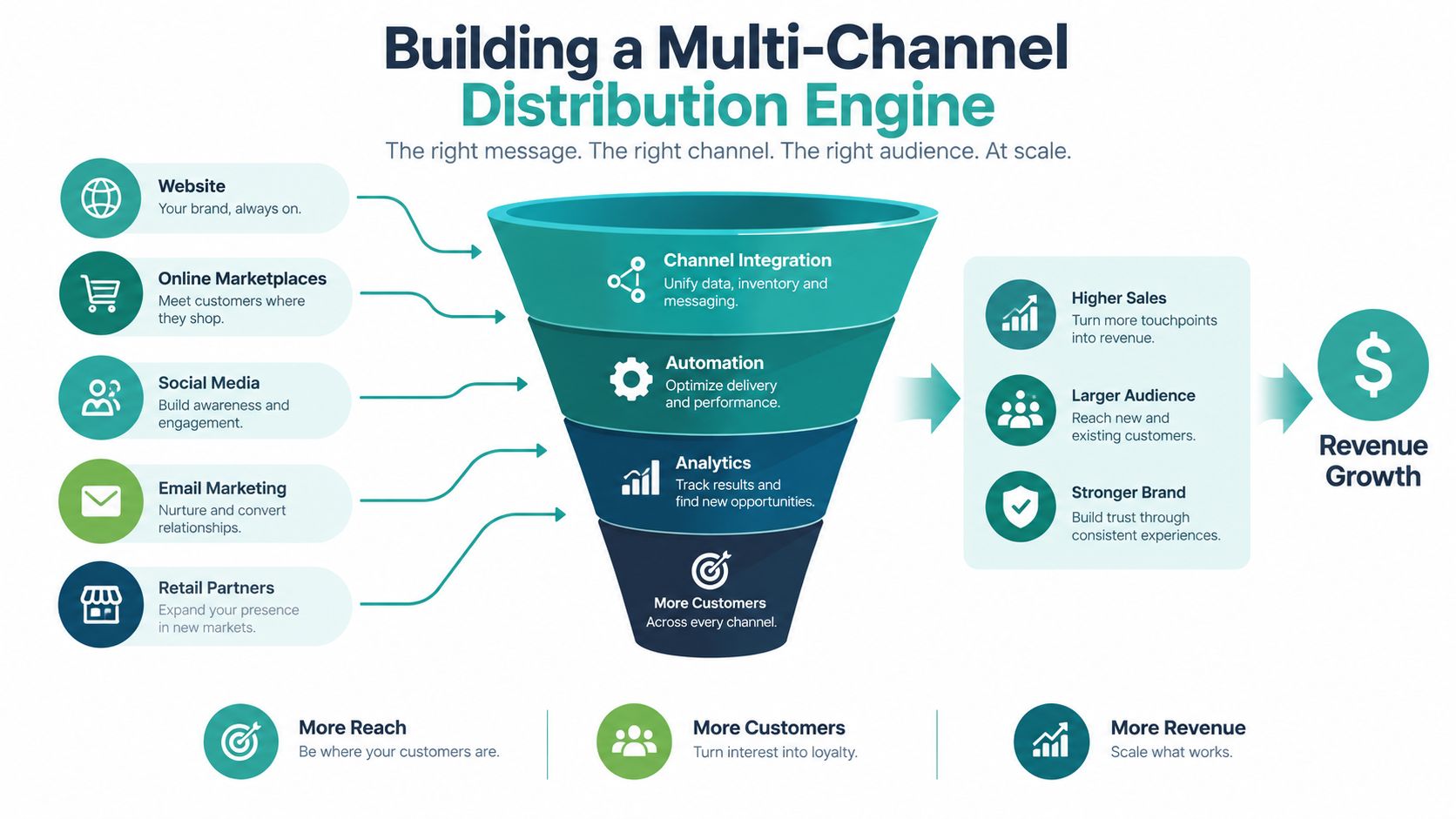
Posting more often is rarely the bottleneck. Distribution usually breaks because the team treats each channel as a separate content job instead of building one evidence-based asset that can travel.
Start with a strong anchor piece, usually a long-form article or customer-facing memo. Its job is to explain one important problem clearly enough that a buyer, a teammate, or a referral partner can reuse the logic later. From there, the team should turn the same point of view into formats built for different moments of attention.
The sequence matters because each format does different work. The article carries depth and proof. A short video lets prospects hear how the founder explains the issue under pressure. An email adds interpretation and context. A social post isolates one useful decision rule. A sales asset helps an internal champion defend the recommendation when procurement, finance, or operations start asking harder questions.
Publish the insight where trust is strongest
The founder’s profile should usually publish the original perspective first. The company page can republish, summarize, or archive the substance afterward. Publishing in that order gives the idea a human source before it becomes a brand asset, which matters for hidden buyers who may see a clip, screenshot, or forwarded email without any other context.
The company page still matters. It becomes the durable record buyers can find later, and it gives sales, recruiting, and partnerships a stable place to reference. But copying the same post with a new logo is weak distribution. The personal account supplies the credibility. The brand account preserves the substance.
Adapt the asset by stakeholder, not just by platform:
- Owner: Explain the commercial decision and the risk of delay.
- Marketing manager: Show the process, channel logic, and how results will be reviewed.
- Finance stakeholder: Clarify spend controls, assumptions, and limits.
- Operator: Address workload, dependencies, and what implementation requires.
In regulated or high-trust categories, clarity matters more than volume. Advisor Momentum’s financial content guide is a useful reference for explaining complex offers without slipping into vague promotional language.
Extend the message without copying it
One article about testing advertising can become a founder video explaining the first decision, a carousel showing the evaluation process, an email answering a common objection, and a short sales note for a prospect comparing channels. Each piece should stand on its own. Each one should still point back to the same argument, evidence, and decision rule.
That is how distribution becomes a system instead of a posting calendar. The blog keeps the nuance. Social carries one sharp observation. Email handles interpretation. Sales enablement carries proof, objections, and next-step language.
If the team needs a repeatable workflow, use a practical guide to content distribution while the anchor asset is being developed, not after it goes live. The goal is to build a message that can travel into every channel that matters, including premium placements later, without reinventing it each time.
Extending Digital Trust into Broadcast Television
LinkedIn is usually where founders start. It is not where buyer trust stops. Hidden buyers, local decision-makers, and households that will never engage with a post still form an opinion when they encounter the same clear message in higher-attention channels, including local television and connected TV.
That only works when TV extends a message that already has proof behind it. The job is not to invent a new brand voice for broadcast. The job is to carry the founder’s strongest claim, the one already supported by customer language, evidence, and outcomes, into a format that reaches people who missed the original article, email, or social post.

Use TV as a controlled distribution layer
TV becomes practical once the team treats it as distribution, not a reinvention project. Small businesses often already have the raw material: a founder with a clear point of view, a website that explains the offer, customer objections the team hears every week, and a few claims they can defend. What they usually do not have is a production crew, spare review cycles, or appetite for an open-ended media buy.
Adwave enables small businesses to launch broadcast-ready TV campaigns starting at just $50. That matters less as a headline and more as an operational option. A founder can test whether the message travels into premium channels without building a separate campaign from scratch. If the workflow handles creative assembly, audience setup, launch, and tracking in one place, the team gets a controlled test instead of another draining side project.
Keep the creative tightly aligned with the founder’s existing message. If the content argues that a local business can test TV without uncontrolled spend, the spot should explain that plainly. If the founder is known for sharp guidance on customer acquisition, the ad should connect that expertise to one clear next step. Consistency is what turns recognition into trust.
Start with a measurement baseline
Broadcast is easy to misread if the team starts with reach and stops there. Record a baseline before launch so TV can be evaluated against business signals that matter during the campaign window:
- Branded search activity
- Direct and organic website visits
- Calls and form submissions
- Consultation or demo requests
- Geographic patterns in qualified inquiries
- Content-assisted conversions
Use separate tracking links, landing pages, or campaign identifiers where practical. The point is not to credit every later conversion to television. The point is to compare a defined period against a real baseline and see how broadcast exposure supports founder content, search demand, direct traffic, and sales conversations.
Industry pricing benchmarks place local television and connected-TV inventory around $15 to $35 CPM. At a $25 CPM, a $500 campaign would generate approximately 20,000 impressions, before differences caused by inventory, targeting, or delivery. Treat that as a planning estimate, not a guarantee.
The best use of TV is to make the founder’s proven point of view easier to encounter, remember, and act on.
Designing a Sustainable Weekly Content Workflow
Founder-led content breaks when the founder becomes the production team. The weekly system has to protect scarce founder time, capture real operating evidence, and give the rest of the team enough raw material to turn one conversation into assets that reach buyers across multiple channels.
That means clear ownership.
The founder owns the point of view, the examples, the caveats, and final approval. A marketer, editor, or content partner owns recording, transcription, drafting, repurposing, scheduling, and attribution checks. AI can speed up those tasks, but it should not manufacture the founder’s beliefs or smooth away the details that make the message credible.
A workable weekly cadence
| Day | Activity | Time Commitment | Output |
|---|---|---|---|
| Monday | Review customer questions, objections, and campaign notes | 20 minutes | Three candidate insights |
| Tuesday | Founder evidence interview | 30 minutes | Recorded answers and one selected angle |
| Wednesday | Approve the long-form outline and core claim | 20 minutes | Article brief and proof list |
| Thursday | Record short video or audio adaptations | 25 minutes | Several raw clips |
| Friday | Review final copy, schedule distribution, and inspect attribution | 30 minutes | Published anchor, adaptations, and tracking plan |
Use the schedule as a constraint, not a publishing quota. One focused interview and one approval block are usually enough to keep the system moving. The team can then build the article, short clips, email copy, sales follow-up material, and distribution package without dragging the founder into daily edits.
That last part matters more than many teams expect. Hidden buyers often never react publicly to a post. They read, watch, forward, and show up later through search, referral, direct traffic, or a sales conversation. A sustainable workflow makes sure the founder’s message is documented once, then distributed well enough to reach those people in every place they pay attention.
Keep the founder’s voice intact
Start with a verbatim answer from the interview. Keep the founder’s odd turns of phrase, concrete examples, and qualifying statements. Those are usually the parts a buyer remembers, and they travel better into formats like clips, email, sales enablement, and even broadcast scripts than polished category talk.
Then apply an editorial filter:
- Remove repetition: Keep the strongest explanation rather than every explanation.
- Challenge unsupported claims: Ask what evidence or experience supports the point.
- Add boundaries: State when the recommendation doesn’t apply.
- Protect confidentiality: Replace identifying customer details with approved generalizations.
- Create a single action: Send readers to one relevant next step, not a menu of unrelated offers.
The calendar should include updates, not just new posts. Revisit older articles when the founder’s experience changes, when customer objections keep repeating, or when a strong idea deserves a second life in another channel. The three-month content calendar template can help a small team organize those priorities without turning planning into its own job.
A good workflow feels ordinary. That is the point. Repeatable interviews, approvals, and distribution steps preserve the founder’s authority and extend it far beyond one LinkedIn post.
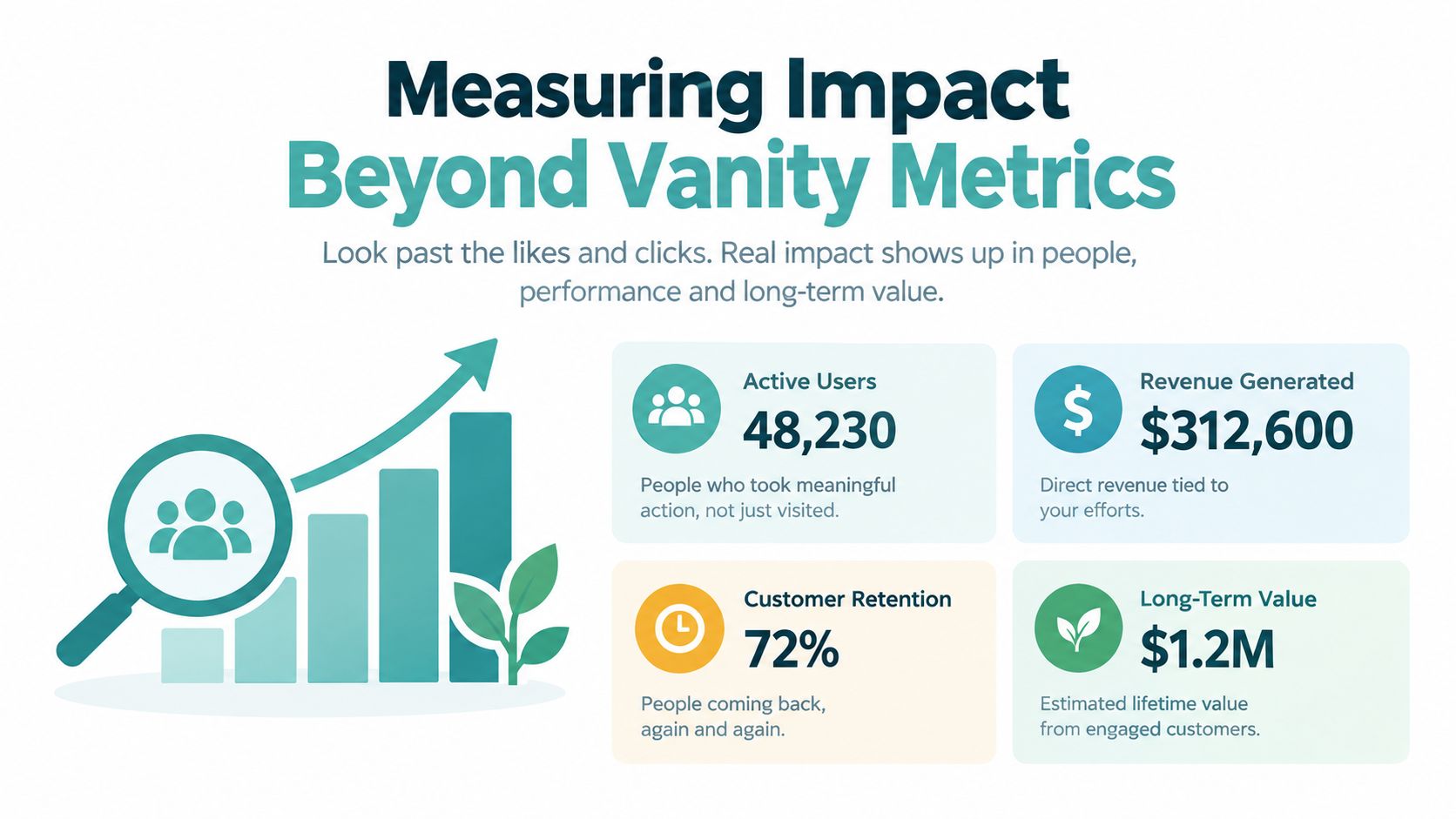
Measuring Impact Beyond Vanity Metrics
Likes and shares can indicate resonance, but they don’t prove commercial value. A founder-led program needs a scorecard that distinguishes attention from progress toward a business outcome.
The measurement challenge is widespread. Content Marketing Institute’s B2B research found that only 46% of surveyed B2B marketers agreed their organizations measured content performance effectively. The leading metrics were conversions at 73% and email engagement at 71%, which is a useful reminder that impressions shouldn’t be the endpoint.
Build a funnel scorecard
Measure each stage separately so a weak result has somewhere specific to be diagnosed.
Qualified traffic shows whether the content attracts the right audience. Segment by geography, company type, role, or other meaningful qualification criteria instead of treating every visit as equal.
Engaged sessions indicate whether visitors interact with the material. Look at meaningful page depth, return visits, resource use, and progression to a relevant next page. Avoid defining engagement only through time, because a short visit can still produce a valuable action.
Email and demo conversion connect the content to identifiable intent. Use a dedicated CTA for each anchor asset, with a form or booking path that records the originating content.
Assisted pipeline captures influence that direct-response reporting misses. A prospect may read a founder article, return through branded search, and convert after a sales conversation. That article deserves credit as an assist, not necessarily as the sole source.
Revenue is the final commercial check. Connect content interactions to CRM records, opportunities, and closed business where the data allows. Keep the model transparent about what it can and can’t prove.
Separate organic influence from paid reach
Use UTM parameters for founder posts, newsletters, adapted articles, and broadcast campaigns. Give sales teams a simple field for recording content influence during calls. Then compare founder-led content, paid acquisition, direct traffic, and referral activity in the same reporting view.
This separation matters because a founder’s content can affect a decision without receiving the final click. It can also generate attention that paid distribution later amplifies. The scorecard should show both paths rather than forcing every conversion into one channel.
For a useful perspective on why condensed business material can lose important context, see Artul.ai’s analysis of why earnings call summaries fail. The lesson applies to founder content too: compression is useful only when it preserves the decision-relevant evidence.
A practical KPI tracking framework can keep the reporting focused on actions the team can improve. Review the scorecard on a regular operating rhythm, then change the topic, CTA, format, or distribution channel based on evidence rather than personal preference.
Adwave helps small businesses turn website information into broadcast-ready TV ads, launch campaigns across premium channels, and track performance with automated pacing that stays within the chosen budget. Use it to extend a founder’s trusted message beyond social feeds and test local television as part of an evidence-to-distribution system by visiting Adwave.