-
$78K
Average annual SMB ad budget
-
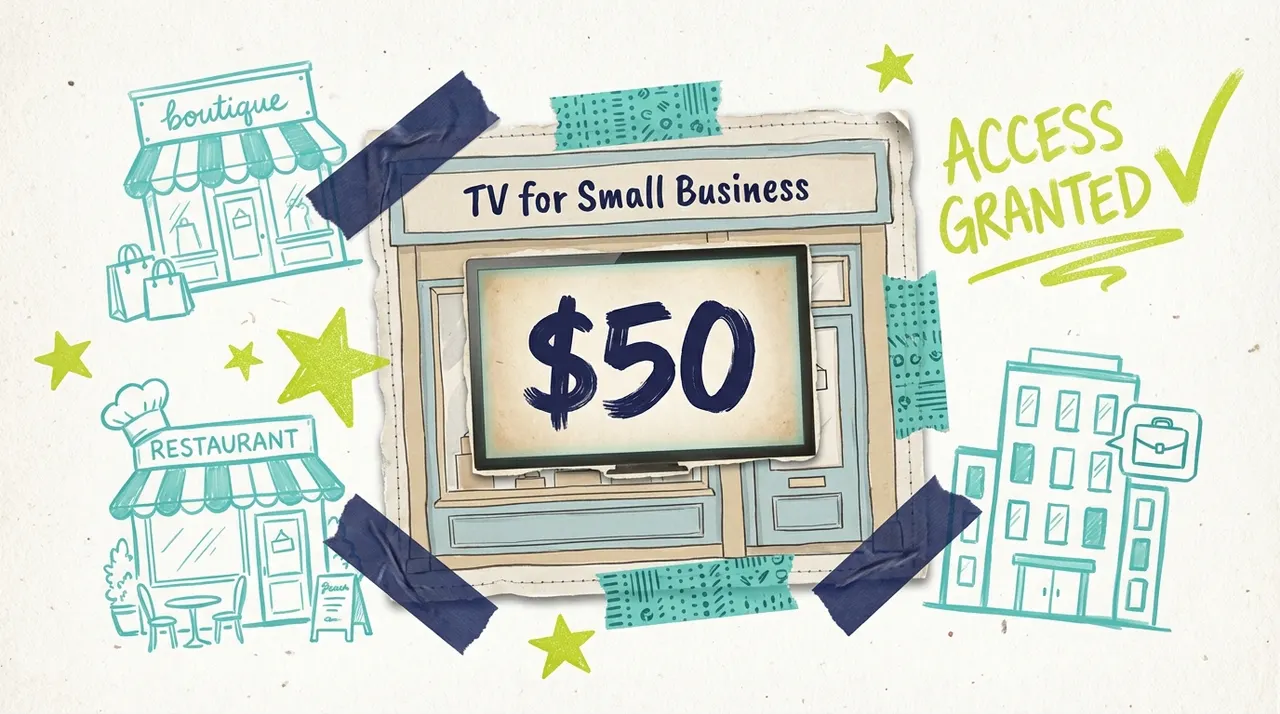
$50
Minimum CTV campaign budget
-
86%
SMB advertisers using or planning GenAI for video ads
Article Content
Small businesses in the United States spend an average of $78,000 annually on advertising, approximately $6,500 per month, according to QuickBooks research. What's changing rapidly is where that money goes. Television advertising, historically inaccessible to small businesses due to high minimums and production costs, has become a viable channel with streaming platforms accepting campaigns starting at just $50. The combination of lower entry points, AI-powered creative tools, and sophisticated targeting has triggered a surge in small business TV adoption that industry analysts call one of the fastest channel shifts in local advertising history.
What the data shows
The $78,000 average annual advertising budget represents a median across all U.S. small businesses, with significant variation by industry, region, and business size. Understanding how this budget typically allocates reveals where TV fits in the mix.
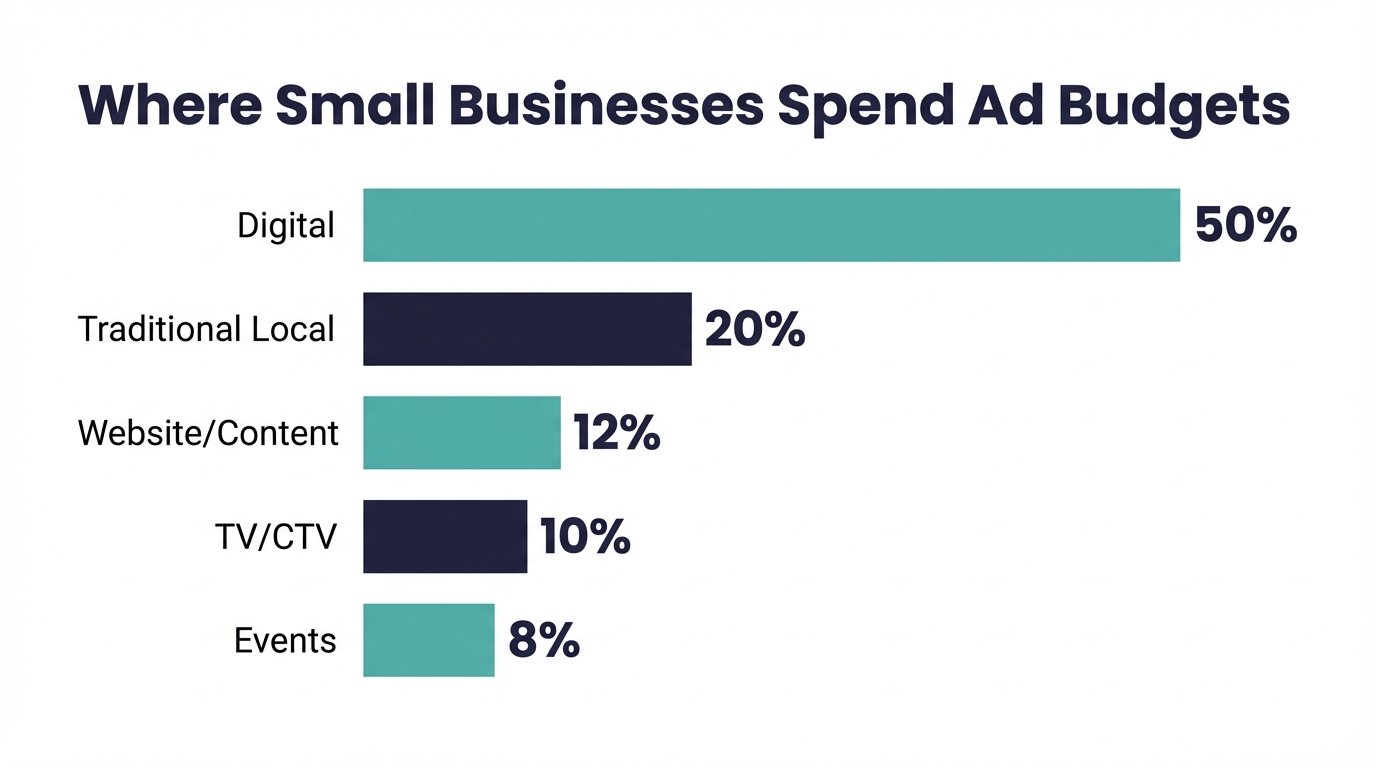
Typical small business advertising allocation:
Digital advertising (search, social, display): 45-55% of budget ($35K-$43K)
Traditional local media (print, radio, direct mail): 15-25% ($12K-$19K)
Website and content: 10-15% ($8K-$12K)
Events and sponsorships: 5-10% ($4K-$8K)
Television (emerging): 5-15% ($4K-$12K) for those who've adopted
The television allocation is the fastest-changing category. Just three years ago, fewer than 10% of small businesses included TV in their marketing mix. Current estimates suggest 25-30% of digitally active small businesses have tested or are actively running CTV campaigns, with adoption accelerating.
Budget variation by business type:
Professional services (law, accounting, medical): $100K-$200K average annual ad spend
Restaurants and hospitality: $50K-$100K average
Retail stores: $40K-$80K average
Home services (plumbing, HVAC, cleaning): $30K-$60K average
E-commerce: $50K-$150K average (heavily digital-weighted)
The professional services category shows highest TV adoption rates because these businesses have larger budgets, longer customer lifecycles justifying brand investment, and local service areas that benefit from geographic targeting.
CTV-specific small business spending:
Entry-level campaigns: $50-$200/month (testing and learning)
Moderate campaigns: $500-$1,500/month (building local frequency)
Substantial campaigns: $2,000-$5,000/month (serious brand building)
Advanced campaigns: $5,000+/month (multi-market or aggressive growth)
Industry data suggests the median small business CTV campaign runs approximately $300-$500/month, enough to achieve meaningful frequency within a local market over time.
Breaking down the numbers
Small business TV advertising economics have changed dramatically. Understanding the cost structure reveals why adoption is accelerating.
Production costs: then vs. now
Traditional TV production (linear era):
Professional video production: $10,000-$100,000+
Agency creative fees: $5,000-$25,000
Talent and licensing: $2,000-$10,000
Total creative investment: $17,000-$135,000 minimum
CTV production (streaming era):
AI-generated commercial (Adwave): $0 (included with campaign)
Self-produced video upload: $0 (use existing content)
Professional production (if desired): $1,000-$5,000
Total creative investment: $0-$5,000 typical
This cost collapse is perhaps the most significant change enabling small business TV adoption. When production alone cost $20,000+, the math never worked for local businesses. When production costs $0, the math changes entirely.
Media costs: local TV landscape
Local linear TV (30-second spot):
Small markets (DMAs 151-210): $200-$1,500 per spot
Mid-sized markets (DMAs 51-150): $500-$3,000 per spot
Large markets (DMAs 1-50): $2,000-$10,000 per spot
Top 10 markets: $5,000-$50,000+ per spot
These per-spot costs require volume commitments. Most local TV stations require minimum monthly spends of $2,000-$10,000. Combined with production costs, linear TV minimum investment typically exceeds $25,000.
CTV/Streaming TV costs:
Minimum campaign: $50 (platforms like Adwave)
CPM range: $15-35 (varies by inventory quality)
Effective local campaign: $200-$500/month
No production requirement: AI creative included
At $25 CPM, a $500 campaign delivers approximately 20,000 impressions. With geographic targeting to a 15-mile radius, that can achieve meaningful frequency among local households.
ROI considerations
Small business TV advertising ROI differs from direct-response channels:
Measurement timeline: 4-12 weeks for brand effects to materialize
Primary metrics: Brand search lift, website traffic increase, customer survey attribution
Secondary metrics: Social engagement, foot traffic, phone call volume
Expected lift: 10-30% increase in brand search during active campaigns (industry benchmarks)
The ROI calculation must account for TV's role as a brand-building channel. Direct conversion tracking underestimates value; brand search and awareness metrics capture fuller impact.

Why it matters for your business
The $78,000 average advertising budget represents meaningful resources that most small businesses struggle to allocate effectively. Television's new accessibility changes the optimization equation.
For local businesses with defined service areas, television offers something digital channels struggle to provide: trusted, premium-environment brand exposure to households in your market. When a plumber appears on Hulu during prime time, they borrow credibility from that context. When a law firm runs ads alongside trusted news content, perception shifts.
The budget math now works for local businesses. A $500/month TV investment from a $78,000 annual budget represents less than 8% of total advertising spend. That allocation can generate 20,000+ monthly impressions among local households, building recognition over time without straining overall marketing resources.
For businesses already investing heavily in digital, TV addresses the frequency fatigue problem. After seeing the same Facebook ad 15 times, additional impressions have diminishing returns. TV provides a different context and format, reaching people in lean-back, receptive moments. Cross-channel studies consistently show that adding TV to digital-only strategies improves overall campaign performance.
The competitive angle matters too. In most local markets, small business TV adoption remains under 30%. Early adopters gain advantage in categories where competitors haven't discovered streaming TV's accessibility. A dental practice advertising on TV when competitors rely solely on Google stands out in ways that translate to appointment bookings.
How to take advantage of this trend
Small business TV advertising success follows patterns that differ from both linear TV (which most businesses never accessed) and digital marketing (which most businesses know).
Starting strategy for first-time TV advertisers:
Budget: Begin with $200-$500 for a 2-4 week test
Targeting: Set geographic radius around your primary service area (10-25 miles typical)
Creative: Use AI-generated commercials from your website and photos
Timing: Run during prime time (6-10 PM) when household attention peaks
Duration: Commit to at least 4 weeks to observe brand effects
Platform selection guidance:
Self-serve aggregators ([Adwave](https://adwave.com/how-it-works)): Best for businesses new to TV, budgets under $2,000/month, seeking simplicity
Direct streaming platforms: Options for larger budgets, specific platform requirements
Local linear TV: Consider if targeting older demographics in smaller markets
Budget allocation within TV:
Premium inventory (Netflix, Hulu, Disney+): 30-40% of TV budget for credibility and quality
FAST services (Tubi, Pluto TV): 40-50% for reach and frequency
Experimental: 10-20% for testing new platforms or dayparts
Measurement framework:
Week 1-2: Establish baseline (brand search volume, website traffic patterns)
Week 3-6: Active campaign with monitoring
Week 7-8: Post-campaign analysis
Key metrics: Brand search lift (Google Trends for your business name), direct traffic increase, new customer survey responses
Success threshold: 15%+ lift in brand search indicates meaningful impact
The most common mistake small businesses make is expecting TV to perform like search advertising. TV builds awareness that converts through other channels over time. Patience and appropriate measurement are essential.
The bigger picture
Small business TV advertising represents a structural shift in local marketing, not just a new channel option.
The democratization of television
For 70+ years, television advertising was economically inaccessible to small businesses. Minimum production and media costs created a floor of $25,000-$50,000 that excluded local advertisers. This wasn't a gradual barrier; it was a wall.
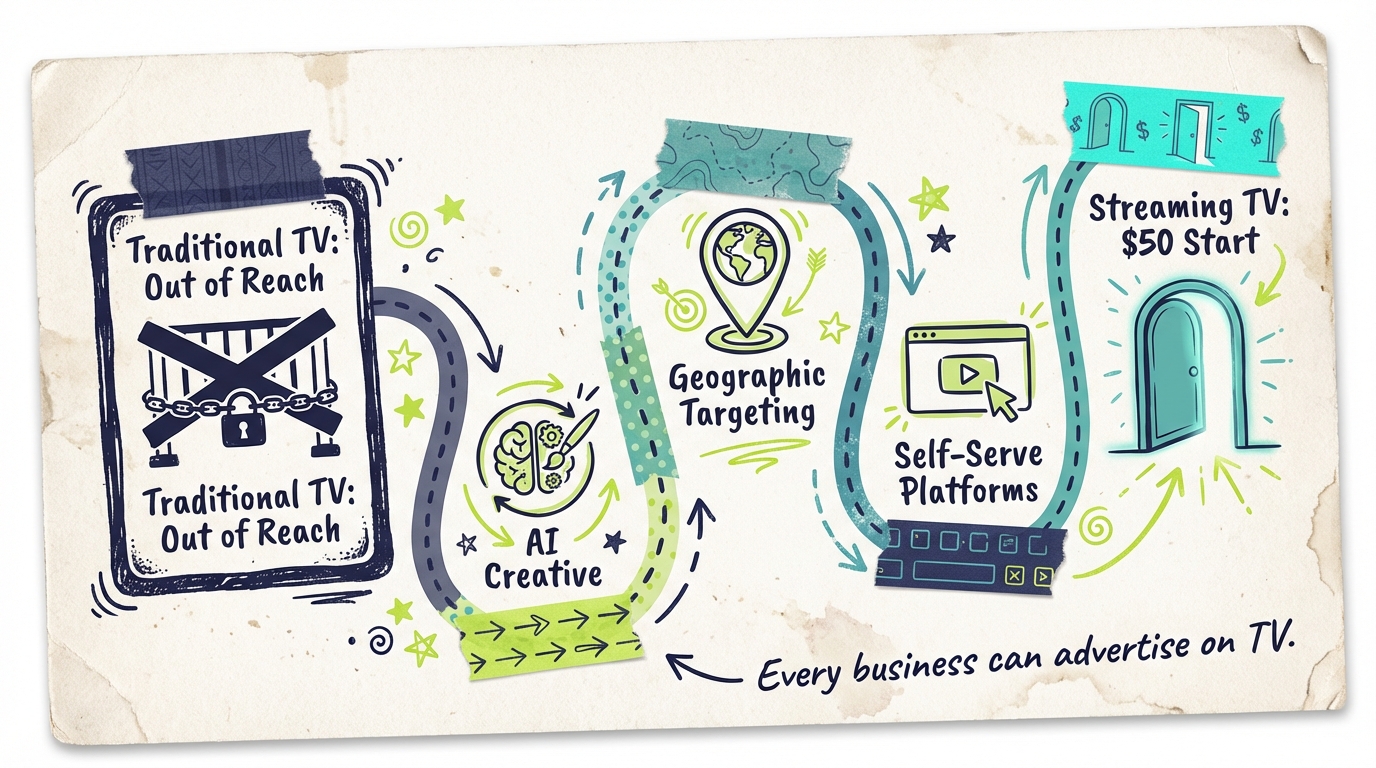
Streaming and AI have demolished that wall. Production costs have dropped to $0 through AI creative tools. Media minimums have dropped to $50 through programmatic infrastructure. What was impossible is now routine.
The implications extend beyond individual businesses. When every restaurant, real estate agent, and local service provider can afford TV, the advertising landscape changes. TV's historical advantage for big brands, that they could access a medium others couldn't, disappears.
The AI acceleration
The 86% of advertisers using or planning to use generative AI for video ads, according to IAB research, signals production's continued democratization. AI doesn't just reduce costs; it eliminates the skills barrier that made video production daunting for small businesses.
This acceleration compounds. As AI tools improve, creative quality rises while effort decreases. A small business owner can generate a broadcast-quality commercial in minutes without design skills, production knowledge, or video editing experience. Adwave's platform exemplifies this capability.
The local advertising transformation
Small business TV adoption is part of a broader shift in local advertising. Digital platforms (Google, Meta) have captured most local ad dollars over the past decade. But their effectiveness for brand-building is limited, and competition has raised costs substantially in many verticals.
CTV represents a new local advertising option that combines digital's targeting with television's brand-building power. For small businesses seeking alternatives to increasingly expensive digital channels, TV offers differentiation and effectiveness at accessible price points.
What experts are saying
Industry analysts have identified small business CTV adoption as one of the most significant trends in local advertising.
QuickBooks' 2025 advertising trends research noted that "the average $78,000 small business advertising budget increasingly includes TV as CTV has removed traditional barriers. This represents the most significant expansion of TV's advertiser base since cable fragmented broadcast audiences."
The Interactive Advertising Bureau found that "86% of digital video ad buyers are using or planning to use generative AI for ad creation, with small businesses showing the highest enthusiasm. AI has converted non-advertisers into advertisers by eliminating production barriers."
Comcast's analysis of their Universal Ads platform showed that "small businesses represent the fastest-growing segment of CTV advertisers. These advertisers aren't shifting from linear TV; they're advertising on television for the first time ever."
Local advertising research from Borrell Associates emphasized that "streaming TV adoption among local advertisers is outpacing every other digital channel. The combination of geographic targeting and accessible minimums aligns perfectly with local business needs."
Common questions answered
What's the minimum budget for small business TV advertising?
Self-serve CTV platforms like Adwave enable campaigns starting at $50. This minimum buys approximately 2,000-4,000 impressions depending on targeting and inventory. More meaningful tests start at $200-$500, providing enough scale to generate measurable brand effects. Linear TV minimums remain much higher, typically $2,000-$10,000/month plus production costs.
How much should a small business allocate to TV?
As a guideline, 5-15% of total advertising budget can go to TV once other essential channels (website, basic digital presence) are covered. For a business spending $78,000/year on advertising, that translates to $4,000-$12,000 annually for TV, or roughly $300-$1,000/month. Start smaller to learn before committing larger allocations.
Do small businesses need to produce TV commercials?
No. AI creative tools can generate broadcast-quality 30-second commercials from your existing website and photos in minutes at no additional cost. Platforms like Adwave include creative generation, eliminating the production barrier that historically excluded small businesses. If you have existing video content, you can also upload and use that directly.
How does small business TV compare to Meta or Google ads?
They serve different purposes. Meta and Google excel at direct response: generating clicks, leads, and immediate conversions with measurable ROI. TV excels at brand building: creating awareness, trust, and recognition that supports all other marketing efforts. Most effective strategies use both, with TV building the brand that direct-response channels convert.
What results should small businesses expect from TV?
TV is a brand channel, not a direct-response channel. Expect to see increased brand search volume (more people Googling your business name), higher direct website traffic, and new customers mentioning they saw you "on TV" when surveyed. These effects typically take 4-8 weeks to materialize and compound over time with continued investment. Don't expect immediate click-through conversions like digital advertising.
Is TV worth it for businesses with small service areas?
Yes. Local targeting lets you focus a streaming campaign on the area your business serves.
Supporting data
Additional statistics on small business TV advertising:
Average SMB ad budget: $78,000/year (~$6,500/month) (QuickBooks)
SMB budget as % of revenue: 2-4% typical, higher for growth-focused businesses
CTV adoption: ~25-30% of digitally active SMBs have tested CTV
Minimum CTV spend: $50 on self-serve platforms
Effective local campaign: $200-$500/month achieves meaningful frequency
AI creative adoption: 86% of advertisers using or planning GenAI for video (IAB)
Production cost reduction: From $20K+ (traditional) to $0 (AI-generated)
Linear TV minimums: $2,000-$10,000/month plus production
CPM range: $15-35 for CTV ($25 average for small businesses)
Impressions per $500: ~20,000 at $25 CPM
Brand search lift: 10-30% typical during active TV campaigns
Professional services TV adoption: Highest among SMB categories
Budget allocation strategies for SMBs
Small businesses face unique challenges when entering TV advertising, but the democratization of streaming TV has opened doors that were previously closed to all but the largest advertisers. Strategic budget allocation can help SMBs maximize the impact of their television advertising investment.
For businesses with monthly marketing budgets under $5,000, experts recommend allocating 15-25% to TV advertising as a brand-building complement to direct response digital channels. This balance allows businesses to build long-term brand equity while maintaining the immediate return on investment they need to sustain operations.
Local businesses typically see the best results by focusing their TV spend on specific dayparts when their target customers are most likely to be watching. A restaurant might concentrate spend on dinner hours, while a gym could target early morning and evening workout times when fitness-minded viewers are tuning in.
Seasonal budgeting is especially important for small businesses with limited funds. Rather than spreading a small budget thinly across the entire year, concentrating spend during peak business seasons can generate the frequency needed to drive action and make a meaningful impact on sales.
Recommended TV allocation for SMBs: 15-25% of marketing budget
Minimum effective monthly TV spend: $500-1,000
Optimal campaign length: 4-6 weeks for awareness building
Local targeting radius: 10-25 miles for most local businesses
Best starting point: Test with $100-200 over 1-2 weeks
Co-op advertising programs offer small businesses the opportunity to stretch their TV budgets further. Many manufacturers and franchisors provide matching funds for local TV advertising, effectively doubling the impact of small business ad spend when properly structured.
Measuring ROI for small business TV campaigns
Attribution and measurement have historically been challenging for TV advertisers, but new technologies are making it easier for small businesses to understand the return on their TV investment. Multiple measurement approaches can work together to paint a complete picture of TV advertising effectiveness.
Website lift analysis compares online traffic during and after TV ad airings to baseline periods, revealing the direct impact of TV exposure on digital engagement. Most small businesses see website traffic increases of 20-40% during active TV campaigns, with the effect extending several hours beyond actual ad times.
QR codes and custom URLs provide direct response tracking for TV campaigns, allowing small businesses to measure immediate actions taken by viewers. Response rates for well-designed TV calls-to-action typically range from 0.5-2% of impressions, depending on the offer and audience targeting.
Brand lift studies, once available only to enterprise advertisers, are now accessible to small businesses through self-serve survey platforms. These studies measure changes in awareness, consideration, and purchase intent among audiences exposed to TV advertising versus unexposed control groups.
Budget allocation strategies for SMBs
Small businesses face unique challenges when entering TV advertising, but the democratization of streaming TV has opened doors that were previously closed to all but the largest advertisers. Strategic budget allocation can help SMBs maximize the impact of their television advertising investment.
For businesses with monthly marketing budgets under $5,000, experts recommend allocating 15-25% to TV advertising as a brand-building complement to direct response digital channels. This balance allows businesses to build long-term brand equity while maintaining the immediate return on investment they need to sustain operations.
Local businesses typically see the best results by focusing their TV spend on specific dayparts when their target customers are most likely to be watching. A restaurant might concentrate spend on dinner hours, while a gym could target early morning and evening workout times when fitness-minded viewers are tuning in.
Seasonal budgeting is especially important for small businesses with limited funds. Rather than spreading a small budget thinly across the entire year, concentrating spend during peak business seasons can generate the frequency needed to drive action and make a meaningful impact on sales.
Recommended TV allocation for SMBs: 15-25% of marketing budget
Minimum effective monthly TV spend: $500-1,000
Optimal campaign length: 4-6 weeks for awareness building
Local targeting radius: 10-25 miles for most local businesses
Best starting point: Test with $100-200 over 1-2 weeks
Co-op advertising programs offer small businesses the opportunity to stretch their TV budgets further. Many manufacturers and franchisors provide matching funds for local TV advertising, effectively doubling the impact of small business ad spend when properly structured.
Measuring ROI for small business TV campaigns
Attribution and measurement have historically been challenging for TV advertisers, but new technologies are making it easier for small businesses to understand the return on their TV investment. Multiple measurement approaches can work together to paint a complete picture of TV advertising effectiveness.
Website lift analysis compares online traffic during and after TV ad airings to baseline periods, revealing the direct impact of TV exposure on digital engagement. Most small businesses see website traffic increases of 20-40% during active TV campaigns, with the effect extending several hours beyond actual ad times.
QR codes and custom URLs provide direct response tracking for TV campaigns, allowing small businesses to measure immediate actions taken by viewers. Response rates for well-designed TV calls-to-action typically range from 0.5-2% of impressions, depending on the offer and audience targeting.
Brand lift studies, once available only to enterprise advertisers, are now accessible to small businesses through self-serve survey platforms. These studies measure changes in awareness, consideration, and purchase intent among audiences exposed to TV advertising versus unexposed control groups.
Get started with TV advertising
The $78,000 average small business advertising budget now has room for television. Production costs have dropped to $0. Media minimums start at $50. Geographic targeting ensures efficiency. The barriers are gone.
Adwave makes small business TV advertising simple. Create your commercial from your website in minutes, set targeting for your service area, choose a budget that fits your goals, and reach customers across 100+ premium streaming channels.
Every business can advertise on TV now. The question is whether you will.