A plumbing company can serve an entire city, yet the calls that keep its schedule full usually come from a much smaller circle. After publishing pages for specific neighborhoods, streets, and service conditions, the owner may notice that more calls mention nearby landmarks or arrive from customers only a short drive away. That pattern is the practical value of hyperlocal content marketing. It connects what a business sells with where a customer lives, works, shops, or needs help right now.
Local search already sits inside everyday consumer behavior. BrightLocal reports that 84% of consumers searched for a local business in the past 3 months, while 45% default to Google for local searches and 39% estimate that at least 41% of their searches concern local businesses (BrightLocal’s local SEO statistics). For an SMB, the opportunity isn’t to publish more. It’s to become unmistakably relevant to the neighborhoods it can serve well.
What Hyperlocal Content Marketing Really Means for Local SMBs
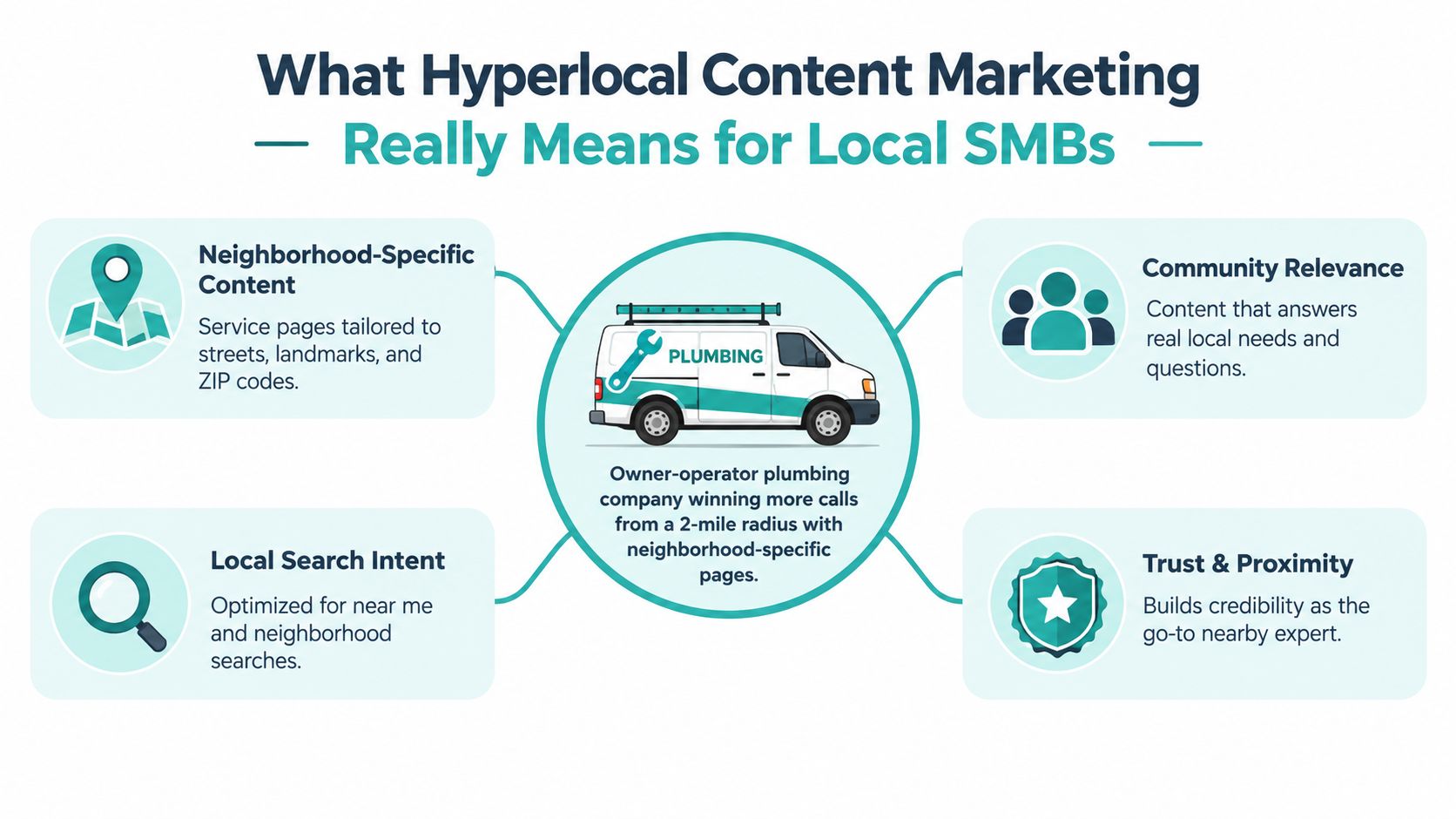
Hyperlocal content marketing is an umbrella strategy built around a defined micro-area. That area might be a ZIP+4, a neighborhood polygon, a commercial corridor, a housing development, or a practical service radius. It goes further than writing a city name into a page title. The content should reflect the places, questions, travel patterns, landmarks, and buying situations that make one part of a city different from another.
Four connected parts of the strategy
A workable program usually combines four components:
- Hyperlocal SEO content: Neighborhood service pages, local FAQs, landmark references, and useful guides built around specific search intent.
- Neighborhood social and email: Posts, short videos, and newsletters written for people who recognize the area and its daily concerns.
- Community partnerships: Collaborations with nearby businesses, schools, associations, leagues, and local media.
- Broadcast reach: Programmatic and TV campaigns that place the same neighborhood message in front of households within a defined geographic area.
Generic local marketing might promote “plumbing services in Denver.” Hyperlocal marketing speaks to “water heater repair near the historic district” or explains how a particular neighborhood’s older homes affect pipe maintenance. The difference is practical. A nearby customer can decide faster when the page, offer, route, and proof all feel connected to their circumstances.
Practical rule: If a customer can remove the neighborhood name from the page and nothing else changes, the page probably isn’t hyperlocal enough.
Local intent has become too important for SMBs to treat this work as a niche tactic. The same need for proximity appears in map results, calls, store visits, social discovery, and television exposure. A useful companion to this broader strategy is the local business content marketing guide from Transactional LLC, especially when turning local knowledge into a repeatable content process.
Mapping Your Neighborhood Audience Before You Write a Word
The fastest way to waste a hyperlocal budget is to create pages for every nearby area without knowing which audiences differ. A useful mapping exercise can fit into one workday if the team starts with existing evidence instead of guessing.
A practical research sequence
Begin with Google Business Profile Insights and Google Search Console. Look for queries that already mention neighborhoods, landmarks, “near me” language, service problems, directions, or specific property types. Then map those queries against ZIP+4 areas and neighborhood boundaries available through a local chamber, municipal open-data portal, or other reliable geographic source.
Next, segment the areas by customer context. Useful distinctions include:
- Property situation: Homeowner, renter, landlord, property manager, or commercial operator.
- Housing or business stock: Historic homes, new construction, condo towers, retail strips, offices, or mixed-use buildings.
- Primary need: Emergency service, planned maintenance, installation, convenience, appearance, or recurring support.
- Decision friction: Parking, access, appointment timing, trust, pricing clarity, or distance.
For local keyword discovery, local keyword research by Sight AI can help structure the query process. The important point is to connect keyword themes with real neighborhoods rather than treating every phrase as an isolated SEO target. A customer searching for HVAC help in a historic district may need a different answer from someone in a newly built subdivision.
A worked HVAC segmentation
Suppose an HVAC company serves ten ZIP codes. Instead of producing ten nearly identical pages, it can group the territory into four meaningful clusters:
| Neighborhood Cluster | Housing Type | Primary Need | Keyword Themes |
|---|---|---|---|
| Historic homes | Older detached properties | Ductwork, insulation, preservation-sensitive upgrades | HVAC for historic homes, duct repair nearby, heating maintenance |
| New builds | Recently constructed subdivisions | Warranty questions, efficient cooling, smart thermostats | New home HVAC setup, thermostat installation, AC service |
| Condo towers | Multi-unit buildings | Access coordination, compact systems, building rules | Condo HVAC repair, apartment air conditioning, scheduled service |
| Small commercial | Shops, offices, and mixed-use sites | After-hours work, equipment reliability, tenant comfort | Commercial HVAC nearby, emergency maintenance, rooftop unit service |
Record the result in a one-page Persona + Neighborhood Sheet. Include the named area, audience type, property context, service need, local vocabulary, proof available, preferred offer, objections, channels, and conversion action. Reuse that sheet for SEO briefs, GBP posts, social creative, email topics, programmatic audiences, and TV scripts.
A customer journey mapping framework for small businesses is useful here because the neighborhood sheet should describe not only who the customer is, but what they need before and after the first contact.
Content Formats and Ideas That Win at the Block Level
The strongest neighborhood campaigns don’t start with a list of keywords. They start with a buying situation and choose a format that removes the next obstacle.
Consider a dental practice serving young families across three subdivisions. Problem-aware parents may respond to a guide about finding an appointment near school pickup routes. Solution-aware parents need pages explaining preventive visits, insurance questions, or pediatric scheduling. Decision-ready parents want proof, office photos, parking details, and a clear booking path.
A boutique retailer on one commercial street needs a different mix. A short video showing the walk from a recognizable corner can reduce uncertainty for first-time visitors. A GBP post tied to a street event can turn local awareness into a same-day visit. An email digest can combine a new product, a nearby event, and a practical reason to stop in.
Match the format to the job
| Content Format | Buyer-Path Stage | Example | Primary Channel |
|---|---|---|---|
| Neighborhood service page | Solution-aware | “Family dental visits near the three west-side subdivisions” | Organic search |
| Community event GBP post | Problem-aware or decision | Appointment availability connected to a school or street event | Google Business Profile |
| Walking-route video | Decision | A short route from a local landmark to the retailer | Instagram, YouTube, TV adaptation |
| Neighborhood email digest | Solution-aware | Local story, seasonal reminder, and offer | |
| Adjacent-business partnership | Problem-aware | A retailer and café share a weekend guide | Social, email, local press |
Keep the first version small. A service page needs original local detail, a useful FAQ, proof connected to the area, and one obvious action. A GBP post should add a timely update, image, and next step. A walking video can be recorded on-site with a phone, provided the route and destination are clear. The metric should match the format, such as calls from the service page, direction requests from the profile, video visits, email clicks, or partner referrals.
One core story should travel across channels. The dental practice can publish a neighborhood guide, turn its strongest answer into a GBP update, film the route to the office, send the guide to local subscribers, and adapt the headline into a TV voice-over. A retailer can do the same with a street event or seasonal collection. Guidance on using user-generated content to get customers creating marketing can add authentic customer voices without requiring a new campaign concept for every channel.
Building Your Editorial Calendar and Posting Rhythm
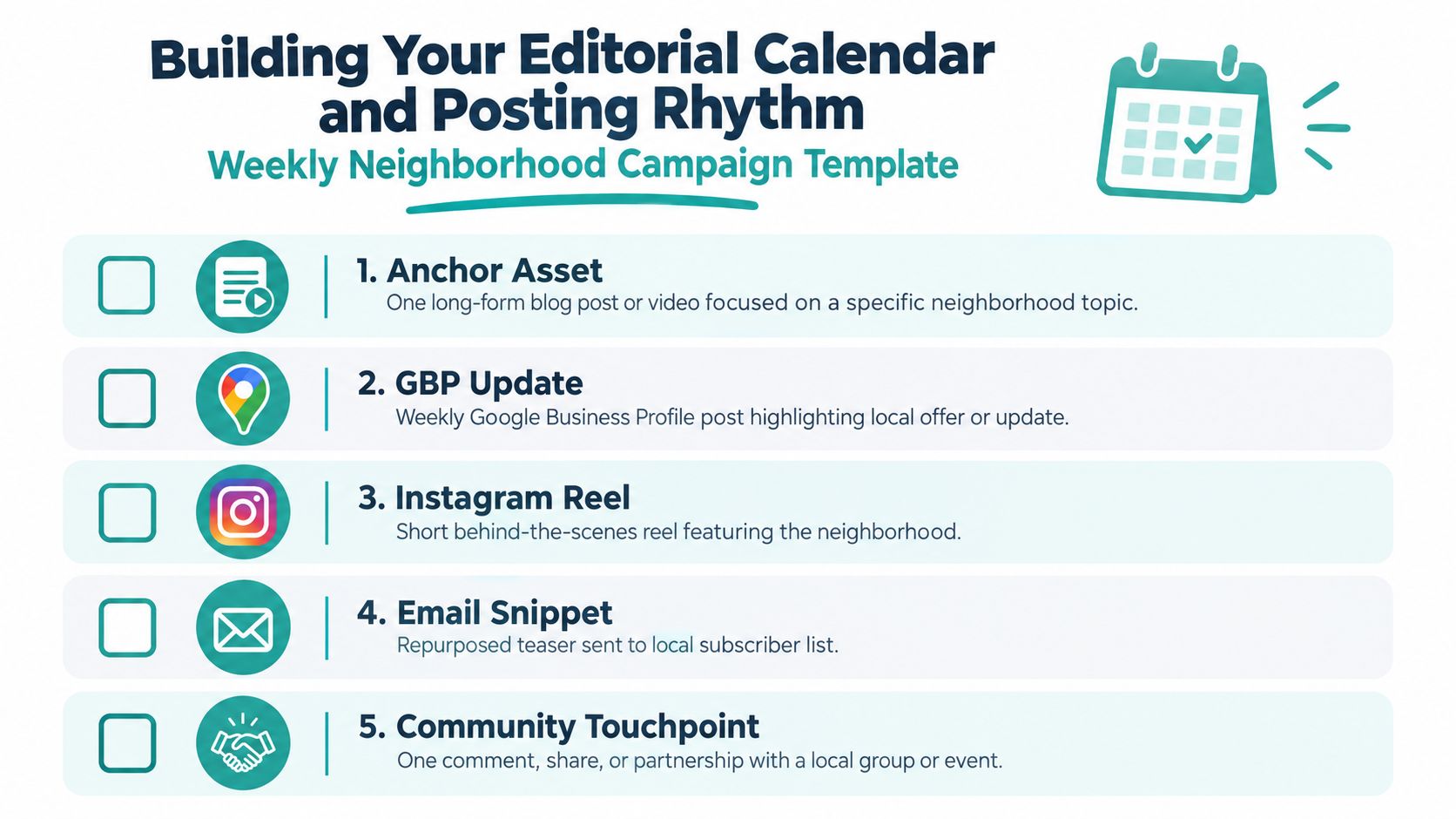
A neighborhood campaign needs a rhythm the team can sustain after the initial enthusiasm fades. The model that works well for lean SMB teams is one anchor asset supported by smaller adaptations.
Each week, assign:
- One anchor asset: A substantial neighborhood article, guide, or video.
- Three supporting posts: A GBP update, an Instagram Reel, and an email snippet.
- One community trigger: A partner mention, review request, local event reference, or community interaction.
Use GBP twice weekly, Instagram three to five times, email biweekly, and a blog biweekly. The anchor doesn’t need to be newly produced every day. One well-researched piece can supply multiple short posts, a sales-team talking point, a TV hook, and a follow-up email.
Assign ownership before publishing
The owner-operator should supply local judgment, approve claims, and identify community details. Front-of-house staff can collect customer questions, photos, and review opportunities. A freelancer or agency can draft, edit, format, and publish. One person must have final approval, or the calendar will stall while everyone assumes someone else is responsible.
Use this copyable Google Sheet layout:
| Neighborhood | Format | Channel | Publish Date | Hook Line | Conversion Goal | |—|—|—|—|—|—|
A three-month content calendar template can help turn this weekly system into a longer planning cycle. Keep the weekly review to thirty minutes. Check what shipped, confirm the next anchor, assign owners, verify the conversion goal, and remove any item that depends on information nobody can provide.
Channel Tactics Across SEO, Social, Email, and Partnerships
Run each neighborhood campaign from one brief across its local channels. Name the area, audience, problem, proof, offer, destination page, tracking method, and creative direction. Keep the geographic signal consistent while adapting the format to each platform.
Start with the organic foundation
Build a neighborhood landing page around a genuine service need rather than replacing a city name in a generic template. Include local references, service boundaries, staff or customer proof where available, useful FAQs, and clear contact options. Add appropriate LocalBusiness structured data and connect the page with related service content through internal links. GBP posts can send visitors to the page, while photos and Q&A content should address questions customers ask before calling or visiting.
Social content performs better when the setting is unmistakably local. Film on-site, show the route, identify the event, and use radius targeting for Instagram or Facebook campaigns when the platform supports it. Tag nearby businesses only when the relationship is real. A bakery, realtor, gym, or home service provider can introduce a related business to a nearby audience through a genuine collaboration.
Email should read like a neighborhood note, not a citywide promotion. Pair an offer with a local story, practical reminder, or event update. Subscribers then have a reason to open the message before they are ready to buy.
To extend reach beyond owned channels, use practical tactics to build an audience with taap.bio, then direct that audience to the same local offer or destination page.
Add partnerships, programmatic, and TV
Partnerships may include cross-promotions, school or league sponsorship content, co-created guides, and pitches to hyperlocal press. Programmatic targeting can place the same message in defined neighborhoods. TV can add household reach within the selected geography, with the resulting response tracked against the content and offer used elsewhere. Location-based personalization can combine first-party information with location services, weather data, and platforms such as Foursquare, as described in Braze’s guide to location-based personalization.
| Stage | Primary Channels | Asset Type | Cadence |
|---|---|---|---|
| Discovery | SEO, GBP, partnerships | Local guide, event post, community mention | Ongoing |
| Consideration | Social, email, programmatic | Short video, FAQ, offer, testimonial | Planned campaign bursts |
| Decision | TV, landing page, GBP, calls | TV spot, proof page, tracked offer | Flighted and reviewed |
| Retention | Email, GBP, partnerships | Follow-up, review request, local update | Recurring |
Keep the neighborhood name aligned across the search result, landing page, ad, TV spot, and follow-up. That shared identifier helps customers recognize the campaign and gives the team one reporting unit across search, social, programmatic, email, partnerships, and TV.
Pairing Hyperlocal Content With Targeted TV Campaigns
Broadcast TV belongs in the hyperlocal mix when the geography and message are specific enough. It shouldn’t be treated only as a broad awareness purchase. A local business can use a TV campaign to make a neighborhood familiar with an offer, event, service, listing, or local proof point, then use content to answer the questions viewers ask afterward.
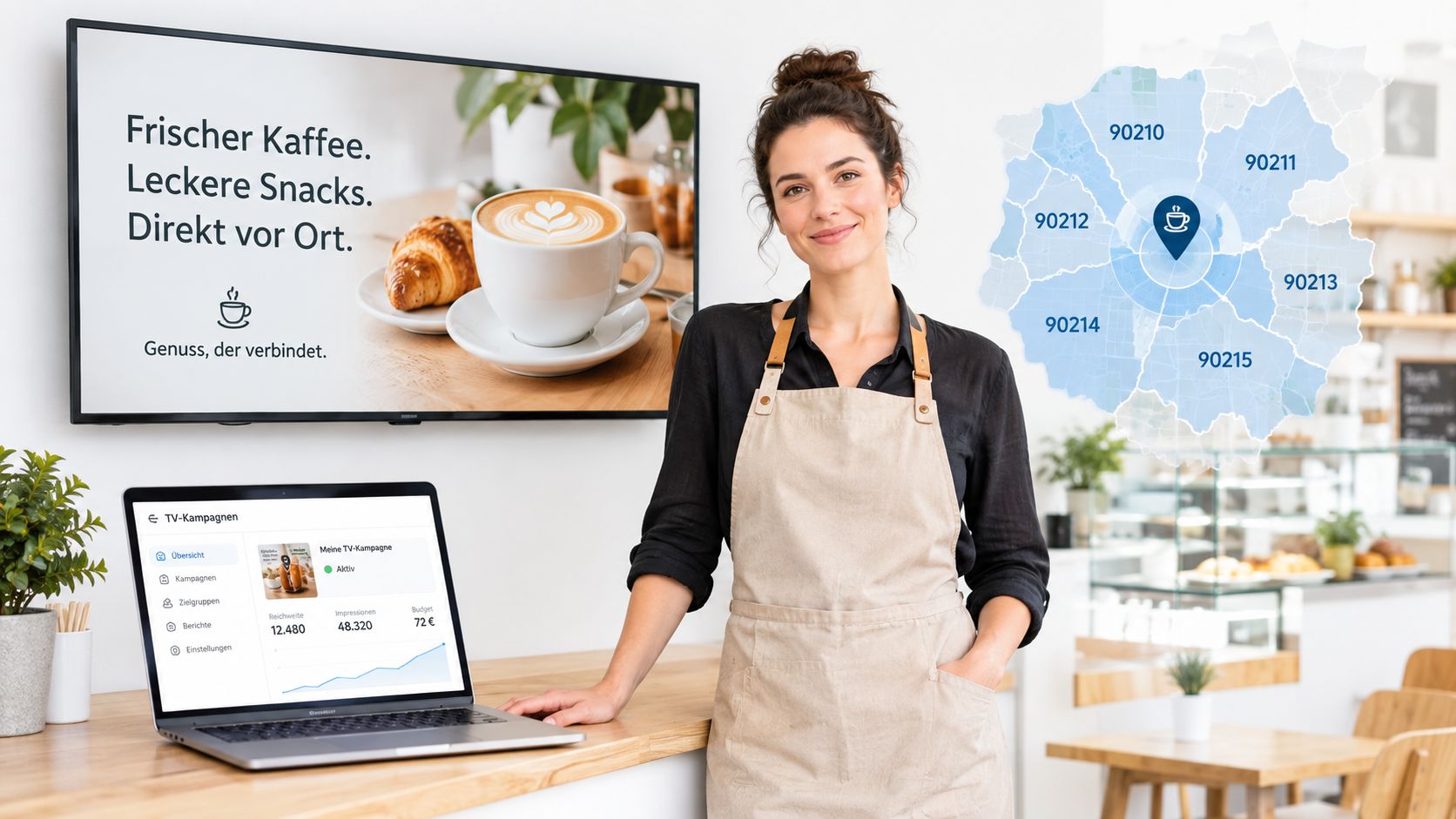
Build one geography, then adapt the creative
An Adwave-style self-service TV platform can help an SMB target households by ZIP code or DMA section, then align that audience with the neighborhoods already covered by its content. The important discipline is matching the TV geography to the service reality. A campaign aimed at one neighborhood should direct viewers to a page, phone number, offer, or location that serves that neighborhood clearly.
Creative adaptation doesn’t require starting from a blank page:
- Blog headline to voice-over hook: Turn the central local problem into the first spoken line.
- GBP photo to on-screen visual: Use an authentic storefront, team, vehicle, route, or local setting.
- Customer testimonial to short spot: Reduce the proof to one specific outcome or reason to choose the business.
- Neighborhood guide to call to action: Send viewers to a dedicated page with the same area language.
A practical flighting pattern is to increase TV activity during the 14 days around a neighborhood event, then let organic content, email, GBP, and social maintain attention between flights. This keeps the campaign connected to a real local moment instead of asking a small team to invent new creative every week.
The measurement loop should be explicit. TV can prompt branded searches and direct calls. Content can capture that interest through a neighborhood landing page, useful FAQs, proof, and a clear next action. Call tracking, UTM-tagged pages, profile actions, and geographic source reporting help connect the two surfaces.
Businesses evaluating the channel can review Adwave’s information on advertising on local TV. Adwave supports location-specific creative and targeting, making it a practical option for testing TV alongside neighborhood content rather than running television as a disconnected brand exercise.
Targeting, KPIs, and a Testing Rhythm You Can Trust
An owner-operator doesn’t need a dashboard full of abstract marketing indicators. Start with what can be checked on a Monday morning: profile views, direction requests, and calls that ring the shop or office. Then connect those actions to the page, post, email, audience, or TV creative that influenced them.
Local behavior supports this focus. One local search compilation reports that 78% of local mobile searches result in an offline purchase, 88% of local-business searches on mobile lead to a call or visit within 24 hours, and 72% of local searchers visit a store within 5 miles (Digital Applied’s local SEO data points). Another source reports that 46% of Google searches have local intent and 76% of people searching “near me” visit a local business within 24 hours (Growth for Local’s local search guidance).
Use a tiered KPI stack
| Funnel Stage | KPI | Driven By | Stage 1 Target | Stage 2 Target | Stage 3 Target |
|---|---|---|---|---|---|
| Awareness | Impressions, branded search lift, TV reach | TV, programmatic, partnerships | Establish baseline | Compare neighborhoods | Expand proven areas |
| Engagement | GBP actions, page time, email click-to-open by ZIP | SEO, GBP, social, email | Identify useful topics | Improve weak assets | Replicate strong themes |
| Conversion | Calls, forms, walk-ins, booked jobs | Landing pages, offers, calls, TV | Capture source data | Improve conversion paths | Attribute revenue by area |
These stage labels are operating phases, not universal performance promises. In the launch phase, make tracking reliable before chasing scale. In optimization, change one element at a time, such as the neighborhood headline, offer, call-to-action, video opening, or TV hook. In scale, apply the winning pattern to another qualified area only after checking capacity, service radius, and sales quality.
Expert hyperlocal benchmarks suggest watching campaign maturity across month ranges, with positions 15 to 30 in months 1 to 3, 5 to 15 in months 4 to 6, and 1 to 5 in months 7 to 12 (Emulent’s hyperlocal SEO framework). The same framework describes traffic moving from baseline to a 25% to 50% increase, then to 100% or more growth as campaigns mature. Use those ranges as directional benchmarks, not guarantees, and prioritize neighborhood leads, local pack visibility, Google Business Profile query performance, and revenue attribution by area.
Review trust as part of conversion
Ranking isn’t the end of the journey. Rio SEO reports that 75% of consumers read at least four reviews before deciding, 53% say inaccurate listings drive them away, and 59% expect a response within 24 hours (Rio SEO’s local search consumer behavior study). Make review response, listing accuracy, and response speed part of the campaign workflow. Track about 7 metrics per location so the review stays actionable, as recommended by the same Emulent framework.
Run one test per channel each month. Write the hypothesis in plain language: “If we replace a generic offer with a neighborhood-specific service promise, qualified calls from that area will improve.” Define the source, owner, read window, and decision before launch. Original local content matters, too. One field study found that businesses publishing 2 or more pages per month averaged 326% more traffic than businesses without a content strategy, while multi-location businesses averaged 557% more traffic than single-location businesses. The same study reported that fully AI-automated content averaged 854% lower traffic than original content (Website That Sell’s Australian local SEO statistics). Use automation for production support, not as a substitute for local knowledge, proof, and editorial judgment.
Adwave offers SMBs a way to create broadcast-ready TV ads, target local audiences by ZIP codes and DMA areas, manage a defined budget, and track campaign performance alongside neighborhood content. Visit Adwave to connect a location-specific TV test with the pages, offers, calls, and local actions already driving your hyperlocal growth.