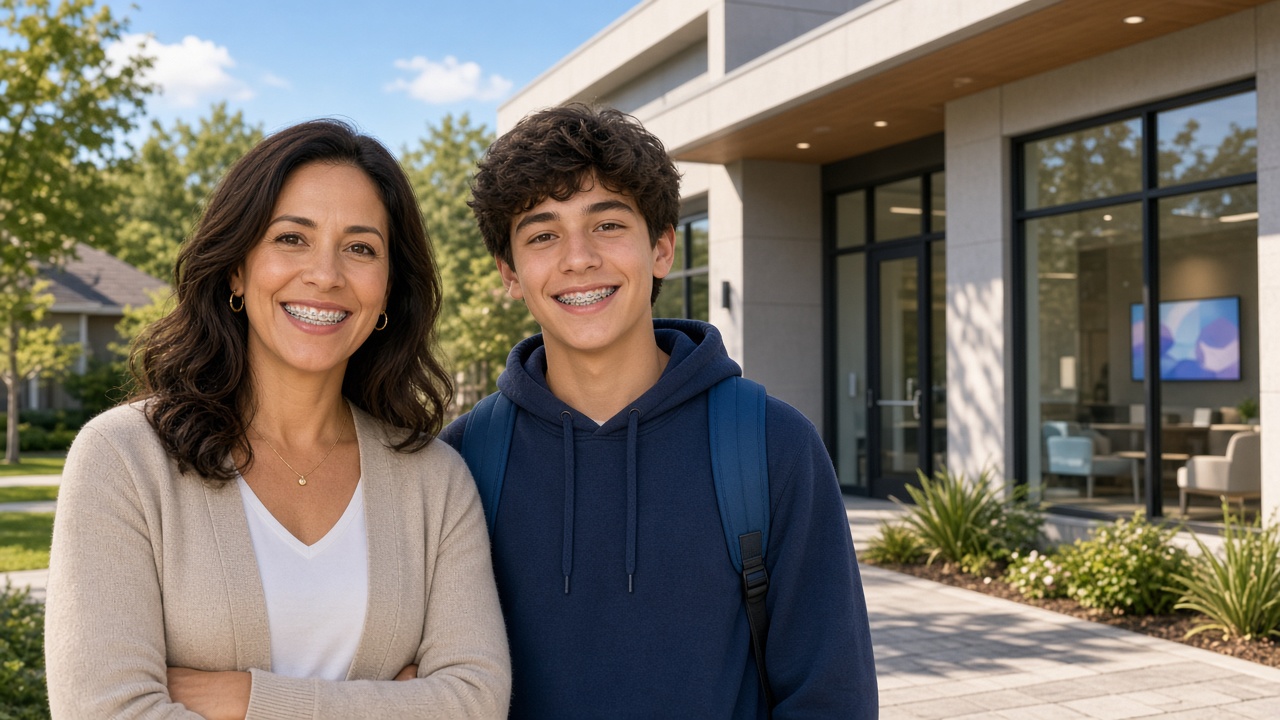
Orthodontist advertising usually speaks to two buyers: parents deciding for a child or teen, and adults considering braces or aligners for themselves. Search ads reach people already looking for treatment, while social and streaming TV make the practice familiar to both groups. Every ad has to stay truthful under FTC rules and your state dental board’s rules.
How orthodontic practices get new patients
Most orthodontic practices draw new patients from a few places: referrals from general dentists, local search, online reviews and paid visibility. Dentist referrals are often the largest source. Some practices that receive a lot of them run fewer ads, or none. People searching on their own type phrases such as “orthodontist near me,” “braces consultation near me” or “Invisalign” plus a city. They compare reviews and decide whether booking looks easy.
Patients travel farther for an orthodontist than they do for a general dentist. Because orthodontics is a specialty, patients will often travel farther for a provider with strong reviews. That makes a wider ad radius reasonable for many practices. Advertising works best as an addition to referrals. It reaches families and adults whose dentist never mentioned treatment, and it puts the practice’s name in front of people before they search. If you also run a general practice, our TV advertising guide for dentists covers that side.
Two audiences: parents of kids and teens, and adults
Parents pay and make the final call. They want a practice they can trust with their child, with clear experience and plain payment information. The teen still matters, because a reluctant 14-year-old can stall treatment that a parent has already approved. Ads for parents should lead with trust, process and cost clarity. Social content can carry the lighter, patient-facing side that appeals to teens.

Adults decide for themselves and ask different questions. They want discreet options such as clear aligners, appointments that fit a work schedule, and answers about whether treatment makes sense at their age. Orthodontists rarely promote treatment to adults, so many practices still look like they treat only children. There is also an easy overlap to use: the parent who brings a child to a consult may be a candidate too.
Two examples show how the messages differ. Neither is a real campaign or a measured result.
For parents, an example: a 15-second streaming TV spot and an Instagram video could show a relaxed first visit and close on the practice’s actual offer, for instance “Free consultation. Clear payment plans. Book online.” if the consultation really is free and payment plans really exist. Both would run within a radius of the office and link to a page about treatment for kids and teens.
For adults, an example: a search ad for “clear aligners” plus the city, paired with a Facebook image ad showing an adult professional. The copy offers early-morning and evening consult times, and the ad links to a page on adult treatment.
Other specialty practices use a similar split. See how chiropractors use local TV for a related approach.
Which advertising channels fit an orthodontist
Search, social and TV each reach patients at a different stage. Search catches demand that already exists. Social and TV create familiarity before anyone searches. The table below lists the conditions under which each channel runs in Adwave, based on its current published pricing.

| Channel | Job for parents | Job for adults | Budget condition in Adwave |
|---|---|---|---|
| Google Search | Catches searches like braces for kids plus a city | Catches Invisalign, aligner and adult braces searches | From the $30/day minimum |
| Facebook and Instagram | Instagram reaches parents in their feeds | Adult treatment stories and consult offers | From the $30/day minimum |
| Streaming TV | Builds local familiarity before a search | Same job, with an adult-focused spot | From the $30/day minimum |
| YouTube | Short video explaining the first visit | Short video on adult options | Included in Google placements |
| Web and mobile apps | Reminders across sites and apps | Same | Included |
| Limited fit | Adults researching treatment in community discussions | From about $35/day | |
| TikTok | Awareness with teens | Limited fit | Opt-in from about $91/day, needs a connected TikTok account |
A practice with a small budget can start with search plus Facebook and Instagram, then add TV once it can afford enough frequency in its area. For background on that tradeoff, see how advertising reach works.
What ads should say and where they should send people
Ads only work when the page they lead to is already clear. The same checks apply whichever channel the ad runs on:
- Lead with one consultation offer per ad, and state its real conditions.
- Describe the treatment options without implying that every viewer is a candidate for aligners or any other specific treatment.
- Use photos of adults in ads for adults, and photos of kids and teens in ads for parents.
- Send each ad to a matching page: adult ads to an adult treatment page, and parent ads to a kids and teens page or a booking page.
- Make booking work on a phone, and offer virtual consults if the practice provides them.
- Put payment options where people can find them, since parents and adults both ask about cost before booking.
A campaign also needs a destination even if the practice has no website, such as a booking page or a form. The Adwave FAQ lists the options.
Realistic orthodontist advertising budgets
A common guideline for dental and orthodontic practices is to spend 7 to 10% of gross revenue on marketing. Ortho Marketing’s budget guide cites that range and notes that goals and local market conditions change it. Treat it as an adviser’s rule of thumb, not a requirement. Marketing also covers more than ads. It includes the website, photography, call tracking and community sponsorships.
Competition sets much of the number. Onboard Marketing Group’s 2026 guide states that no universal Google Ads budget exists for orthodontists. A practice facing several established competitors in a growing metro area may need more than a practice in a small town. A sensible way to set spend is to work backward from how many consultations and starts the campaign has to produce to pay for itself. For channel-level figures, see our guide to local advertising costs by channel.
Adwave’s pricing is simple to plan around:
- You set a daily budget from $30 to $10,000, prepaid, with no subscription and no contract.
- As a planning example, $75 a day over 30 active days comes to $2,250.
- The daily budget covers media, ads and management, and campaign creative is included.
- Extra creation is priced separately: $0.38 per image, $6 per social video, $6 per 15-second TV spot and $12 per 30-second TV spot.
- Card deposits add the processing fee shown at checkout, while ACH deposits have no added fee.
Judge results by consultation requests and starts, tracked by source. Clicks alone don’t tell you whether a channel is working.
Advertising rules that apply to orthodontists
Orthodontic ads fall under three overlapping sets of rules.

The Federal Trade Commission enforces federal law against deceptive advertising. Any claim about a treatment has to be truthful and backed by evidence, as Sunrise Dental Solutions explains.
State dental boards add their own rules, and these vary from state to state. A practice that advertises across a state line has to follow each state’s rules.
The ADA Principles of Ethics and Code of Professional Conduct is the third layer. Section 5 of the code says no dentist shall advertise in a way that is false or misleading in any “material” respect, according to Oberman Law Firm’s summary. The ADA’s marketing and advertising guide points dentists to both the code and state and federal rules.
HIP Creative’s overview of dental advertising rules names where practices most often get into trouble:
- specialty claims
- testimonials and reviews
- before-and-after images
- “free” offers, which must actually be free, with no hidden conditions
- financing terms, which can trigger federal disclosure requirements
- patient privacy and consent
HIP Creative’s overview also notes that the licensed dentist and the practice generally remain responsible for their ads, even when an agency creates them. Check your state board’s website before launch, and ask a healthcare attorney licensed in your state about any claim you’re unsure of.
Running an orthodontic campaign in Adwave
Adwave creates the ads from your practice website and runs them across TV, search, social and the web. You don’t need separate ad accounts. Here are the steps:
- Paste your practice website. Adwave reads it for offers and photos and suggests the audiences worth reaching, such as parents and adults.
- Review the suggested audiences and the ads (image ads, social video and a TV spot) before you add a card. Edit the creative, or upload ads you already have.
- Choose the area: a radius around the office, ZIP codes or a city.
- Set your daily budget, fund the prepaid wallet and launch. Adwave buys media across the channels your budget makes eligible.
- Install the tracking snippet and set consultation requests as the actions to count, so reporting reflects real inquiries.
- Adjust or pause whenever you like. Pausing stops future daily charges, and a campaign also pauses if the wallet can’t cover the day.
Practices with several offices can set up separate areas for each one. See advertising for multi-location practices for that setup.