Most product brands still treat Pinterest like a digital mood board. That’s a mistake. The value sits in unbranded discovery behavior, not in pretty images, because 96% of top searches are unbranded and Pinterest’s search environment increasingly captures people before they’ve chosen a brand at all, according to Retail Brew’s coverage of Pinterest’s 2025 search rollout.
That matters because Pinterest isn’t small or niche anymore. It grew from a visual bookmarking startup launched in March 2010 into a global discovery platform with 514 million monthly active users in the first quarter of 2025, up by 51 million users year over year, after reaching 463 million in the first quarter of 2024, as summarized in Thunderbit’s Pinterest statistics history. If you sell products people browse, compare, save, and come back to, Pinterest trends are often a better early demand signal than your paid social comments.
Why Pinterest Trends Now Drive Product Demand
Pinterest trends matter because they’re closer to shopping intent formation than most brand teams admit. People don’t open Pinterest to admire your logo. They open it to solve something, outfit something, redesign something, gift something, or buy something. Shopify’s enterprise coverage notes that more than 631 million people use Pinterest monthly to find ideas and research products, and 96% of its searches are unbranded, which means brands that wait for branded demand are showing up too late in the decision path. Pinterest also reports that 80% of weekly Pinners feel inspired by its shopping experience, which is exactly why the platform works as a demand detection layer rather than a simple awareness channel in Shopify’s social commerce analysis.
Discovery beats recall for product brands
A product brand wins on Pinterest when it captures category demand before a competitor becomes the default choice. That changes the job of creative. Your Pin title, image, and landing page need to answer a search like “small living room storage” or “neutral kitchen shelves,” not just push your brand name.
Practical rule: If the Pin still makes sense after you remove the brand name, it’s built for discovery.
That’s why Pinterest trends are more useful than many marketers think. They reveal the language, style, and use-case framing shoppers adopt before they search for a specific company. If your team needs help sharpening the product angle after spotting a rising theme, these differentiation tactics from top brands are a useful way to translate abstract trend energy into a sharper product story.
Why this matters beyond Pinterest
A trend spotted on Pinterest shouldn’t stay trapped on Pinterest. Once a product theme shows real traction, the next job is to expand awareness beyond the platform. Small brands especially need reach outside the feed if they want local buyers to remember the offer when they’re ready to act. That’s where a broader channel mix starts to make sense.
If you want a practical view of how social signals connect to broader campaign planning, Adwave’s guide to social media trends for small business in 2026 is a useful reference point. The right model in 2026 isn’t inspiration first and measurement later. It’s signal first, then amplification.
What Pinterest Trends Actually Measure
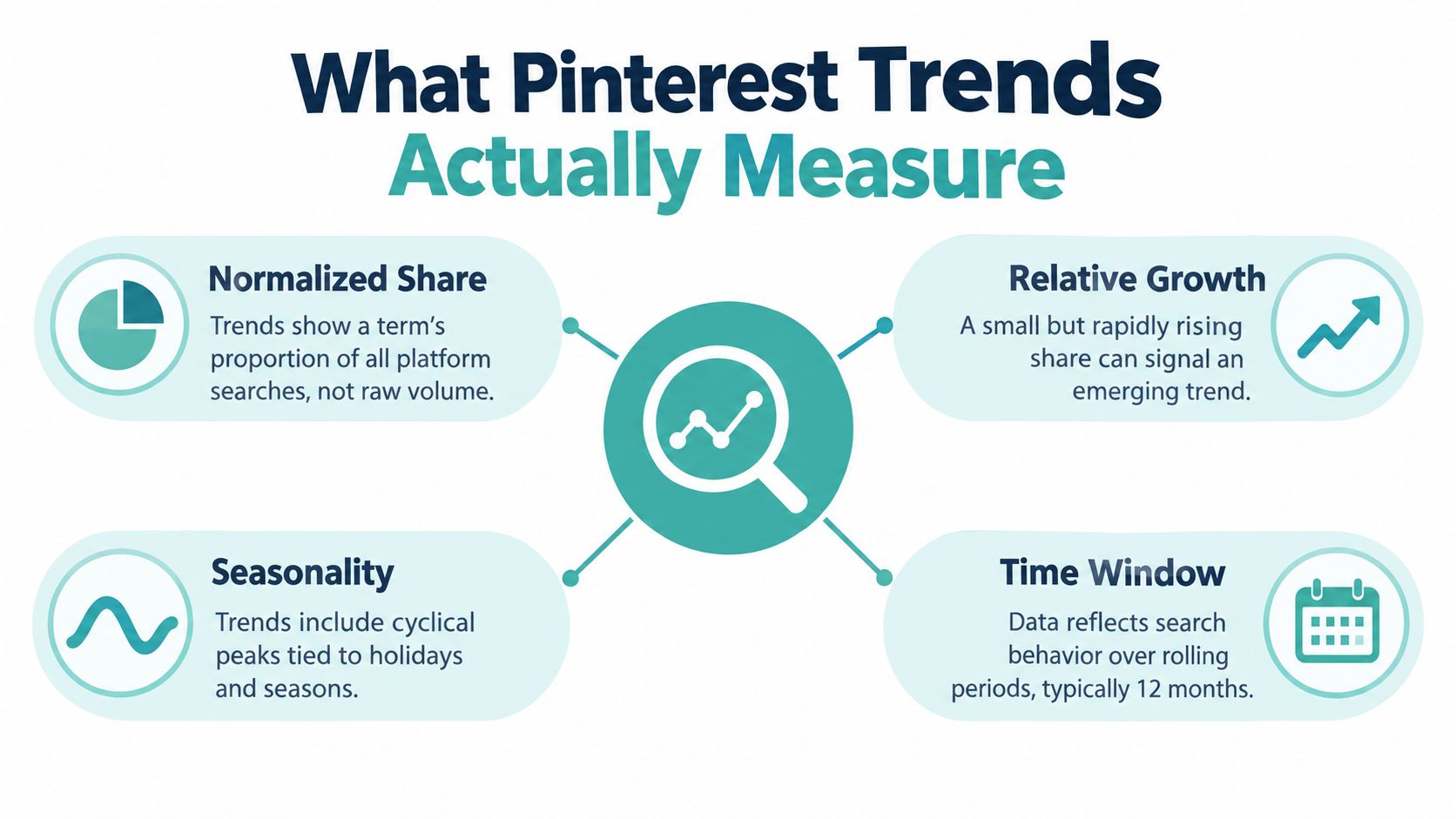
Many teams read a Pinterest trend chart the wrong way. They assume it’s showing raw popularity. It isn’t. Pinterest says its Trends tool compares a term by looking at its share of all searches on the platform during the same time period, not just raw search counts, in the company’s own explanation of how Pinterest Trends works.
That distinction changes how you make product decisions.
Read the chart like relative momentum
Think of Pinterest Trends like a rising tide on a beach. The important question isn’t how much water exists overall. The important question is which part of the shoreline is getting covered faster right now. A term with modest total demand can still be strategically important if its share of platform searches is climbing.
That’s why a smaller, fast-rising style term can be more useful than a giant evergreen category word. One tells you where attention is heading. The other mostly tells you where attention already lives.
Use that logic in three passes:
- Check relative movement instead of chasing only broad category keywords.
- Compare related terms to see which variation is gaining traction.
- Match the term to a product page that resolves the same need or aesthetic.
Why that matters commercially
Pinterest’s value isn’t just that users search. It’s that they search while planning purchases. Historical audience research found that 84% of users had used Pinterest when deciding what to buy, and more recent summaries report that 85% of weekly Pinners have made purchases influenced by Pins, according to Market.us Pinterest statistics.
That creates a longer decision window than a fast-scrolling social feed. A product can be saved, revisited, compared, and re-evaluated over time. For product brands, that means one strong visual asset tied to a rising query can do more work than a generic awareness ad with no search alignment.
Don’t ask whether a trend term is “big enough.” Ask whether its share is rising fast enough, and whether your product page can satisfy the exact intent behind it.
What teams should stop doing
Stop treating Pinterest Trends as a list of decor themes or color palettes. It’s a behavior signal. The chart is telling you where buyer curiosity is moving. Your job is to decide whether that movement maps to a product, offer, bundle, or seasonal landing page you can sell.
The Four Trend Tools Every Product Brand Should Know
Pinterest gives brands several surfaces that look similar from the outside and do very different jobs in practice. Teams often blur them together, then wonder why their trend strategy feels soft. Don’t do that. Pick the tool based on the decision you’re trying to make.
Matching Pinterest tools to product brand goals
| Pinterest Tool | What It Measures | Best For | Watch Out For |
|---|---|---|---|
| Pinterest Trends | Relative search momentum over time | Spotting emerging product themes and seasonal rises | Confusing normalized momentum with total market size |
| Pinterest Predicts | Annual forecast based on rising search patterns | Planning collections, creative themes, and merchandising calendars | Copying the headline trend name too literally |
| Idea Pins | Creative engagement and niche audience resonance | Testing storytelling, routines, styling, and product education | Treating engagement as proof of sales impact |
| Top of Search and related search placements | Presence near active search behavior | Capturing demand when users are comparing options | Overfocusing on branded terms instead of descriptive discovery queries |
Use Trends for current motion, not annual strategy
Pinterest Trends is your tactical dashboard. Use it when you need to decide whether a term is gaining traction now, whether two adjacent phrases are moving differently, or whether a category is becoming more relevant this season.
It’s especially useful when paired with outside validation. If your content team already uses search trend frameworks elsewhere, this guide on how to use Google Trends to find timely content ideas helps sharpen the comparison mindset. The key difference is that Pinterest reflects visual shopping and project intent more directly.
Use Pinterest Predicts for planning, not guessing
Pinterest Predicts is a forecast, not a live dashboard. Pinterest says the report is based on year over year growth in search terms, and the company said its annual predictions were 80% accurate over the previous five years in the official Pinterest Predicts 2025 newsroom release. That makes it useful for product planning, seasonal creative, and inventory decisions.
But don’t copy trend names and call it strategy. Translate the broader motivation into your category. A home brand might adapt “maximalism” into bolder materials or layered product photography. A food brand might turn a rising visual theme into packaging, menu styling, or limited-edition merchandising.
Use Idea Pins and search placements for different jobs
Idea Pins are for creative testing. They help you learn which routines, product demonstrations, and visual narratives build affinity in a niche audience. They are not your cleanest sales signal.
Search placements like Top of Search are different. They sit close to active comparison behavior. Use them when your product already has a clear category fit and you want to intercept demand efficiently. That’s where a lot of brands underinvest because they’re still writing social-style copy instead of search-aligned creative.
How to Localize a Global Pinterest Trend
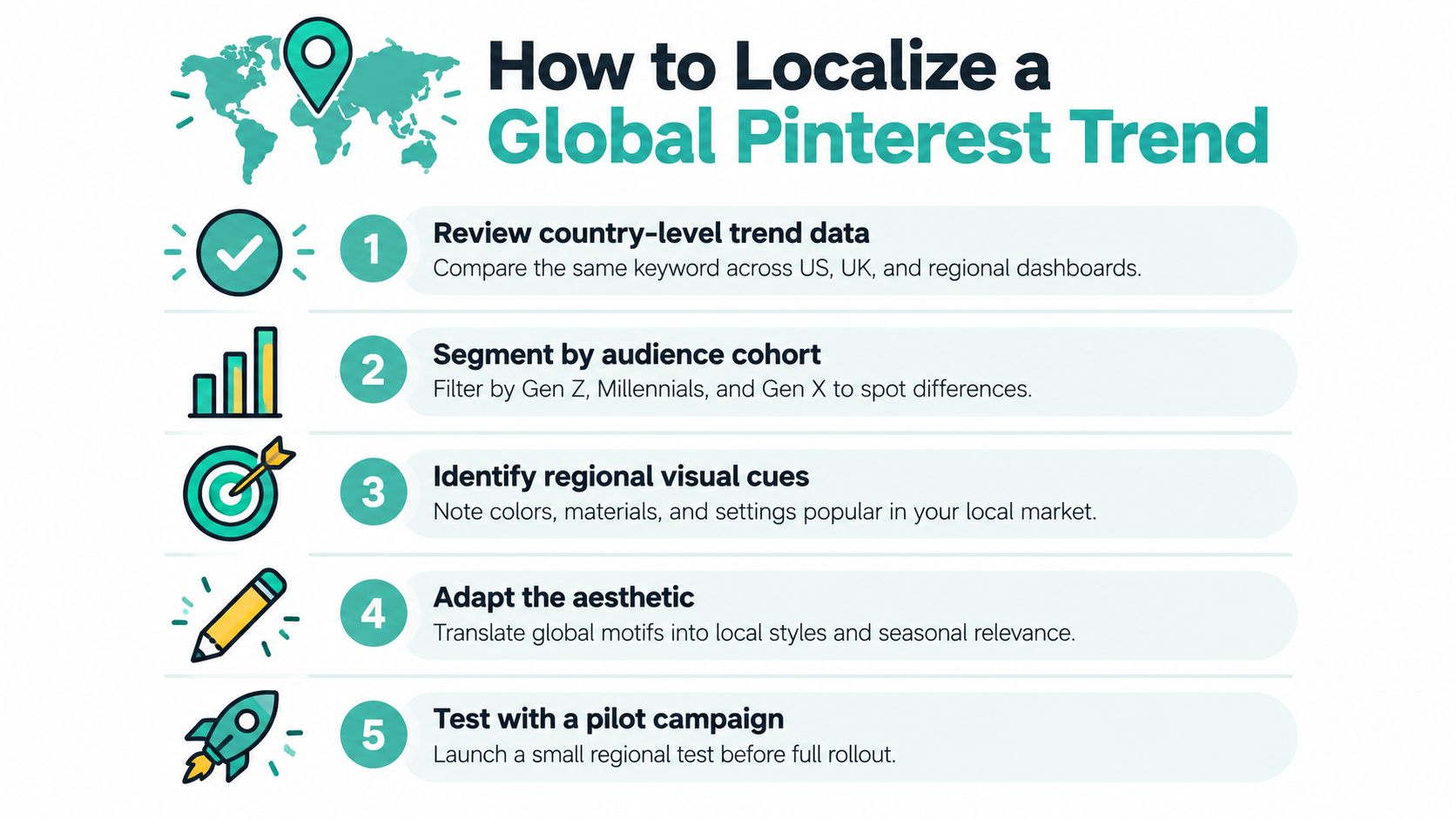
Global trend names are seductive. They feel ready-made. They’re also where a lot of local product brands waste money. A trend can be real globally and still be weak for your market, your audience, or your product line.
Recent Pinterest Predicts coverage makes that problem obvious. Marketing-Interactive’s reporting on 2026 Pinterest Predicts themes found that Singaporean Gen Z users were 4.12 times more likely than the average Pinterest user to engage with “Pen Pals,” while “Glamoratti” was nearly six times more popular among Singaporean Gen Z users than global users. That isn’t a small variation. It’s a warning against copy-pasting global creative across markets.
A better localization framework
Score each trend across five lenses before you invest in creative production:
- Search growth: Is the theme clearly gaining traction in the market you sell into?
- Geographic concentration: Is the rise broad enough to matter locally, or isolated to another country or cohort?
- Audience fit: Does the audience engaging with the trend overlap with your actual buyer?
- Commercial intent: Can this trend plausibly lead to a purchase, booking, visit, or inquiry?
- Operational readiness: Can your team build the offer, page, visuals, and inventory fast enough to matter?
You don’t need fake precision. You need discipline. A local furniture store, restaurant group, or real estate brokerage should reject trends that look exciting but don’t fit local demand patterns or execution capacity.
What localization looks like in practice
A regional home retailer shouldn’t launch a full “global aesthetic” campaign just because the trend name is hot. It should adapt the underlying cues into local product merchandising. If the theme suggests nostalgia and layered styling, the store might build a seasonal display, re-shoot product imagery in local home settings, and create city-specific landing pages around room type, climate, or housing style.
A restaurant should do the same. Don’t copy the visual language exactly. Translate it into a limited-time menu item, packaging detail, or in-store visual motif that customers in your area will recognize and order.
A local trend strategy works when the audience sees something familiar inside the global theme, not when they see a brand trying too hard to be internet-native.
Decide when not to localize
The smartest move is often restraint. If the trend is concentrated in a distant market or a niche cohort you don’t serve, skip it. Product brands don’t need more creative concepts. They need fewer, stronger bets that fit local demand and operational reality.
A Practical Workflow to Apply Trends in Campaigns
Product teams that move straight from a rising term like “circus interior” to asset production waste budget. Pinterest trends should be treated as unbranded demand signals, then translated into offers, creative, and media that can be measured. The workflow matters more than the mood board.
Pinterest’s forecasting approach gives you a useful starting signal because it tracks user behavior, not editorial taste. Coverage from Fortune says Pinterest’s annual forecasts draw on billions of searches and saves, and that 88% of its predictions over the prior six years materialized in Fortune’s reporting on Pinterest Predicts accuracy. Use that as input. Do not treat it as a substitute for campaign discipline.
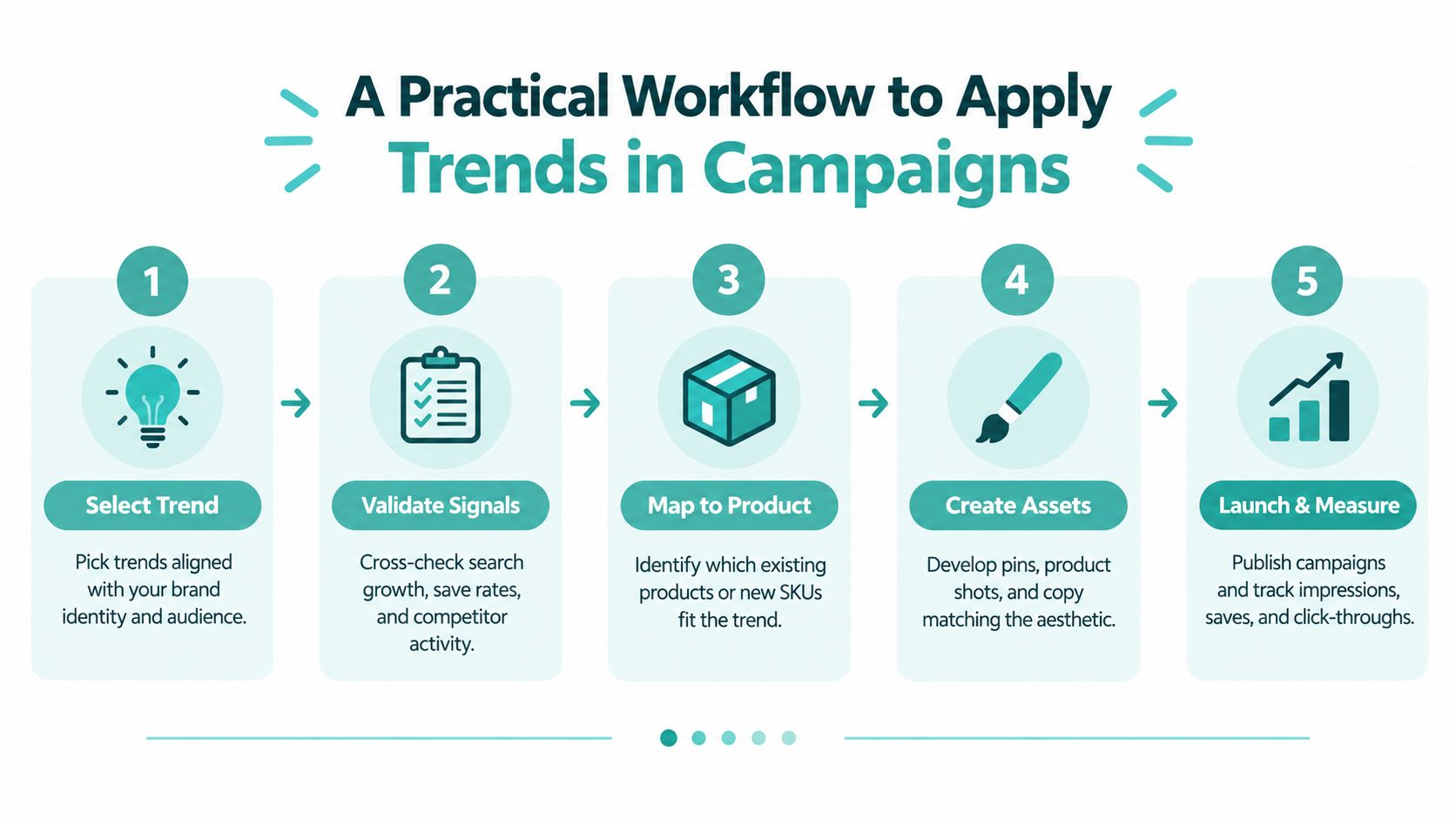
The five-step operating rhythm
-
Select the trend
Pick one theme with clear category fit and real margin potential. A visually interesting trend with weak product economics should not make it into the campaign. -
Validate the signal
Check search movement, save behavior, click patterns, and audience relevance. Kill the idea here if the signal looks culturally interesting but commercially soft. -
Map the motivation to the product
The opportunity is usually not the surface look. It is the underlying driver, such as nostalgia, comfort, personalization, or maximalism. Build the offer around that driver, because that is what turns discovery into purchase intent. -
Align assets to intent
Your Pins, product titles, images, landing pages, and merchandising need to tell one consistent story. If the Pin sells a specific style or feeling, the page cannot drop shoppers into a generic product grid. -
Launch in waves
Start with discovery-led creative. Then refresh into stronger commercial variants as the trend matures and you learn what gets response. If you are pushing for regional sales, pair Pinterest discovery with broadcast-style reinforcement through channels such as Adwave so the trend moves from saved inspiration to local memory.
What teams should copy, and what they shouldn’t
Copy the motivation behind a trend. Do not copy the trend skin.
If “circus interior” rises, a home brand should not rush into literal circus-themed products. Fortune’s coverage cited Pinterest examples including “circus interior” up 130%, “vintage circus aesthetic” up 70%, and “circus nursery” up 50% during Pinterest’s measurement period. The commercial takeaway is the demand pattern underneath those terms: nostalgia, playfulness, and layered styling. That is what your assortment, offer framing, and media should reflect.
Set up the handoff early
Before launch, assign each trend to one product page, one offer, one creative angle, and one success metric. Then assign an owner for the move from insight to SKU, from SKU to asset, and from asset to media. Teams lose momentum when trend research sits with content, ecommerce waits on creative, and paid media enters too late to build a measurable rollout.
Product Brand Examples and When TV Reinforcement Beats Pinterest Alone
Pinterest trends are demand signals, not just mood boards. For product brands, that distinction matters. The platform is strong at surfacing unbranded intent early, but regional growth usually needs more than discovery. If you want local memory, store traffic, or broader brand recognition, you need reinforcement beyond the Pin.
Pinterest is large enough to justify that move. The company reported 578 million global monthly active users in the second quarter of 2025, up 11% year over year, and $998 million in quarterly revenue, up 17%, in its official Q2 2025 investor release. Treat that scale for what it is: proof that Pinterest can reveal category demand at meaningful volume. Then decide whether your sales target requires a second channel to make that demand stick locally.
Three scenarios that clarify the decision
Home goods brand
A home goods brand sees a rising interior theme and turns it into a seasonal collection. Pinterest often performs well here because people save ideas, compare looks, and come back later when they are ready to buy. If the brand already has healthy direct traffic, a clean ecommerce path, and product pages that convert, Pinterest can carry more of the load.
The limit shows up when the goal shifts from online discovery to area-wide awareness. A shopper may save the style on Pinterest, then need repeated exposure elsewhere before visiting a local showroom or retailer. That is where TV-style reinforcement earns its budget.
Regional restaurant chain
A restaurant chain can use a Pinterest-validated food aesthetic to shape a limited-time offer, visual identity, and in-store creative. Pinterest can help generate curiosity. It is less reliable at creating the repeated in-market exposure that drives meal decisions across a region.
Restaurants win on memory. If people notice the dish on Pinterest, then see the same cue again in a broadcast-style campaign, the offer moves from inspiration to recall faster.
Real estate brokerage
A brokerage can use Pinterest trends to sharpen listing presentation, seasonal styling, and neighborhood aspiration cues. That improves the creative. It does not guarantee broad local reach among potential sellers and buyers who are not actively browsing Pinterest at that moment.
When reinforcement beats staying digital-only
Use reinforcement when your sale depends on local recall, household reach, or repeat exposure. In those cases, Pinterest should start the demand curve, not finish it.
Adwave fits that handoff well. It can generate an ad from a website URL, launch campaigns starting at $50, and distribute across more than 100 premium channels including NBC, Hulu, and ESPN. For a local brand turning Pinterest-validated interest into broader awareness, that is a practical bridge between digital discovery and TV-style repetition.
Do not ignore naming, either. Trend-led launches often fail because the product line sounds generic even when the creative looks current. If you are building a trend-informed sub-line, this guide on how to craft a running shoe brand name is a useful reminder that memorability comes from positioning and naming, not visuals alone.
Measuring Pinterest Trend Performance Without Overclaiming
Pinterest can surface demand early. It can also make a trend look bigger than the business outcome it produces.
That is the core measurement discipline. Treat Pinterest trends as unbranded demand signals, then judge whether that signal earns the right to scale into broader media. Saves and clicks matter. Sales, qualified traffic, and local lift matter more.
Measure in layers, with one page and one code per test
Use a layered scorecard tied to one product page and one promo code per trend test. Set a fixed comparison window against an evergreen control, assign one owner, and review the same cuts every week.
- Platform response: impressions, saves, outbound clicks, and search placement visibility
- Site behavior: product page views, repeat visits, add-to-cart activity, and checkout starts
- Business response: assisted conversions, promo code use, branded search lift, and store, lead, or inquiry lift where available
That setup adds discipline most brand teams skip. A trend theme should not send traffic to three pages, four offers, and mixed creative. If you do that, you lose attribution before the test even starts.
Keep the evaluation simple. Compare the trend-led unit against one evergreen product campaign over the same period. Look for stronger traffic quality, stronger product-page behavior, and cleaner conversion paths. If those move, the trend has commercial potential.
What to ignore, and what to test next
Ignore isolated engagement spikes. A Pin that gets saved but produces weak product-page behavior has creative appeal, not selling power.
Measurement filter: Count a Pinterest trend test as promising only when product-page quality and business response improve within the same comparison window.
This matters even more for local brands. Pinterest often starts discovery, but local memory gets built through repetition. If a trend-led campaign lifts qualified visits or branded search, that is the moment to test reinforcement through broadcast-style reach, not to keep optimizing Pins in isolation. Adwave is useful at that stage because it helps extend a validated theme into local awareness without changing the core message.
Do not overclaim last-click revenue from Pinterest alone. A shopper may discover the product on Pinterest, return later through branded search, and convert after broader media exposure. Measure that path accurately. Then scale the trends that create both digital response and local recall.
Putting Pinterest Trends to Work This Quarter
The smart play isn’t to chase every Pinterest aesthetic. It’s to treat Pinterest trends for product brands as an early demand map, then act on the few signals that fit your market, product line, and operating capacity.
Start with one trend, not five. Localize it. Translate the motivation behind it into an offer, collection, menu item, or campaign angle. Build matching Pins and landing pages, then test whether the signal turns into real commercial movement. For teams that need a tighter execution playbook, Adwave’s guide to Pinterest marketing for product-based small businesses is a solid place to tighten the search-to-product workflow.
Use the next quarter like this:
- First 30 days: choose and validate one trend
- Next 30 days: build creative, landing pages, and offer alignment
- Final 30 days: launch, compare against evergreen creative, and decide whether local awareness needs broader reinforcement
Pinterest should tell you what demand is forming. Your media mix should decide how far that demand can go.
If you’ve identified a Pinterest trend worth scaling, Adwave can turn your website into a broadcast-ready ad and place it across premium channels with budget controls built in. That makes it a practical next step when Pinterest has validated the theme, but you still need broader local awareness to move more buyers from inspiration to action.