
You know the feeling. One client slows down, one service line gets soft, one ad channel stops pulling its weight, and suddenly the month looks fragile even though the business is still healthy on paper. That's usually the point where owners start talking about Revenue Diversification: Adding New Income Streams, but the smarter move is to treat it like portfolio management, not emergency repair.
A good portfolio doesn't chase every opportunity. It protects the core, adds the right second and third engines, and keeps anything new small enough to learn from before it becomes a distraction. That's the standard I use with SMBs, and it's the standard this article uses too.
Why Smart SMBs Treat Revenue Diversification Like a Portfolio
A lot of owners only think about diversification after a bad quarter. That's backward. If you wait for pain, you'll usually rush into the first shiny offer that looks like relief, and that's how businesses create more complexity instead of more resilience.
A better pattern is to think in portfolio terms. A business doing under $5M a year does not need ten income streams. It needs a core business, one or two adjacent supports, and a clean way to measure whether the mix is reducing risk. Research on nonprofit organizations found that diversification had little effect on financial vulnerability and a slightly negative effect on financial capacity, which is the reminder most owners ignore: adding streams can lower concentration risk without automatically improving operating strength unless execution is disciplined. The same research also notes that organizations with diversified revenue were reported as 87% less likely to be financially susceptible to economic changes in a separate dissertation-based study, which shows the upside can be real, but context matters. Springer study on diversification and financial vulnerability
The practical lesson is simple. Don't ask, “What else can I sell?” Ask, “What would reduce dependence without starving the core?” That question keeps you from overbuilding side projects that look clever but never stabilize cash flow.
What healthy diversification looks like
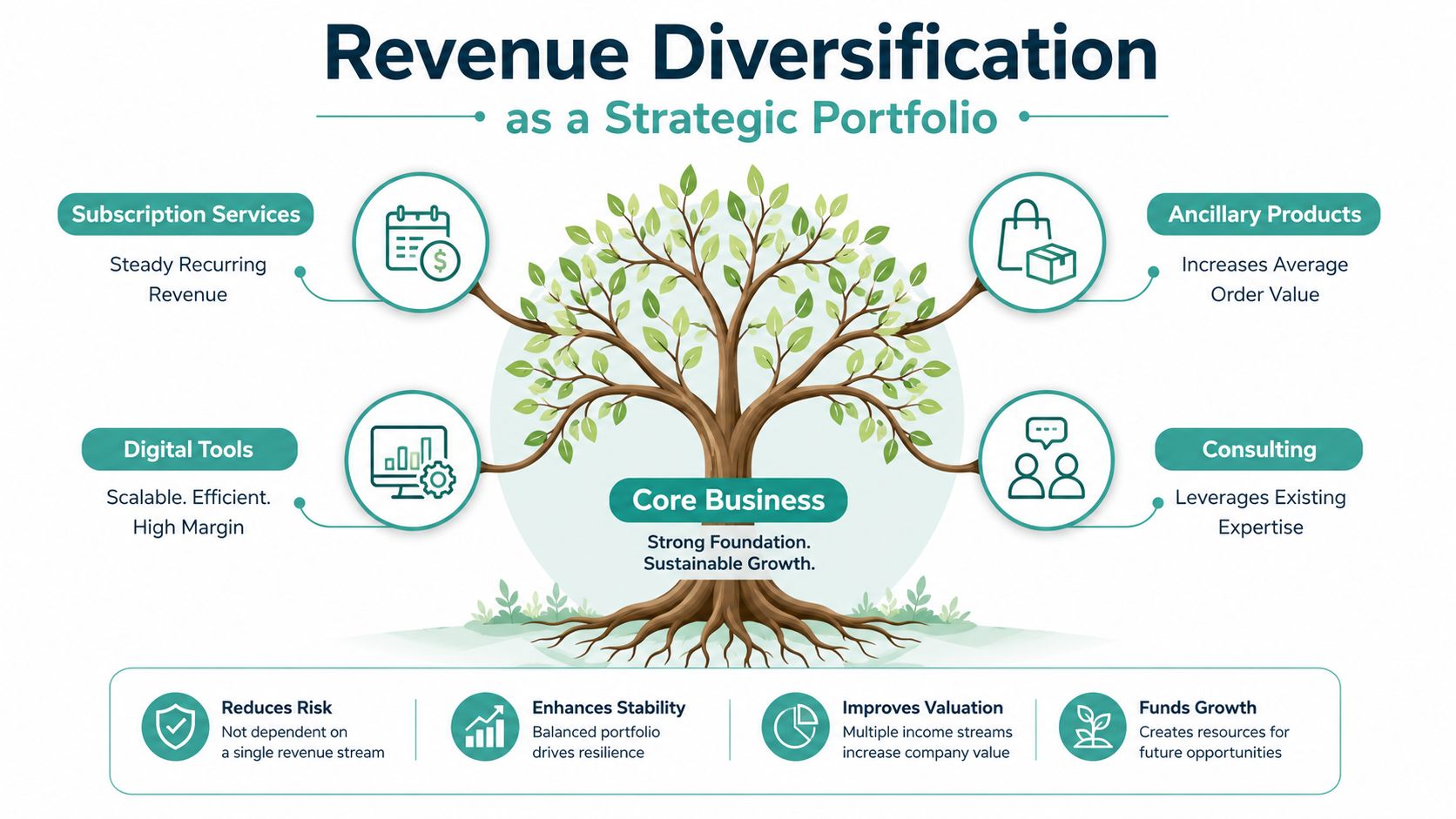
A healthy mix is usually boring in the best way. One source keeps the lights on, another makes demand less seasonal, and a third gives you room to test something new without betting payroll on it. In nonprofit research, organizations using four or more sources of revenue were less likely to be financially vulnerable to economic changes, which gives you a useful benchmark even if your business model is different. Walden dissertation on revenue diversification
Practical rule: if one customer, one service, or one channel can still break the month, you don't have a portfolio yet.
Here's the kind of scenario that matters. A home services company goes into a slow season, but it already has a second channel bringing in steady demand. The core crew can keep rebuilding while the side channel carries cash flow, so the owner doesn't panic-cut labor or slash prices just to stay afloat. That's what diversification is supposed to do, give you breathing room while the main engine resets.
Early warning signs are usually visible before the damage shows up in the bank account. If one client dominates too much of your receivables, if one service line carries the whole gross margin load, or if one channel controls almost all discovery, you're not diversified. You're exposed.
Auditing Your Current Revenue Concentration
You can't fix concentration if you don't measure it first. Start with a plain audit of clients, services, and channels, then sort each source by how much of the business it carries and how painful it would be if it vanished for a quarter.
Use a simple concentration lens. The point is not to create a perfect model, it's to identify fragility fast. A diversification ratio can help here, defined as revenue from new product or service lines divided by total revenue, with one guide recommending aiming for at least 30% to signal a strong diversification effort. That benchmark comes with an important warning, new streams should not starve the core business. Aviy on revenue diversification
If you want to know where the risk sits, score each source on three questions. How dependent are you on it? How volatile is it? How hard would it be to replace if it disappeared? Your top three fragilities usually show up quickly.
Revenue Concentration Audit Template
A large-city fiscal study gives you a useful analogy. Researchers defined revenue diversification as the share of own-source revenue that comes from sources other than the property tax, and a one standard deviation increase in diversification, equal to 13 percentage points, was associated with a 7.2% increase in general revenue. Cities moving from the 25th percentile to the 75th percentile of diversification, from 51% to 69%, had about 10% higher revenue over a 12-year period. Lincoln Institute study on city revenue diversification
The research concerns public finance. For a small business, the relevant question is how much revenue and margin each income stream contributes.
A local retailer I'd start with would look for concentration hidden inside a single quarter. If most sales ran through two channels at once, the business would be more fragile than it felt. The fix isn't to celebrate variety for its own sake. It's to add a third leg before the table starts wobbling.
Scoring and Prioritizing Candidate Income Streams
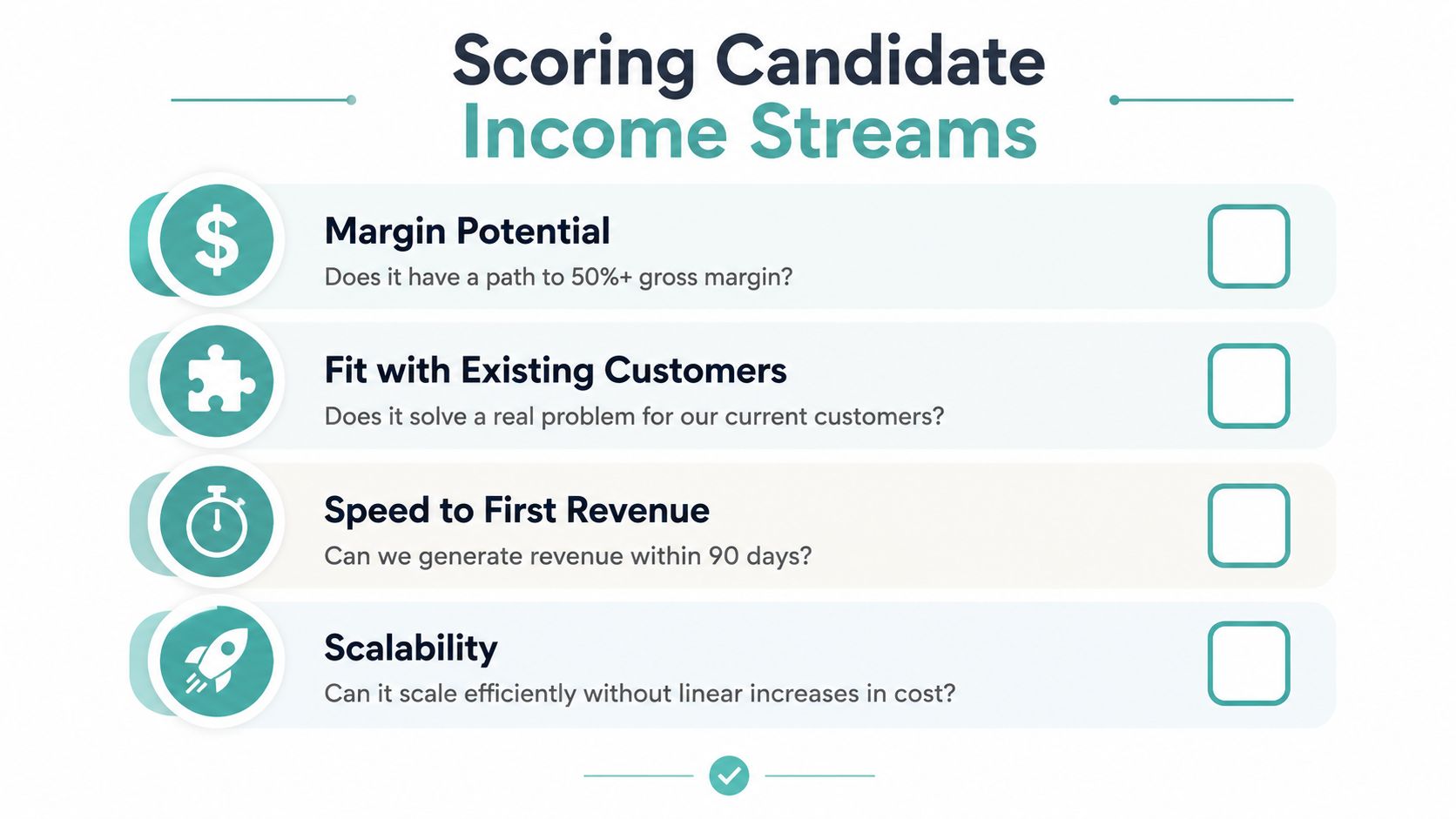
Brainstorming is cheap. Picking the right stream is where owners have to get disciplined. Score every candidate on four factors, margin potential, fit with existing customers, speed to first revenue, and scalability. If an idea looks attractive but creates too much operational drag, it usually turns into a side headache instead of a growth lever.
Keep the list short. Two or three options is enough. More than that usually means the owner is confusing possibility with priority.
How to judge the idea before you build it
Start with margin. If the stream cannot produce healthy gross profit, it needs a much stronger strategic case to justify the effort. Then check customer fit. The best new revenue usually comes from people who already trust you, because the sales cycle is shorter and the education burden is lower. Use a clear customer acquisition cost lens so you do not chase revenue that costs too much to bring in.
Speed matters too. A stream that takes a year to mature may still be worth it, but only if the business can afford the wait. Bain's guidance on revenue diversification makes the same point in a practical way, asking whether a new stream justifies the capital, management attention, regulatory burden, and implementation challenge compared with putting more effort into the core. It also pushes portfolio thinking, early wins, and governance because no single new stream should be expected to carry the whole plan. Bain guidance on revenue diversification strategy
I would rank common SMB options by how quickly they fit the current business and how much strain they add. A retailer may get more value from an ancillary product or a loyalty-style recurring offer than from a totally unrelated pivot. A real estate team may do better with premium lead-gen services or bundled marketing support. An auto shop may add maintenance plans or partnerships with local fleet operators. A home services firm may test a recurring maintenance retainer or a paid referral channel.
For local businesses, a low-cost TV test can be a practical way to add a second revenue path without starving the core business. Adwave lets a company create and launch broadcast-ready TV ads from a website URL, with campaigns that start at $50 and automatic pacing to keep spend inside the set limit. That kind of channel belongs on the shortlist when you want a measurable side stream that can move the diversification ratio without forcing a full rebuild of the business.
Designing a Pilot That Proves the Concept
Most diversification failures start with fuzzy success criteria. The owner launches, gets a few leads, feels hopeful, and then keeps spending long after the pilot should have been killed or scaled. That is not testing. That is drifting.
A real pilot has one offer, one customer segment, one budget cap, and one decision date. I prefer a 60 to 90 day window because it is long enough to show real behavior and short enough to stop damage early. If the stream cannot prove itself in that frame, it does not deserve more capital yet.
Build the test so it cannot wander
Pick the smallest audience that still reflects the market. If you run a local services business, do not test on everybody. Pick the best-fit segment and one channel you can measure cleanly. Price the offer so margin stays protected from day one, and make the back office part of the pilot, not an afterthought.
If billing, fulfillment, and reporting are not instrumented before launch, the pilot will lie to you.
Set the pass, pause, and stop rules before spending starts. Decide what counts as success, what earns another round, and what kills the idea outright. That keeps emotion out of the decision when the numbers are mixed.
For a local services business testing broadcast TV through Adwave, the structure can stay disciplined. The campaign starts at $50, the creative is auto-generated from the website URL, and the spend is capped so the test cannot run away. That makes it a practical way to validate whether a new media channel can produce trackable demand without pulling attention from the main operation. Adwave's $50 marketing test
The point is not to go big on day one. The point is to prove that the stream can produce useful revenue without creating operational drag. The 2020 IMF research is a good reminder that diversification can improve revenue performance and reduce volatility when the mix is measured properly. A 10% increase in a country's Tax Revenue Diversification Index was associated with an additional 0.2 to 0.4 percentage points of GDP in tax revenue, and a one-point improvement in diversification was associated with a 0.5 to 2.8 point reduction in tax revenue volatility. IMF study on tax revenue diversification
That does not mean every new stream works. It means the test has to tell the truth.
Choosing Between Adjacent, Unrelated, and Partnership Streams
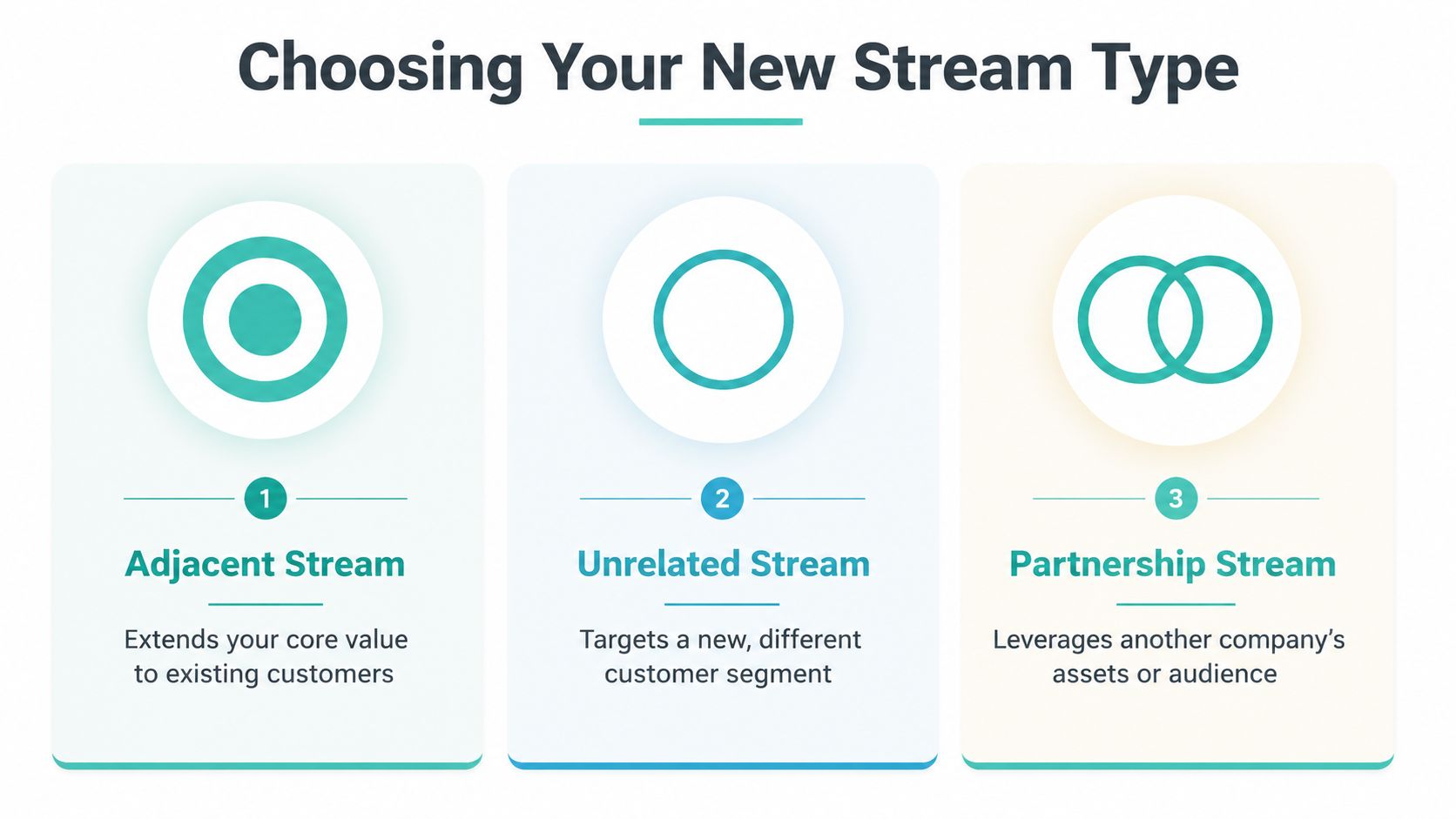
Not every revenue stream deserves the same treatment. Some are close to the core and easy to sell. Some chase a different customer altogether. Others rely on another brand's audience or assets. Treat those as three separate bets, not three versions of the same thing.
Adjacent streams usually win first
Adjacent streams extend the existing value proposition. They tend to convert faster because the customer already understands you. They also carry less brand dilution risk, which matters more than owners admit. If your business already has trust, don't throw it away chasing a disconnected idea.
Unrelated streams can work, but they demand more education, more marketing, and more patience. They're the ones most likely to pull focus away from the core if you start before the business is ready. Partnerships sit in the middle. They can share risk and reach, but only if the deal structure is clean and the mission fit is real.
The Bonadio guidance is useful here because it flags a real risk that many owners gloss over, unintended consequences such as alienating stakeholders, irritating peers, or losing focus on current programs. It also pushes a more nuanced question, whether the opportunity extends your value proposition or replaces it with something harder to protect. Bonadio on revenue diversification strategy
A practical screen for mission drift
Ask three blunt questions before you commit. Does this stream help the same customers solve a related problem? Does it strengthen the brand you already own? Does it avoid creating a second business that needs its own management stack?
If the answer is no to all three, keep it off the table for now.
Channels like TV can make sense for SMBs. A new channel is not automatically an unrelated bet. If it reaches the same local customer base and extends your existing offer, it can be an adjacent move instead of a leap into a different business model. That's why local advertisers often do better with channels that amplify the core than with side projects that need an entirely new identity.
Partnerships can be smart when you need audience access without building the whole thing yourself. But a partnership only deserves the slot if both sides know who owns lead flow, fulfillment, and the customer relationship. Anything less becomes confusion with a logo on it.
Measuring, Governing, and Scaling Winning Streams
Adding a stream is easy. Protecting the core while you scale it is the primary job. You need a simple dashboard that tells you whether the new line is adding strength or diverting management attention.
Track three things for each stream. Contribution margin, volatility, and whether the stream changes the load on the core team. If margin looks good but the team is drowning in billing corrections or fulfillment exceptions, the business is paying for that revenue in a hidden currency.
Use a quarterly operating rhythm
Review concentration every quarter. If a stream is working, decide whether it deserves more capital, more automation, or more standard operating procedures. If it's weak, cut it before it becomes emotional baggage. That's especially important because operational drag from billing, payment timing, and tracking can kill a new stream before it scales, which is why the launch sequence matters so much.
A simple governance rule works better than a complicated model. New revenue should not monopolize the team, and the core should not subsidize a side line forever. If a stream needs constant handholding and still can't justify its weight, it's not ready.
Measure what changes cash, not just what looks active.
For local businesses, a performance-measured channel like TV can fit well when it's tracked as part of the portfolio rather than treated as a one-off campaign. If you want a practical way to connect ad spending to business outcomes, use this resource on measuring marketing ROI. The point isn't to celebrate impressions. The point is to know whether the stream is earning its place.
The Norwegian newspaper industry is a good reminder that diversification can be deliberate and sustained over time. The Revenue Diversity Index rose from 65 in 2006 to 79 in 2019, while total revenue fell from 14.2 billion NOK to 11.9 billion NOK, a decline of 2.3 billion NOK or 17%. The mix included e-commerce, B2B services, events, merchandising, and crowdfunding alongside traditional revenue sources. Norwegian newspaper industry revenue diversification study
Set rules for evaluating each revenue stream, including costs, margins, and the staff time it requires.
Your 90-Day Revenue Diversification Action Plan
Start with a tight sequence. Week one is the audit. List revenue by client, service, and channel, then flag concentration, dependency, and volatility. Week two is prioritization. Score candidate streams on margin, fit, speed, and operational drag, then choose two or three at most.
Weeks three and four are pilot design. Lock the budget, define the offer, choose the customer segment, and set the go or no-go criteria before launch. If you're testing a marketing channel, use a clean setup with a measurable path from spend to revenue. A simple planning aid like this three-month content calendar template can help you keep the test organized without overcomplicating it.
Weeks five through ten are launch and measurement. Do not add side experiments. Do not widen the audience because you're nervous. Follow the pilot, collect the data, and watch for the common failure modes, launching too broadly, using hourly-cost pricing instead of value-based pricing, and failing to systematize admin. Those mistakes turn a promising stream into noise.
Kill signals you should respect
Close a revenue stream if it cannot justify its costs and workload after a reasonable period of improvement.
By days 80 to 90, make a hard call. Scale it, pause it, or kill it. Then move into a quarterly rhythm so the business keeps managing the portfolio instead of improvising around it. That's how diversification becomes a discipline rather than a side project.
If you want to add a new income stream without putting the core business at risk, use Adwave as a practical test channel and measure it like a portfolio asset, not a hunch. Visit Adwave to see how a low-cost TV campaign can fit into a disciplined revenue diversification plan and help you build a more resilient mix.


