You’ve got a customer list, a few exports from your point-of-sale system, and a marketing budget that can’t absorb another campaign aimed at everyone. Recent buyers receive the same offer as dormant customers, frequent customers get treated like one-time purchasers, and your best local customers may never see your next promotion. RFM segmentation for small business gives you a practical way to sort that list by what customers do, then connect those groups to email, SMS, retention, and targeted TV advertising.
Why RFM Segmentation Works for Small Businesses
A local retailer can spend an entire week promoting a sale to people who haven’t purchased in years, while a customer who bought repeatedly last month receives no special reason to return. The problem usually isn’t a lack of customer data. It’s the absence of a useful decision rule.
RFM means Recency, Frequency, and Monetary value. Recency asks how recently someone bought. Frequency counts qualifying purchases. Monetary value measures what that customer contributed during the selected period. Together, those three measures turn a flat customer file into a practical view of who deserves retention effort, who needs reactivation, and who may be ready for an upsell.
The method has a long operating history. Catalog and mail-order firms had used RFM in direct and database marketing since at least the 1980s, when response costs made it important to decide which households deserved attention, as described in this history of RFM segmentation. Its modern form became more widely recognized in the 1990s, as transaction databases and statistical software made customer ranking easier.
The small-business advantage
RFM was built around a constraint small businesses understand well: limited budget and limited staff time. You don’t need a machine-learning infrastructure to rank customers on their transaction behavior. A modest dataset can support structured scoring, often on a 1 to 5 scale, and the logic works across retail, travel, subscriptions, gaming, financial services, software, and other B2C or B2B settings.
The value isn’t the score itself. The value is the decision that follows it. A recent repeat buyer may justify a loyalty message, while a previously valuable customer who has gone quiet may justify a carefully timed win-back campaign. A basic small-business social media guide can help with channel planning, but RFM tells you which customers should receive the attention before you choose the channel.
For local advertising, customer behavior also gives you a stronger starting point than a broad audience label. Audience segmentation explained by Adwave provides useful context for turning customer characteristics into reachable groups. RFM adds a behavioral layer, so your media plan can distinguish recent repeat buyers from lapsed high-value customers rather than treating every local viewer as equally valuable.
Preparing Your Transaction Data for Scoring
Scoring bad data produces confident-looking nonsense. Before calculating anything, decide what business decision the scores must support. Are you trying to retain frequent buyers, bring back lapsed customers, increase order frequency, or decide which existing customers should inform a local advertising test?
Choose the observation window around the purchase cycle, not around convenience. A practical workflow uses a 6 to 24 month lookback window, then cleans and organizes the transaction history before scoring, as outlined in this RFM data preparation workflow.
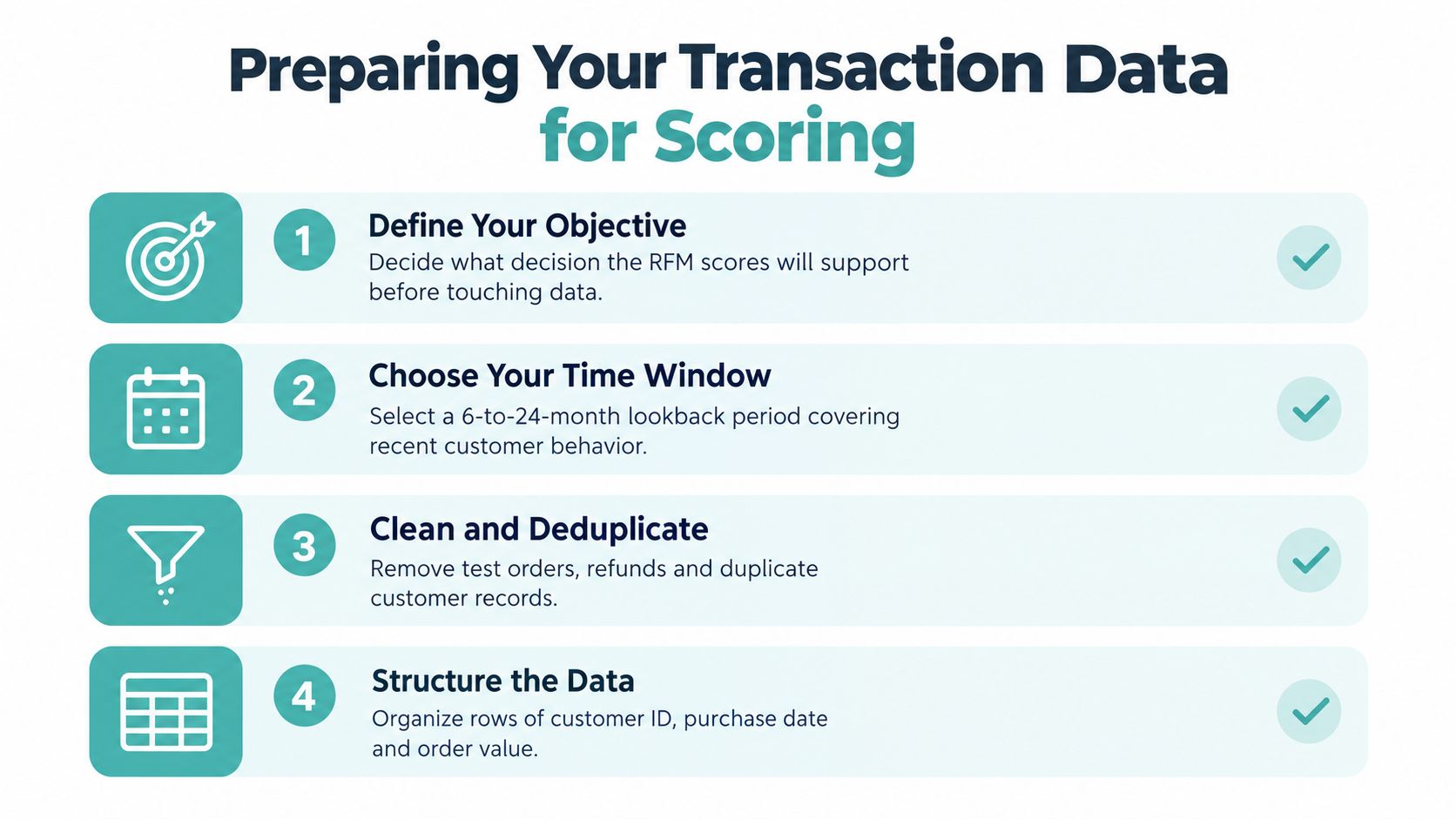
Make the lookback fit the buying rhythm
A business with frequent replenishment needs a window that reflects recent buying behavior. A business with seasonal or infrequent purchases needs enough history to avoid labeling normal pauses as churn. The right window is the one that captures a meaningful cycle without allowing very old behavior to dominate current decisions.
Next, create a stable customer identity. One person may appear under an email address in one system, a loyalty identifier in another, and a slightly different name at the register. Deduplicate those records before calculating Frequency. Otherwise, one customer can look like several occasional buyers, and your loyalty audience will be understated.
Clean the transaction rows
Remove or isolate transactions that don’t represent genuine customer value:
- Test orders: Exclude internal purchases and system checks that inflate order counts.
- Returns and refunds: Reverse their effect rather than counting them as positive revenue.
- Fraudulent transactions: Remove activity that shouldn’t guide marketing decisions.
- Duplicate records: Collapse repeated exports or duplicated order IDs.
- Customer identity errors: Standardize identifiers before grouping transactions.
For Monetary value, contribution value is more useful than raw revenue when cost data is available. A high-revenue customer who consistently generates expensive returns may deserve a different treatment from a customer whose purchases produce healthier contribution.
Finish with a simple table containing a customer ID, purchase date, and qualifying order value. Keep the raw export untouched, save the cleaned version separately, and document every exclusion. That record makes later troubleshooting much easier and gives your first-party data a dependable foundation. You can find broader context on first-party data for small businesses when connecting transaction records to audience activation.
Calculating Recency Frequency and Monetary Scores
Once the records are clean, the calculations are straightforward. For each customer, calculate Recency as the number of days since the last qualifying order, Frequency as the number of qualifying transactions in the observation window, and Monetary as the total transaction value in that same window.
The difficult choice is how to turn those raw values into comparable scores. A customer with three orders may be highly frequent in one business and unremarkable in another. Fixed thresholds can misclassify customers when buying patterns change, so RFM threshold guidance recommends quantile breakpoints, segment profiling, and validation rather than arbitrary cutoffs.
Use quantiles before inventing rules
A common implementation ranks customers separately on each variable and divides each ranking into five equal groups. The strongest group receives a score of 5 and the weakest receives a score of 1. Recency runs in the opposite direction from the other variables: the most recent customers receive the highest score, while customers with the longest time since purchase receive the lowest.
| Variable | Top 20% (Score 5) | Bottom 20% (Score 1) |
|---|---|---|
| Recency | Most recent customers, with the fewest days since their last order | Customers with the longest time since their last order |
| Frequency | Customers with the most qualifying transactions | Customers with the fewest qualifying transactions |
| Monetary | Customers with the highest qualifying transaction value | Customers with the lowest qualifying transaction value |
The table is a scoring pattern, not a universal set of calendar or spending cutoffs. Let your own customer distribution determine the boundaries. For a small customer base, fewer bins may be more stable than forcing five groups with very few records in each one.
Practical rule: Score the customer population you actually have, then inspect whether the resulting groups behave differently. Don’t copy a threshold from another industry simply because it looks tidy.
Validate before you activate
After assigning scores, profile each group. Compare average and median recency, transaction counts, and contribution value. Guidance also recommends checking separation with ANOVA or a similar statistical test after scoring, but the operational test matters just as much: can your team describe the group, choose an offer, and identify the right channel?
Over-segmentation creates another problem. Dozens of tiny clusters may look detailed, but they force a small team to write too many campaigns and weaken media efficiency. A practical operating model usually maps the scores into 6 to 10 actionable groups, with fewer groups when the database is small or the buying cycle is simple.
Mapping Scores to Actionable Customer Segments
A score such as 5-4-5 is only useful when it changes what your team does. Give each operational segment a plain-language name, a clear business purpose, and a campaign rule. The exact boundaries should reflect your distributions, but the strategic roles are familiar.
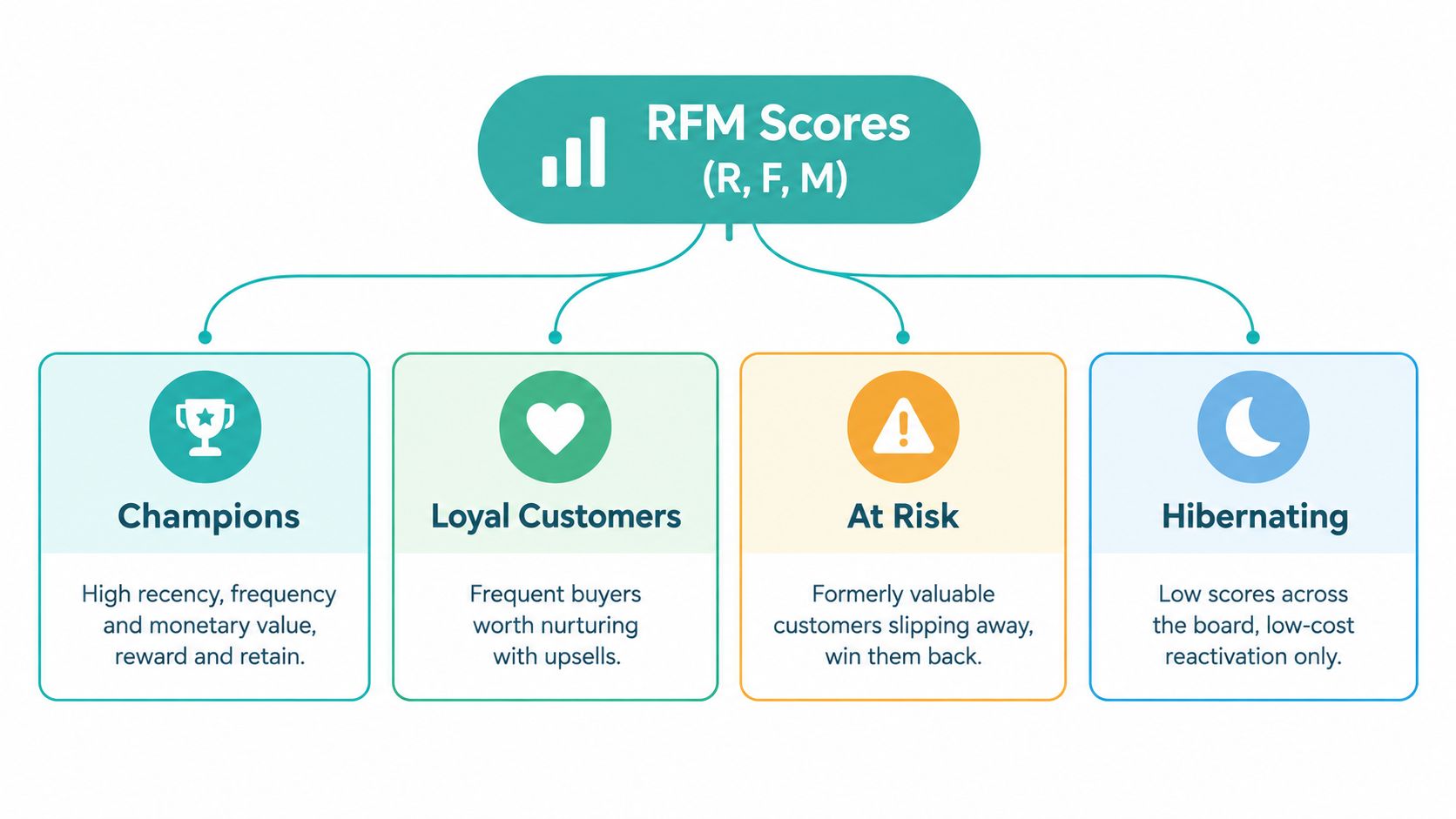
Four groups that earn their place
Champions score strongly across Recency, Frequency, and Monetary value. They should receive recognition, early access, loyalty rewards, referral invitations, and service that protects the relationship. Don’t train them to wait for a discount. Give them reasons to stay close to the brand.
Loyal Customers purchase frequently and show dependable value, even if they aren’t at the very top on every measure. Use complementary product recommendations, bundles, membership benefits, and sensible upsells. Their next action should feel like a natural extension of what they’ve already bought.
At Risk customers often combine a history of value with weakening Recency. Treat them differently from ordinary inactive buyers. Review their last purchase, identify a relevant reason to return, and use a win-back sequence that can include email, SMS, service outreach, or a targeted local media message.
Hibernating customers score low across the behavioral dimensions. Keep reactivation inexpensive and learn from the response. A broad offer, a preference prompt, or a final low-cost test can be appropriate, but don’t let this group consume the budget meant for customers with stronger evidence of future value.
These categories are supported by academic and applied work showing that RFM can separate customers into useful groups such as Champions, Loyal Customers, At-Risk, and Hibernating, as described in this empirical RFM study.
Turn each group into a playbook
Write the action before launching the segment. For example:
- Champions: Offer VIP access, appreciation benefits, and referral opportunities.
- Loyal Customers: Recommend related products and invite them into retention or loyalty programs.
- At Risk: Use a personal win-back message tied to the customer’s previous category or service.
- Hibernating: Test low-cost reactivation, collect feedback, and suppress repeated broad promotions when there’s no response.
The best segment map is one your team can execute consistently. Start with a manageable set of groups, document the score logic, and make sure every segment has an owner, a message, and a next action.
Activating Segments with Email and TV Advertising
Email is often the first RFM channel because it’s easy to connect a customer score to an automated sequence. That doesn’t mean email should be the finish line. A high-value local customer group can also inform SMS timing, direct outreach, creative themes, and TV audience decisions.
Start with channel hygiene. Before a customer file enters an email workflow, use an Email Validation API to identify invalid addresses and reduce avoidable delivery problems. Then match the message to the segment. Champions may respond to recognition and access, while At Risk customers need a relevant reason to return rather than another generic newsletter.
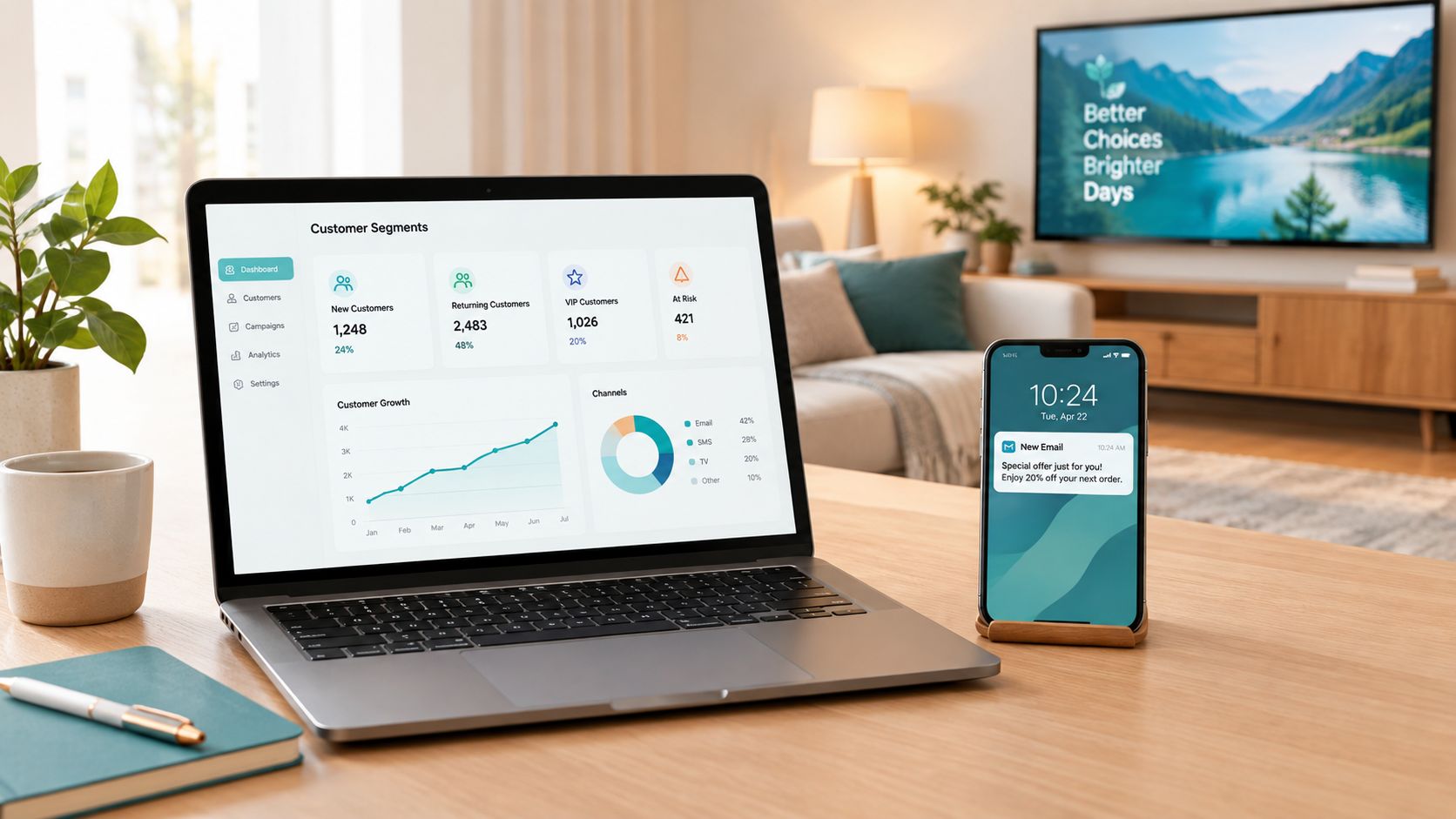
Extend the signal into local media
RFM can help a small business decide who should shape a TV test. Recent repeat buyers may indicate the profile of a customer worth retaining, while high-value lapsed buyers may indicate a local audience that needs a strong reminder. The model doesn’t replace geographic or media planning. It gives those decisions a customer-value lens.
Adwave fits this use case by providing broadcast-ready TV campaigns, automatic pacing, and local audience targeting for small businesses. Its campaigns start at $50, so a business can test TV against a clearly defined RFM-informed audience without committing to a large upfront media budget. The platform can also generate a spot from a website URL and support performance tracking, which keeps the workflow connected from creative through measurement.
Use email lifecycle marketing guidance to coordinate the sequence. For example, an At Risk customer might receive a win-back email first, then see a locally relevant TV message during the same promotional period. Keep the audience definition, offer, landing page, and measurement window consistent enough that you can interpret the result.
The trade-off is reach versus precision. Email and SMS offer direct identity-level communication, while TV can build local awareness beyond the people already in your database. RFM helps you decide where broader reach is justified, instead of paying to communicate the same message indiscriminately.
Measuring Segment Performance and ROI
Measure both customer movement and campaign economics. A successful win-back effort should produce more than clicks. Track whether At Risk customers become active again, whether Loyal Customers remain stable, and whether Champions continue to purchase without excessive discounting.
Create a simple reporting view for each segment:
- Response: Record purchases, replies, visits, or other defined actions.
- Migration: Track movement between Hibernating, At Risk, Loyal, and Champion groups.
- Value: Compare contribution from the segment with campaign and media costs.
- Efficiency: Review cost per response and return on targeted spend.
- Quality: Check unsubscribes, complaints, refunds, and margin impact.
Recalculate scores on a schedule that matches the business. A faster-moving retailer may need more frequent refreshes, while a slower purchase cycle can support a less frequent review. Document seasonal effects so a normal quiet period isn’t mistaken for permanent customer loss.
For a practical framework on connecting campaign costs with outcomes, use Adwave’s guide to measuring marketing ROI. The important habit is consistency. Keep the segment definitions stable long enough to learn, then adjust them when customer behavior or the buying cycle changes.
Adwave helps small businesses turn customer insight into broadcast-ready TV advertising with AI-generated creative, local targeting, automatic pacing, and performance tracking. Use your RFM groups to decide which customers and local audiences deserve broader reach, then visit Adwave to explore a focused TV campaign.