Maria, who owns a three-location dental group, had just approved a six-figure Connected TV buy. She expected the phones to ring, and they did, for about two weeks. Then the calls slowed, while the landing-page analytics showed people had visited, looked around, and left without giving the practice a usable way to follow up.
That’s the failure pattern I see in local marketing. The television campaign paid to create attention, but the business treated the first visit as the finish line. Without permission-based email capture, source tagging, and a relevant sequence, the team can’t reconnect with the people who weren’t ready to book immediately. The same viewer might see the spot three times and still never receive an inbox message that continues the conversation.
Email lifecycle marketing fixes that gap. It connects a broadcast impression to a known contact, a known contact to a next action, and that action to revenue reporting. It isn’t an extra channel bolted onto TV. It’s the operating system that helps a business capture and monetize the audience its media already reached.
When a TV Spot Without an Email Plan Burns Money
Maria’s campaign produced visits, but the team couldn’t distinguish a casual browser from someone comparing dental providers, looking for insurance information, or trying to schedule an appointment after business hours. The landing page had done its job as a destination, yet it hadn’t created a durable relationship with the visitor.
That leaves two costs hidden. First, the business knows what it paid to generate attention and site visits, but not what portion of those visits became booked appointments after the visitor left. Second, the team loses the ability to send a relevant reminder, answer a common objection, or offer a low-friction consultation to people who showed interest but weren’t ready to act.
Operator’s rule: A TV campaign should never end at the landing-page visit. It should end with a permissioned contact, a measurable next step, or both.
The practical fix starts with a dedicated landing page and one conversion goal. A dental group might offer an appointment request, an insurance checklist, or a new-patient consultation. The form should attach the TV campaign, creative variant, location, and submission time to the contact record. A welcome email can then mirror the promise made on screen while the brand is still familiar.
Why repetition without follow-up wastes attention
Broadcast exposure creates recognition, but recognition doesn’t tell you what a person needs next. Someone who watched an offer and visited the page may need proof, directions, pricing context, or a direct booking prompt. Sending the same promotional message to every visitor ignores the behavior that separates those needs.
A lifecycle sequence gives the business a way to respond. A visitor who submits a form can receive an immediate confirmation. Someone who visits a service page but doesn’t submit can enter a consent-compliant nurture path if the business has captured an address elsewhere. A booked patient should leave acquisition messaging and move into appointment preparation, reminders, and post-service retention.
That continuity also improves attribution. The original influence may have been television, while the final conversion came through email. Reporting should preserve both facts instead of forcing the business to label the appointment as either “TV” or “email.” TV created the initial demand, and lifecycle messaging helped close it.
For Maria, the important question isn’t whether email replaces television. It’s whether the media investment produces a reusable audience and a follow-up process. Without that process, every new TV flight starts from zero.
What Email Lifecycle Marketing Actually Means
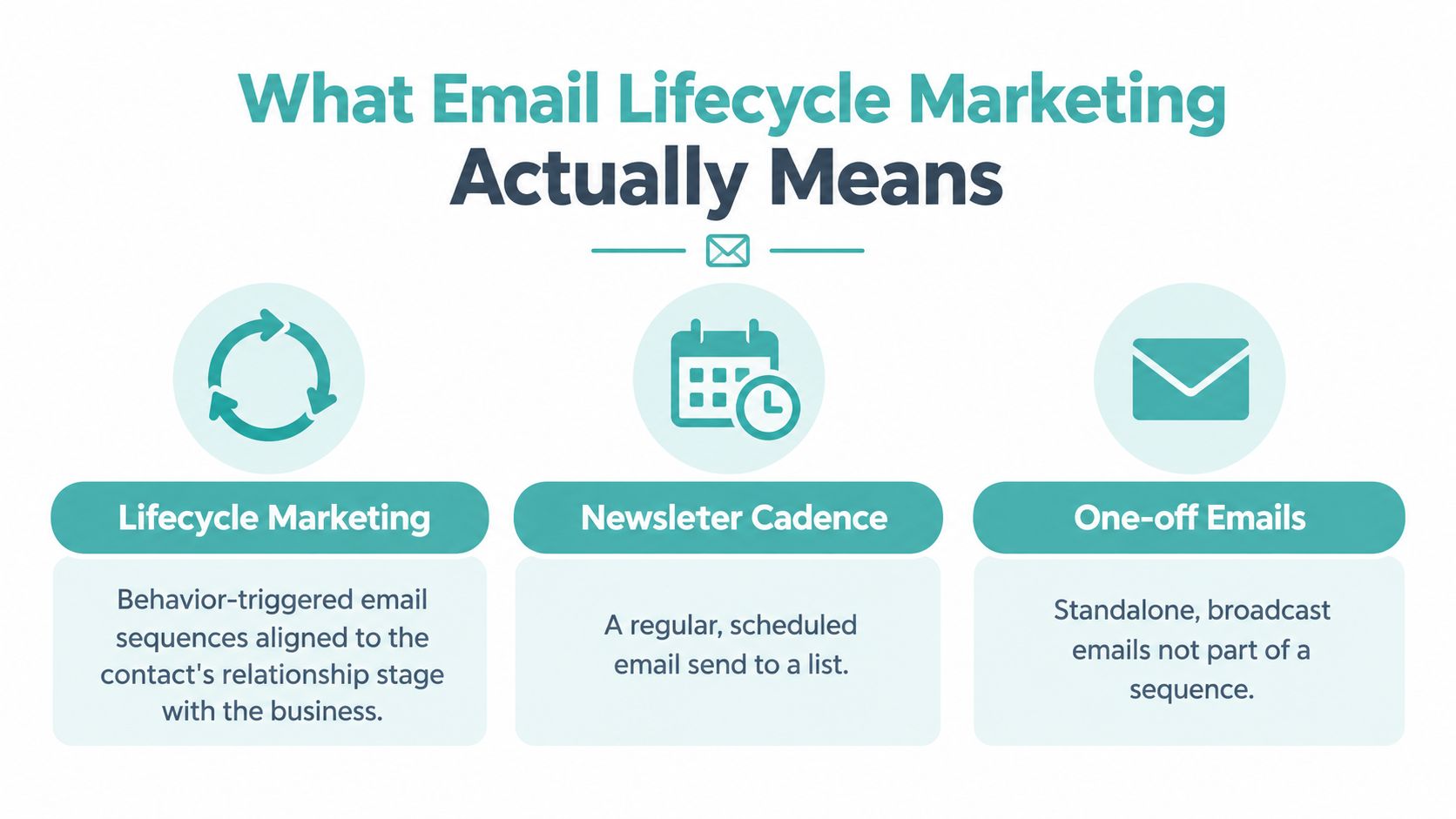
Email lifecycle marketing is a set of behavior-triggered sequences aligned with a contact’s relationship to a business. It differs from a newsletter cadence, which sends on a regular schedule, and from a one-off blast, which broadcasts a standalone message to a broad list.
A useful analogy for a Monday team meeting is a houseplant. A newsletter is the watering can used on a fixed schedule. A blast floods the whole room. Lifecycle marketing is the moisture sensor that waters each plant when its soil reads dry. The contact’s action determines the message and timing, not the date on the calendar.
The three pieces every program needs
A workable program has three structural requirements:
- A behavioral source of truth: The system records page views, form fills, purchases, appointments, service milestones, TV-driven landing-page visits, and meaningful inactivity.
- A modular email library: The team creates reusable messages for welcome, education, reminders, post-purchase support, cross-sell, and reactivation instead of writing every send from scratch.
- Trigger and suppression rules: Automation determines which event starts a flow, how long the system waits, which contacts should be excluded, and when a person moves into a different stage.
The goal isn’t to maximize open rate in isolation. The goal is to move a known contact to the next measurable step, such as completing a consultation request, attending an appointment, placing a second order, or returning after dormancy.
Segmentation makes that system more precise. This pipeline-driven email marketing guide is useful for teams that need to connect lead capture with follow-up rather than treating email as a disconnected broadcast activity. The same principle applies to local retail and service businesses. A contact’s source and behavior should shape the next message.
A newsletter still has a place. It can build familiarity and provide useful editorial content. A blast can support a timely promotion. Neither should carry the entire customer journey, because neither automatically adapts when the recipient takes action.
The Five Lifecycle Stages From First Click to Loyal Customer
The five stages below give a small team a common operating language. Each stage needs four decisions: what starts it, what business outcome matters, what the email offers, and which metric proves progress.
Acquisition
Acquisition begins when someone submits a form, scans a QR code connected to a TV spot, or otherwise gives the business permission to communicate. The immediate objective is a first conversion, not a long introduction to every product or service.
The first email should make the next step easy. That might be a consultation request, a booking link, a product recommendation, or a short guide related to the original promise. Measure the lead-to-customer rate, because a high volume of captured addresses means little if contacts don’t progress.
Onboarding
Onboarding starts at signup or first purchase. Its job is to help the customer reach an early success point and establish the habit that makes the relationship useful.
For a retailer, that could mean showing how to use the product, explaining delivery, or recommending an appropriate companion item. For a service business, it may include preparation instructions, location details, or what happens during the first appointment. The primary measure is day-7 retention, interpreted according to the business’s natural buying or service cycle.
Engagement
Engagement begins when the customer shows repeat behavior, such as viewing content again, purchasing a second time, or returning to a service page. The objective is deeper use and stronger relevance.
The offer should reflect observed behavior. A customer who repeatedly views outdoor furniture shouldn’t receive the same message as someone browsing kitchen products. Track sessions per customer or an equivalent depth-of-use measure that fits the business.
Retention
Retention follows a post-purchase or post-service milestone. The business is now trying to increase lifetime value through a useful ongoing relationship, loyalty recognition, replenishment, or carefully chosen cross-sell.
A dental practice might invite a patient to schedule the next preventive visit. A retailer might provide care guidance and a complementary recommendation. The primary measure is repeat purchase rate, or repeat booking rate for services.
Reactivation
Reactivation begins when a customer reaches the business’s dormancy threshold. The team’s job is to revive the relationship without training people to wait for discounts.
A win-back email can remind the customer of past value, present a relevant reason to return, or ask whether their needs have changed. Track reactivation rate and revenue recovered, while also suppressing contacts who remain inactive after the defined attempt.
| Stage | Trigger | Goal | Offer | Primary Metric |
|---|---|---|---|---|
| Acquisition | Landing-page submit or TV QR scan | First conversion | Low-friction next step | Lead-to-customer rate |
| Onboarding | Signup or first purchase | Activation and habit | Quick-win guidance | Day-7 retention |
| Engagement | Repeat behavior or content view | Depth of use | Personalization | Sessions per customer |
| Retention | Post-purchase or post-service milestone | Lifetime value | Loyalty or cross-sell | Repeat purchase rate |
| Reactivation | Dormancy threshold | Revival | Win-back message | Reactivation rate and revenue recovered |
The email list segmentation resource from Adwave provides a practical companion for deciding who should receive each message. A stage is only useful when the contact can move in and out of it based on behavior.
Trigger-Based Automations and Timing Windows That Drive Revenue
A lifecycle stage becomes operational when a specific action fires a message. Small teams don’t need a maze of automations. They need a small set of flows with clear entry conditions, timing windows, offers, and exit rules.
Start with the highest-intent events
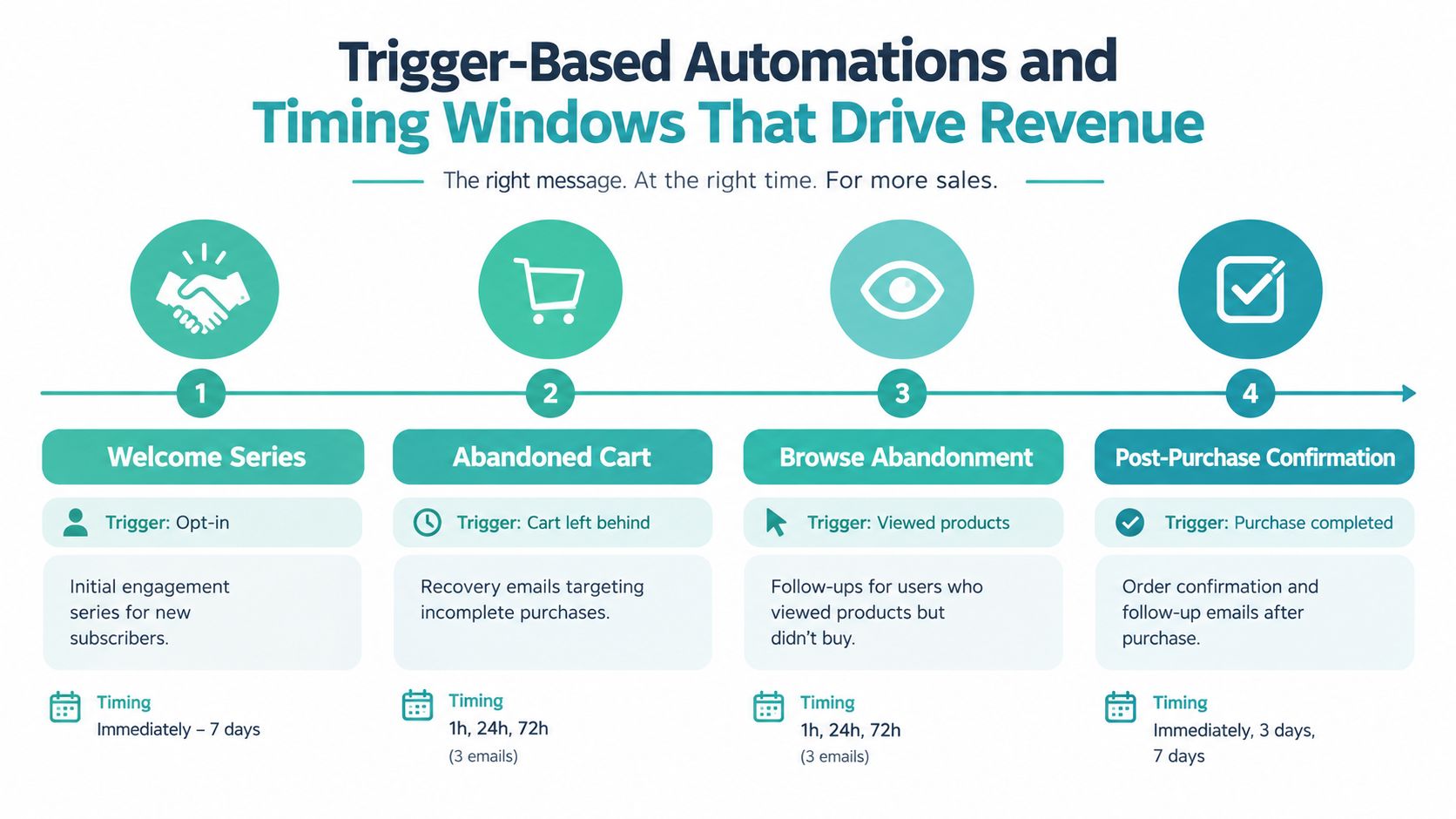
A welcome series starts at opt-in. The first message confirms the exchange, restates the promised value, and points to one action. Later messages can answer objections or explain the next step, but the series should stop or branch when the contact converts.
Abandoned-cart recovery works best when the customer has shown clear purchase intent. A practical sequence uses reminders at one hour, 24 hours, and 72 hours, with the first message focused on completion, the next on reassurance, and the final message on a relevant reason to return. Measure recovered revenue or completed orders, not just clicks.
Browse abandonment is appropriate for warm traffic that viewed a product without buying. The email should reference the category or product context without becoming invasive. Suppress it if the customer purchases or receives a conflicting promotion.
Match timing to the buying cycle
Post-purchase confirmation is immediate and functional. A cross-sell or usage-support message generally belongs after the customer has had time to receive or experience the purchase, often within the day 3 to day 7 window. Consumables can use replenishment reminders based on expected usage, while win-back flows can begin at 60 or 90 days of inactivity when that matches the category.
Service businesses need different logic. There’s no cart to recover when someone is comparing roofers, dentists, or repair shops. Substitute a consultation-request reminder, appointment confirmation, preparation email, missed-appointment follow-up, or service milestone reminder. The trigger is still behavioral, but the event is a form submission, quote request, appointment, or lapse in scheduled care.
Re-engagement should happen before sunset suppression. If a subscriber stops engaging, the business can make a final relevance-based attempt, then remove or suppress the contact according to its policy. This practical overview of implementing AI in marketing automation is relevant when a team wants help prioritizing signals, but automation should remain governed by consent, frequency limits, and clear business goals.
Measurement rule: Use one trigger, one goal, and one offer per flow. Judge the result by revenue per send or the next business outcome, not open rate alone.
For a small team choosing the first campaigns, Adwave’s guide to email automation for small business offers a useful launch sequence. Build the flow that catches the strongest intent before expanding into edge cases.
Lifecycle Flows for Local SMB Verticals
The framework changes with the buying cycle. A real estate lead may need education before a conversation, an auto customer needs reliable service reminders, and a restaurant guest may return because a timely personal occasion creates relevance.
Real estate
A listing landing-page form can trigger a CMA request at 15 minutes, while the contact still remembers the property or valuation promise. A neighborhood guide follows on day 2, then a market update drip runs every 14 days. At day 30, the agent can hand off contacts whose intent score has crossed the agreed threshold.
The flow’s single KPI is qualified appointment rate. Email count matters less than whether the sequence helps the agent identify and respond to serious intent.
Auto
The auto flow starts with service appointment confirmation, followed by a repair-status update when the vehicle enters the shop. A 90-day inspection reminder supports retention, while a trade-in valuation campaign can use the vehicle’s model year as a relevance signal.
The primary KPI is repeat service booking rate. A dealership shouldn’t send a trade-in pitch to someone waiting for a repair update, so stage and service status need to suppress conflicting messages.
Restaurants
A reservation confirmation should include directions and practical details. A post-visit review request arrives on day 2, followed by birthday and anniversary offers when the customer has provided those dates. A win-back flow at 90 days can offer a free item when that incentive fits the margin and customer history.
The primary KPI is repeat visit rate. The strongest restaurant flows make the next visit easy rather than sending a general promotion to every subscriber.
| Vertical | Trigger Event | Emails | Timing Window | Primary KPI |
|---|---|---|---|---|
| Real estate | Listing landing-page form | CMA request, neighborhood guide, market updates, agent handoff | 15 minutes, day 2, every 14 days, day 30 | Qualified appointment rate |
| Auto | Service appointment and vehicle milestones | Confirmation, repair update, inspection reminder, trade-in campaign | Immediate, during service, 90 days, model-year timing | Repeat service booking rate |
| Restaurants | Reservation and visit history | Confirmation, review request, occasion offers, win-back | Immediate, day 2, date-based, 90 days | Repeat visit rate |
The contrast is the point. The five stages remain consistent, but the trigger, offer, and acceptable delay depend on transaction value, urgency, and how often customers naturally return.
How TV Campaigns Feed the Lifecycle
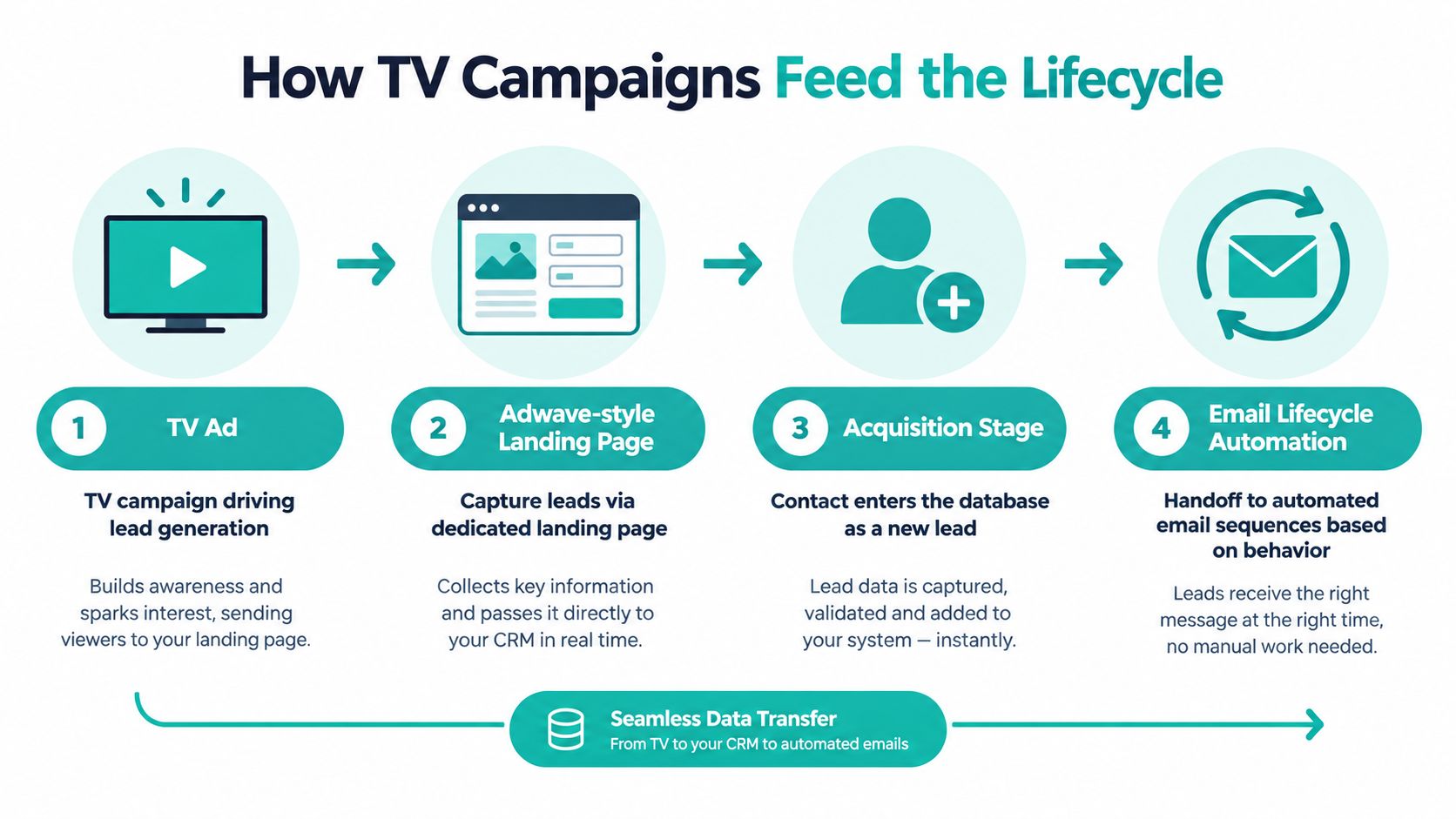
A TV campaign should enter the lifecycle at acquisition, not disappear after someone submits a form. An Adwave-style landing page can give the spot a focused destination, while the form transfers the campaign source and creative context into the contact record.
The data flow is straightforward:
- The TV spot creates demand: The call to action directs viewers to a dedicated page or memorable response path.
- The landing page captures permission: One form supports one conversion goal, such as requesting a quote, booking a consultation, or claiming an offer.
- The contact receives source tags: The record stores the TV campaign, creative variant, location, and relevant consent details.
- The welcome sequence starts promptly: The first email mirrors the on-air promise and provides the next action.
- Behavior determines progression: Clicks, form completions, purchases, appointments, and inactivity move the contact through later stages.
Keep the message thread intact
The welcome email shouldn’t introduce an unrelated offer. If the television spot promotes a dental consultation, the first message should confirm that request or help the person schedule. If the spot promotes a restaurant offer, the email should make redemption and directions clear.
After that, the campaign source should stop controlling every message. A TV lead who books an appointment needs onboarding and reminders. A TV lead who buys a product needs post-purchase support. A contact who becomes inactive needs reactivation. Lifecycle logic follows the person, not the media flight.
Frequency also needs coordination. During a heavy TV week, the business may increase awareness touches while its email system continues sending automated messages. Suppression rules can prevent a person from receiving a promotional broadcast immediately after a triggered email, or pause a nurture sequence after a conversion.
Attribution should preserve the full path. Report television as the initiating source when it introduced the contact, and email as an assisting or closing interaction when it helped produce the appointment or purchase. This gives the owner a more useful view than assigning all credit to the last click.
KPIs Deliverability and Optimization You Can Run This Week
Open rate can help diagnose a delivery or subject-line problem, but it shouldn’t be the program’s final scorecard. Privacy changes and signal loss make it safer to prioritize inbox placement, complaints, conversions, revenue per recipient, and stage-to-stage movement.
Use metrics that map to business outcomes
Activation rate shows how many contacts move from acquisition into onboarding. Engagement rate should be evaluated within the relevant stage, because a post-purchase message and a cold reactivation email serve different jobs. Revenue per email ties the send to commercial output, while stage-to-stage conversion shows where the journey loses momentum.
| Stage | Primary KPI | Benchmark | Action Threshold |
|---|---|---|---|
| Acquisition | Lead-to-customer rate | Improving progression from captured lead to customer | Review the offer, form, and source tags when leads stall |
| Onboarding | Activation rate | Contacts completing the intended early action | Revise the sequence when activation falls |
| Engagement | Revenue per email | Positive commercial contribution from relevant sends | Recheck segmentation and offer relevance when revenue weakens |
| Retention | Repeat purchase or booking rate | Customers returning after the milestone | Audit timing, cross-sell logic, and service reminders |
| Reactivation | Reactivation rate and revenue recovered | Dormant contacts returning or buying again | Suppress persistent non-responders and refine the win-back |
Deliverability starts before the first campaign. Braze recommends SPF, DKIM, and DMARC for sending domains, a preference center, sunset policies, prompt hard-bounce removal, complaint management, and frequency adjustments by segment. Its guide to high-impact email marketing strategy is a useful reference for turning those controls into operating practice.
Use a dedicated sending domain or subdomain for marketing where appropriate, keep transactional mail distinct, and maintain list hygiene. The Adwave resource on email spam and deliverability provides a practical checklist for small teams diagnosing inbox placement.
Run one clean test at a time
A solo marketer can test a subject line, send time, or CTA copy. Choose one variable, test it on 20% of the list for 24 hours, promote the winner, and log the result. Don’t change the audience, offer, design, and timing together, because you won’t know which decision caused the outcome.
Teams looking for a different strategic perspective can review Crescade’s lifecycle marketing approach. The operating rhythm should stay simple: review funnel drop-offs weekly, audit automations monthly, and prune unengaged subscribers quarterly.
Your Minimum Viable Lifecycle Program in 30 Days
A small business doesn’t need every possible flow before launch. It needs a clean entry point, a useful welcome sequence, one retention mechanism, and measurement that shows whether contacts move forward.
Week-by-week rollout
- Week 1, build the foundation: Audit the existing list, establish a dedicated sending domain, authenticate SPF, DKIM, and DMARC, and create the TV-capture landing page. Build the welcome flow with one clear next action.
- Week 2, connect the entry point: Launch onboarding, pass the TV lead source into the lifecycle system, and define suppression rules for conversions, complaints, inactivity, and overlapping campaigns.
- Week 3, add commercial follow-up: Deploy engagement and post-purchase flows, add behavioral tags, and wire a basic win-back trigger at 60 days.
- Week 4, test and document: Enable reactivation, run the first subject-line A/B test, review revenue and stage progression, and document the next 60-day roadmap.
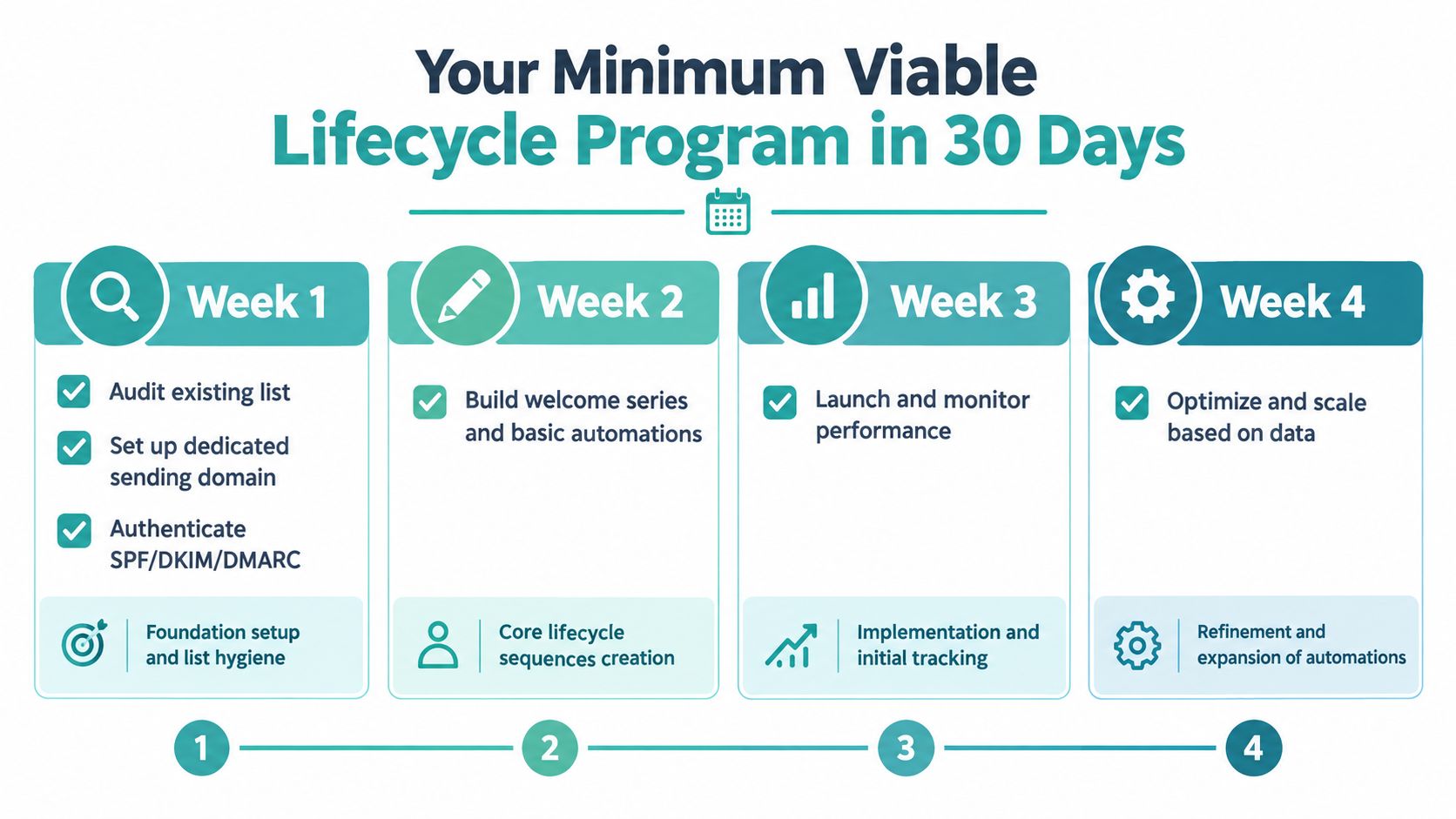
The deliberate deferrals matter. Don’t build complex predictive segments, elaborate loyalty branches, or a dozen edge-case automations before the core flows have clean data and reliable suppression. The welcome email sequence guide from Adwave can help shape the first sequence without turning launch into a copywriting project.
Measure captured leads, first actions, booked appointments or purchases, revenue per send, unsubscribes, complaints, and inactive-contact suppression. If the TV campaign is running, preserve its source tag through every stage so the team can see whether broadcast exposure created customers that email later helped convert.
Adwave helps small businesses create and launch broadcast-ready TV ads, direct viewers to focused landing pages, and track campaign performance without requiring a production crew. Pairing that TV capture workflow with behavior-based email lifecycle marketing gives your team a practical way to turn attention into follow-up and follow-up into measurable customer action. Visit Adwave to connect your next TV campaign with a more complete growth system.