
The first sign usually isn't a red-hot sales spike. It's the calendar. Q4 is suddenly close, the promo plan is still a rough note in someone's inbox, and the team is about to do what too many small businesses do every year, throw spend at the season evenly and hope timing takes care of the rest. It usually doesn't.
Seasonal campaigns work when they're treated like a forecasting problem, a calendar problem, and a pacing problem, not just a discount problem. The businesses that do this well don't start with “What should we mark down?” They start with “When does demand peak, what do we already know from past seasons, and how do we concentrate attention when buyers are most ready to act?” That's the difference between a sale that moves product and a seasonal system that gets sharper every year.
The Seasonal Sales Reality for Small Businesses
The panic is familiar. A local retailer looks up, realizes the season is only weeks away, and everything is still open loop, offers, creative, budget, inventory, and media. That scramble is exactly why many seasonal promotions underperform. They launch too late, spread too thin, or rely on instinct when the business already has better clues sitting in past sales records.
The smarter framing is simple. Seasonal sales strategy is a planning discipline, not a one-off discount event. A retail planning guide recommends starting at least 90 days before the target season, and a holiday forecasting guide advises beginning in July-August so there's enough time to coordinate lead times, inventory, and campaign execution, while using historical sales data and promotional performance as the baseline for objectives and inventory levels ( seasonal product promotion strategies 2025). That's the core lesson, the calendar has to come first.
Why the last-minute sale usually misses
Most underperforming seasonal pushes fail in the same three ways. They start late, so creative and inventory are rushed. They spread spend evenly, so nothing gets enough pressure during the actual peak. And they're built on gut feel instead of the sales patterns that already exist in the business.
Practical rule: if last year's season already told you when demand rose, don't rebuild the plan from scratch this year. Tighten the same calendar and improve the execution.
The most useful seasonal playbook is reusable. Use the same skeleton each year, then adjust for changes in demand, marketing spend, and competitive pressure. That's how a small business closes the gap with bigger competitors without trying to match their budgets. The goal is not to shout all season long. It's to arrive prepared, spend with purpose, and make the peak window do the heavy lifting.
A good seasonal campaign usually moves through four stages, teaser, early access, main push, and last-chance urgency. The order matters because buyers need time to notice, compare, and then convert. If you skip straight to a discount blast, you often train the audience to wait for deeper cuts instead of acting when the offer first appears.
Adwave's seasonal advertising resources fit naturally into that planning mindset because the platform is built around scheduled, local reach rather than improvised last-minute buys.
Building Your 3 to 6 Month Campaign Timeline
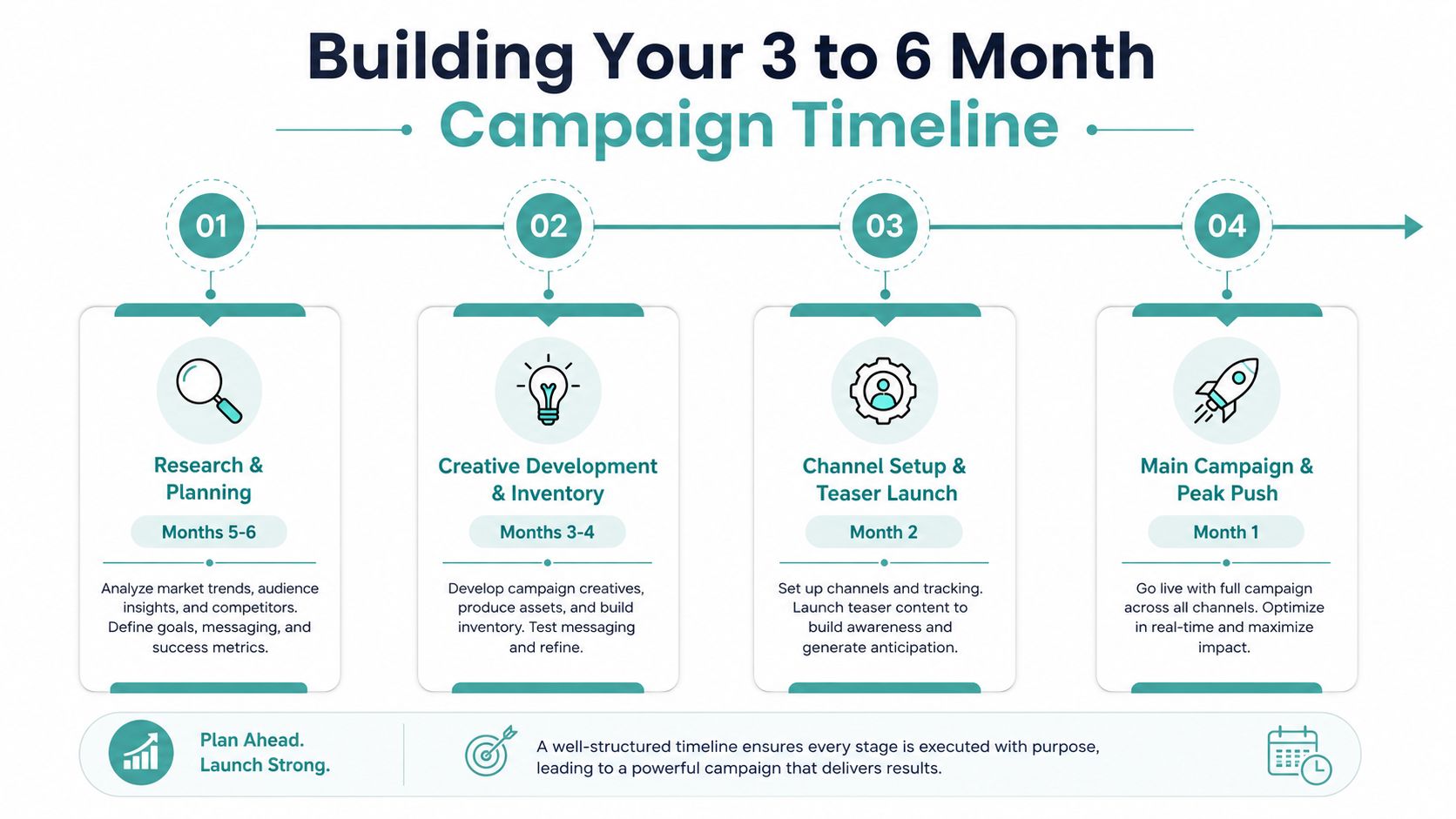
The cleanest seasonal plans begin well before the first ad goes live. Guidance for seasonal campaign planning consistently points to a 3-6 month lead time because that window gives enough room for research, creative work, testing, and channel setup before the peak dates arrive ( seasonal marketing planning guide). If a team is already busy, that timeline doesn't add work, it distributes the work so nobody is trying to solve inventory, messaging, and media at the same time.
What belongs in each planning window
Months 5-6 are for research and planning. Lock the season, review prior performance, and decide what success looks like. This is when you decide which products, services, or offers deserve the spotlight, and which ones should stay out of the promotion entirely.
Months 3-4 are for creative development and inventory. Offers get finalized, assets get built, and supply decisions get made with the campaign calendar in mind. If you wait until this point to decide what's on sale, you've already made the season harder than it needs to be.
Month 2 is for channel setup and teaser launch. Email segmentation, social creative, landing pages, and any paid placements should be ready before the first audience touch. Pre-season testing belongs here too, because underperforming messages are much cheaper to swap before the primary demand window opens.
Month 1 is the main campaign and peak push. This is not the time for experimentation, it's the time for coordination. The launch dates, inventory, staffing, and promotional intensity should already be aligned.
The businesses that stay calm in peak season usually made the hard decisions months earlier.
A practical example helps. A local home services company planning a winter maintenance push might lock its offer in late summer, build creative in early fall, test its audience segments before the first cold snap, and then shift budget into the exact weeks when demand typically rises. A retailer can do the same thing with holiday gifting, and a service business can do it with weather-driven or event-driven spikes. The scheduling logic is the same.
Planning templates for every season are useful here because the challenge is sequence, not effort. If the timeline is clean, the whole campaign becomes easier to manage.
Setting Goals, KPIs, and Forecasts With Real Data
Forecasting should start with what the business already knows, not with wishful thinking. Seasonal businesses are advised to collect at least 2-3 complete cycles of data, broken down by days, weeks, or months, and then calculate seasonality indices by comparing each period's average sales with the overall average ( sales forecasting for seasonal businesses). That gives an usable baseline, and it's much better than guessing what the season will do because last year felt busy.
The metrics that matter
The most useful KPI set for a seasonal push includes revenue, order volume, average order value, conversion rate, customer acquisition cost, discount depth, redemption rates, gross margin before and after discounts, and inventory turnover ( sales forecasting for seasonal businesses). Those measures tell you whether the promotion created real demand or just shifted the timing of purchases while cutting into profit.
A simple seasonality index is straightforward. If a certain week or month consistently performs above the overall average, that period deserves more weight in the media plan and inventory plan. If a promotion lifts order volume but hurts gross margin badly, the campaign may be pulling demand forward instead of adding profitable demand. That's the question to answer before you scale the offer next year.
Here's the kind of working example I'd use with a local business. Suppose a service company sees that one pre-holiday period routinely outperforms the rest of the quarter. If that window is paired with a strong offer and the team watches gross margin before and after discounts, it becomes clear whether the promotion is healthy or just busy. The goal isn't to chase the biggest top-line spike, it's to protect margin while still creating urgency.
Staged discounting keeps those numbers healthier. Start with full-price or targeted offers, then expand only as demand justifies it, and save the deepest cuts for end-of-season clearance when clearing excess inventory matters most. That sequence protects margin better than opening with your strongest discount and having nowhere to go later.
Designing the Four-Stage Promo Architecture
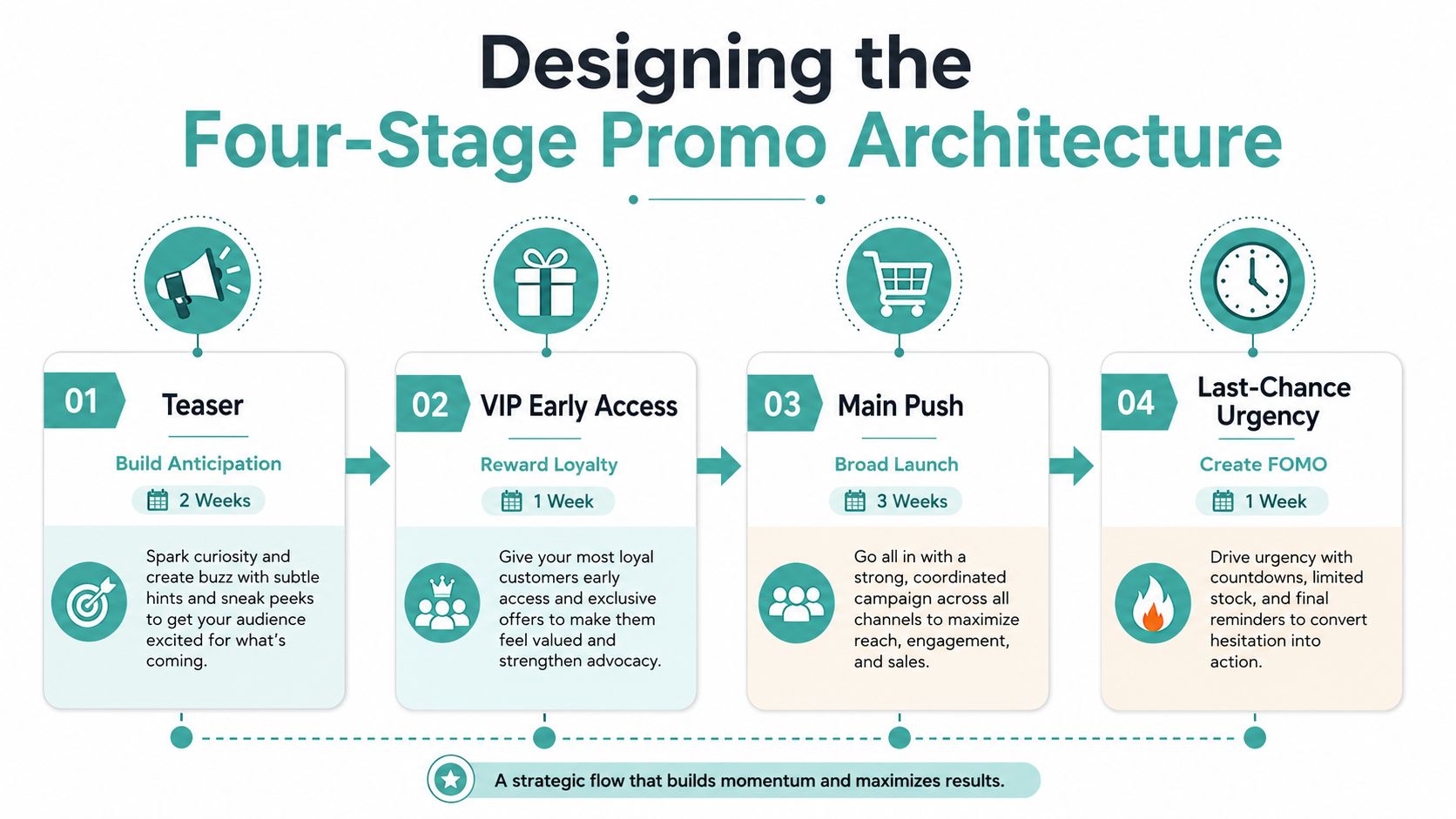
A single launch blast sounds efficient, but it usually wastes momentum. Seasonal campaigns work better when they move through a staged architecture, teaser, VIP early access, main push, and last-chance urgency. That structure creates anticipation before the sale opens and keeps the audience moving without burning them out too early.
How the four stages should feel
The teaser stage is about attention, not conversion. Short social posts, email subject lines, and simple countdown language work well here because the audience isn't ready to buy yet. Limited-quantity messaging can help, but it has to feel informative rather than frantic.
VIP early access is where loyalty gets rewarded. One planning framework recommends 24-48 hours of early access, which gives your best customers a reason to act before the wider audience sees the offer ( seasonal promotion planning guide). That window is especially useful when you want to protect margin and still create a real sense of exclusivity.
The main push is the broad launch. This is when the campaign should peak on the highest-value shopping days and when segmented messaging matters most. The offer can be wider here, but it shouldn't be so deep that the final stage loses its job.
Last-chance urgency is the cleanup phase. It should be short, direct, and tied to real inventory pressure or deadline pressure. By then, the only job is to convert fence-sitters and clear what remains.
A common mistake is launching too late or discounting too early. Both compress margin and weaken the most valuable part of the season. The better move is to test messages 4-6 weeks ahead of the main season, then swap underperforming offers before the highest-value dates arrive ( seasonal promotion planning guide).
Segmented messaging beats blanket urgency. The right customer cohort should see the right offer at the right point in the calendar.
The tactical question isn't whether to use urgency, it's when. Used early, it cheapens the campaign. Used late, it helps finish the season strong.
Choosing Channels and Messaging That Fit Your Offer
Different channels play different jobs in a seasonal push. Email is the conversion engine. Social is the amplifier. Paid digital captures intent. TV and OTT build reach and local credibility before the offer even opens. The mistake small businesses make is treating every channel like a duplicate of the others. They're not duplicates. They're sequential tools.
Email should carry the sharpest offer language because it reaches people who already know the brand or have opted in. Social works best when it extends the same story with short-form reminders, testimonials, and teaser creative. Paid digital does the cleanup work, it catches people who are already searching, comparing, or browsing with purchase intent. TV and OTT fill the top of the funnel by making the business feel established and familiar before the discount ever lands.
Schedule emails around the offer’s start and end dates, and explain the terms clearly. (join as a maker)
Where Adwave fits
Adwave fits into the awareness layer of a seasonal campaign because it helps small businesses create broadcast-ready TV spots from a website URL, place them across 100+ premium channels, and launch campaigns that start at $50 with automatic pacing, according to the platform's published product description. Its estimated $15-$35 CPM range makes TV/OTT easier to frame as a concentrated burst rather than an always-on luxury, which is exactly how seasonal reach should be used for a local business. That matters when the goal is to build trust before the main push, not to replace email or social.
The practical advantage is timing. A small team can prepare creative, targeting, and launch plans in advance instead of rushing to produce video at the last minute. For seasonal planning, that kind of setup turns TV into an usable local channel, not a brand-only media buy.
One useful way to think about the mix is by audience state. Cold audiences need awareness. Warm audiences need reminders. Hot audiences need conversion language. If the channel and the message don't match the stage, the offer gets weaker no matter how good the discount looks.
Budgeting and Pacing Spend for Peak Demand
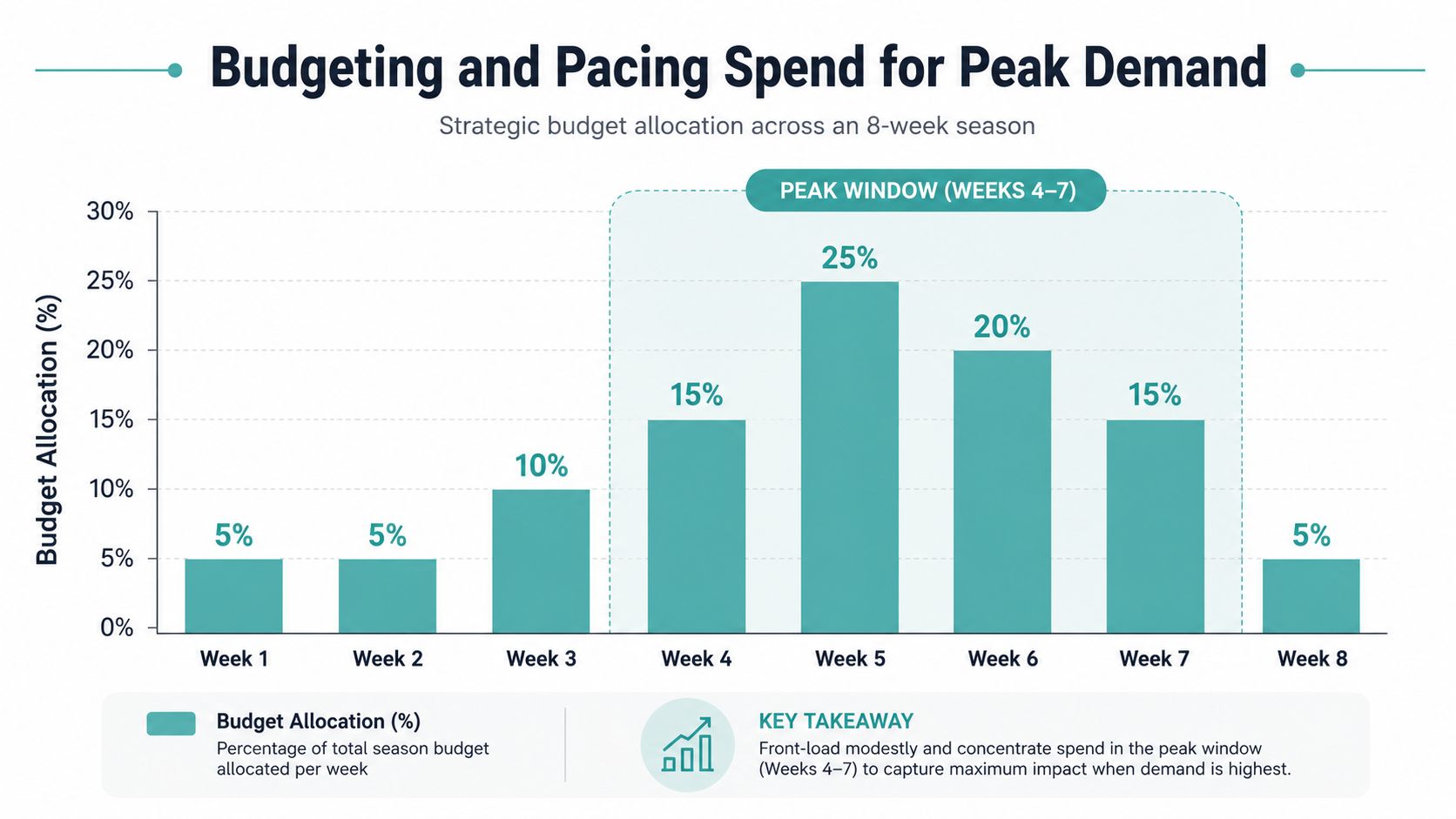
Most SMBs don't have a budgeting problem first. They have a pacing problem. They spread spend evenly across the season, then run out of budget just before the highest-intent window, exactly when more pressure would have mattered most. Seasonal planning guidance warns against that by recommending concentrated spend in the strongest demand period and reserve budget for in-flight optimization ( holiday seasonal promotions planning framework).
A pacing model that works
A practical season can be paced like this, 5% in week 1, 5% in week 2, 10% in week 3, 15% in week 4, 25% in week 5, 20% in week 6, 15% in week 7, and 5% in week 8. That allocation concentrates the bulk of spend into the peak window instead of flattening the entire season into a low-intensity drip.
The budget itself should be assigned by role. Awareness gets enough to create reach. Consideration gets enough to keep the offer visible. Conversion gets the biggest share during peak intent. Reserve spend stays untouched until the campaign is live and real performance data comes in.
For a small business, the exact dollars matter less than the ratio. A $1,500 seasonal budget can still work if the business concentrates the majority of its spend where intent is highest. The same idea scales to $5,000 and $10,000. What changes is the amount of testing and support you can afford, not the need to focus spend on the peak window.
One planning framework assumes 30-50% traffic growth for many growing brands and recommends adding 15-25% safety stock for best sellers because conversion can rise 15-25% when the offer is materially stronger ( holiday seasonal promotions planning framework). Those numbers aren't a reason to overspend blindly. They're a reminder to connect budget, stock, and timing before launch.
Budget rule: if your strongest demand arrives in a short window, your budget should behave like a burst, not a drip.
TV and OTT become surprisingly practical for local businesses when framed as a short burst, not a year-round commitment. The awareness layer can support the rest of the mix without swallowing the budget. That's why a seasonal plan should always ask where the peak window is, then fund that period first.
Measuring Results and Turning One Season Into the Next
The best seasonal campaign doesn't end when the promo ends. It ends when the business knows what to do differently next time. That means comparing actual performance against the forecast, checking which stages of the promo architecture earned their spend, and looking at which channels delivered the best customers, not just the cheapest clicks.
The post-campaign review should be blunt. Did revenue land where expected? Did order volume rise without destroying margin? Did the main push outperform the teaser and last-chance stages, or was the strongest response somewhere unexpected? Those answers matter because seasonal strategy improves when the business stops treating each season like a separate event.
The off-season is part of the system too. The U.S. Small Business Administration recommends using slower periods for early payment specials, referrals, and low-cost channels like social media, public relations, and email, and suggests getting permission to send a regular email cadence, “say, once a month,” to promote off-season specials or build anticipation for the next season ( SBA seasonal business marketing ideas). That's a practical way to stay present without pretending the budget is the same in slow months.
Measuring advertising effectiveness matters here because a seasonal system only gets smarter if the team can tie spend to outcomes and feed those learnings back into next year's seasonality indices.
What to carry forward
Keep the best-performing calendar windows. Keep the offers that protected margin. Keep the channels that brought in higher-quality customers. Drop the tactics that looked busy but didn't move profit.
A seasonal playbook compounds when every season leaves behind a cleaner forecast, a tighter pacing plan, and a better sense of which messages deserve more budget. Businesses that add tools like Adwave to the mix can extend that learning into local TV reach without turning seasonal planning into a big-agency exercise.
If you want a seasonal plan that puts spend where demand is peaking, Adwave gives small businesses a way to launch broadcast-ready TV ads from a website URL and time them around the windows that matter most. Use it to add local reach before the offer opens, then let your email, social, and conversion channels do the rest when the season hits.


