Seasonal businesses run on a rhythm that most advertising advice quietly ignores. The landscaper's phone melts in April and goes silent in November. The tax preparer lives a year inside fourteen weeks. The HVAC company has two seasons, the pool installer has one, and the beach-town restaurant has a hundred days to make twelve months of rent.
When demand swings that hard, the standard advice ("spend a steady X% of revenue on marketing") produces a predictable mistake: advertising heaviest when you're already busy and going dark exactly when next season's customers are deciding. about seasonal demand: the revenue arrives in the peak, but the customers are won earlier and cheaper than almost any owner believes. This guide lays out the four-phase annual structure that smooths the curve, with budgets, channel roles, and a worked example.
The seasonal trap
Most seasonal operators advertise procyclically: budget follows revenue, so spend peaks with the season and stops when the season ends. It feels responsible. It's backwards, three ways:
You're buying the most expensive clicks of the year. Peak season is when every competitor floods the same channels. Cost per click and cost per lead hit annual highs at exactly the moment you spend most.
You're advertising to people who already decided. A large share of seasonal purchases are chosen before the season starts: the pool quote shortlist forms in March, the tax preparer is picked in January, the wedding photographer a year out. Peak-season ads reach the leftovers.
You disappear during the deciding window. When you go dark in the off-season, you vanish from the months when next year's customers form preferences, and you restart from zero awareness every spring, paying the restart tax annually.
The fix isn't spending more. It's redistributing the same annual budget across four phases with different jobs.
The four-phase annual cycle
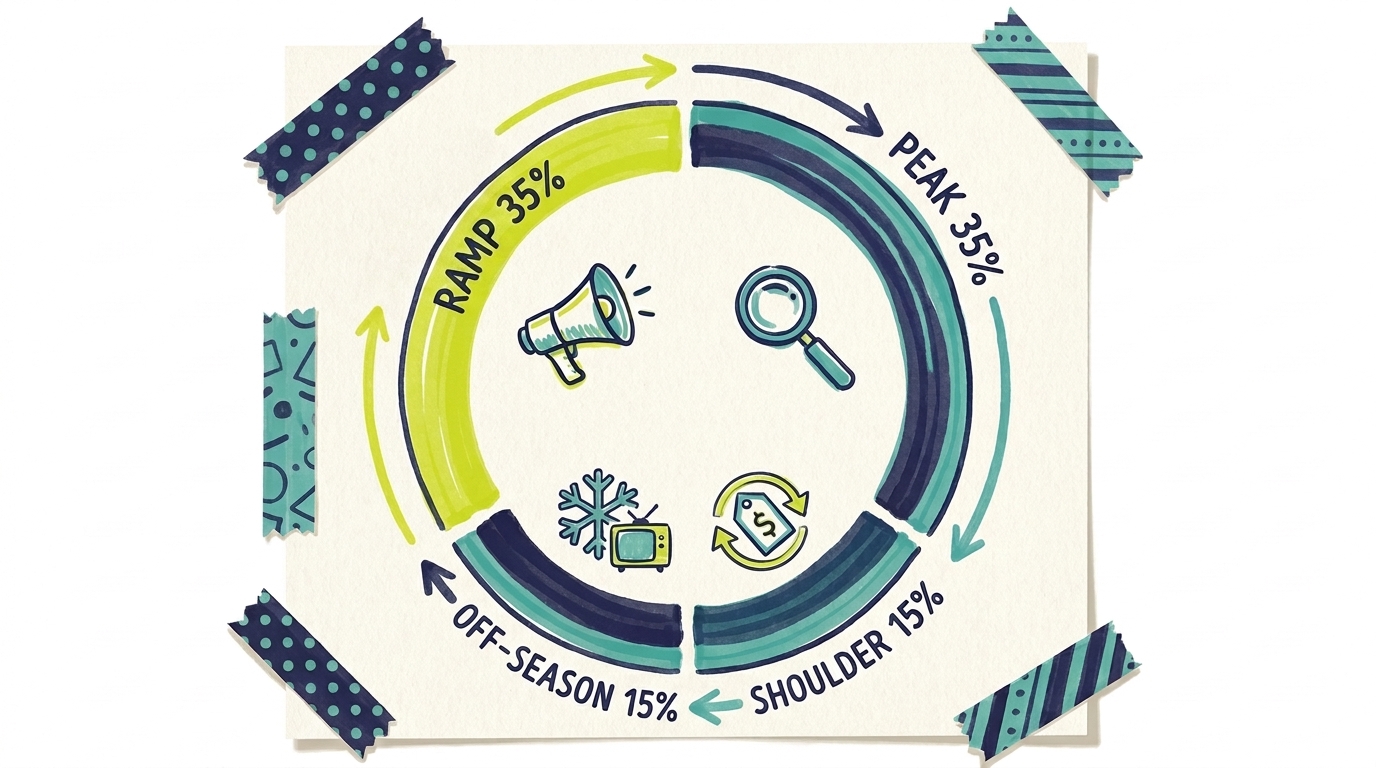
Phase 1: Pre-season ramp (8-12 weeks before peak)
This is where seasonal fortunes are made. Demand hasn't arrived, competitors are still quiet, ad costs are low, and customers are quietly forming shortlists. Your job: be the name they've already seen when the season's first warm weekend sends them to Google.
Weight this phase toward awareness channels (TV, social) layered over always-on search. A landscaping company running steady CTV frequency in February and March enters April as "the company I keep seeing," which converts the season's panicked first searches at a fraction of peak-auction prices. Our seasonal TV advertising calendar maps the standard ramp windows by category.
Phase 2: Peak (the season itself)
Now search carries the load: demand exists, capture it. Keep awareness running at maintenance frequency (you're reinforcing, not building), push budget into high-intent search terms, and let capacity govern spend. If you're booked three weeks out, throttle lead generation before you train your market that you never answer; redirect that budget to deposits-for-later or to Phase 3.
Phase 3: Shoulder (season's end)
The most neglected phase. Demand is fading but not gone, competitors are already quitting, and two valuable audiences remain: late deciders (cheaper to win now that auctions thinned) and this season's customers, who are one good offer away from booking next season early. Early-bird renewals, pre-pay discounts, and "lock next year's price" campaigns convert peak goodwill into off-season cash flow.
Phase 4: Off-season (the quiet months)
Not dark; different. Off-season advertising runs at 20-30% of peak budget and does two jobs that pay all year:
Cheap brand-building. Awareness CPMs don't follow your demand curve; the attention is the same price in November as in May, but nobody in your category is buying it. A modest CTV presence through the off-season compounds into pre-season recognition your competitors have to buy at ramp prices.
Counter-season revenue. Most "one-season" businesses have a second product hiding in their capabilities: the landscaper's snow removal or holiday lighting, the pool company's service contracts, the tax preparer's bookkeeping and planning work. Advertising those lines in the off-season keeps the crew busy and the brand visible. Our guide to slow-season marketing strategies digs into the tactical menu for these months.
Budget across the cycle
A practical split of an annual advertising budget for a single-peak business:
Two-peak businesses (HVAC's summer and winter) run the cycle twice with shorter phases. The principle holds: front-load awareness before each peak, let search ride the peak, never go fully dark.
If your total budget needs defining first, start with our small business marketing budget guide, then apply the seasonal shape to the number.
The cash-flow objection (and the fix)
The honest pushback to pre-season spending is cash: "In February there's no revenue to spend." That's real, and the fix is accounting, not bravado.
Treat next year's ramp as a cost of this year's season. When peak revenue is flowing, reserve the ramp budget the way you'd reserve money for equipment or winter payroll: a fixed percentage of peak-month revenue (3-5% works for most) moved into a marketing reserve. By the time February arrives, the ramp is pre-funded from the season it will feed, and the decision stress is gone.
Two supporting moves shrink the burden further. Shoulder-season renewal campaigns convert this year's customers into next year's booked revenue, putting deposits in the bank before the ramp begins. And the off-season's counter-season lines exist partly for this reason: even modest winter revenue keeps the reserve intact. Seasonal businesses that structure cash this way describe the same shift: advertising stops feeling like a gamble made during the scary months and becomes a standing system the season pays for in advance.
Three seasonal archetypes
The four-phase shape flexes by how your demand concentrates:
Single long peak (landscaping, marinas, tourism). The full cycle as described: long ramp, sustained peak, real shoulder, quiet winter. Your biggest lever is the ramp; your biggest waste is peak-season overbidding.
Dual peak (HVAC, tire shops, tutoring). Two compressed cycles a year, with transitional weeks instead of a true off-season. Always-on awareness matters most here, because you're never more than a few months from the next ramp and full restarts are ruinously inefficient.
Compressed burst (tax prep, Halloween retail, wedding services booked far ahead). The season is short but the decision window is long and early. Shift the weight even harder forward: for tax preparers, the real campaign runs December-January, not April; for wedding vendors, this season's ads are mostly winning next year's dates. In burst categories, peak-season advertising is almost entirely too late.
Identify your archetype, and the budget table above bends accordingly: bursts push ramp share to 50%+, dual peaks split everything in two, single peaks run it as written.
Channel roles: who works when
Channels respond to seasonality differently, and the cycle exploits that:
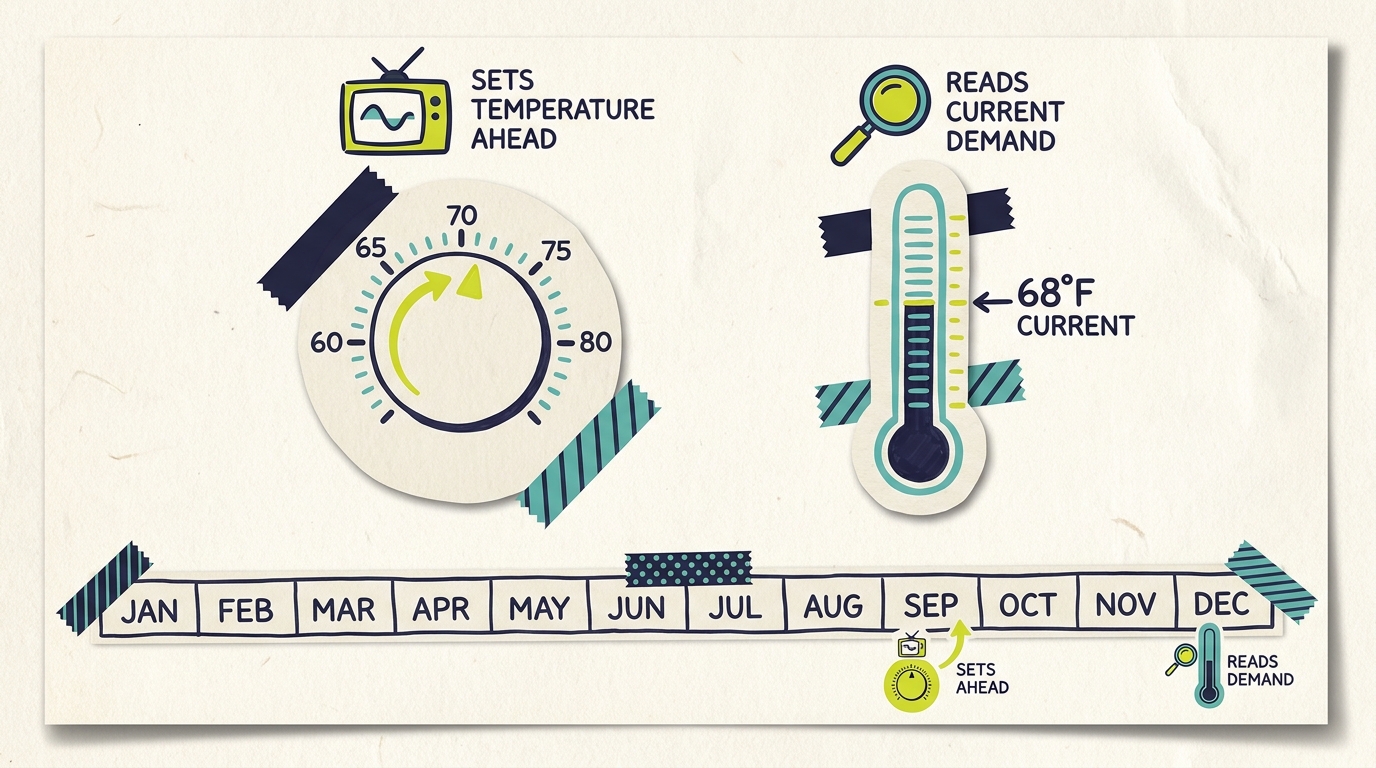
Search is a demand thermometer. It produces exactly when people search and nothing when they don't. Run it always-on (cheap in the off-season, where the few searches are gold), and surge it at peak. Don't ask search to create your season; it can't.
TV and social are demand thermostats. They work ahead of the season, setting the temperature of preference before searches happen. Their cost doesn't rise with your season (CTV runs $15-35 CPM in February and July alike), which makes pre-season and off-season the arbitrage windows: full-price attention, half-price competition. With ad creation free and two-minute generation on Adwave, swapping creative per phase (the seasonal campaign mechanics) costs nothing but the decision.
Email and SMS are season extenders. Your past-customer list is the cheapest revenue in the building: early-bird offers in the shoulder, counter-season services in the winter, "we're booking up" urgency in the ramp.
Local presence rides along. Reviews, Google Business Profile photos, and spring-ready local campaigns should refresh at every phase turn, because seasonal searchers check recency.
A worked example: the landscaping calendar
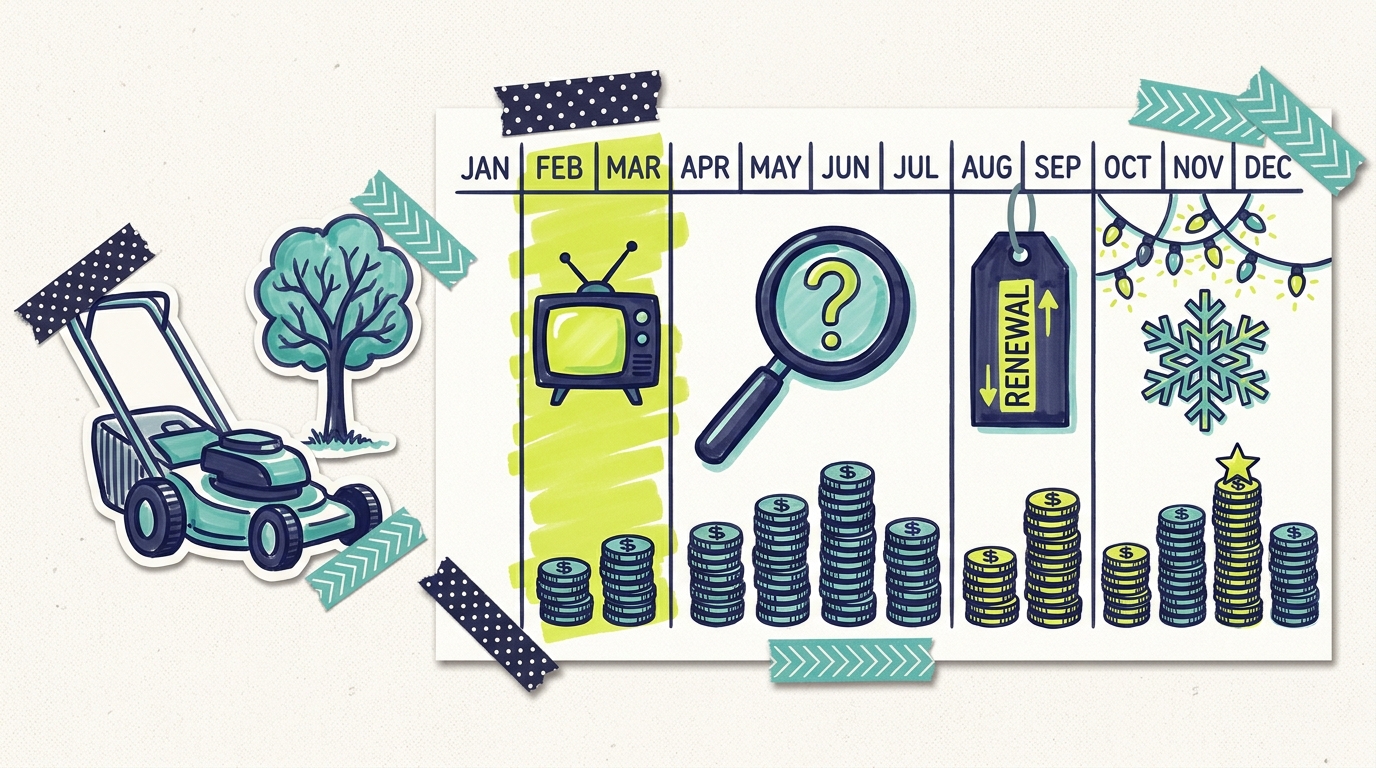
Take a landscaping company with a $24,000 annual ad budget and an April-October season:
February-March (ramp, $8,400). CTV at steady frequency across the service-area zips ($2,800/month) plus always-on search ($1,400/month). Creative: spring transformation imagery, "book your spring cleanup."
April-July (peak, $8,400). Search-led ($1,600/month) with CTV at maintenance ($500/month). Capacity governs: when the crew calendar fills, search throttles down and a "now booking August" message replaces "free estimates."
August-September (shoulder, $3,600). Late-season search stays on; an early-renewal email and social push offers next-spring pricing to this year's clients; fall cleanup creative extends the season.
October-January (off-season, $3,600). CTV drops to $600/month but never zero; creative flips to holiday lighting and snow contracts; January creative quietly pivots to "spring books fast" awareness.
The February CTV spend looks unjustifiable on a monthly P&L and is the cheapest customer acquisition of the company's year: by the time competitors wake up in April, the shortlists are formed.
Common questions answered
When should a seasonal business start advertising before its season?
Eight to twelve weeks before your demand typically arrives, which is roughly when your future customers start forming shortlists. The earlier end fits high-consideration purchases (pools, remodels, weddings); the later end fits impulse-adjacent seasons (ice cream, tourism activities). The reliable rule: when your first competitor's ad appears, the cheap window is already closing.
Should a seasonal business advertise during the off-season at all?
Yes, at 20-30% of peak levels, for two reasons. Awareness bought in the off-season costs the same per impression but faces almost no competitive noise, and it compounds into pre-season recognition you'd otherwise buy at ramp prices. If you have any counter-season service line, off-season ads also produce direct revenue; if you don't, low-frequency brand presence still beats the annual restart tax of going dark.
How do I keep leads coming when we're already fully booked?
Change the ask, not the visibility. Swap "free estimates" creative for "now booking [next month]" or deposit-based reservations, throttle the highest-intent search terms, and keep awareness channels running untouched. Going invisible at peak feels efficient but surrenders the shoulder season and hands your overflow to competitors by silence.
What's the best advertising channel for a seasonal business?
By phase: TV and social before the season (they create preference ahead of demand at off-peak prices), search during the season (it captures demand that now exists), and your customer list in the shoulder and off-season (renewals and counter-season offers). The expensive mistake is using peak-season search as the only channel, which buys the year's costliest clicks from the year's most contested auctions.
How does a two-season business like HVAC structure this?
Run the four-phase cycle twice, compressed: ramp into summer cooling season, peak, shoulder into fall with maintenance-contract offers, then immediately ramp into heating season. The off-season shrinks to a few transitional weeks, which makes the always-on awareness baseline even more valuable since the next ramp is never far away.
Make the calendar your strategy
Pre-season is the move your competitors keep skipping. See how Adwave works: generate your ramp creative in about two minutes, target your service zips, and own the shortlist before the season starts.