The counterintuitive truth about short-form video is that more posting and faster hooks don’t automatically produce stronger performance. Analysis of nearly 5.7 million videos from more than 582,000 accounts found that short-form publishing increased 71% year over year, while YouTube Shorts likes, engagement, and reach declined, and Instagram Reels views also fell in the analyzed period (MarketingTechNews summary of Metricool’s report). The practical lesson is uncomfortable but useful: short form video scripting isn’t a race to cram more content into fewer seconds. It’s the disciplined engineering of attention, proof, and action for a specific screen, viewer, and business goal.
Why Short Form Video Scripting Is an Engineering Problem
Short-form video scripting is timed engineering. A viewer can leave at any frame, and weak early viewing signals can reduce distribution. Each line and shot therefore has a job: interrupt attention, establish relevance, prove the promise, and make one clear ask.
The format grew from severe time limits. Vine launched in January 2013 with six-second looping videos, forcing creators to fit setup, conflict, payoff, and visual context into a tiny window. Vine shut down in January 2017, but its model helped establish rapid pacing, immediate hooks, looping endings, and economical storytelling (Number Analytics). TikTok later showed how quickly this structure could scale, reportedly reaching 1 billion monthly active users in roughly three years, while Facebook took nearly eight years to reach a comparable milestone (Number Analytics).
The first three seconds carry the commercial
The opening is a contract, not a greeting. Viewers should recognize the problem, benefit, or tension before deciding whether the rest merits attention.
A hook also creates an obligation. If it promises a visible transformation, a useful answer, or a specific local solution, the body must pay that promise off quickly. Cleverness without proof creates curiosity followed by frustration. Branding without relevance creates an easy swipe.
Practical rule: Treat the first three seconds as a test cell, not an introduction.
Distribution changes the engineering constraints. A TikTok cut, Instagram Reel, YouTube Short, sound-off placement, and connected-TV preview may share one idea, but they do not share one viewing environment. Platform research comparing TikTok, Instagram Reels, Facebook Reels, and YouTube Shorts reported different average views and engagement ratios across its sample, supporting adaptation rather than unchanged duplication (Metricool’s short-form video study).
Business outcome sets the final constraint. A script built for calls needs different proof, pacing, and attribution from one built for brand recall. Connect the creative to a measurable objective, then use KPI tracking to judge performance beyond views and likes. For a small business, that same disciplined message can later be edited for local TV without rebuilding the strategy from scratch.
Picking One Objective, One Offer, and One Metric
Before writing dialogue, write a one-page constraint. A short-form ad should answer three questions:
- What should the viewer do?
- What concrete offer or reason supports that action?
- Which metric tells us whether the cut worked?
Choose one primary objective. It might be calls, store visits, quote requests, listing inquiries, online sales, or brand recall. Don’t combine “call us,” “visit our website,” “follow the page,” and “stop by today” in one fifteen-second ending. Multiple asks dilute the decision and make the result harder to interpret.
Turn the objective into a usable offer
An objective becomes scriptable when it has a visible reason to act. A local plumbing company seeking quote requests might lead with a clear service area and a straightforward estimate process. A real estate agent seeking listing inquiries might show the property, identify the neighborhood, and direct viewers to one memorable next step. A restaurant seeking visits needs an offer that can appear on screen and be recognized quickly in the everyday world.
The offer doesn’t need to be loud. It needs to be concrete enough for the proof and CTA to support it. If the video promises convenience, show the process. If it promises a result, show the relevant outcome. If it relies on location, put the location in the spoken line and on-screen text, especially for sound-off viewers.
Pick the metric before the edit
The metric should match the action, not the ego. For a calls campaign, call volume or tracked calls matters more than applause in the comments. For quote requests, completed forms and qualified inquiries matter more than raw reach. For awareness, view choice, watch time, completion, and satisfaction offer a stronger picture than views alone.
YouTube’s official Shorts guidance specifically points to whether viewers choose to watch or ignore a Short, average view duration, the percentage watched, and satisfaction signals such as likes and post-watch surveys (YouTube Shorts performance guidance). Those signals help diagnose the cut, but they don’t replace the business metric.
Write the brief in plain language:
- Objective: Generate quote requests from nearby homeowners.
- Offer: A clearly explained estimate or service invitation.
- Proof: The product, process, location, or outcome shown early.
- CTA: One action, stated once and displayed clearly.
- Primary metric: The action that creates business value.
A video with modest reach that produces identifiable inquiries can outperform a widely liked video that produces none. That is the discipline behind measuring advertising effectiveness before production begins.
The Hook, the Beats, and the Page Layout
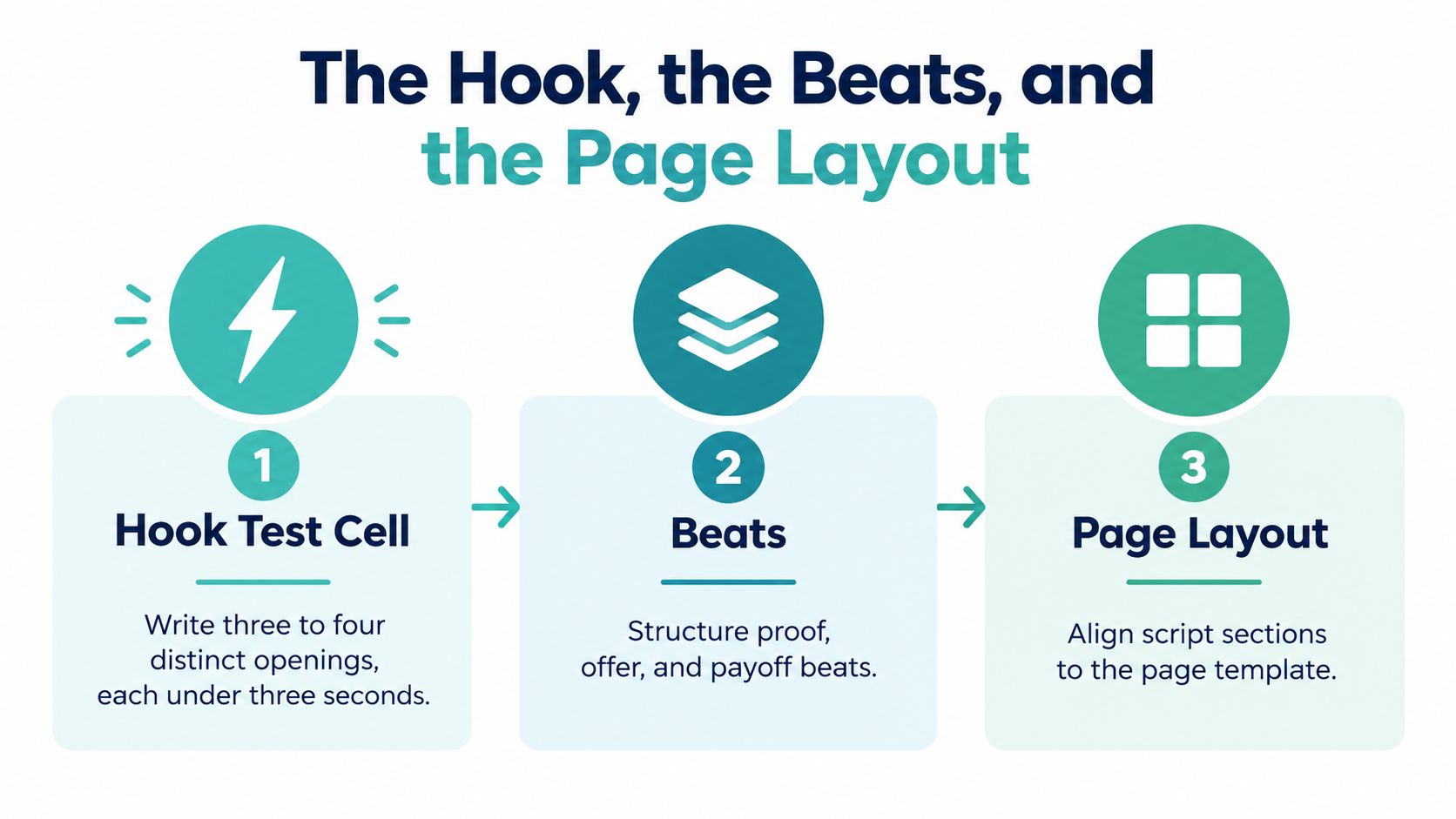
Treat the script as a timed production system. The opening must work as a shot, a spoken line, and a caption before the viewer has time to decide whether to scroll. Draft three or four hooks using different mechanisms:
- A curiosity gap, framed around the question the demonstration will answer.
- An urgency cue, tied to a problem that needs attention now.
- A direct problem statement that reflects the viewer’s situation.
- A visual demonstration that shows the result before the explanation.
Keep the body and CTA unchanged while testing these openings. Changing the whole script makes the result impossible to attribute to the hook.
Use time as the outline
A beat map gives the editor a sequence of jobs rather than a vague instruction to “make it engaging.” For a fifteen-second cut, use this working structure:
| Time | Job | What the viewer should receive |
|---|---|---|
| 0 to 2 seconds | Pattern interrupt and promise | A reason to continue |
| 2 to 6 seconds | Problem recognition | Confirmation that the message applies |
| 6 to 11 seconds | Demonstration or proof | Evidence that the promise is credible |
| 11 to 15 seconds | CTA and brand attribution | One clear next step |
The table is a drafting tool, not a rule for every platform. A thirty-second version should preserve the sequence and add one proof layer, such as a product detail, customer statement, visual comparison, or concise explanation. More runtime should strengthen the same payoff, not introduce a second story.
Build the page like a production tool
A script page should remove guesswork from the edit. Set up columns for:
| Spoken line | On-screen text | Shot or B-roll | Editing note |
|---|---|---|---|
| “Still waiting days for a quote?” | “Local quotes, without the wait” | Close shot of unanswered messages, then business owner answering | Cut on the phone vibration |
| “Send your details and see what happens next.” | “Request a quote” | Screen recording or staff demonstration | Keep the action visible |
| “Visit [business name] today.” | “One action: request your quote” | Exterior, logo, URL | Hold long enough to read |
Give the opening its own row. That forces the first shot, spoken line, caption, and edit instruction to agree. It also exposes a weak hook before production costs rise.
Read the finished page aloud at the intended edit speed. Cut lines that sound written, take too long, or contain two ideas competing for attention. Avoid logo-first openings, captions that repeat every spoken word, unsupported superlatives, and stacked CTAs. For a more polished advertising format, use this guide to write a commercial script.
Adapting the Same Script Across Platforms and Formats
One campaign idea should produce a family of cuts, not one universal file. Keep the promise, offer, proof, and brand consistent. Change the speed, caption treatment, audio assumptions, visual density, and CTA placement to match the surface.
TikTok and Instagram Reels often benefit from a strong opening beat and frequent visual clarification. YouTube Shorts deserves deliberate packaging because the analyzed study reported a much lower average-view figure for Shorts than for the other platforms in its sample, even though its engagement ratio was comparatively high (Metricool’s short-form video study). A connected-TV preview needs cleaner audio design, larger text, and a premise that remains legible from a more relaxed viewing distance.
| Platform or Format | Ideal Length | Sound Assumption | Caption Density | CTA Placement | Visual Pacing |
|---|---|---|---|---|---|
| TikTok | Several seconds to a few minutes, matched to the idea | Sound may be on, but don’t depend on it | Concise, emphasis-led | Early signal, final action | Fast, with frequent visual changes |
| Instagram Reels | Several seconds to a few minutes, matched to the idea | Sound-on or sound-off | Clear and highly scannable | Near the payoff and close | Fast, polished, visually direct |
| YouTube Shorts | Several seconds to a few minutes, matched to the idea | Mixed | Packaging should clarify the premise | Make the action easy to understand | Deliberate opening, efficient body |
| Sound-off placement | Keep only what the idea needs | Sound-off | Essential information must appear visually | On-screen and unmistakable | Use motion to replace vocal emphasis |
| Connected-TV preview | Fifteen or thirty seconds when the concept fits | Sound-on, with clean mix | Sparse, large, readable | Clear near the close | Slightly slower first beat, strong composition |
A social cut can use quick caption changes and close framing. A TV version often needs more visual breathing room and a spoken line that carries meaning without relying on kinetic text. The edit shouldn’t feel like a damaged version of the original. It should feel intentionally written for the viewer’s context.
Music can also change the read. If you’re evaluating tools for a Reel built around a sound-led idea, pick a generator for Reels offers a useful reference for matching music-video workflows to TikTok and Reels formats. The tool is secondary to the message, though. A strong soundtrack can’t rescue a weak promise.
Use content repurposing as a creative system, not a shortcut. Start with the core idea, then rewrite each version so the viewer receives the same value in the way that surface expects.
Where the Proof, the Offer, and the CTA Should Land
Proof must arrive before the viewer has a reason to leave. An ACM-published analysis of TikTok short-video ads found that 85.2% of users who began watching exited before reaching 25% of the ad’s duration (ACM analysis of TikTok short-video ads). Put a recognizable result, product detail, location, or audience problem near the opening. Branding can support that message, but it should not delay it.

Choose proof the audience can recognize
Proof is not limited to a testimonial. A before-and-after view shows change. A demonstration shows how the product or service works. A technician, service area, product detail, or visible result makes a local claim easier to believe. Choose the form that answers the viewer’s main doubt. A local service ad may need the person doing the work, the process, and the area served. A listing ad may need the property, neighborhood, and viewing action.
The offer should appear early enough to shape the viewer’s decision, then return in the CTA. Show what is available and make the next action specific. “Book an appointment,” “view the property,” and “request a quote” give the viewer a usable destination. Keep the brand beside that action rather than saving both for a final logo card.
Runtime should follow the proof required. A longer video can earn its length when the subject needs demonstration or context. A 2025 analysis of more than 1.1 million TikTok videos found that videos longer than sixty seconds generated more reach and watch time than shorter comparison groups in that analysis, while only about 12% exceeded one minute (EMARKETER analysis). Long is not automatically better. The cut should continue only while each beat adds evidence, explanation, or a reason to act.
Another 2025 marketing-trends paper found an inverted U-shaped relationship between video length and engagement, with an estimated optimum of 34.69 seconds (Marketing Trends Congress paper). That makes roughly thirty-five seconds a defensible starting point for an offer needing some explanation. A simple offer may need less, while a demonstration may justify more. Test the shortest version that makes the proof believable and the CTA easy to follow.
Before and After Scripts for a Local Business
Consider a fictional dental clinic serving a named local area. The weak version opens with the logo, generic claims, and too many actions.
Before
| Time | Spoken line | On-screen text | Shot |
|---|---|---|---|
| 0 to 3 seconds | “Welcome to Bright Smile Dental.” | Clinic logo | Logo animation |
| 3 to 8 seconds | “We provide high-quality dental care for the whole family.” | “Quality care” | Reception and treatment-room montage |
| 8 to 12 seconds | “Call us, visit our website, or follow us for more information.” | Three CTAs | Phone number, URL, social icons |
| 12 to 15 seconds | “Bright Smile Dental, your trusted local choice.” | Logo again | Exterior |
The clinic hasn’t identified a problem, shown useful proof, or chosen an action. The opening spends valuable time introducing the advertiser before giving the viewer a reason to care.
After
| Time | Spoken line | On-screen text | Shot |
|---|---|---|---|
| 0 to 2 seconds | “Need a dentist near [local area]?” | “Dentist near [local area]” | Patient enters, exterior visible |
| 2 to 6 seconds | “Bright Smile Dental makes it simple to request an appointment.” | “Request an appointment” | Staff member answers a call |
| 6 to 11 seconds | “See the clinic, meet the team, and choose a time that works.” | “Local clinic. Simple next step.” | Team and treatment-room details |
| 11 to 15 seconds | “Request your appointment today.” | “Request an appointment” | URL and clinic name |
The rewrite makes the audience and location visible immediately, replaces a broad quality claim with a process, and gives the viewer one next step. The CTA isn’t competing with a follow request or a second destination.
A sixty-second explainer can justify extra runtime if the clinic needs to demonstrate what happens after an inquiry. It might show the request, confirmation, arrival, consultation, and next step in sequence. That added proof earns time because each scene answers a question the fifteen-second cut cannot fully address.
Editing Notes, Testing Plan, and Moving From Social to TV
A script is ready only when the edit preserves its timing. Review the opening frame by frame. The first visual should communicate the premise before the spoken line finishes. Check audio clarity, caption speed, and whether the offer appears without a transition or graphic blocking it.
Use a delivery checklist
- Audio first: Keep the first three seconds clean, intelligible, and free from distracting noise.
- Phone-readable captions: Use text large enough to read quickly, with contrast that survives mobile viewing.
- One visual job per shot: Each change should clarify, demonstrate, or intensify the promise.
- No decorative delay: Remove logo animations, transitions, and effects that postpone the offer.
- Sound-off resilience: Make sure the problem, benefit, and CTA remain understandable without narration.
- Natural delivery: Read every line aloud. Record alternate takes if the first pass sounds stiff.
- Opening inspection: Pause at the first second. Ask whether a stranger can identify the subject and reason to continue.
Test the variable that matters
Create multiple openings while holding the body and CTA constant. Run each version against a fixed budget and compare 3-second retention, average watch time, completion rate, and click-through rate. If the opening loses viewers, rewrite that segment first. A stronger later scene cannot recover people who never reach it.
Use the results to diagnose the script:
- Low 3-second retention: The premise is unclear, slow, or irrelevant.
- Strong opening, weak average watch time: The body does not pay off the hook quickly enough.
- Good watch time, weak clicks: The offer or CTA lacks clarity, relevance, or trust.
- Strong completion, weak business action: The video entertains viewers without connecting to the intended outcome.
Keep the winning objective, offer, proof, and CTA when adapting the message for local TV. The social cut may need faster captions and tighter framing, while a broadcast-ready version can give the proof more room to breathe. Rebuild the timing for the new viewing context rather than stretching one edit across every placement.
A small test can compare several hook concepts before a larger production commitment. Keep the business outcome fixed, change one script variable at a time, and record which version earns attention and action. That creates a clearer decision than judging the cut by taste alone.
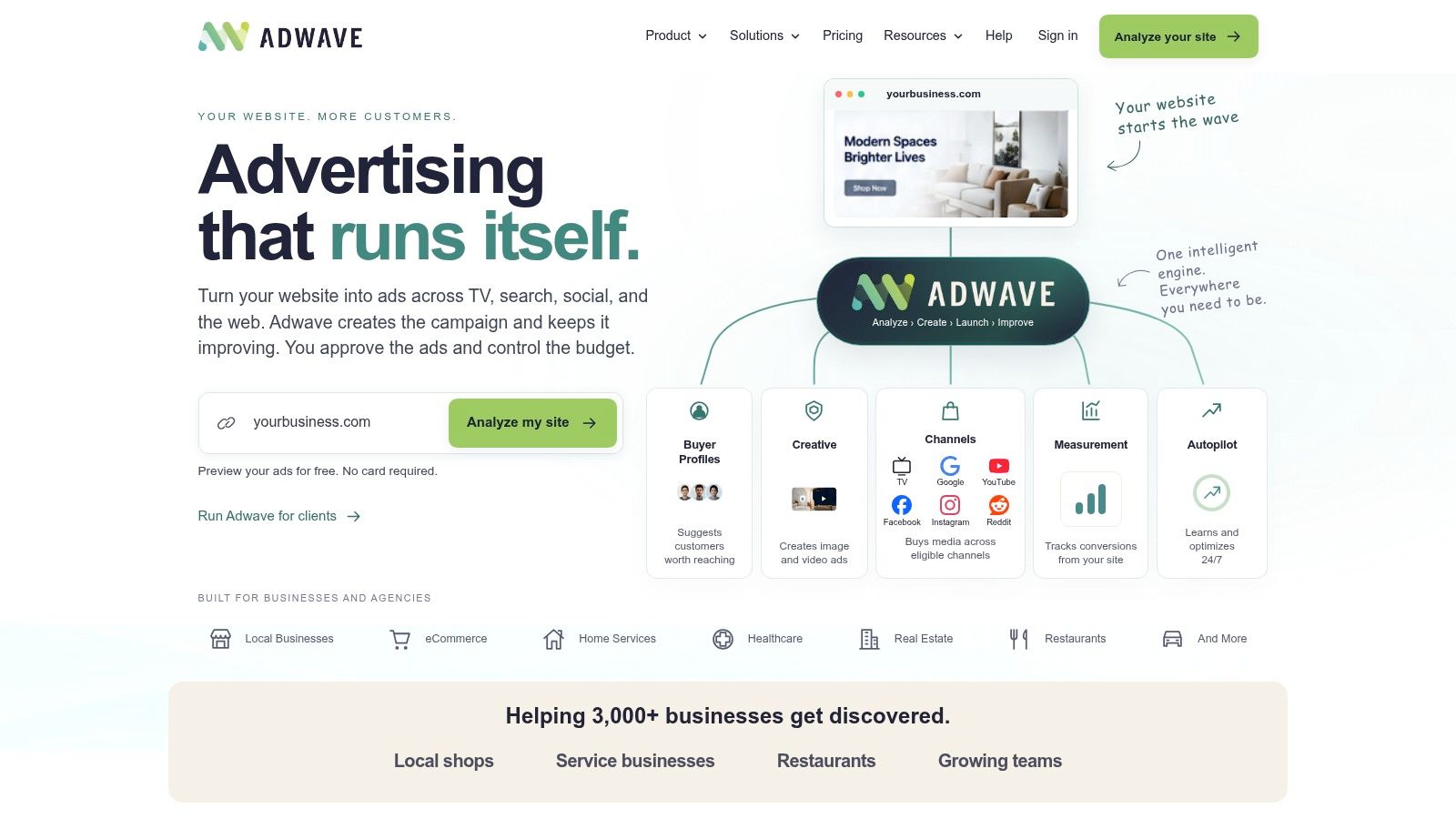
Visit Adwave to turn a website and outcome-led message into a broadcast-ready ad, then test the creative across local premium channels within a chosen spend. Start with one offer, one CTA, and several hook variations. Use the attention and action signals to decide which script deserves wider distribution.