TikTok already sits beside Google in the local discovery journey for younger customers. A 2024 Consumer Behavior Index from SOCi, based on a survey of more than 1,000 U.S. consumers, found that 62% of respondents aged 18 to 24 used TikTok when searching for local businesses to visit in person, compared with 67% for Instagram and 61% for Google Search in that age group. (SOCi consumer behavior data)
That doesn’t mean every local business needs to make TikTok its primary acquisition channel. A neighborhood bakery serving retirees may get more qualified demand from Google Maps and review sites, while a tattoo studio, restaurant, salon, or fitness brand targeting younger residents may be invisible during the research stage if it ignores TikTok search.
The practical question is not how to post on TikTok. It’s whether TikTok SEO matches your audience, category, and service area, and then how to build content that turns discovery into calls, bookings, visits, and branded searches.
Why TikTok SEO Matters for Local Discovery
TikTok’s role in local marketing has changed because people increasingly use short-form video to decide where to go and what to buy. The platform’s U.S. newsroom marked its first national anniversary on December 17, 2020, after launching across the country one year earlier. Within a few years, local-search research showed that TikTok had become particularly relevant to younger consumers. Separate reporting on Google’s internal research stated that almost 40% of U.S. respondents aged 18 to 24 looking for a place to eat used TikTok or Instagram instead of Google Search or Maps. (TikTok’s shift from entertainment to search)
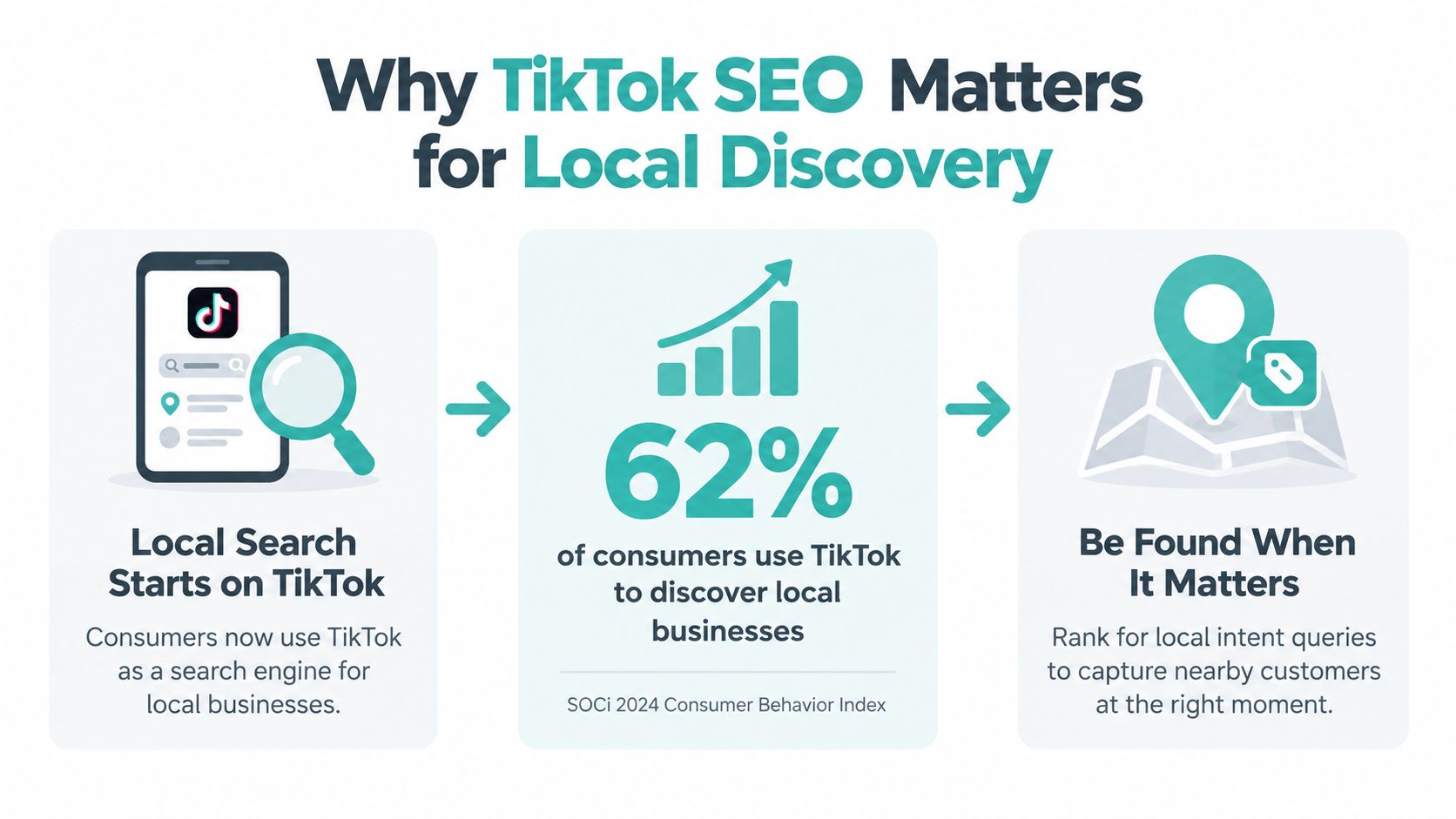
The right interpretation is segment-first, not platform-first. TikTok SEO for a local business deserves serious attention when three conditions overlap:
- Audience fit: Your customer and prospect data shows meaningful Gen Z or younger-adult demand.
- Visual proof: Customers benefit from seeing the food, treatment, property, team, result, atmosphere, or process before they choose.
- Local habit: People in your city or neighborhood already use TikTok to research businesses, activities, and services.
BrightLocal consumer research found that 10% of Gen Z consumers use TikTok for local search, placing it third among the platforms measured. That’s a valuable opening, but it’s a segment-specific signal, not evidence that TikTok replaces Google Business Profile or Google Maps. (BrightLocal local-search research)
Run the audience check first
Start with your own evidence. Review point-of-sale or CRM data for customer age, ZIP code, neighborhood, service type, and booking value. Then compare that audience with the local-search behavior described above.
A restaurant near a university, a salon serving young professionals, or a real-estate agent building awareness with first-time buyers may find a strong match. A home-service company focused on older homeowners may still use TikTok for awareness, but Google Business Profile, Maps, referrals, and reviews should probably carry more of the high-intent workload.
Practical rule: Don’t confuse high engagement with high customer fit. If your actual buyers live in Google Maps reviews and local Facebook groups, TikTok virality can become an expensive distraction.
TikTok SEO should help you make five decisions: whether the audience is present, which local queries matter, what proof the video must show, which actions count as success, and which other channels need to support the campaign. A useful local search intent framework keeps that decision tied to customer needs instead of vanity reach.
Set Up Your Profile and Metadata for Local Search
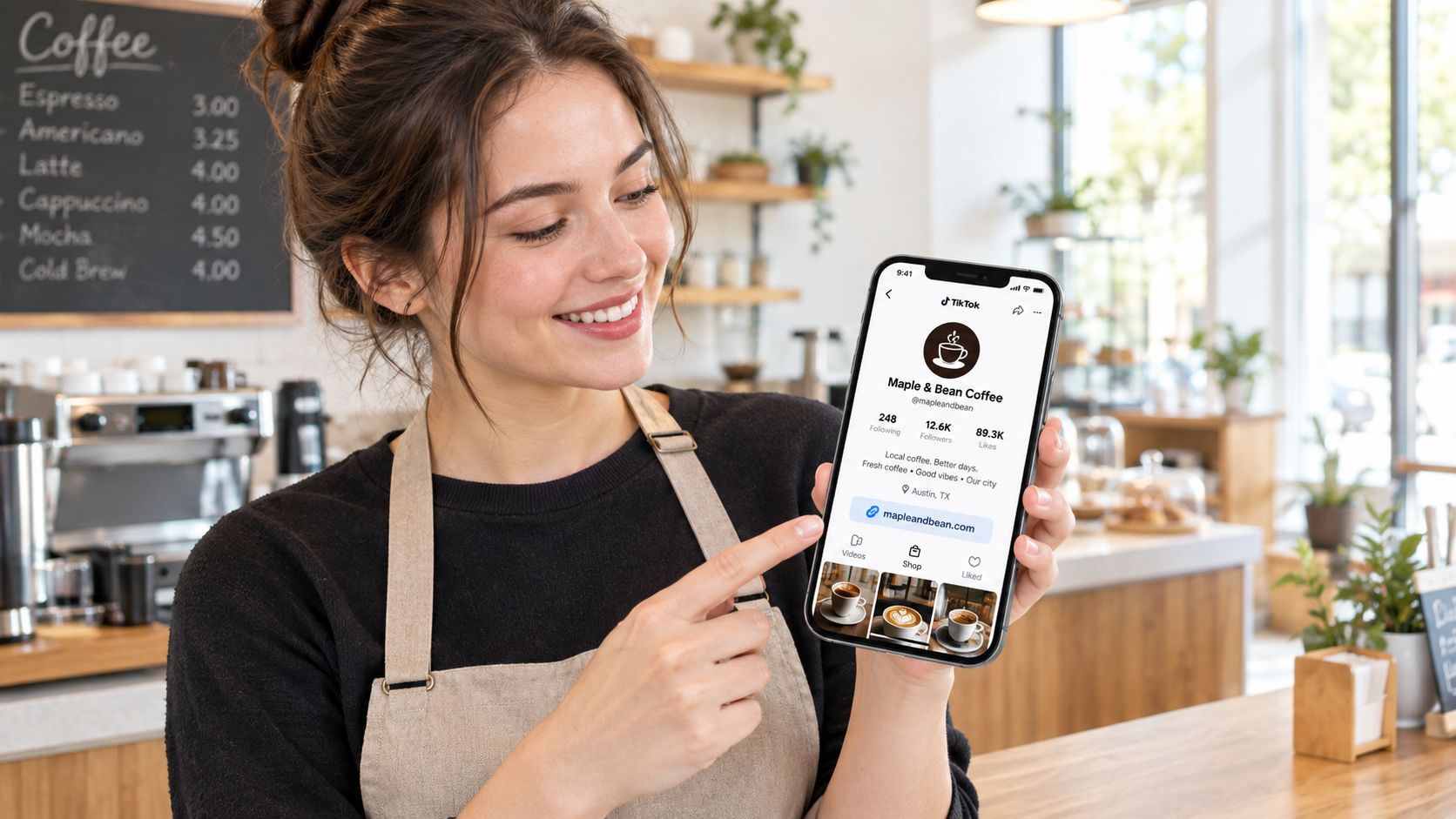
TikTok needs consistent signals to understand who you serve and where you operate. Put the service-plus-location phrase in the places customers and the platform can read: display name, bio, spoken audio, on-screen text, caption, hashtags, and link destination.
Search-oriented guidance recommends placing the primary local phrase in the first 100 to 150 caption characters, with combinations such as “Brooklyn dentist” or “matcha Williamsburg.” (Local TikTok keyword guidance)
A weak profile says:
“Making people smile every day. Book below.”
A clearer version says:
“Brooklyn dentist for cleanings, emergency visits, and cosmetic care. Book an appointment in Park Slope.”
The second version gives TikTok and the customer a category, a service area, and a reason to click. Keep the business name, address, phone number, and service area consistent across TikTok, your website, Instagram, and Google Business Profile. Inconsistency makes local relevance harder to establish and can create friction when someone is ready to call.
Build the profile around seven signals
- Display name: Include the recognizable business name and, where natural, the city or service category.
- Username: Keep it easy to search and consistent with other channels.
- Bio: State the service, location, and next action in plain language.
- Category: Choose the closest available business category.
- Profile link: Send visitors to a local booking, menu, listing, or service page rather than a generic homepage.
- Pinned video: Repeat the location, offer, and customer problem in a short introduction.
- Content language: Use the same service and location terms in spoken audio, text overlays, captions, and relevant hashtags.
For a coffee shop, “Austin coffee shop” is broader than “East Austin matcha and pour-over coffee.” The narrower phrase may better match a real local decision, especially when the video shows the counter, street, parking approach, or seating area.
Your link-in-bio setup should preserve intent. A video about same-day dental appointments should lead to appointment availability, not a homepage where visitors must search again. For broader local visibility, use this guide to optimize your Google Business Profile for more calls.
Build One Video Around One Local Intent Query
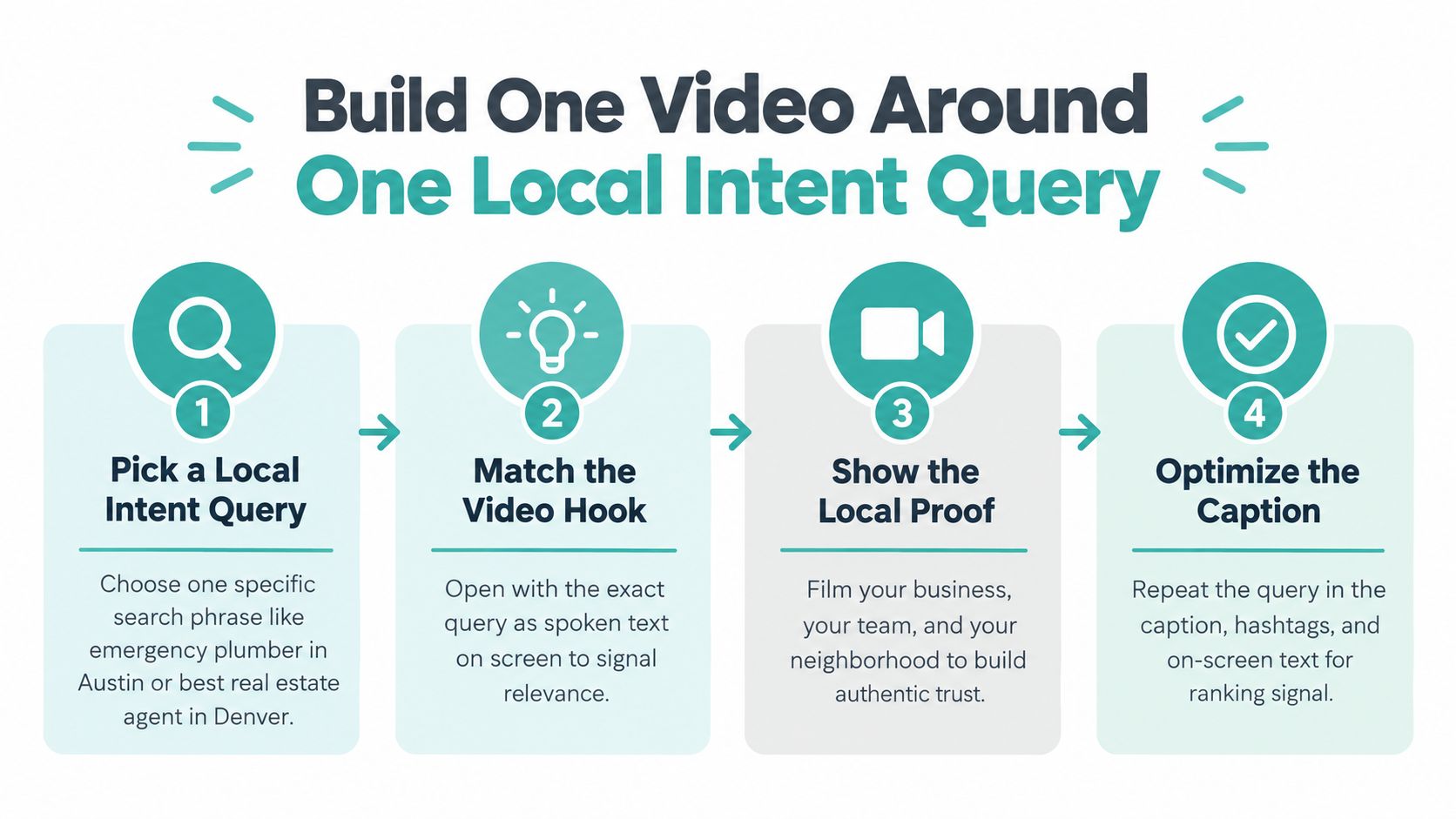
The most reliable local TikTok videos answer one clear search. Pick a phrase such as “emergency plumber in Austin” or “best real estate agent in Manchester”, then make every creative decision reinforce that query.
Validate the phrase before filming. Enter the service into TikTok autocomplete, review Creator Search Insights, and inspect TikTok Creative Center keyword data. Look for variations that reflect real customer language, such as the service plus city, neighborhood, urgency, or occasion.
A practical script for “emergency plumber in Austin” might work like this:
- Opening spoken line: “Need an emergency plumber in Austin tonight?”
- On-screen text: “Emergency plumber in Austin”
- Local proof: Show the technician preparing equipment, the branded vehicle, or a real service-area scene immediately.
- Problem answer: Explain what the company handles and what customers should do while waiting.
- Caption opening: “Emergency plumber in Austin for burst pipes, blocked drains, and urgent water leaks.”
- Local CTA: “Tap the profile link to check tonight’s availability.”
TikTok evaluates captions, hashtags, sounds, keywords, user interactions, and account or device context together. Repeating the concept naturally across audio, text, and caption gives the platform a clearer topic signal than hiding the location in a long block of tags.
Test a series, not a single post
Hold the query constant and vary the hook, proof, presenter, or format. One video might open with a customer question, another with a visual before-and-after, and another with a technician explaining the first safety step. Compare search-driven views, average watch time, completion rate, profile visits, comments, and website actions.
This controlled approach tells you whether the query works, whether the creative earns attention, and whether the traffic has local value. SocialPilot’s cited strategy data gives directional benchmarks of 0.12% engagement for 101 to 200-character captions and 1.16% reach for posts using 1 to 5 hashtags, but those figures aren’t guaranteed outcomes and should be segmented by industry, market, and audience size. (TikTok SEO benchmarks)
Hashtags, Location Tags, and Cross-Channel Signals
Hashtags should clarify a video, not compensate for an unclear one. Use a focused mix with four possible roles:
| Role | Restaurant Example | Dental Clinic Example | Real Estate Example |
|---|---|---|---|
| Niche | #EastAustinEats | #ParkSlopeDental | #ManchesterFirstTimeBuyers |
| Service intent | #AustinBrunch | #EmergencyDentist | #ManchesterRealEstate |
| Geographic | #AustinTX | #BrooklynNYC | #ManchesterUK |
| Broader category | #AustinRestaurants | #Dentist | #RealEstate |
Use three to five tightly relevant hashtags rather than a long generic block. One niche tag, one service-intent tag, one geographic tag, and an optional category tag give each post a job. A large collection of broad tags such as #fyp can dilute the local context and attract viewers who have no reason to visit, book, or call.
Add the location naturally in the video itself. Say the city or neighborhood, place it in readable on-screen text, and include it near the beginning of the caption. Use TikTok’s native location features where available, but don’t rely on a location tag alone.
Make every channel agree
A customer may discover a restaurant on TikTok, check its Google listing, view Instagram photos, and then visit the website. The business name, address, phone number, hours, and service area should match across those destinations. A different street name in the bio or an outdated phone number can turn interest into uncertainty.
Local teams that need a broader social workflow can use this practical resource on local social media for CT businesses. For the TikTok layer itself, a local hashtag strategy helps keep tags tied to search intent rather than trend chasing.
Layer Paid Search Ads for High-Intent Moments
Organic TikTok SEO builds discoverability, but paid search can capture people who are expressing a need now. TikTok recommends organizing keywords into thematically relevant ad groups with at least 20 keywords per ad group, according to its Search Ads guidance. (TikTok Search Ads campaign guidance)
For a plumbing company, separate the campaign into themes rather than mixing every phrase together:
- Service group: emergency plumber, drain repair, burst pipe repair.
- Location group: plumber in Austin, Austin emergency plumbing, plumber near downtown Austin.
- Urgency group: same-day drain repair, after-hours plumber, water leak help.
Each group should have creative that answers its own search. An ad for emergency service should show availability, response process, and the service area. A video for planned bathroom work can focus on workmanship, materials, and consultation.
TikTok reported that campaigns with a dedicated Search Ads component generated a 2.0-times higher purchase lift than comparable initiatives without search campaigns. That result concerns advertising, not organic ranking, but it supports a clear principle: explicit intent deserves its own budget and creative treatment. (TikTok Search Ads performance report)
The Sandbox VR case study offers another useful reference. TikTok reported a 2.36% click-through rate, more than four times the rate of its non-search campaign, while cost per click was 3.5 times lower. The campaign targeted searches tied to local activities and occasions, which is especially relevant to restaurants, attractions, salons, classes, and event-based businesses. (Sandbox VR Search Ads case study)
The trade-off is management complexity. Search campaigns need clean keyword grouping, matching landing pages, location controls, and conversion tracking. Broad interest targeting may create cheaper attention, but intent-led structures make it easier to judge whether the audience can become a customer.
Measure What Actually Drives Local Action
Views tell you that TikTok distributed a video. They don’t tell you whether anyone nearby booked, called, visited, or remembered the brand later. A local dashboard should connect the query to the downstream action.
Track performance by city, neighborhood, service, and intent phrase:
- Query-aligned reach: Did the video reach people connected to the target search?
- Watch quality: Review average watch time and completion rate to identify useful creative.
- Consideration signals: Monitor saves, shares, comments, and profile visits.
- Direct intent: Count messages, calls, booking starts, map-direction clicks, and promo-code use.
- Assisted demand: Watch branded searches, direct traffic, and customer comments that mention TikTok.
Use unique booking paths, landing pages, or offer language where possible. A restaurant can use a TikTok-specific phrase at checkout. A clinic can ask new patients how they found the practice. A real-estate agent can track listing-page visits and direct messages by neighborhood.
A reported survey found that 78% of small businesses running TikTok ads achieved positive return on investment, with most reaching that result within six months. That’s an encouraging signal for paid discovery, not a promise that every account will produce a return. (Small-business TikTok advertising survey)
Use a simple review rhythm
Review early indicators on day three, then compare the series on a consistent schedule. Retire the weakest creative based on local action, not just views. Give more testing room to posts that combine search traffic with profile visits, messages, bookings, or map activity.
Troubleshoot the basics before changing strategy:
- Inconsistent NAP details: Correct the business name, address, and phone number everywhere.
- Trend content without a local angle: Add a real team member, location, customer question, or service demonstration.
- Views-only reporting: Replace raw reach with a dashboard that shows whether local prospects moved closer to a transaction.
Combine TikTok With Broadcast TV for Full Local Reach
TikTok earns attention when local customers search for answers, places, and services in short-form video. It does not reach every valuable segment equally. Businesses serving older homeowners, established professional-services buyers, or families outside TikTok’s strongest audience still need Google, Maps, reviews, and broader awareness media. Segment research should decide whether TikTok deserves sustained effort, rather than turning the platform into a universal checklist.
Broadcast adds a different kind of reach. It builds familiarity among viewers who may never search TikTok for a provider, restaurant, clinic, or neighborhood business. A home-service company can publish a TikTok explaining an urgent repair, then use television to make its name recognizable across the service area. A real-estate agent can answer a neighborhood query in search-led video while broadcast placements reinforce the brand with households that are not actively browsing listings.
Adwave’s broadcast layer supports that role distinction with AI-generated, broadcast-ready spots distributed across premium channels. The platform can turn an approved website, service description, offer, and brand identity into a television ad. Its value here is not to replace TikTok SEO, but to extend local familiarity beyond TikTok’s searchable demand.
The multi-channel marketing approach works best when each channel has a defined job. Keep the geographic message, offer, phone number, and landing page consistent, while giving TikTok an intent-led explanation and broadcast a clear memory cue. This prevents two channels from competing for the same task.
A focused 30-day local discovery plan
- Week one: Review customer age, ZIP codes, service value, and current search behavior. Optimize the TikTok profile around one service-plus-location phrase.
- Week two: Check TikTok autocomplete, Creator Search Insights, and Creative Center data. Film a controlled series around one local intent query.
- Week three: Build one search-ad group for each service theme. Track profile visits, messages, calls, bookings, and map actions.
- Week four: Retire weak creative, keep the strongest query and hook, and run a broadcast flight for audiences outside TikTok’s strongest segment.
TikTok SEO becomes more useful as part of a local demand system. Let the audience determine the channel’s role, let intent shape each video, and let local actions determine whether the work deserves more investment.
Adwave turns a website into a broadcast-ready TV ad and distributes it across premium channels including NBC, Hulu, and ESPN, with campaigns starting at $50 and pacing controlled to your selected budget. Use Adwave alongside TikTok SEO to reach local customers who discover businesses through short-form search and those more likely to respond to television.