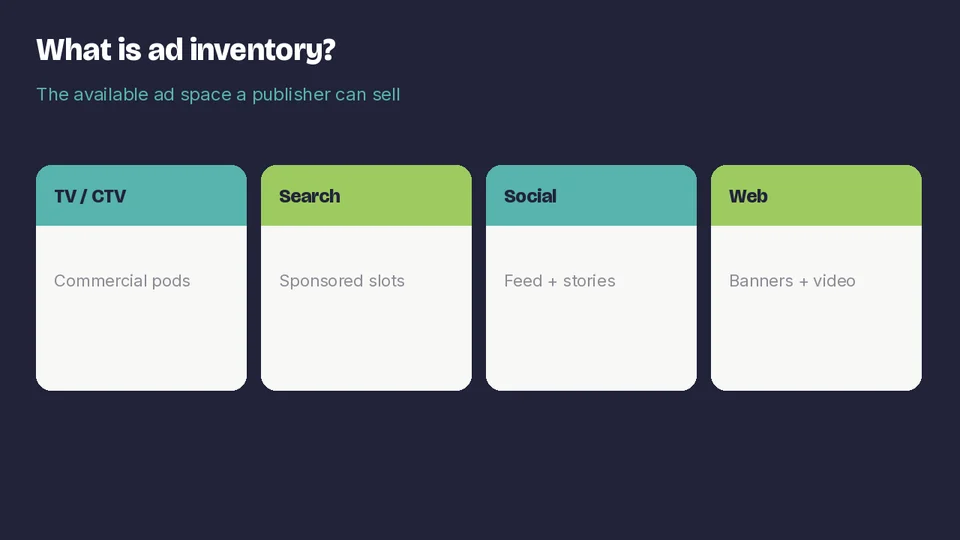
Ad inventory is the advertising space a publisher has available to sell. On TV and streaming, that usually means commercial slots in a break (an ad pod). On the open web and in apps, it means banner or native units. In social and search, it means the feed or results placements the platform sells.
If you buy ads, you are buying inventory (or the right to compete for it). If you publish content, inventory is what you sell to advertisers. Price and availability move with audience, placement quality, season, and how the slot is sold.
You will hear "inventory" in almost every media conversation. The word is simple. The buying path around it is where people get lost. This glossary keeps the definition short and points you to the cost and channel pages when you are ready to plan a buy.
For platform-level pricing context, see TV advertising CPM by platform. For where streaming inventory lives, see CTV advertising platforms.

What counts as ad inventory
Inventory is the slot, not the creative. Your video or image is the ad. The break, feed unit, or search position is the inventory.
Common forms:
Linear TV: Fixed commercial breaks in live or scheduled programming.
Connected TV / streaming: Ad pods on AVOD, FAST, and ad-supported SVOD tiers (Hulu with ads, Tubi, Pluto TV, and similar).
Display and in-app: Banner, native, and interstitial units on sites and apps.
Social: Feed, stories, Reels, and in-stream video units sold by Meta, TikTok, Reddit, and others.
Search: Text (and some visual) placements on results pages.
Publishers and platforms package these slots into packages, auctions, or guaranteed deals. You rarely buy "one random second of airtime" in isolation. You buy access to impressions that match targeting rules.
A concrete example helps. On a streaming app, a 30-second mid-roll slot inside a comedy pod is inventory. The comedy show is content. Your commercial is creative. The platform sells many of those slots every hour across millions of households. Your buy competes for the subset that match your location, device, and audience rules.
On Google Search, the sponsored result above the organic list is inventory. On Meta, a feed unit between posts is inventory. On a local news site, a leaderboard banner is inventory. Same idea, different packaging and pricing.
Examples of ad inventory by channel

These examples stay definitional. They show what the slot looks like in the wild, not how you should spend every dollar.
Local dentist on CTV: Mid-roll pods on free streaming apps, geo-fenced to the practice DMA. Inventory = streaming commercial slots that can hold ZIP or city targeting.
Retailer on Meta: Feed and Stories units promoting a weekend sale. Inventory = the social placements Meta auctions while people scroll.
Home services on Google: Search ads for "emergency plumber near me." Inventory = paid positions on the results page when that query fires.
Restaurant on open web: Native or display units on local publishers and apps. Inventory = site real estate sold direct or through exchanges.
Notice what repeats: you are always buying access to attention inside someone else's media. The channel changes the format and the auction, not the core idea.
Premium inventory vs remnant inventory
Buyers often sort inventory by demand and brand context.
Premium inventory: High-demand environments (popular shows, live sports, well-known streaming apps, clean brand adjacency). Usually costs more on a CPM basis.
Remnant / leftover inventory: Capacity that did not sell in a direct or reserved deal. Often sold through automated auctions at lower prices.
Premium does not always mean "better for your business." A local plumber may get more customers from well-targeted mid-tier streaming inventory than from a national sports sponsorship they cannot afford. Match inventory quality to the job: brand safety and prestige for some campaigns; efficient local reach for others.
A third label you will hear is standard or mid-tier inventory: neither sponsorship-grade nor leftover scrap. Much of the streaming volume small businesses buy sits here. It is good enough for local reach, priced between premium and remnant, and usually sold through automated platforms rather than hand-negotiated packages.
Brand-safety filters also reshape what inventory you are allowed to buy. Excluding certain categories (for example, hard news or mature content) reduces the eligible pool and can lift CPM. That trade is often worth it. Just know you are choosing a smaller shelf of slots on purpose.
How ad inventory is sold (short version)
Three common paths:
Direct / reserved: You (or an agency) negotiate with the publisher for guaranteed slots.
Private marketplace (PMP): A gated auction or deal for selected buyers on premium supply.
Open programmatic: Automated buying across many publishers, often via real-time bidding.
Programmatic advertising is the buying method. Inventory is the thing being bought. On streaming TV, dynamic ad insertion (DAI) is one way ads get placed into the stream for different households. Those pages cover the mechanics. This page stays on the definition of the slots themselves.
Small businesses rarely negotiate cable insertion orders or PMPs by hand. Platforms like Adwave buy across a mix of channels (TV, Meta, Google, TikTok, Reddit, web) from a daily budget so you do not have to assemble inventory deals yourself.
A fourth path sits next to those three for many SMBs: self-serve multichannel platforms. You set a budget and targeting; the platform buys inventory across publishers without sending you insertion orders. You still buy inventory. You just do not negotiate each slot.
Guaranteed deals promise delivery against a reservation. Auctions promise a chance to win each impression. Private marketplaces sit between those poles: more control than the open exchange, less paperwork than a classic IO. For a glossary-level definition, remember only that every path is a way to sell the same underlying thing: available ad space.
Inventory types table

Use this as a map when someone throws labels at you. It is definitional, not a rate card.
CPM tendency is directional. A remnant slot in a scarce local audience can still price high. A premium package with loose geo can still waste money. Always pair the label with targeting and business outcomes. For streaming price context, jump to TV advertising CPM by platform.
Inventory, impressions, and CPM
Inventory supply and demand show up in CPM (cost per 1,000 impressions). Scarce, highly targeted, or premium slots tend to clear at higher CPMs. Broader or lower-demand slots tend to clear lower.
A few definitional relationships:
More competing buyers for the same audience usually raise CPM.
Narrow geo or demo targeting can raise CPM while reducing wasted impressions.
Seasonality (for example, Q4) often tightens inventory and lifts prices.
Under-delivery happens when matching inventory is thin for your targeting and budget.
Use the TV advertising CPM by platform table for directional streaming and linear benchmarks. Treat those figures as planning averages, not a rate card for your ZIP code.
Example math: if a stream of inventory clears at a $25 CPM, $250 buys about 10,000 impressions. If targeting is so tight that only 4,000 matching impressions exist that day, the system cannot invent slots. Delivery slows, effective cost can rise, and dashboards start talking about "limited inventory." The fix is usually wider geo, longer flights, or a less stacked audience, not a different definition of inventory.
Inventory and CPM are linked but not identical. Inventory is supply. CPM is the clearing price when demand meets that supply under your rules. Reading both together keeps you from chasing the cheapest cell in a table or the fanciest logo on a pitch slide.
Why the term matters if you are an SMB
When a salesperson or dashboard says "inventory is tight," they mean matching slots are scarce for your settings. When they say "we found more inventory," they mean more eligible impressions appeared.
Practical takeaways:
Geography first. Local businesses should prefer buys that can hold a city, radius, or ZIP set so you are not paying for inventory in markets you cannot serve.
Audience over logo chasing. The right household in a mid-tier stream often beats a famous show with the wrong ZIP.
Mix channels. TV inventory builds recall; search and social inventory catch demand. One daily-budget mix can cover both jobs.
Read fill and delivery. If a day under-delivers, targeting may be too tight for available inventory.
Adwave is built for that SMB path: paste your site, approve ads, set location and a daily budget (from $30/day), and the system buys across the mix without you managing publisher deals. Creative-only work lives at Wavemaker; media buying stays in Adwave.
One more SMB-specific habit: ask what inventory class you are buying before you celebrate a low CPM. A bargain that cannot hold your city, or that sits next to brand-unsafe content, is not a bargain. A slightly higher CPM on clean, local, completed TV impressions can be the cheaper path to booked appointments.
FAQ
What is ad inventory in simple terms?
It is the ad space available for sale: commercial breaks on TV and streaming, units in feeds and apps, and placements on search results.
Is ad inventory the same as an impression?
No. Inventory is the slot available to sell. An impression is one time an ad runs in a slot.
Does programmatic mean low-quality inventory?
No. Programmatic is how the buy is executed. Premium and remnant inventory can both sell programmatically. See what is programmatic advertising.
How does CTV inventory differ from linear TV inventory?
Linear inventory is tied to scheduled programming and often sold in broader packages. CTV / streaming inventory is usually addressable by household or audience signals and sold through automated platforms. Overview: CTV advertising platforms.
How do I know what inventory will cost?
Start with CPM benchmarks by platform, then expect your real cost to move with targeting, season, and format. Begin with TV advertising CPM by platform.
What is remnant inventory?
Remnant inventory is capacity that did not sell in a reserved or direct deal. Publishers often sell it through automated auctions at lower prices. Lower price does not automatically mean bad inventory; it means leftover supply relative to earlier demand.
What does fill rate mean?
Fill rate is the share of available ad slots that sold or were filled with ads. Publishers watch fill rate as a revenue health metric. Advertisers feel the other side as delivery: if matching inventory is scarce for your targeting, you may under-deliver even when your budget is ready to spend.