You’re probably in the same spot most small business owners hit sooner or later. Sales need a push. Referrals aren’t enough. You know you need to advertise, but every answer you find sounds useless: it depends.
That answer isn’t wrong. It’s just lazy.
How much does it cost to advertise? Ad costs come from a stack of decisions, not one price tag. You’re not just paying for clicks, impressions, or airtime. You’re paying for targeting, creative, placement, timing, management, and sometimes a pile of hidden fees nobody mentions until after you’ve committed.
That’s why one business burns through budget with little to show for it, while another gets traction on a modest spend. The difference usually isn’t the platform. It’s whether the owner understands the total cost before launching.
If you’re trying to benchmark paid search, this breakdown of how much PPC campaigns cost gives useful context on how click-based pricing works and where budgets get eaten up.
Advertising isn’t reserved for national brands anymore. Small businesses can still use Google, Meta, and TikTok effectively. And for the first time, TV has become realistic for local businesses that would’ve dismissed it outright a few years ago.
The Big Question Every Business Asks
A contractor with a solid website asks whether to spend on Google. A real estate agent wonders if Instagram is enough. A restaurant owner thinks TV sounds powerful but assumes it’s out of reach. Different businesses, same anxiety: if I put money into ads, what will this cost me?
The wrong way to think about advertising is to hunt for the cheapest channel. Cheap traffic can still be expensive if it doesn’t convert. Expensive placement can still be efficient if it puts you in front of the right buyers and helps you close more business.
Practical rule: Don’t ask only what an ad costs. Ask what it costs to get attention from the right person, at the right moment, with creative that doesn’t look amateur.
That’s where a lot of owners get blindsided. They budget for media, then forget the rest. A click price is not the total campaign cost. A TV spot rate is not the total TV cost. The media line item is just one piece.
What changes the price
Some costs are obvious. Others are buried until launch week:
Media buying: What you pay for clicks, impressions, or airtime.
Creative production: The ad itself. Video, copy, images, editing.
Targeting layers: Data fees, audience segments, geofencing, retargeting.
Management time: Your time, a freelancer’s time, or agency fees.
Measurement tools: Dashboards, attribution tools, and reporting.
Once you understand those five buckets, the whole advertising market becomes much easier to handle.
Understanding the Levers That Control Ad Spend
Advertising prices aren’t random. Think of your ad budget like a control panel. Every dial you turn changes the final bill.

One reason this feels harder now is that competition is brutal. Global advertising spending is projected to exceed $1 trillion for the first time in 2025, with digital channels capturing 72.7% of that investment. In the US, per capita ad spend is expected to be $1,246 according to Insider Intelligence’s advertising forecast. That means you’re bidding in crowded markets where a lot of money is already chasing attention.
Audience and intent
The more valuable the audience, the more you’ll usually pay. Someone searching for an urgent service is expensive because that person might buy today. A broad awareness audience is often cheaper, but less likely to act immediately.
That’s why search ads usually cost more than passive display inventory. You’re paying for intent, not just visibility.
Placement and timing
Where your ad appears matters. So does when it appears.
A local business can lower costs by adjusting placement choices instead of slashing budget. Running broad campaigns at the busiest times or in the most competitive placements often means paying a premium without getting meaningfully better outcomes.
Consider these common levers:
Geography: Local targeting is usually more efficient than trying to reach everyone.
Scheduling: Peak periods often cost more because more advertisers want the same inventory.
Device and format: Video, search, display, and social all behave differently.
Audience narrowness: The tighter the filter, the more expensive each qualified impression may become.
If your budget is tight, widen one lever at a time. Don’t narrow audience, geography, schedule, and format all at once and then act surprised when costs spike.
Creative and campaign structure
A weak ad makes every channel more expensive. If your message is unclear, your landing page is sloppy, or your offer is forgettable, you’ll pay more for worse outcomes.
That’s true on Google. It’s true on Meta. It’s especially true on video.
There’s also a structural issue most small businesses miss. If you try to run advanced programmatic campaigns in-house, software fees can crush the economics before a single ad performs. Licensing a DSP like The Trade Desk requires a minimum monthly fee of $17,000 or 17% of media spend, whichever is greater, plus setup fees, and full-stack deployment can exceed $50,000 per month minimum according to Programetrix’s breakdown of in-house ad tech costs. That’s why many small businesses should avoid overbuilt stacks and stick to simpler buying paths.
Comparing Ad Costs Across Different Channels
A small business owner can spend $500 on Facebook, $2,000 on Google, or $3,000 on TV and still have no real answer to the same question: what did the full campaign cost?
That’s the mistake. Media price is only part of the bill. Some channels are cheap to launch and expensive to scale. Others look expensive upfront but get more efficient once you factor in reach, production, and brand impact.
2026 Advertising Channel Cost Comparison
The digital figures above come from J. Oliver Advertising’s 2025 digital advertising cost benchmarks. The TV and CTV range reflects common small-business buying ranges seen across targeted streaming and local TV placements.
What these numbers mean
Google Search usually carries the highest click price because you are paying for urgency and intent. If someone searches for a service right before buying, that traffic can justify the premium.
Meta is easier for testing offers, hooks, and creative angles without burning budget too fast. It works best when people do not need your product right this second but will respond after repeated exposure.
TikTok can be cheap media and expensive execution. The ad buy may be affordable, but weak creative gets ignored fast. If your team cannot produce native-looking short video, the low CPM does not help much.
Radio and print are harder to judge because the media rate rarely tells the full story. You often buy bundled placements, commit to fixed schedules, and accept weaker attribution. That does not make them useless. It makes them harder to control.
Here’s the practical rule. Judge channels on total campaign cost, not media cost alone.
TV is the clearest example. Traditional TV used to force small businesses into a bad deal. Production costs, agency markups, and minimum spend requirements made the channel feel closed unless you had a serious budget. Now that AI-powered platforms such as Adwave can handle ad creation and simplify buying, premium video inventory is no longer reserved for larger brands. For many local businesses, TV has shifted from unrealistic to testable.
If you want a cleaner framework for choosing between intent-driven and awareness-driven channels, this comparison of Google Ads vs Facebook Ads vs TV does a good job of showing where each one fits.
For business owners comparing efficiency across regions, this analysis of digital marketing ROI for South African business is a useful reminder that ad costs only make sense when matched against customer value, local competition, and buying behavior.
Decoding CPM and Measuring Advertising ROI
A lot of ad budgets get wasted because owners know what they spent, but not what they bought.
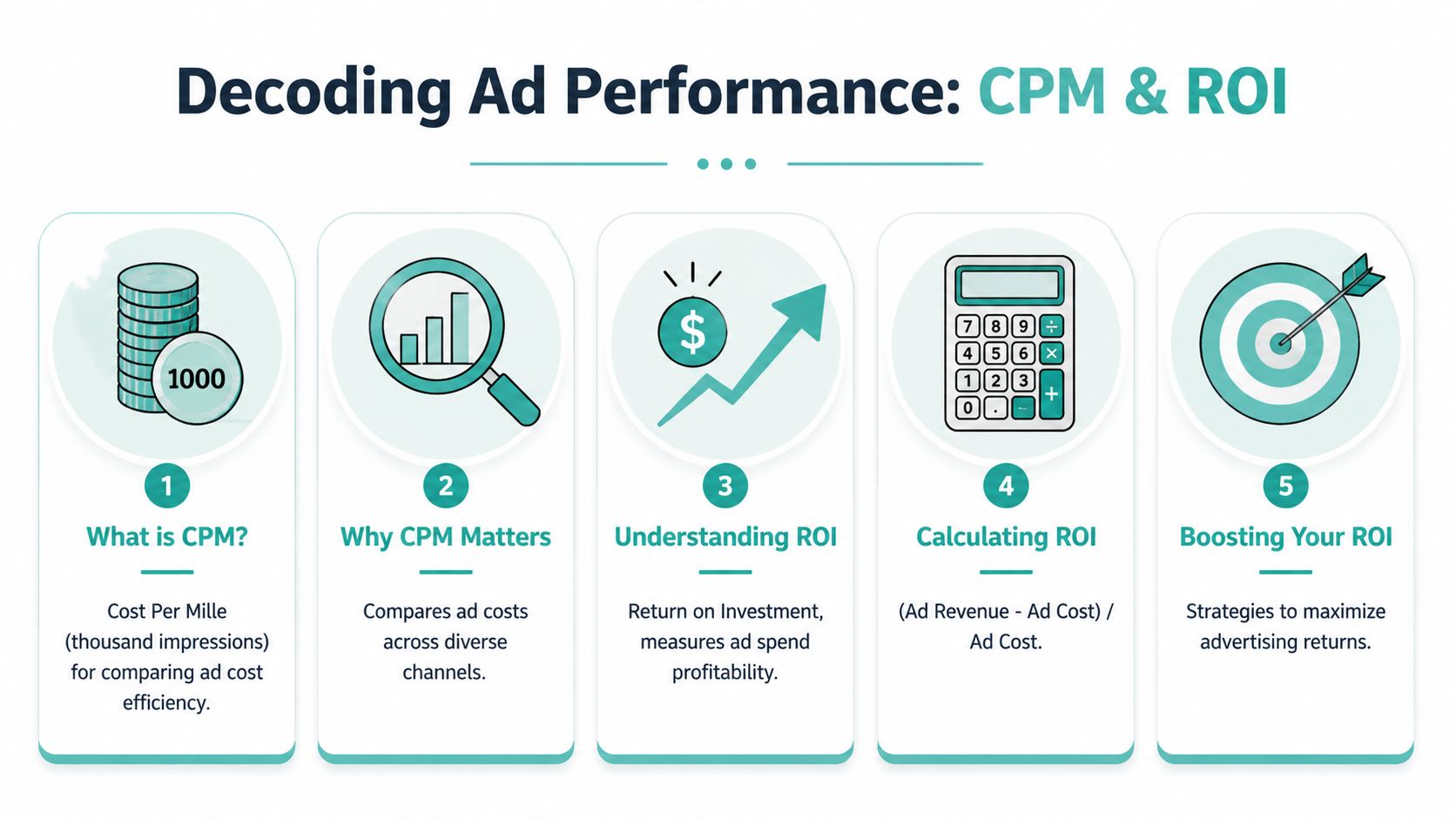
CPM means cost per mille, or the cost to show your ad 1,000 times. It's comparable to paying for 1,000 flyer handoffs. It doesn’t tell you whether those people care. It tells you what it cost to get the message in front of them.
If you’re new to the metric, this guide on what CPM means in advertising gives a clean explanation of when to use it and when not to.
Why CPM matters
CPM is useful because it lets you compare very different channels on a common basis. A click-based platform and a video-based platform can’t be judged by the same immediate action, but they can still be compared on exposure cost.
That matters most when you’re evaluating awareness channels, video placements, and local reach campaigns.
But CPM has a trap. It can look low while the actual campaign cost climbs because of add-ons.
The hidden layer most people miss
If you activate third-party audience data to target specific demographics in digital campaigns, it can add $1.50 to $2.50+ CPM, inflating total media costs by 10% to 25% beyond the base price, according to Tunnl’s breakdown of third-party audience data usage fees. That’s one of the clearest examples of why sticker prices mislead people.
A platform might quote a reasonable media cost, but once data fees stack on top, the actual price changes fast.
Reality check: A low base CPM isn’t automatically efficient if audience fees, platform fees, or weak targeting force you to buy more impressions than you need.
ROI is bigger than click tracking
Return on investment matters more than media cost. If one channel drives calls, booked jobs, foot traffic, and branded search later, it can be profitable even if it doesn’t produce a neat last-click report.
Use a simple lens when you judge any campaign:
Direct response: Calls, form fills, purchases, booked appointments
Assisted impact: Branded search lift, repeat visits, returning customers
Business quality: Better leads, higher-value jobs, stronger close rates
That’s why TV and video often get underestimated. They don’t always win on immediate click tracking. They can still change brand familiarity and buying behavior in ways that show up later in your pipeline.
What a Real-World Ad Budget Looks Like
Most small businesses spend based on anxiety, not a plan. A better approach is to build a budget around how people buy from you.
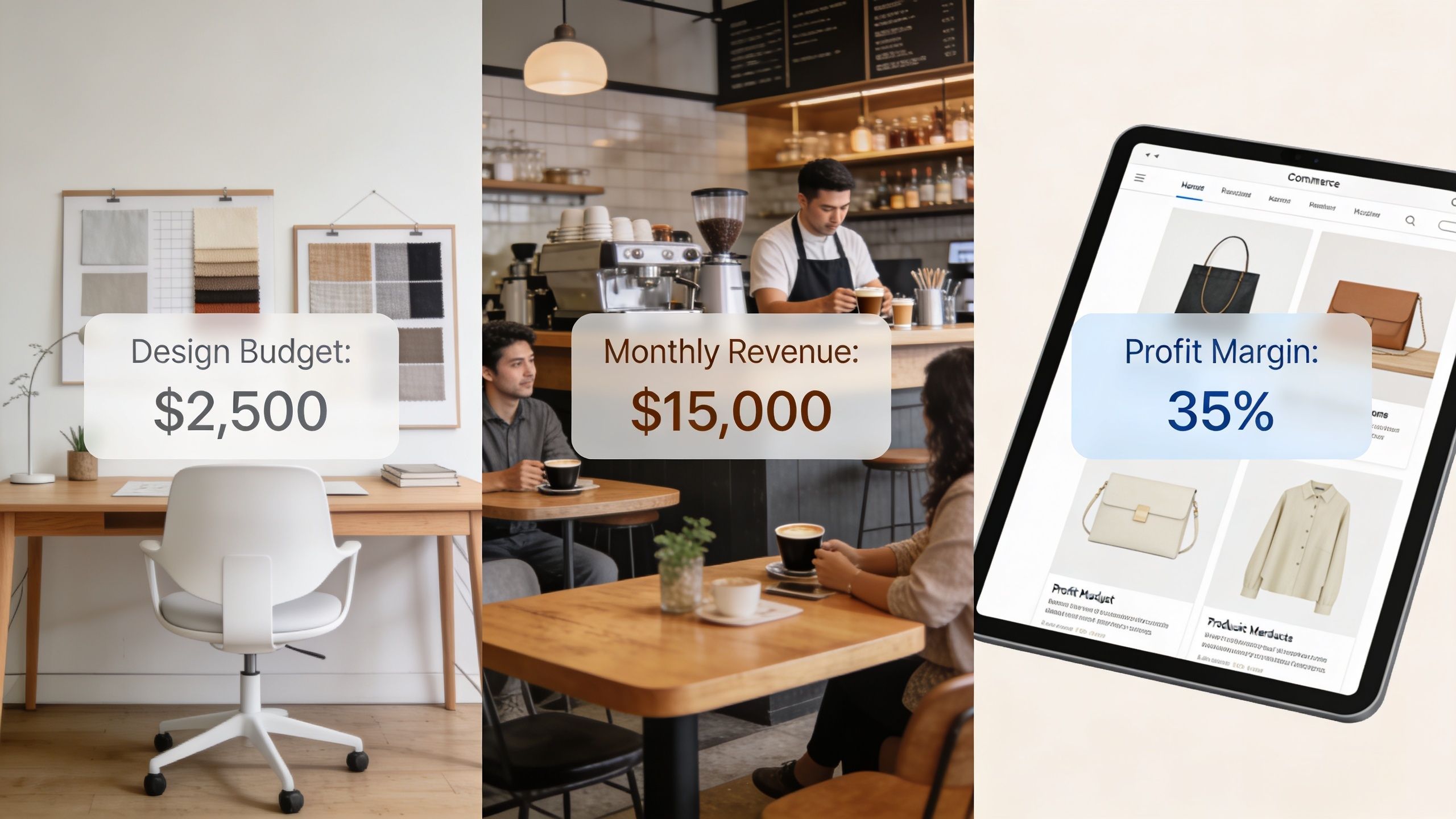
According to Top Draw’s analysis of small business advertising spend, most small businesses allocate 5% to 15% of revenue to marketing, and targeted TV campaigns have shown 150% growth in weeks for businesses like dental clinics. The lesson isn’t that every business should rush into TV. It’s that many owners ignore channels that may fit them because of outdated assumptions.
For broader local planning, this local advertising cost guide for 2026 is a useful benchmark for thinking about spend by market and channel.
Home service contractor
A plumber, roofer, or HVAC company usually needs two things at once: demand capture and local credibility.
A practical monthly budget often looks like this:
Google Search: Focus on urgent, high-intent terms tied to service areas.
Retargeting on Meta: Stay visible after someone visits your site.
Local TV or streaming video: Reinforce trust and help your name feel familiar before the customer needs you.
Search should do the heavy lifting for immediate leads. Video works in the background by making your brand recognizable when the emergency happens.
Real estate agent
An agent needs visibility, repetition, and local market presence. Search matters less than ongoing awareness unless the strategy is heavily lead-form driven.
A strong mix usually includes:
Meta and Instagram: Listing promotion, neighborhood content, seller education
Short-form video: Tour clips, market updates, personality-driven creative
Targeted TV: Household-level awareness in the ZIP codes that matter most
This is one of the clearest cases for video-heavy local reach. The sale cycle is longer, trust matters, and repeated exposure helps.
Local restaurant or cafe
Restaurants don’t need abstract reach. They need nearby attention and action.
A reasonable approach looks like this:
A budget only works if it matches buying behavior. Home services need intent. Real estate needs familiarity. Restaurants need frequency nearby.
The common mistake in all three examples is overfunding one channel and expecting it to do every job. Search won’t always build memory. Social won’t always capture urgent demand. TV won’t always produce trackable clicks. Use each where it fits.
How AI Is Making TV Advertising Accessible
You price out a local TV campaign, see a media number that feels possible, then get hit with the full bill. Script. Shoot. Editing. Revisions. Music. Voiceover. Approval delays. For years, that stack of production costs kept small businesses out of TV long before airtime did.
That is the part many owners miss when they ask how much advertising costs. Traditional TV was never just a media buy. It was a production project attached to a media buy, and the production side often made the channel impractical for a local business that needed to test, learn, and revise quickly.
The old process was expensive because it forced you to commit early. You had to assemble creative assets, coordinate outside help, and pay for polished output before you knew whether the message would work. That is a bad fit for a small budget.
AI changes the economics by removing much of that upfront overhead. A business can now create usable video faster, revise it without restarting the whole process, and launch without treating every ad like a custom studio production. That matters more than the hype. Lower creative friction means TV becomes testable.
Tools such as Adwave’s AI video ad creator let a business generate a broadcast-ready ad from a website URL and run on premium TV inventory without the traditional production workflow. The practical benefit is simple. You can put TV into the same budget conversation as paid social, YouTube, or display instead of dismissing it as a channel reserved for brands with agency-level spend.
TV inventory itself can be competitive with other reach channels, as noted earlier. The difference now is that the total cost has changed. Once you cut down the hidden creative fees, TV stops looking like a luxury item and starts looking like another option for local awareness, frequency, and trust-building.
That does not make TV the first dollar for every business. It does make TV a serious option for businesses that benefit from repeated local exposure, especially when search captures demand and TV builds recognition before the customer is ready to act.
Your Next Steps in Launching an Ad Campaign
Start with the total cost, not the platform headline. If you don’t account for creative, targeting add-ons, tools, and management time, you’re not budgeting. You’re guessing.
Keep your first campaign simple:
Choose one main objective. Calls, booked appointments, store visits, or awareness in a defined area.
Pick one demand channel and one visibility channel. For many businesses, that means search plus video.
Use creative you can revise fast. Slow production kills learning.
Measure business outcomes, not vanity metrics. Leads, sales quality, repeat customers, and branded demand matter more than cheap impressions.
Scale only after you see signal. Don’t spread budget across five platforms because you’re afraid to commit.
If you’re still asking how much does it cost to advertise, the most honest answer is this: it costs less than most owners fear when the campaign is tight, targeted, and built around a realistic buying path. It costs far more when you pay for complexity you don’t need.
Small businesses should still use Google and social. But they shouldn’t ignore TV just because the old version of TV was clunky and expensive. That version isn’t the only option anymore.
If you want to test TV without taking on traditional production costs, Adwave gives you a practical starting point. You can create a broadcast-ready ad from your website, launch with a small budget, and treat TV as a measurable local growth channel instead of a six-figure brand play.