Insights
September 22, 2025
What Is the Average TV Ad CPM by Platform? [Q3 2025]
CTV CPMs range from $15-35 depending on platform and targeting. Here's the breakdown.
Table of Contents
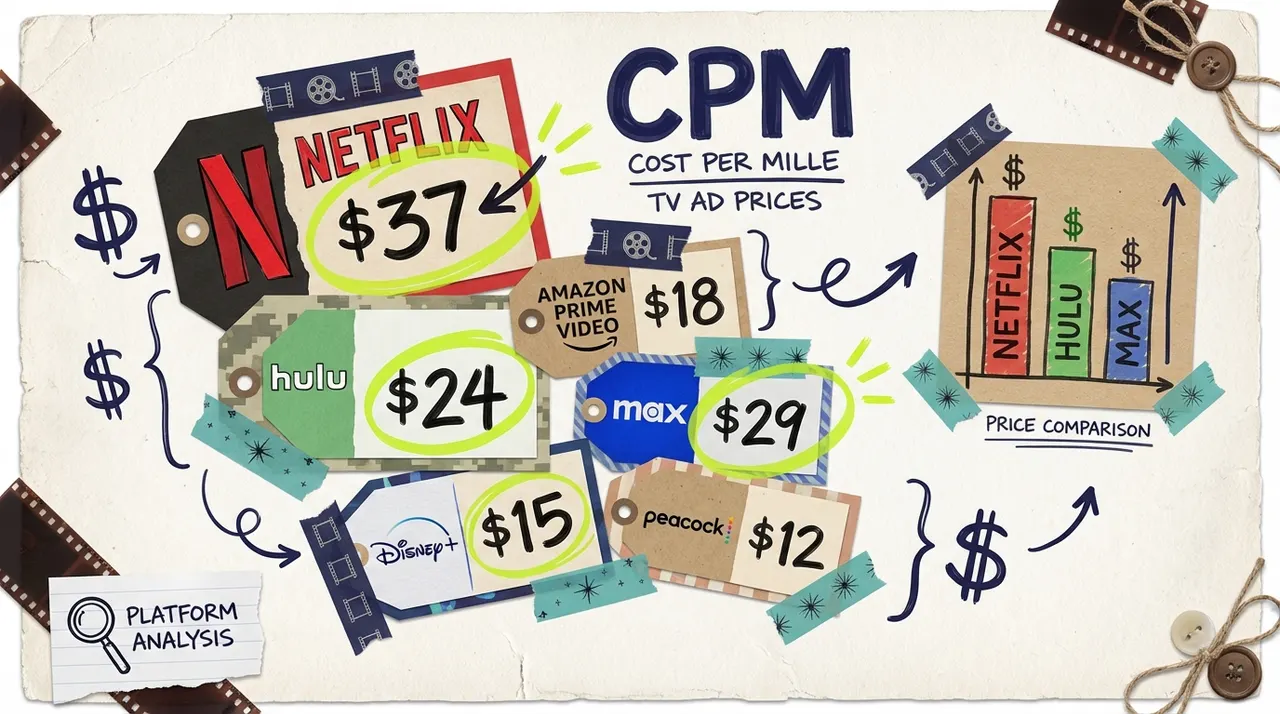
Understanding what you'll pay for TV advertising starts with knowing the CPM (cost per thousand impressions) across different platforms. In 2024, streaming TV advertising costs varied dramatically by platform, with Netflix commanding an average CPM of $37.02 while FAST channels like Pluto TV averaged just $14.72, according to Ad Age's streaming commercial pricing analysis. This 150% price difference between the most and least expensive streaming platforms creates real opportunities for advertisers who understand where their dollars deliver the best value.
For small businesses exploring TV advertising for the first time, CPM represents the foundation of media planning. It tells you how much you'll pay to reach 1,000 viewers on any given platform. But raw CPM alone doesn't tell the whole story. A $15 CPM on a free streaming service might seem like a bargain compared to $37 on Netflix, but audience quality, targeting capabilities, and brand environment all factor into the real value equation. This guide breaks down CPM by platform to help you make smarter TV advertising decisions.
What the data shows
The streaming TV advertising market experienced significant CPM declines across nearly every major platform in 2024. According to Ad Age's analysis of data from multiple media-buying agencies, the overall average CPM for streaming services dropped 21% year-over-year, settling at approximately $25.68.
These figures represent directional averages from agency data rather than official platform pricing, as streaming services don't publicly disclose their rate cards. Actual CPMs can vary significantly based on targeting parameters, ad format, campaign timing, and negotiated relationships between agencies and platforms.
The most dramatic shift came from Netflix, which saw its average CPM plummet 32% from $54.78 to $37.02. This decline reflects both increased inventory as Netflix's ad tier grew to over 70 million global subscribers and competitive pressure from Amazon Prime Video's entry into the advertising market. When Prime Video launched its ad tier in early 2024 with CPMs around $24, it created downward pressure across the entire streaming advertising ecosystem.
Linear television CPMs tell a different story. According to Inside Radio reporting on TV upfront data, national broadcast networks averaged approximately $45.34 CPM in 2024 (down 6% year-over-year), while cable networks averaged $20.60 (down 7%). The continued erosion of linear TV viewership has put pressure on traditional television pricing, though premium broadcast inventory for live events like sports and award shows still commands premium rates.
Understanding these benchmarks helps advertisers allocate budgets strategically across platforms. A campaign targeting premium audiences might accept Netflix's higher CPM for its brand-safe environment, while a reach-focused campaign might stretch dollars further on FAST platforms like Tubi and Pluto TV.
Breaking down the numbers
By platform tier
Streaming platforms cluster into distinct pricing tiers based on their content strategy, audience positioning, and ad load philosophy. Understanding these tiers helps advertisers match platforms to campaign objectives.
Premium tier ($30-40+ CPM): Netflix and Max represent the premium tier, commanding the highest CPMs in the streaming market. Netflix's premium pricing reflects its vast subscriber base, award-winning original content, and relatively low ad frequency (approximately 4-5 minutes of ads per hour compared to 9-12 minutes on other platforms). Max's positioning stems from its HBO legacy, prestige programming like "House of the Dragon" and "The Last of Us," and an audience that skews affluent and highly educated. Advertisers pay premium rates on these platforms for access to engaged viewers in quality content environments.
Mid-tier ($24-30 CPM): Disney+, Paramount+, Peacock, Prime Video, and Hulu occupy the middle ground. These platforms balance reasonable pricing with strong content libraries and established audiences. Disney+ benefits from family-friendly content and the Marvel/Star Wars universes. Paramount+ offers NFL football and CBS programming. Peacock provides NBC content and Premier League soccer. Prime Video's massive reach (integrated with Amazon's retail ecosystem) and Hulu's position as the leading ad-supported streaming service make this tier particularly attractive for advertisers seeking scale at moderate costs.
Value tier ($15-25 CPM): FAST (Free Ad-Supported Streaming TV) platforms like Tubi and Pluto TV offer the lowest CPMs in streaming. These services provide free content to viewers in exchange for higher ad loads (often 12-15 minutes per hour). While audiences may be less affluent on average than premium platform viewers, FAST services deliver significant reach at accessible price points. For local businesses and advertisers focused on awareness over prestige, FAST platforms provide excellent value.
By ad format
CPM rates vary based on ad format and placement within the streaming experience. Standard pre-roll and mid-roll video ads form the baseline, but premium formats command higher prices.
Standard 30-second non-skippable video ads represent the core CTV ad unit. These ads appear before content (pre-roll) or during natural breaks (mid-roll) and achieve completion rates above 95%. CPMs quoted throughout this article generally refer to standard video placements.
First-position ads (the first ad in a pod) typically cost 10-20% more than standard placements. Viewers pay more attention to the first ad in a sequence, making this position valuable for brand messaging. Some platforms offer guaranteed first-position buys at premium rates.
Interactive and shoppable CTV formats command premiums of 20-40% above standard video CPMs. These formats allow viewers to engage with ads through remote-control interactions, QR codes, or direct purchase capabilities. The higher engagement potential justifies premium pricing for advertisers seeking direct response.
Sponsorship and integration opportunities vary widely in pricing but generally command the highest CPMs. A title sponsorship before a popular show or integration within content can cost multiples of standard ad rates but offers unique brand association benefits.
By targeting approach
Targeting specificity significantly impacts CPM. Broader targeting delivers lower CPMs, while precise audience targeting commands premiums.
Run-of-network (RON) inventory, where ads can appear anywhere on a platform without specific targeting, typically represents the lowest available CPM. Advertisers sacrifice control over context and audience in exchange for cost efficiency and maximum reach.
Demographic targeting (age, gender, household income) increases CPMs by 10-25% above RON rates. Most streaming platforms offer basic demographic targeting as a standard capability, allowing advertisers to focus impressions on likely customer profiles.
Behavioral and interest targeting adds another 15-30% to base CPMs. This targeting uses viewing history, purchase data, and third-party data segments to identify audiences with specific interests or purchase intent. The precision improves campaign efficiency for advertisers with well-defined target customers.
Geographic targeting is essential for local TV advertising and typically adds 5-15% to CPMs. Local businesses can target specific DMAs (Designated Market Areas) or even radius targeting around physical locations. For businesses like restaurants, dental practices, or home service contractors, geographic targeting ensures every impression reaches potential customers within the service area.
Advanced targeting combinations (layering multiple targeting parameters) can increase CPMs by 40-60% or more above base rates. However, the improved efficiency often delivers better ROI despite higher CPMs, as fewer wasted impressions mean more relevant audience reach.
Netflix (ad-supported): $37 CPM average, premium positioning and brand-safe environment
Hulu: $30-35 CPM, established ad ecosystem with next-day network content
YouTube CTV: $25-30 CPM, massive scale with sophisticated targeting options
Peacock: $25-30 CPM, NBC sports and news content adjacencies
Tubi/Pluto TV (FAST): $15-20 CPM, lower costs with ad-tolerant audiences
Why it matters for your business
CPM directly determines how far your advertising budget stretches and how many potential customers see your message. Understanding platform-specific CPMs helps businesses at every budget level make smarter investment decisions.
For a business spending $500 on TV advertising, the platform choice dramatically impacts reach. At Pluto TV's $15 CPM, that budget delivers approximately 33,000 impressions. At Netflix's $37 CPM, the same budget delivers roughly 13,500 impressions. That's nearly 2.5 times more reach on the lower-cost platform for the identical investment.
But reach alone doesn't determine advertising value. Consider these factors alongside CPM when evaluating platforms:
Audience quality: Premium platforms like Netflix and Disney+ attract subscribers willing to pay for entertainment, suggesting higher disposable income and engagement. FAST platforms serve viewers seeking free content, which may include more price-sensitive households. Neither audience is inherently better; the right choice depends on your customer profile.
Ad environment: Fewer ads per hour (like Netflix's 4-5 minutes) means your ad faces less competition for viewer attention. Higher ad loads (like FAST's 12-15 minutes) mean more clutter but lower costs. For brand-building campaigns where message clarity matters, premium environments may justify higher CPMs.
Completion rates: CTV platforms consistently achieve 95%+ ad completion rates regardless of platform tier. This consistency means CPM differences primarily affect reach rather than message delivery, unlike digital video where completion rates vary dramatically by platform.
Targeting capabilities: Platforms with sophisticated first-party data (Amazon, Disney, NBCUniversal) can offer more precise targeting, potentially improving campaign efficiency despite higher base CPMs. The ability to reach exactly the right audience often delivers better ROI than reaching more people loosely matched to your customer profile.
For most small businesses, the sweet spot lies in the mid-tier platforms ($24-30 CPM) that balance reach, quality, and cost. Platforms like Hulu, Peacock, and Prime Video offer professional content environments at accessible rates, with targeting capabilities that help focus spending on relevant audiences.
How to take advantage of this trend
The declining CPM environment in streaming TV advertising creates unprecedented opportunities for businesses to enter television advertising or expand existing efforts. Here's how to capitalize on current market conditions.
First, consider programmatic CTV buying to access the best available rates. Platforms like Adwave aggregate inventory across multiple streaming services, allowing advertisers to reach audiences across platforms without negotiating individual deals. Programmatic buying often delivers CPMs below platform direct rates because it accesses remnant inventory and benefits from real-time bidding efficiency.
Second, test FAST platforms if reach matters more than prestige. For local businesses focused on awareness, platforms like Tubi and Pluto TV deliver significant impression volume at CPMs 50-60% below premium streamers. A car dealership or law firm building name recognition might achieve better results spending $1,000 on FAST platforms (delivering 60,000+ impressions) than the same budget on Netflix (delivering 27,000 impressions).
Third, use geographic targeting to improve efficiency. National CPM averages assume national reach, but local advertisers can often achieve lower effective CPMs by targeting specific markets. Reducing waste impressions on viewers outside your service area improves ROI even at identical CPM rates.
Fourth, time campaigns strategically. CPMs fluctuate seasonally, with Q4 (holiday shopping season) commanding premium rates and Q1 often offering lower pricing. If your business isn't dependent on holiday timing, shifting budget to off-peak periods can stretch dollars further.
Fifth, invest in quality creative. At any CPM, well-produced ads outperform poor creative. Adwave's AI-generated commercials achieve broadcast-quality production without traditional production costs, ensuring your message resonates regardless of platform placement. A compelling 30-second ad at $30 CPM will outperform a mediocre ad at $15 CPM in terms of business impact.
Limited budget ($50-$200): Start with FAST platforms like Tubi for maximum impressions at lowest CPM
Testing phase ($200-$500): Mix FAST and mid-tier platforms to compare performance across audiences
Scaling campaigns ($500+): Add premium platforms for brand-safe, high-quality adjacencies
Local focus: Prioritize platforms with strong geographic targeting capabilities
The bigger picture
Market dynamics driving CPM changes
The streaming advertising market has undergone fundamental restructuring since 2022, when Netflix and Disney+ launched ad-supported tiers. The resulting inventory expansion has been dramatic: millions of new ad-supported subscribers across premium platforms created billions of new impression opportunities annually. Basic economics dictates that when supply increases faster than demand, prices fall.
Amazon Prime Video's entry in early 2024 accelerated this trend. Prime Video instantly became one of the largest ad-supported streaming platforms, with an estimated 115 million U.S. viewers defaulted into the ad tier. The launch CPM of approximately $24 established a new pricing benchmark that pressured competitors to adjust rates downward.
Looking ahead, industry analysts expect CPMs to stabilize rather than continue declining precipitously. The initial shock of new inventory has been absorbed, and platforms are increasingly focused on premium pricing for high-quality inventory rather than volume-based competition. Live sports rights on streaming platforms (like NFL games on Peacock, Prime Video, and Netflix) command premium CPMs that counter downward pressure on overall averages.
CTV vs. linear TV economics
The relationship between CTV and linear TV pricing continues to evolve. Traditional broadcast television still commands premium CPMs ($45+ for network prime time) due to massive reach during live events and established measurement systems. However, the value proposition increasingly favors CTV for most advertisers.
CTV offers targeting precision that linear TV cannot match. While a linear TV commercial reaches everyone watching a particular program, CTV enables advertisers to reach specific households based on demographics, interests, and behaviors. This targeting efficiency means CTV advertisers can achieve equal or better business results at lower total cost, even if raw CPM comparisons seem similar.
The shift toward streaming further erodes linear TV's value proposition. As audiences migrate from cable to streaming, linear TV reaches an increasingly narrow (and older) demographic slice. For advertisers targeting adults under 50, CTV has become essential for comprehensive reach.
Measurement and attribution evolution
CTV's digital nature enables measurement capabilities that traditional TV cannot provide. Beyond basic impression and completion metrics, CTV platforms increasingly offer conversion attribution that connects ad exposure to website visits, app installs, and purchases. This attribution clarity helps advertisers understand true ROI rather than relying on correlation-based estimates.
As measurement improves, CPM becomes one factor in a broader value equation. An advertiser might accept a $35 CPM if attribution shows that platform consistently drives conversions, while rejecting a $20 CPM from a platform where exposure doesn't translate to business results. This shift toward performance-based evaluation will increasingly influence platform pricing strategies.
What experts are saying
Industry analysts and advertising professionals have noted the significance of declining streaming CPMs and their implications for advertisers.
Media buyers report increased bargaining power in negotiations with streaming platforms. The combination of expanded inventory and economic uncertainty has shifted power toward advertisers, enabling better rates and more flexible deal structures than were available when streaming advertising was supply-constrained.
Streaming executives acknowledge the competitive pricing environment while emphasizing the value of their audiences and content environments. Platform representatives point to completion rates, brand safety, and audience engagement as factors justifying their CPMs relative to other digital video options.
Advertising technology leaders see the CTV market moving toward greater efficiency through programmatic buying and automated optimization. As more inventory becomes available programmatically, advertisers gain tools to optimize CPM automatically based on performance, potentially making manual platform-by-platform analysis less necessary.
Small business advertising advocates highlight how declining CPMs have democratized television advertising. What was once restricted to businesses with six-figure budgets has become accessible at modest spend levels. A local business can now achieve meaningful TV reach with budgets starting as low as $50 through platforms like Adwave.
Common questions answered
What is a good CPM for TV advertising?
A good TV advertising CPM depends on your objectives and platform expectations. For CTV advertising, CPMs between $20-35 represent the current market average, with FAST channels available at $15-20 and premium platforms like Netflix at $35-45. For linear TV, expect $20-25 for cable and $40-50 for broadcast networks. Generally, if you're achieving CPMs within these ranges while reaching your target audience, you're paying fair market rates. CPMs significantly above these benchmarks may indicate over-targeting or premium inventory that may not be necessary for your campaign goals.
Why do streaming CPMs vary so much between platforms?
Streaming CPM variations reflect differences in content quality, audience composition, ad load, and inventory availability. Premium platforms like Netflix and Max charge more because they offer prestigious content environments with lower ad frequency and affluent audiences. FAST platforms like Tubi and Pluto TV price lower because they offer free content with higher ad loads to audiences seeking cost-free entertainment. The variation allows advertisers to choose platforms that match their brand positioning and budget constraints.
Are higher CPM platforms worth the extra cost?
Higher CPM platforms can be worth the premium when brand environment and audience quality matter more than raw reach. For luxury brands, professional services, or advertisers sensitive to context, appearing alongside premium content may justify higher costs. However, for awareness-focused campaigns where maximum reach matters most, lower CPM platforms often deliver better cost efficiency. The right answer depends on your specific campaign objectives, target audience, and brand positioning. Testing across platform tiers can help determine which delivers best results for your business.
How do CTV CPMs compare to social media video CPMs?
CTV CPMs generally run higher than social media video CPMs, which typically range from $5-15 for platforms like Facebook, Instagram, and TikTok. However, this comparison overlooks significant differences in ad experience. CTV ads are non-skippable, achieve 95%+ completion rates, and play on the largest screen in the home. Social video ads are often skippable, achieve 30-70% completion rates, and compete with scrolling behavior. When normalized for completion, the effective cost of a completed view may actually favor CTV despite higher nominal CPMs.
Can small businesses afford TV advertising CPMs?
Yes. Small businesses can absolutely afford TV advertising at current CPM rates. A $500 budget at a $25 CPM delivers 20,000 impressions to targeted households in your service area. Platforms like Adwave enable campaigns starting at just $50, making TV advertising accessible at virtually any budget level. The key is using geographic targeting to ensure impressions reach potential customers rather than paying for national reach that includes irrelevant markets. With proper targeting, small businesses can achieve meaningful TV presence at costs comparable to or below digital advertising channels.
How do I negotiate better CPM rates?
Better CPM rates come from scale, timing, and flexibility. Larger commitments typically unlock volume discounts. Advertising during off-peak periods (Q1, early Q2) often delivers lower rates than Q4. Flexibility on platform selection allows access to the best available inventory at the lowest rates. Working with programmatic platforms or aggregators like Adwave can provide access to favorable rates without the scale typically required for direct platform negotiations. Focus on total campaign value rather than CPM alone; a slightly higher CPM with better targeting may deliver superior ROI.
Supporting data
Additional context on TV advertising CPM by platform:
Overall streaming CPM average: $25.68 (2024, down 21% YoY) (Ad Age)
Netflix average CPM: $37.02 (down 32% from $54.78 in 2023) (Ad Age)
Max (HBO) average CPM: $32.26 (down 16% from $38.28 in 2023) (Ad Age)
Disney+ average CPM: $29.04 (down 25% from $38.68 in 2023) (Ad Age)
Paramount+ average CPM: $26.23 (down 15% from $30.99 in 2023) (Ad Age)
Peacock average CPM: $26.02 (down 10% from $29.03 in 2023) (Ad Age)
Prime Video average CPM: $24.27 (new entrant in 2024) (Ad Age)
Hulu average CPM: $23.59 (down 15% from $27.74 in 2023) (Ad Age)
Tubi average CPM: $17.95 (down 14% from $20.87 in 2023) (Ad Age)
Pluto TV average CPM: $14.72 (down 23% from $19.08 in 2023) (Ad Age)
Broadcast TV average CPM: $45.34 (down 6% YoY) (Inside Radio)
Cable TV average CPM: $20.60 (down 7% YoY) (Inside Radio)
All sources linked above. Data current as of September 2025.
Get started with TV advertising
Ready to put these CPM insights into action? TV advertising has never been more accessible for businesses of all sizes. With streaming CPMs at historic lows and powerful targeting options, reaching your ideal customers on the big screen is within reach.
Adwave makes TV advertising simple and affordable. Create a professional 30-second commercial in minutes using AI, target viewers in your local market, and launch campaigns starting at just $50. Your ads run across 100+ premium streaming platforms at competitive CPMs, with no production costs or long-term commitments.