
Think about the old-school way of buying ad space. It was a grind. You'd spend days, sometimes weeks, on the phone and sending emails, trying to negotiate a deal with a single website owner. It was slow, clunky, and you were essentially just guessing if the right people would even see your ad.
This isn't just about being faster; it's about being smarter. Instead of buying space on a website and just hoping your ideal customer shows up, you're buying direct access to a specific audience, no matter where they are online. This makes every single ad dollar work much harder for you.
What Is Programmatic Advertising Explained
At its heart, programmatic advertising is a powerful form of marketing automation tools that handles the buying, placement, and optimization of digital ads for you. The system crunches massive amounts of data to make split-second decisions about which ad to show to which person, at the perfect moment. This ensures your message connects with people who are likely to care about what you're selling.
So, what does this automated approach really get you?
Massive Efficiency: Forget the manual back-and-forth. This frees you up to focus on the big picture, your strategy and creative ideas.
Pinpoint Targeting: You can get specific, targeting audiences based on their demographics, online behavior, interests, location, and so much more.
Real-Time Adjustments: Campaigns can be tweaked on the fly. If something isn't working, you can shift your budget to what is, instantly.
To see the difference clearly, let's compare the old and new methods side-by-side.
Traditional Ad Buying vs Programmatic Advertising
This table breaks down the fundamental shift from manual, relationship-based ad buying to the data-driven, automated world of programmatic.
The takeaway is simple: programmatic brings a level of precision and efficiency that was impossible just a few years ago.
This technology isn't some fringe tactic anymore, it's become the default for digital advertising. It gives businesses of all sizes a chance to compete, reaching customers with a level of focus that was once unimaginable.
A New Era for Small Businesses
For a long time, this kind of powerful advertising was walled off, accessible only to huge corporations with bottomless budgets. That's not the case anymore. Programmatic advertising's efficiency has opened the door for small and local businesses to get in on the action, especially in exciting new areas like streaming TV.
Platforms like Adwave were built specifically to make this technology simple and accessible. Adwave takes the complexity out of the process, helping local businesses place ads on major streaming channels like Hulu and ESPN without needing a giant budget or an in-house team of ad-tech experts.
This means a local pizza shop or a neighborhood real estate agent can now use the very same advertising tools as a global brand to connect with customers right in their own living rooms. The numbers back this up: global programmatic ad spend was estimated at $595 billion USD in 2024, with projections showing that over 95% of all digital display ads will be bought this way by 2027.
How Programmatic Advertising Works
Think of programmatic advertising like a high-speed stock exchange, but instead of trading stocks, we're trading ad space. Every single transaction (every ad you see) happens in the milliseconds it takes for a webpage to load on your screen. The engine driving this whole operation is a technology called Real-Time Bidding (RTB), which is essentially a lightning-fast auction for every ad impression available.
This isn't your classic, slow-moving negotiation with phone calls and contracts. It’s an instantaneous, automated showdown where advertisers compete to show their ad to a specific person, at a specific moment. When you visit a website, that site sends out a signal that an ad slot is open. This signal also carries anonymous data about you, things like your general location, interests, and recent browsing behavior.
Advertisers who want to reach someone just like you then place their bids in real time. The entire auction is over and done before the page even finishes loading. The highest bidder wins, and their ad is instantly displayed. It’s a beautifully efficient system that makes sure the ad you see is relevant, and the advertiser only pays to reach their ideal customer.
This flowchart shows just how far we've come, from slow, manual ad buying to the efficient, automated process we have today.
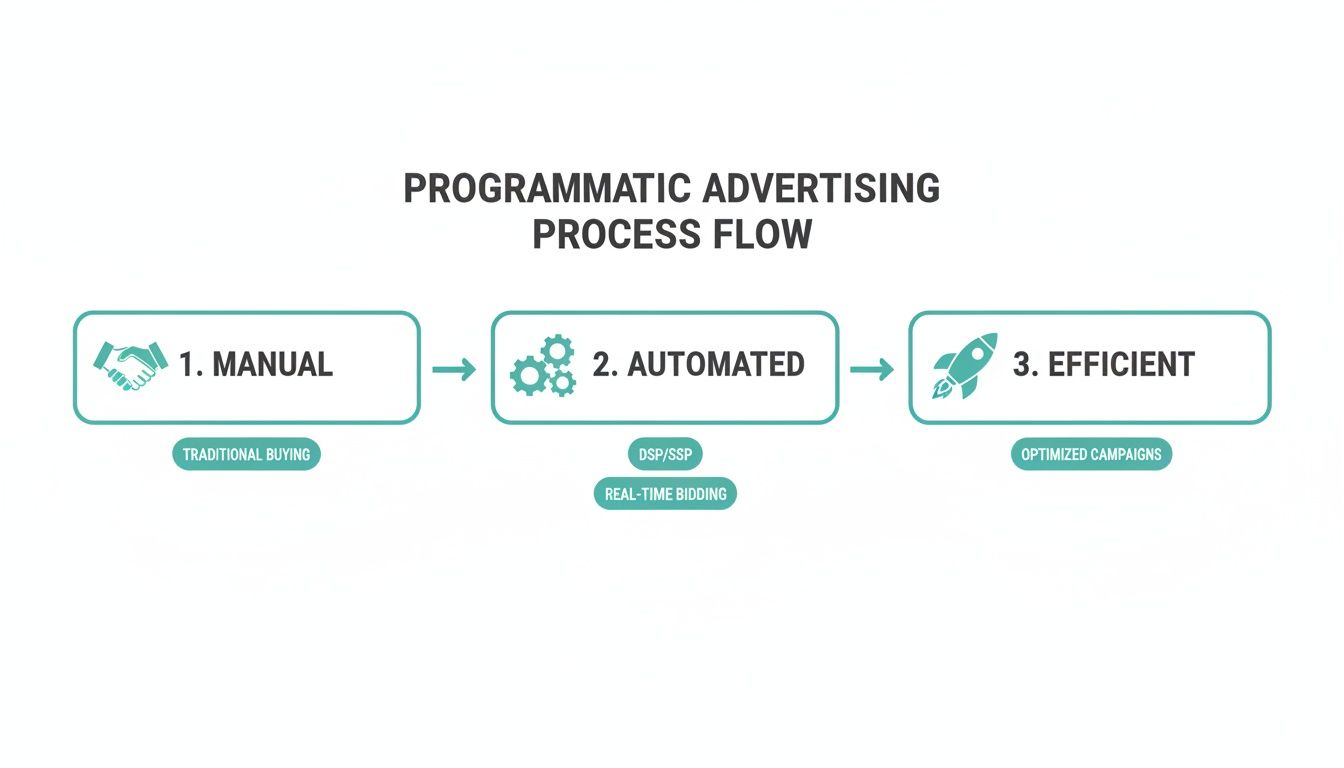
The big takeaway here is how technology has eliminated all the friction. We've moved from clunky handshakes and guesswork to a data-driven system that delivers results almost instantly.
The Key Players in the Programmatic Ecosystem
To make these high-speed auctions happen, a few key platforms have to work together behind the scenes. Think of them as the essential gears in the programmatic machine, each with a very specific job to do.
Let’s quickly break down who’s who:
Demand-Side Platform (DSP): This is the advertiser's command center. Businesses use a DSP to manage their ad campaigns across countless websites and apps from a single dashboard. The DSP is the tool that places bids on their behalf, based on the campaign's targeting rules and budget. Adwave functions as a user-friendly DSP, making this powerful technology accessible to everyone.
Supply-Side Platform (SSP): This is the publisher's side of the equation. Website owners and app developers use an SSP to sell their available ad space to the highest bidder. The SSP connects their ad inventory to a whole network of ad exchanges, which helps them make the most money possible.
Ad Exchange: This is the digital marketplace itself. It’s the neutral ground where the DSPs (the buyers) and the SSPs (the sellers) meet to do business. The auction happens right here, in real time.
When these three platforms work in concert, they create the connected, automated flow that makes programmatic buying possible. It's what allows advertisers to connect with valuable audiences with incredible precision.
Following an Ad from Start to Finish
Let's walk through a real-world example. Imagine a local coffee shop wants to run an ad for its new pumpkin spice latte, targeting coffee lovers within a five-mile radius.
A User Visits a Website: A person who lives two miles from the shop opens a local news app on their phone to check the weather.
The Auction Begins: The news app's SSP tells the ad exchange that an ad spot is available. It also passes along anonymous data points, like the user's location and that their browsing habits suggest they're a "coffee lover."
Bids Are Placed: The coffee shop's DSP immediately sees a perfect match for its target audience and places a bid for that ad space. Other advertisers might bid, too.
The Winner Is Chosen: In a flash, the ad exchange picks the highest bidder, our local coffee shop.
The Ad Is Served: The coffee shop's pumpkin spice latte ad instantly appears on the user's screen as they scroll through the news. This ability to serve up relevant and personalized ads on the fly is a core part of how programmatic works, and it's often powered by Dynamic Creative Optimization (DCO) tools.
This whole sequence is automated and optimized for one thing: relevance.
The same idea applies to streaming TV. A platform like Adwave allows businesses to place their video ads directly into the streaming shows their target audience is watching. The system finds the right viewer at the right moment, a process made even smoother by technology you can learn more about in this guide on https://adwave.com/resources/what-is-dynamic-ad-insertion, which directly places ads into video streams.
This complex, automated process is what makes programmatic so powerful. It replaces guesswork with data-driven certainty, so that advertising budgets are spent reaching the people most likely to become customers.
Where Do Programmatic Ads Show Up?
When you hear "digital ads," your mind probably jumps to the banner ads you see on websites. That’s definitely part of the picture, but programmatic advertising has grown to cover so much more than your web browser. Today, these automated ads can find your audience almost anywhere they are, creating a natural connection throughout their day.
This means you can reach potential customers whether they're streaming a podcast during their morning commute, scrolling an app on their lunch break, or kicking back with their favorite show at night. It's less about a single touchpoint and more about being present in the moments that matter.
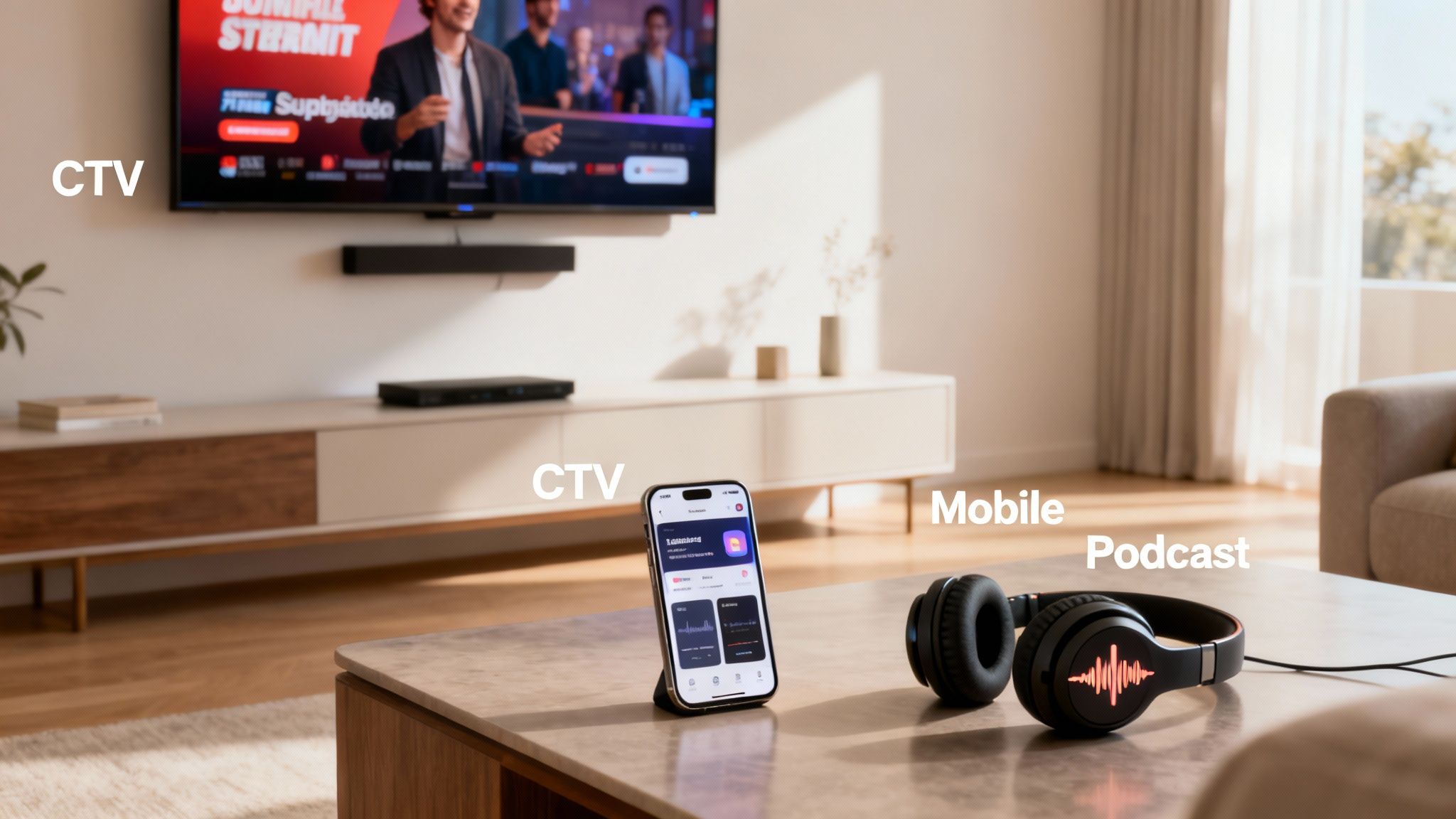
Programmatic platforms buy ads in several formats, including video, display, and mobile placements.
The Channels With the Most Clout
The programmatic world is big, but a few key channels have really proven their worth for businesses trying to make a real impact. Getting a feel for these will help you see where your ads can connect with people.
Here are the heavy hitters where programmatic ads run today:
Display Ads: These are the classic visual banner ads on websites and in apps. They’re the original programmatic format and still a cornerstone for building brand awareness.
Video Ads: From the ads before a YouTube video to the ones that play in the middle of an online article, programmatic video is a powerful and engaging way to tell a story.
Mobile Ads: People live on their phones, making mobile a non-negotiable channel. This includes everything from in-app banners and full-screen ads to the rewarded videos you see in mobile games.
Audio Ads: Think podcasts and music streaming services like Spotify or Pandora. Programmatic audio lets you reach listeners with targeted ads when they're tuned in and often screen-free.
Connected TV (CTV): This is where things get really exciting. CTV is any television connected to the internet, which includes major streaming platforms like Hulu, Peacock, and even live sports on ESPN.
The Game-Changer: Connected TV (CTV)
Of all these channels, Connected TV (CTV) represents one of the biggest opportunities for small and local businesses right now. For decades, TV advertising felt like an exclusive club for giant corporations with bottomless budgets. Programmatic has completely flipped that script.
Instead of getting locked into expensive, long-term contracts with networks, businesses can now bid on ad slots on streaming services automatically. A local restaurant or real estate agent can place a high-impact video ad right inside the shows their ideal customers are binge-watching. It makes TV advertising more accessible, affordable, and targeted than ever before. If this is new to you, our guide explaining what Connected TV advertising is is a great place to start.
This isn't just a passing trend. The global programmatic ad market was valued at $678.37 billion USD in 2023 and is on track to hit $2.75 trillion USD by 2030.
This massive growth is being driven by the channels people love most. Programmatic video ad spending blew past $120 billion USD in 2024, and video now makes up roughly half of all programmatic budgets. In the CTV world specifically, programmatic ad spend is expected to top $45 billion USD by 2026, which shows you exactly where eyeballs are headed. You can dig into more of this data from Grand View Research.
For businesses that want to get in on this action, a platform like Adwave is the perfect entry point. Adwave demystifies the whole process of programmatic TV advertising, taking the complicated world of CTV and making it simple. You can launch a broadcast-quality TV campaign on major streaming channels in just a few clicks, bringing the power of television to your local business without the old-school cost and hassle.
Why Programmatic Matters for Your Small Business
It’s one thing to understand the tech behind programmatic advertising, but it’s another to see what it can do for your business. For small and local businesses, programmatic isn't just another box to check in your marketing plan. It’s a powerful tool that helps you compete with the big guys, even if you don't have their massive budgets.
Essentially, this automated approach stops you from playing a guessing game with your ad dollars. Instead of buying a billboard and just hoping the right people drive by, you’re only paying to show your ad to someone who fits your ideal customer profile. That simple shift is what makes it so valuable.
Unlocking Unmatched Cost Efficiency
For any small business, making every single dollar count is the name of the game. Programmatic is brilliant at this because it cuts out so much wasted ad spend. You stop buying generic ad space and start buying access to a specific audience. This means your budget is laser-focused on the people who are likely to buy from you.
Think of it this way: instead of a mail carrier blanketing a whole town with your flyers, you have a highly skilled specialist who only delivers them to households they know are looking for what you offer. This precision targeting makes your marketing budget work smarter and harder, driving a much better return on investment (ROI).
Programmatic advertising shifts your focus from buying broad ad inventory to buying precise audience impressions. This fundamental change is what maximizes efficiency and ensures your message reaches the right people, every time.
This efficiency is why programmatic is driving so much growth. A 2025 industry report notes that over 90% of digital display ads are now bought this way. We see it everywhere: the auto industry boosted its programmatic TV usage by 55% to reach cord-cutters, and the travel industry bounced back post-pandemic with a 200% jump in programmatic spending. You can find more detailed statistics about programmatic advertising trends on Marketing LT&B.
Precision Targeting for Local Impact
If you run a local business, getting in front of customers in your own neighborhood is everything. Programmatic advertising offers accurate geographic and demographic targeting, letting you connect with potential customers right down to their zip code.
Let’s say you own a local pizzeria. With a simple platform like Adwave, you could automatically show a video ad for your dinner special to people within a five-mile radius of your shop, right around 5 PM when they’re wondering what to eat. That kind of local precision used to be out of reach for small businesses, but now it’s built right into the technology.
This hyper-local targeting lets you:
Reach Nearby Customers: Target people based on their physical location to drive real foot traffic.
Connect with Ideal Demographics: Focus on specific age groups, income levels, or interests that match your best customers.
Time Your Message Perfectly: Deliver ads at the exact moment a customer is most likely to make a purchase.
Accessing Premium Channels on a Small Budget
Not long ago, advertising on major TV networks or popular streaming services was only for national brands with six-figure budgets. Programmatic has completely flipped that script, making high-impact TV advertising accessible and surprisingly affordable.
This is where a platform like Adwave comes in. We built Adwave specifically to close this gap. It simplifies the entire process, letting a small business launch a campaign on top-tier streaming services like Hulu, Peacock, and ESPN with a budget as small as $50. All the technical heavy lifting is handled behind the scenes, so you can focus on running your business while your ads appear in your customers’ living rooms.
This opens up a whole new world, allowing you to build brand awareness on the very same channels as the industry giants. For a deeper dive into your options, check out our guide on the best programmatic advertising platforms.
Making TV Advertising Accessible Through Programmatic Tech
For decades, TV advertising was an exclusive club. If you didn't have a massive budget and the right industry connections, you were on the outside looking in. The whole process was slow, expensive, and tied up in long-term contracts that put it completely out of reach for small and local businesses.
Thankfully, programmatic technology has completely torn down those old walls, changing the game for good.
This shift has turned TV advertising on its head. Gone are the days of buying rigid, fixed ad slots months in advance. Now, businesses can get in on an auction-based model, bidding for individual ad impressions in real time and reaching specific viewers while they're streaming their favorite shows. It’s a monumental change that finally makes the power of television a realistic marketing tool for just about anyone.
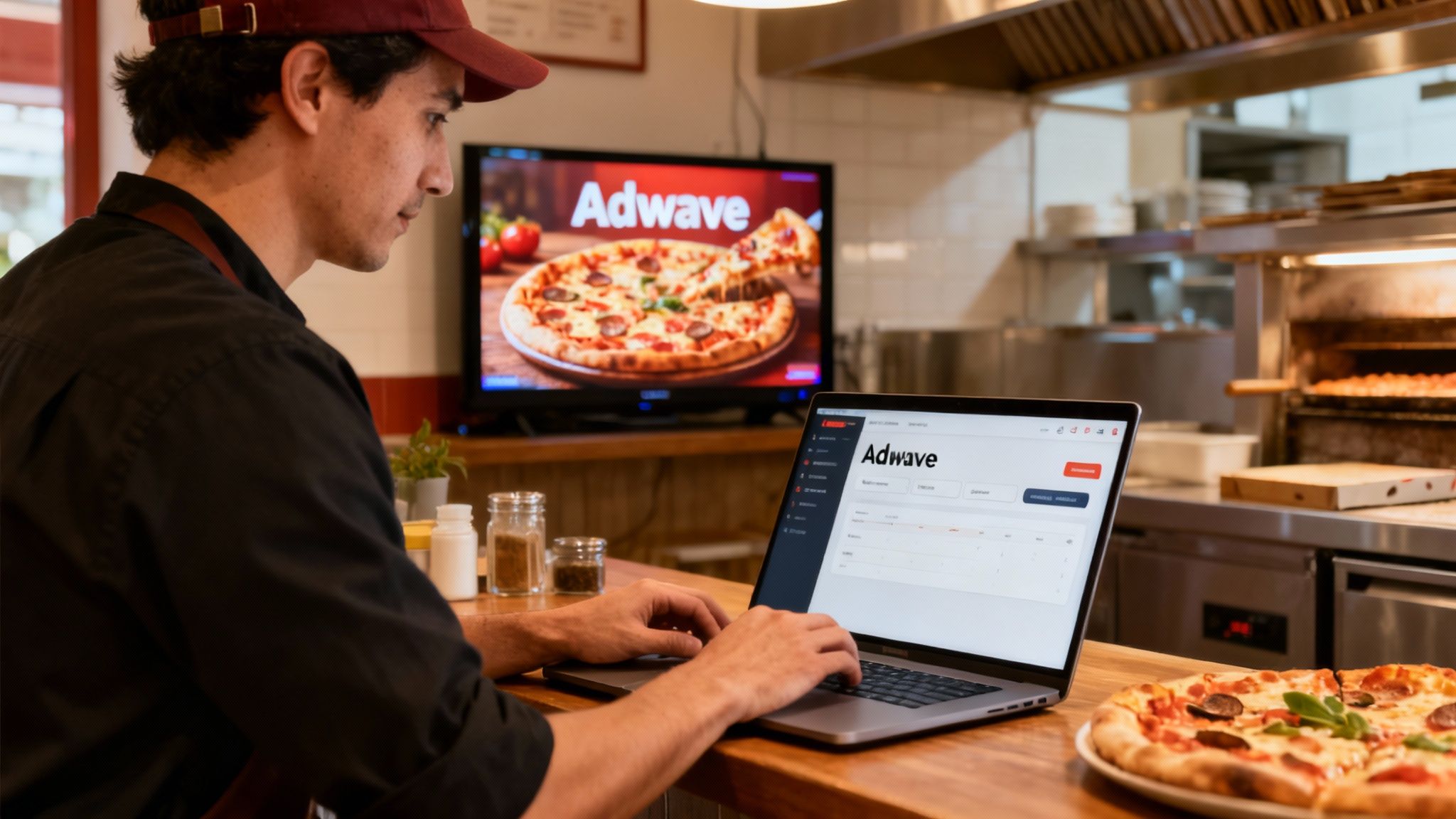
This new level of accessibility is exactly why Adwave was created. Our platform was designed from the ground up to take the intimidating, complex world of programmatic TV and make it simple and affordable for the small businesses that form the backbone of our communities. We handle all the technical heavy lifting so you can stay focused on what matters, running your business.
From Complex Tech to Simple Steps
Let’s say you're a local real estate agent who wants to reach potential homebuyers in your area. Here’s how simple that process becomes with Adwave:
Generate Your Ad Instantly: Just enter your website's URL. Adwave’s AI gets to work, analyzing your site to automatically create a professional, broadcast-ready video ad in minutes. No film crews, no production costs.
Define Your Audience: Next, you pinpoint who you want to reach. You can target viewers by location right down to the zip code and layer on demographic profiles that match your ideal client perfectly.
Set a Budget You Control: You decide exactly how much to spend. Campaigns can start with as little as $50, and you can set a firm cap so you never go over budget. The system then automatically paces your spending to get the most mileage out of every dollar.
Launch Your Campaign: With one last click, your ad is ready for primetime. Adwave’s platform takes it from there, bidding on ad space and placing your commercial on premium channels like Hulu, ESPN, and Peacock, right in front of your target audience.
This whole workflow turns what was once a months-long, complicated negotiation into something you can knock out in less time than it takes to grab a coffee.
The goal is to democratize TV advertising. By removing the barriers of cost, complexity, and production, platforms like Adwave empower local businesses to build brand awareness on the same channels as global corporations, leveling the playing field.
Making Premium Channels a Reality for SMBs
Perhaps the most exciting part of this shift is the access it provides. A small, local business can now see its brand appear alongside household names on the world’s biggest streaming platforms. This is about more than placing an ad; it's about building serious credibility and becoming familiar with customers in their own living rooms.
The explosive growth in programmatic TV ad spend clearly shows this is a trend that's here to stay, as more businesses recognize the opportunity. You can learn more about this growth in our detailed guide on programmatic TV ad spend.
This newfound access is a direct result of the efficiency of programmatic tech. By automating the entire buying process, platforms can offer ad inventory on major networks for a fraction of the traditional cost. Adwave, for instance, operates on a Cost Per Mille (CPM) model, which typically ranges from $15 to $35. This means you only pay for every thousand views, making sure your budget is tied directly to measurable exposure.
Ultimately, this technology delivers on a powerful promise to small business owners: you no longer have to be big to be seen on the big screen. The tools that were once kept under lock and key are now right at your fingertips, making powerful, targeted TV advertising a tangible and affordable reality.
Your Questions About Programmatic Advertising, Answered
Jumping into something like programmatic advertising can feel intimidating, especially when you're busy running a local business. You're probably wondering about the real cost, how complicated it is, and what kind of results you can honestly expect.
How Much Does Programmatic Advertising Cost for a Small Business?
One of the biggest myths out there is that this kind of advertising is only for the big players with deep pockets. The truth is, programmatic costs are flexible, which is exactly why it’s such a great fit for small businesses. Forget the massive, upfront commitments of traditional advertising, you can get started with a budget that feels comfortable for you.
For instance, with a platform like Adwave, you can launch your first programmatic TV campaign for as little as $50. How is that possible? It’s all based on a CPM (Cost Per Mille) model, meaning you pay a small fee for every 1,000 times your ad is shown. Adwave’s CPMs typically fall between $15 and $35, so you’re always in the driver's seat. You set the spending cap, and the system works within that limit, period.
This approach lets you test the waters without a huge risk. You can see what resonates with your audience, learn, and then scale your budget once you see the results coming in.
Is This Going to Be Too Complicated for Me to Manage?
While the technology behind programmatic is definitely complex, managing a campaign doesn't have to be. This is where modern, user-friendly platforms designed for business owners (not ad-tech gurus) are a useful option. You shouldn’t need a degree in ad operations to get your commercial on TV.
A tool like Adwave was built specifically to hide all that complexity. The platform's AI handles the technical heavy lifting, boiling the entire process down to a few simple steps:
Generate your ad just by entering your website's URL.
Define your audience and pinpoint your local service area.
Set your budget and decide how long you want the campaign to run.
Launch everything with one click.
The whole point of platforms like Adwave is to give you access to powerful advertising technology without the steep learning curve.
What Kind of Results Can I Realistically Expect from Programmatic TV?
When you run a programmatic TV campaign, the main goal is to build powerful brand awareness and get in front of a highly targeted local audience. Success here isn't just about counting clicks; it's about becoming the first name people think of in your community.
The key numbers you’ll want to watch are:
Impressions: The total number of times your ad was shown on screen.
Reach: How many unique households saw your commercial.
Frequency: The average number of times each household saw your ad.
Because programmatic targeting is so precise, you know your ad is being seen by potential customers right in your service area. We've seen it work time and again for our clients, some businesses have seen 150% growth in just a few weeks, while others report a direct and significant lift in revenue.
The real win is achieving familiar awareness. When someone in your town needs what you offer, your business should be the first one that comes to mind.
Can I Target a Really Specific Local Audience?
Yes. You can choose supported audience criteria and a geographic area for the campaign.
You can target viewers based on all sorts of factors, including:
Geography: Get as broad as a state or as granular as a single zip code.
Demographics: Focus on viewers by age, gender, or household income.
Viewing Habits: Reach people who watch specific types of shows or genres that align with your ideal customer.
A roofer, for example, can target homeowners in specific neighborhoods that were recently hit by a storm. A local real estate agent can run ads in zip codes where they know people are looking to buy. This level of control means your budget works smarter, reaching the most relevant people and maximizing your return.


