-
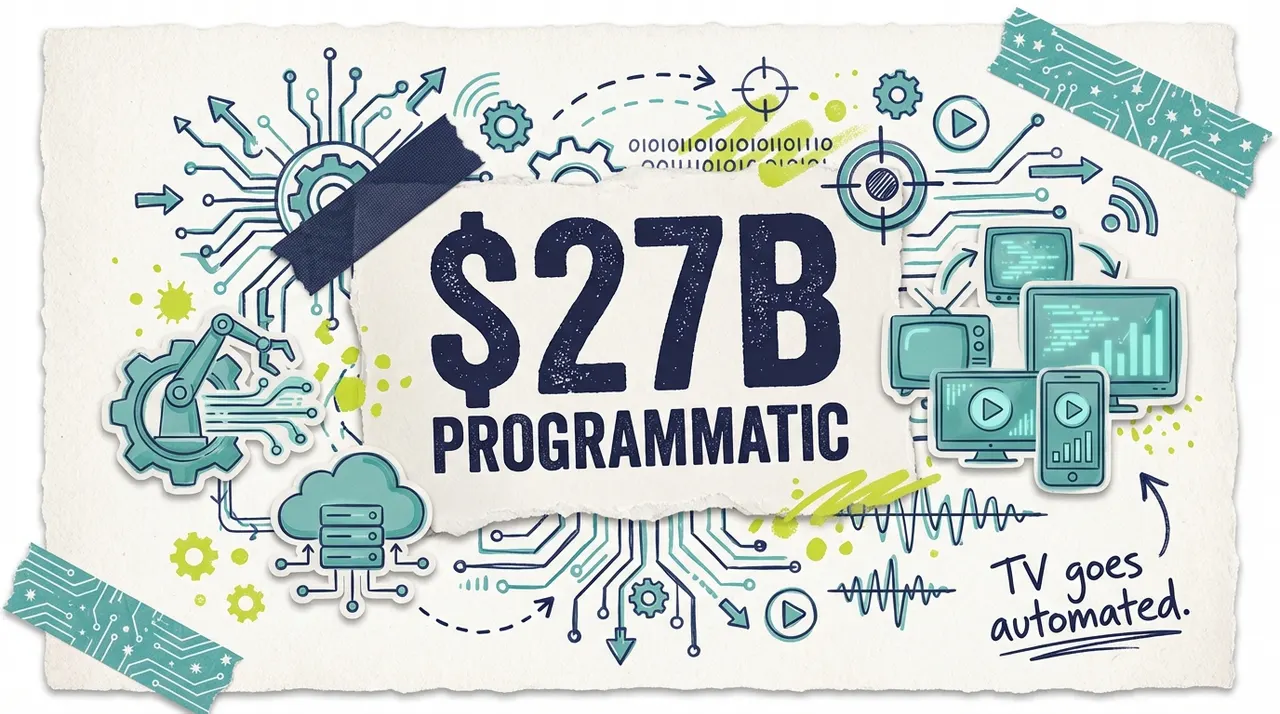
$27B
Programmatic CTV spend (2025)
-
84%
Share of CTV bought programmatically
-
75%
CTV transactions now automated
Article Content
Programmatic TV advertising has reached $27 billion in annual spend in the United States, representing approximately 84% of all connected TV (CTV) advertising, according to eMarketer and Senal News analysis. This means that for every $4 spent on streaming television advertising, more than $3 flows through automated, software-driven buying systems. The implications are significant: programmatic infrastructure has made television advertising accessible, targetable, and measurable in ways that traditional TV never was. For small businesses, programmatic CTV represents the mechanism that finally opens television to budgets starting at $50.
What the data shows
The $27 billion programmatic CTV figure represents a fundamental transformation in how television advertising is bought and sold. Understanding its composition reveals why this shift matters.
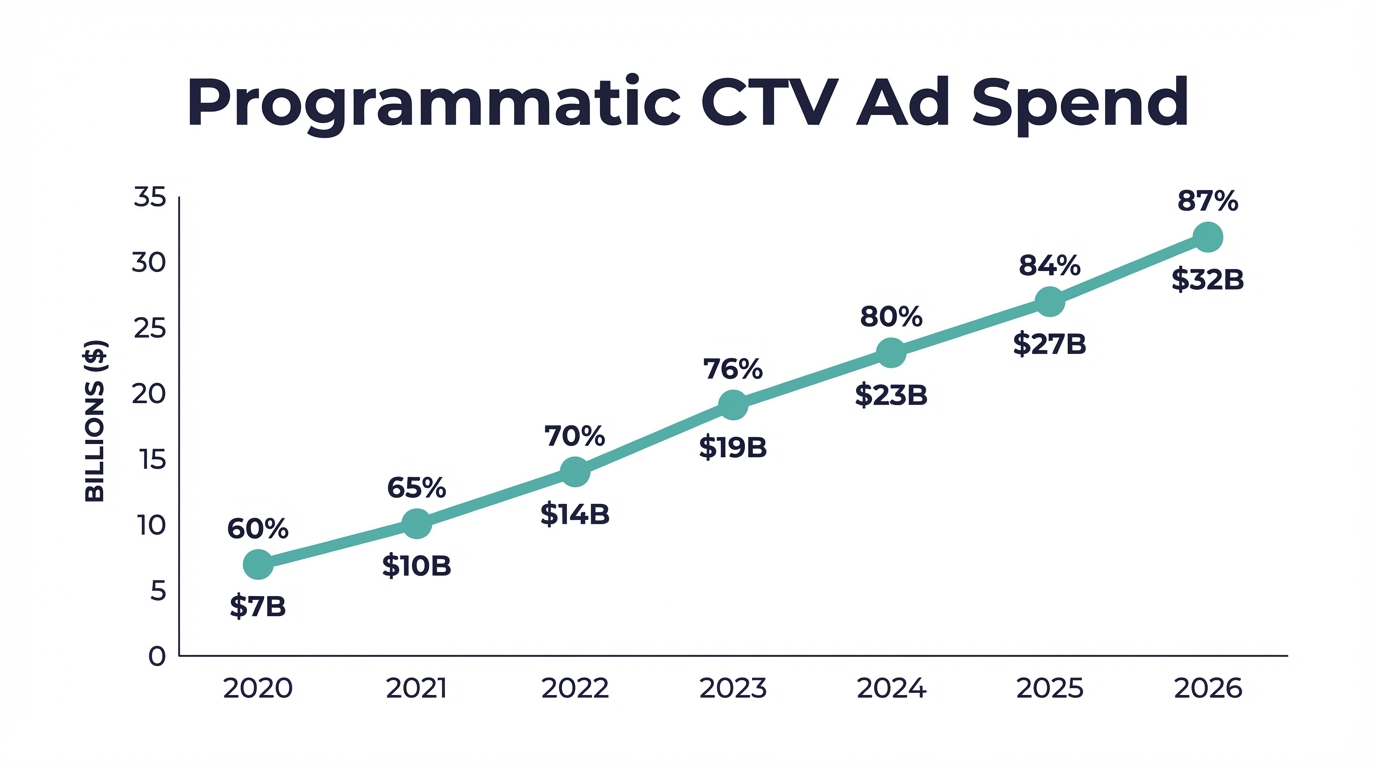
Growth trajectory of programmatic CTV:
2020: Programmatic CTV spend was approximately $7 billion (~60% of CTV)
2021: Grew to $10 billion (~65% of CTV)
2022: Reached $14 billion (~70% of CTV)
2023: Expanded to $19 billion (~76% of CTV)
2024: Hit $23 billion (~80% of CTV)
2025: Now at $27 billion (~84% of CTV)
2026 projected: Expected to reach $32 billion (~87% of CTV)
The percentage increase is as important as the absolute growth. Programmatic's share of CTV has grown from 60% to 84% in five years, while non-programmatic (direct sales, insertion orders) has declined from 40% to 16%. By 2028, programmatic is projected to represent over 90% of CTV transactions.
Global programmatic CTV spending adds context. In Q1 2025 alone, open programmatic CTV ad spend reached $5.02 billion globally, up 10% year-over-year according to Pixalate research. The U.S. represents approximately 65% of this global spend, which reflects America's more mature streaming and advertising technology infrastructure.
What's driving this programmatic dominance? Three factors explain the shift. First, programmatic enables targeting precision that direct sales cannot match, including geographic, demographic, and behavioral filtering at scale. Second, programmatic provides real-time optimization, allowing advertisers to adjust campaigns based on performance data. Third, programmatic reduces friction, enabling campaigns to launch in minutes rather than weeks and eliminating the relationship requirements of traditional TV buying.
Breaking down the numbers
The $27 billion programmatic CTV market operates through several distinct buying mechanisms, each serving different advertiser needs.
By transaction type
Programmatic guaranteed (~35% of programmatic spend):
Pre-negotiated deals executed through programmatic pipes
Fixed pricing with guaranteed impressions
Typically used by larger advertisers with volume commitments
Combines direct relationship benefits with programmatic efficiency
Private marketplace (PMP) deals (~30% of programmatic spend):
Invitation-only auctions with select publishers
Premium inventory with some price negotiation
Brand safety through curated environments
Popular with brand advertisers seeking quality and scale
Open exchange (~19% of programmatic spend):
Real-time bidding on available inventory
Market-driven pricing
Broadest inventory access
Most accessible to smaller advertisers
Direct/IO (~16% of total CTV, non-programmatic):
Traditional insertion orders
Manual negotiation and trafficking
Declining as programmatic expands
Still used for premium sponsorships and exclusives
By platform access
Different platforms have varying levels of programmatic availability:
FAST services (Tubi, Pluto TV, Roku Channel): Nearly 100% programmatically accessible
Hulu: Approximately 85% programmatic, with some direct-only premium inventory
Peacock: 80% programmatic availability
Disney+: Expanding programmatic access, currently ~60%
Netflix: Limited programmatic, primarily direct sales, but expanding
Amazon Prime Video: Growing programmatic access through Amazon DSP
The trend is clear: platforms are expanding programmatic access because it's more efficient for both buyers and sellers.
By advertiser size
Programmatic CTV serves advertisers across the spectrum:
Enterprise ($1M+ annual CTV spend): Use all transaction types, often with custom deals
Mid-market ($100K-$1M spend): Primarily PMP and open exchange
Small business (under $100K spend): Primarily open exchange through aggregators
Local business (under $10K spend): Self-serve platforms accessing open exchange
The critical development is that the same programmatic infrastructure serves all tiers. A Fortune 500 brand and a local restaurant can access the same inventory pools, just at different volumes and with different support structures.

Why it matters for your business
The $27 billion programmatic CTV market isn't just a number for media technologists. It's the infrastructure that makes television advertising accessible to businesses of all sizes.
Programmatic buying eliminated the gatekeepers. Traditional TV advertising required media agency relationships, sales representative negotiations, and volume commitments. Programmatic automates these functions, enabling self-serve access for any advertiser willing to spend $50 or $50 million.
Small businesses can buy programmatic TV inventory through platforms that handle media buying and local targeting.
The targeting capabilities of programmatic CTV create efficiency that linear TV cannot match. Geographic precision means no wasted impressions on viewers outside your market. Frequency capping means your budget builds reach rather than bombarding the same households repeatedly. Daypart targeting means your ads run when your audience is watching.
Real-time optimization is equally valuable. Traditional TV buys were set weeks in advance and largely fixed. Programmatic campaigns can be adjusted daily based on performance data. If one creative outperforms another, budget shifts automatically. If certain inventory sources underperform, spend reallocates. This optimization was previously available only to sophisticated digital advertisers; now it applies to television.
How to take advantage of this trend
The $27 billion programmatic market is accessible through several pathways depending on your business size and needs.
For local and small businesses:
Self-serve platforms: Services like Adwave aggregate programmatic inventory, providing simple interfaces for campaign creation and management
Starting budgets: $50-500 is sufficient for initial testing and learning
Geographic targeting: Set your service area (10-25 mile radius) to ensure efficiency
AI creative: Use platform tools to generate professional ads without production costs
For mid-size businesses:
Managed service options: Some platforms offer hands-on optimization support
PMP access: Larger budgets unlock private marketplace deals with premium publishers
Cross-platform campaigns: Coordinate CTV with social and search programmatically
Attribution integration: Connect CTV exposure to website visits and conversions
Key strategies regardless of size:
Test and learn: Start with enough budget to generate meaningful data ($200-500)
Mix inventory sources: Combine premium and FAST services for reach and quality
Monitor frequency: Programmatic enables frequency capping, use it to avoid waste
Iterate creative: The programmatic environment allows A/B testing at scale
Measure appropriately: Track brand metrics (search lift, traffic) not just direct response
The programmatic infrastructure handles complexity behind the scenes. You don't need to understand real-time bidding mechanics to benefit from them. Focus on your targeting, creative, and budget; let the systems optimize delivery.
The bigger picture
The $27 billion programmatic CTV market represents television's completion of a digital transformation that began over a decade ago.
The automation of television
Programmatic's dominance of CTV mirrors what happened in display and video advertising a decade earlier. Manual buying gives way to automated systems because automation is more efficient for everyone involved. Publishers fill inventory more effectively. Advertisers achieve better targeting. Transactions happen faster with lower overhead.
Television was the last major ad medium to automate because its infrastructure was analog. CTV's digital foundation made programmatic possible. Once possible, adoption was inevitable because the efficiency gains are substantial.
The democratization effect
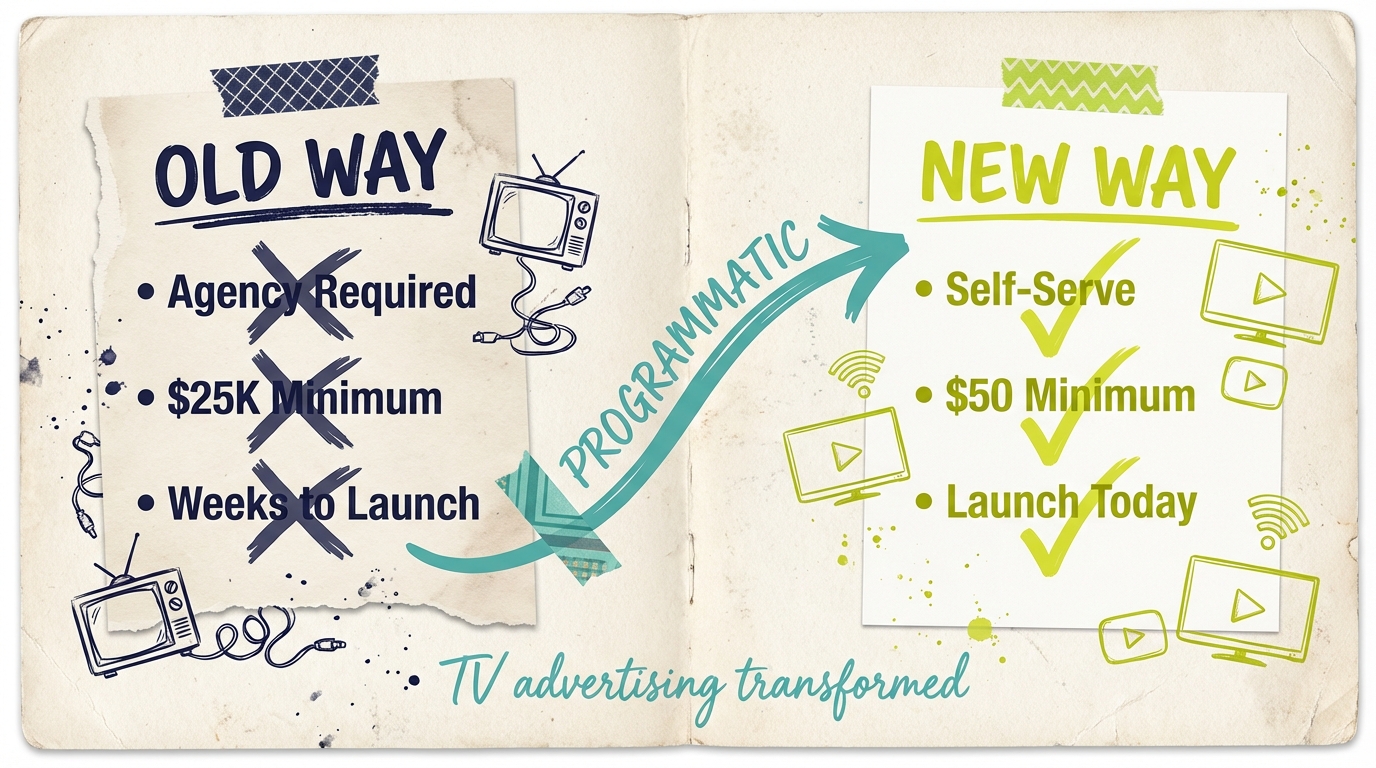
Programmatic's most significant impact may be accessibility. Traditional TV advertising required:
Minimum commitments: $5,000-$25,000+ monthly minimums
Agency relationships: Media buyers to negotiate and place
Production budgets: $10,000-$100,000+ for commercial creation
Lead times: Weeks to months for campaign setup
Programmatic CTV requires:
Minimum spend: As low as $50 on self-serve platforms
No agency needed: Self-serve interfaces accessible to anyone
AI creative: Professional ads generated in minutes at no cost
Speed: Campaigns live in hours, not weeks
This isn't incremental improvement; it's a structural change in who can advertise on television. The 100+ premium channels available through CTV were previously accessible only to large advertisers. Now they're open to any business.
The measurement evolution
Programmatic CTV brings digital measurement standards to television. Traditional TV measurement relied on panel-based ratings with limited targeting insight. Programmatic CTV enables:
Impression-level tracking: Know exactly where and when ads ran
Cross-device attribution: Connect TV exposure to digital actions
Incrementality measurement: Understand CTV's true contribution
Real-time reporting: Monitor campaigns as they run
For advertisers accustomed to digital measurement, CTV finally provides comparable visibility into television performance.
What experts are saying
Industry analysts view programmatic CTV's growth as both inevitable and transformative.
The Interactive Advertising Bureau's 2025 analysis noted that "programmatic's 84% share of CTV reflects advertiser demand for efficiency, targeting, and measurement. The remaining direct-sold inventory will likely be reserved for premium sponsorships, with programmatic becoming the default buying method."
EMarketer's forecast emphasized the growth trajectory: "Programmatic is driving all CTV growth. Non-programmatic CTV spending is declining in absolute terms as advertisers shift to automated buying."
Senal News research highlighted accessibility: "The programmatic infrastructure that handles $27 billion in spend is the same infrastructure that enables a small business to run a $500 campaign. Scale has created accessibility, not exclusivity."
For small business TV advertising specifically, analysts note that "programmatic has removed every structural barrier that historically kept local businesses off television. The technology that serves enterprise campaigns serves small business campaigns equally well."
Common questions answered
What does "programmatic" mean in TV advertising?
Programmatic TV advertising refers to automated, software-driven buying and selling of television ad inventory. Instead of negotiating directly with publishers, advertisers use technology platforms that match ads to available inventory based on targeting criteria, price parameters, and optimization rules. The process happens in real-time or near-real-time, with algorithms handling placement decisions that were previously made by humans.
How is programmatic CTV different from programmatic display?
The core mechanics are similar: automated buying through demand-side platforms, inventory sold through supply-side platforms, with ad exchanges facilitating transactions. The differences are in the ad format (video vs. banners), the environment (TV screen vs. web/app), and typically higher CPMs reflects premium attention. CTV programmatic also operates in a living room context with household-level targeting rather than individual device targeting.
Does programmatic mean lower quality inventory?
No. Programmatic is a buying method, not an inventory type. Premium inventory from Netflix, Hulu, and Disney+ is increasingly available programmatically. Programmatic guaranteed deals provide the same inventory as direct sales, just executed through automated systems. The misconception comes from early programmatic display, where remnant inventory dominated exchanges. CTV programmatic includes premium inventory across all quality tiers.
Can small businesses really access the same inventory as large advertisers?
Yes, through open exchange and aggregated platforms. While large advertisers may have custom PMP deals and volume pricing, the underlying inventory pools overlap significantly. A local business running a campaign through Adwave accesses the same FAST service inventory and many of the same premium placements as national campaigns. Geographic and budget differences determine scale, not fundamental access.
What's the minimum budget for programmatic CTV?
Self-serve platforms like Adwave enable campaigns starting at $50. At this level, you'll receive a smaller number of impressions (typically 2,000-4,000) focused on your geographic target area. More meaningful tests start at $200-500 over two weeks, providing enough impressions to evaluate creative performance and audience response. There's no technical minimum for programmatic; the floor is set by platform policies and practical effectiveness.
Is programmatic CTV replacing traditional TV buying?
Programmatic is becoming the dominant method for CTV, representing 84% of spend. For traditional linear TV, programmatic adoption is slower (approximately 15-20% of linear spend is programmatic). The trend favors continued programmatic growth across both CTV and linear, though linear's analog infrastructure limits automation speed. In CTV specifically, programmatic is essentially the default buying method.
Supporting data
Additional statistics on programmatic TV advertising:
Programmatic CTV spend (2025): $27 billion in the U.S. (eMarketer, Senal News)
Share of CTV: 84% bought programmatically, up from 60% in 2020
Transaction growth: 75% of CTV ad transactions now automated
Global Q1 2025 spend: $5.02 billion open programmatic CTV globally (Pixalate)
2026 projection: $32 billion programmatic CTV, 87% share
2028 projection: Programmatic expected to exceed 90% of CTV
Programmatic guaranteed: ~35% of programmatic spend
Private marketplace: ~30% of programmatic spend
Open exchange: ~19% of programmatic spend
Direct/IO (non-programmatic): ~16% of total CTV
Small business access: Self-serve platforms enable $50 minimum campaigns
Programmatic buying models explained
Programmatic TV advertising encompasses several distinct buying methods, each with different levels of automation, targeting precision, and inventory access. Understanding these models helps advertisers choose the right approach for their campaign objectives and budget constraints.
Private marketplaces (PMPs) represent the largest segment of programmatic TV spending, accounting for approximately 60% of all programmatic CTV transactions. These invitation-only deals combine the efficiency of automated buying with the quality assurance of direct publisher relationships.
Programmatic guaranteed deals provide the predictability of traditional TV buys with programmatic execution and targeting capabilities. Advertisers commit to spending levels in advance and receive guaranteed inventory at negotiated CPMs, making this model popular with brand advertisers who need reach certainty.
Open auction buying on CTV remains a smaller but growing segment, offering the most flexibility and often the lowest CPMs. However, inventory quality and brand safety concerns have limited adoption among major brand advertisers, with most open auction spend coming from direct response and performance-focused campaigns.
Private marketplaces: 60% of programmatic CTV spend
Programmatic guaranteed: 25% of spend, growing with brand advertisers
Open auction: 15% of spend, popular with DR advertisers
Average PMP CPM: $25-35
Average open auction CPM: $15-22
Cross-screen programmatic buying has emerged as a key capability, allowing advertisers to reach the same audiences across connected TV, desktop, and mobile devices with coordinated frequency management. This unified approach can improve campaign efficiency by 20-30% compared to siloed buying.
Data and targeting advancements
The sophistication of targeting capabilities in programmatic TV has advanced rapidly, moving beyond basic demographics to incorporate behavioral, contextual, and first-party data signals. These targeting improvements are driving the shift from traditional TV to programmatic CTV.
ACR (Automatic Content Recognition) data from smart TVs provides unprecedented insight into viewing behavior, enabling targeting based on programs watched, ads seen, and content preferences. This technology powers competitive conquesting and sequential messaging strategies that were impossible with traditional TV.
First-party data activation on CTV has become a major priority for advertisers, with data clean rooms enabling privacy-safe matching of customer data against streaming audiences. Retailers, financial services companies, and travel brands have been early adopters of this capability.
Contextual targeting in streaming environments goes beyond program genre to include mood, moment, and content theme analysis. AI-powered contextual tools can now identify optimal ad placements within streaming content at the scene level, improving relevance and reducing viewer irritation.
Programmatic buying models explained
Programmatic TV advertising encompasses several distinct buying methods, each with different levels of automation, targeting precision, and inventory access. Understanding these models helps advertisers choose the right approach for their campaign objectives and budget constraints.
Private marketplaces (PMPs) represent the largest segment of programmatic TV spending, accounting for approximately 60% of all programmatic CTV transactions. These invitation-only deals combine the efficiency of automated buying with the quality assurance of direct publisher relationships.
Programmatic guaranteed deals provide the predictability of traditional TV buys with programmatic execution and targeting capabilities. Advertisers commit to spending levels in advance and receive guaranteed inventory at negotiated CPMs, making this model popular with brand advertisers who need reach certainty.
Open auction buying on CTV remains a smaller but growing segment, offering the most flexibility and often the lowest CPMs. However, inventory quality and brand safety concerns have limited adoption among major brand advertisers, with most open auction spend coming from direct response and performance-focused campaigns.
Private marketplaces: 60% of programmatic CTV spend
Programmatic guaranteed: 25% of spend, growing with brand advertisers
Open auction: 15% of spend, popular with DR advertisers
Average PMP CPM: $25-35
Average open auction CPM: $15-22
Cross-screen programmatic buying has emerged as a key capability, allowing advertisers to reach the same audiences across connected TV, desktop, and mobile devices with coordinated frequency management. This unified approach can improve campaign efficiency by 20-30% compared to siloed buying.
Data and targeting advancements
The sophistication of targeting capabilities in programmatic TV has advanced rapidly, moving beyond basic demographics to incorporate behavioral, contextual, and first-party data signals. These targeting improvements are driving the shift from traditional TV to programmatic CTV.
ACR (Automatic Content Recognition) data from smart TVs provides unprecedented insight into viewing behavior, enabling targeting based on programs watched, ads seen, and content preferences. This technology powers competitive conquesting and sequential messaging strategies that were impossible with traditional TV.
First-party data activation on CTV has become a major priority for advertisers, with data clean rooms enabling privacy-safe matching of customer data against streaming audiences. Retailers, financial services companies, and travel brands have been early adopters of this capability.
Contextual targeting in streaming environments goes beyond program genre to include mood, moment, and content theme analysis. AI-powered contextual tools can now identify optimal ad placements within streaming content at the scene level, improving relevance and reducing viewer irritation.
Programmatic buying models explained
Programmatic TV advertising encompasses several distinct buying methods, each with different levels of automation, targeting precision, and inventory access. Understanding these models helps advertisers choose the right approach for their campaign objectives and budget constraints.
Private marketplaces (PMPs) represent the largest segment of programmatic TV spending, accounting for approximately 60% of all programmatic CTV transactions. These invitation-only deals combine the efficiency of automated buying with the quality assurance of direct publisher relationships.
Programmatic guaranteed deals provide the predictability of traditional TV buys with programmatic execution and targeting capabilities. Advertisers commit to spending levels in advance and receive guaranteed inventory at negotiated CPMs, making this model popular with brand advertisers who need reach certainty.
Open auction buying on CTV remains a smaller but growing segment, offering the most flexibility and often the lowest CPMs. However, inventory quality and brand safety concerns have limited adoption among major brand advertisers, with most open auction spend coming from direct response and performance-focused campaigns.
Private marketplaces: 60% of programmatic CTV spend
Programmatic guaranteed: 25% of spend, growing with brand advertisers
Open auction: 15% of spend, popular with DR advertisers
Average PMP CPM: $25-35
Average open auction CPM: $15-22
Cross-screen programmatic buying has emerged as a key capability, allowing advertisers to reach the same audiences across connected TV, desktop, and mobile devices with coordinated frequency management. This unified approach can improve campaign efficiency by 20-30% compared to siloed buying.
Data and targeting advancements
The sophistication of targeting capabilities in programmatic TV has advanced rapidly, moving beyond basic demographics to incorporate behavioral, contextual, and first-party data signals. These targeting improvements are driving the shift from traditional TV to programmatic CTV.
ACR (Automatic Content Recognition) data from smart TVs provides unprecedented insight into viewing behavior, enabling targeting based on programs watched, ads seen, and content preferences. This technology powers competitive conquesting and sequential messaging strategies that were impossible with traditional TV.
First-party data activation on CTV has become a major priority for advertisers, with data clean rooms enabling privacy-safe matching of customer data against streaming audiences. Retailers, financial services companies, and travel brands have been early adopters of this capability.
Contextual targeting in streaming environments goes beyond program genre to include mood, moment, and content theme analysis. AI-powered contextual tools can now identify optimal ad placements within streaming content at the scene level, improving relevance and reducing viewer irritation.
Get started with TV advertising
Programmatic infrastructure has transformed television from an exclusive medium to an accessible one. The $27 billion market operates through the same systems whether you're spending $50 or $5 million.
Adwave provides simple access to programmatic CTV. Create your commercial from your website in minutes, set geographic targeting for your service area, choose a budget starting at $50, and launch campaigns across 100+ premium streaming channels.
The automation is built. The inventory is abundant. The opportunity is open.