
Navigating the world of programmatic advertising can feel overwhelming, especially for small and medium-sized businesses trying to make every dollar count. Choosing the right platform is the critical first step to launching effective, automated ad campaigns across display, video, connected TV (CTV), and native formats. This guide is designed to cut through the complexity and provide a clear, practical roadmap to selecting the best programmatic advertising platforms for your specific business needs.
We've moved beyond generic feature lists to give you a detailed breakdown of the top contenders. For each platform, you'll find a detailed analysis of its core features, targeting capabilities, and available inventory. We evaluate pricing structures, minimum ad spends, and ideal use cases, helping you understand which solution aligns with your budget and goals. You'll see direct comparisons, pros and cons, and specific recommendations for industries like real estate, automotive, and retail.
This resource is built for action. We provide screenshots for a clear look at each interface and direct links to get you started. Before launching your campaigns on any programmatic platform, defining your audience is paramount. Dive deeper into effective customer segmentation strategies to ensure your programmatic ads reach the right people with the right message. From industry giants like Google DV360 and The Trade Desk to accessible, SMB-focused platforms like Adwave, this curated list offers the insights you need to confidently invest in programmatic advertising and drive real growth.
1. Adwave
Best For: Streamlining TV Advertising for Local Businesses
Adwave distinguishes itself among the best programmatic advertising platforms by uniquely democratizing television advertising for small and mid-sized businesses. It combines an innovative AI-powered creative engine with programmatic media buying, effectively eliminating the high production costs and complex ad-buying processes that traditionally gatekept TV. This integrated approach allows a local business owner, from a real estate agent to a restaurant franchisee, to create and launch a broadcast-quality TV commercial in minutes, using only their website URL.
The platform’s end-to-end workflow is its core strength. Adwave’s AI analyzes your website content to automatically generate a polished TV spot, complete with visuals, voice-over, and branding. From there, it handles programmatic placement across a premium inventory of over 100 channels, including major networks like NBC, Hulu, and ESPN. Campaigns can be launched with budgets as low as $50, with automated pacing to ensure you never overspend. This makes it a powerful tool for SMBs looking to test the waters of TV advertising without significant financial risk.
Standout Features & Use Cases
Adwave is built for rapid execution and tangible local impact. Its feature set is engineered to solve the most significant pain points for small advertisers venturing into television.
AI-Powered Ad Creation: Start with your website to create ads for TV, search, and social. For a home services company or a local car dealership, this means you can create a new ad to promote a seasonal offer in the morning and have it running on local screens by the afternoon without hiring a production crew.
Hyper-Local Audience Targeting: Beyond simple geo-fencing, Adwave uses audience and viewing pattern data. A real estate agent, for example, can target specific neighborhoods where potential homebuyers are watching certain programs, maximizing ad relevance and minimizing wasted spend.
Accessible Budgeting & Pacing: With a low entry point of $50 and estimated CPMs of $15-$35, Adwave is exceptionally accessible. The automatic budget pacing gives founders and marketing managers peace of mind, knowing their campaign spend is controlled and predictable.
Who is Adwave Best For?
Adwave is an ideal solution for local businesses, founders, and marketing teams who want to use the brand-building power of TV without the traditional complexity or cost. It is especially effective for service-based businesses, retailers, and real estate professionals aiming to build name recognition and drive foot traffic within a specific geographic area. While the AI-generated creative offers less custom control than a full-scale production, its speed and efficiency provide an unparalleled advantage for agile marketing.
Pros:Rapid End-to-End Execution: Create and launch TV ads in minutes directly from a URL.
Affordable & Controlled Spend: Low campaign minimums ($50) with automated budget pacing.
Premium Local Reach: Access top-tier channels with precise local audience targeting.
Measurable Impact: Real-time tracking of key performance indicators for SMBs.
Limited Creative Control: AI-generated ads are efficient but less bespoke than high-end productions.
Performance Metrics are Estimates: Actual CPMs and traffic lift can vary based on market and targeting.
2. Google Display & Video 360 (DV360)
Google Display & Video 360, or DV360, is the enterprise-level demand-side platform (DSP) in the Google Marketing Platform. It stands out by offering a unified, end-to-end solution for planning, executing, and measuring sophisticated, omnichannel campaigns across display, video, YouTube, Connected TV (CTV), and audio. Its native integration with other Google products like Analytics 360 provides unparalleled data coordination, making it a powerhouse for large advertisers seeking granular control and broad reach.
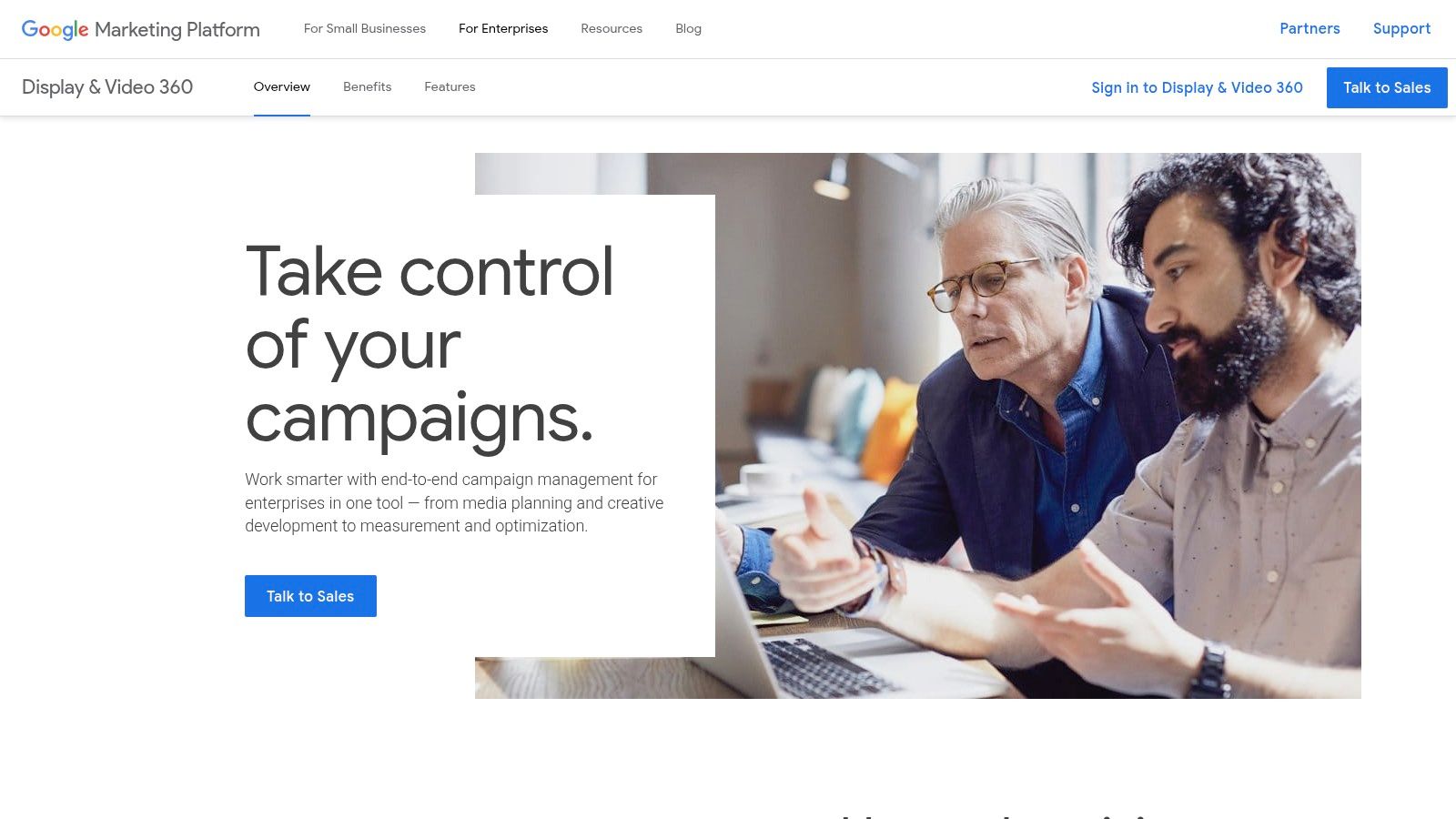
Unlike more accessible platforms, DV360 is built for scale and complexity. Its five integrated modules (Campaigns, Audiences, Creatives, Inventory, and Insights) allow teams to manage every aspect of the programmatic workflow. The platform excels in providing access to premium inventory through Programmatic Guaranteed deals and its marketplace, including exclusive access to YouTube ad formats. This makes it an ideal choice for campaigns that utilize advanced strategies, such as server-side ad insertion for CTV. To better understand this technology, learn more about dynamic ad insertion here.
Access and Ideal Use Cases
Pricing/Minimums: Pricing and minimum spend requirements are not publicly available. Access typically requires significant media spend and is often managed through a Google-certified partner or a direct contract with Google.
Best For:
Large enterprises and advertising agencies managing multi-channel, high-budget campaigns.
Advertisers heavily invested in the Google ecosystem who need deep integration with Analytics 360 and Campaign Manager.
Brands prioritizing premium video and CTV inventory, including exclusive YouTube formats.
Pros and Cons
Quick Recommendation: For SMBs, gaining direct access to DV360 is often impractical. Platforms like Adwave offer a much better alternative by providing access to premium programmatic inventory, including CTV, without the enterprise-level minimums and complexity associated with DV360.
Visit Google Display & Video 360
3. The Trade Desk
The Trade Desk is a leading independent demand-side platform (DSP) that has become a cornerstone for advertisers looking to buy media across the open internet. It provides a detailed, omnichannel solution for managing campaigns across Connected TV (CTV), display, video, audio, and even digital out-of-home (DOOH). The platform is renowned for its powerful data and identity capabilities, allowing advertisers to reach precise audiences at scale without relying on walled gardens.
The Trade Desk stands out with its open, interoperable marketplace, which integrates with a vast ecosystem of data, measurement, and brand-safety partners. Its AI-driven optimization engine, Koa, helps advertisers make real-time decisions to improve campaign performance and meet specific business outcomes. This makes it one of the best programmatic advertising platforms for mid-market and enterprise buyers who require sophisticated tools and broad reach, especially in the fast-growing CTV space. To better understand this trend, learn more about the rise in programmatic TV ad spend.
Access and Ideal Use Cases
Pricing/Minimums: The Trade Desk does not publicly post its pricing or minimum spend requirements. Access is generally geared toward mid-market and enterprise advertisers and is typically facilitated through their sales team or certified agency partners.
Best For:
Mid-to-large-sized brands and agencies seeking a powerful, independent DSP with significant scale outside of Google and Facebook.
Advertisers prioritizing CTV and premium video inventory across the open internet.
Campaigns requiring sophisticated data integrations and partnerships, such as those using retail media data.
Pros and Cons
Quick Recommendation: For SMBs, the cost and complexity of The Trade Desk can be prohibitive. Platforms like Adwave provide an important alternative, offering access to the same high-quality programmatic CTV and display inventory but with a simplified, self-serve model designed for smaller budgets.
4. Amazon DSP
Amazon DSP is a demand-side platform that allows advertisers to programmatically buy display, video, and audio ads both on and off Amazon. Its primary differentiator is its deep integration with Amazon's vast first-party data, using data from shopping behaviors, browsing history, and streaming habits across its ecosystem. This enables advertisers to reach highly specific audiences based on actual purchase intent and media consumption signals.
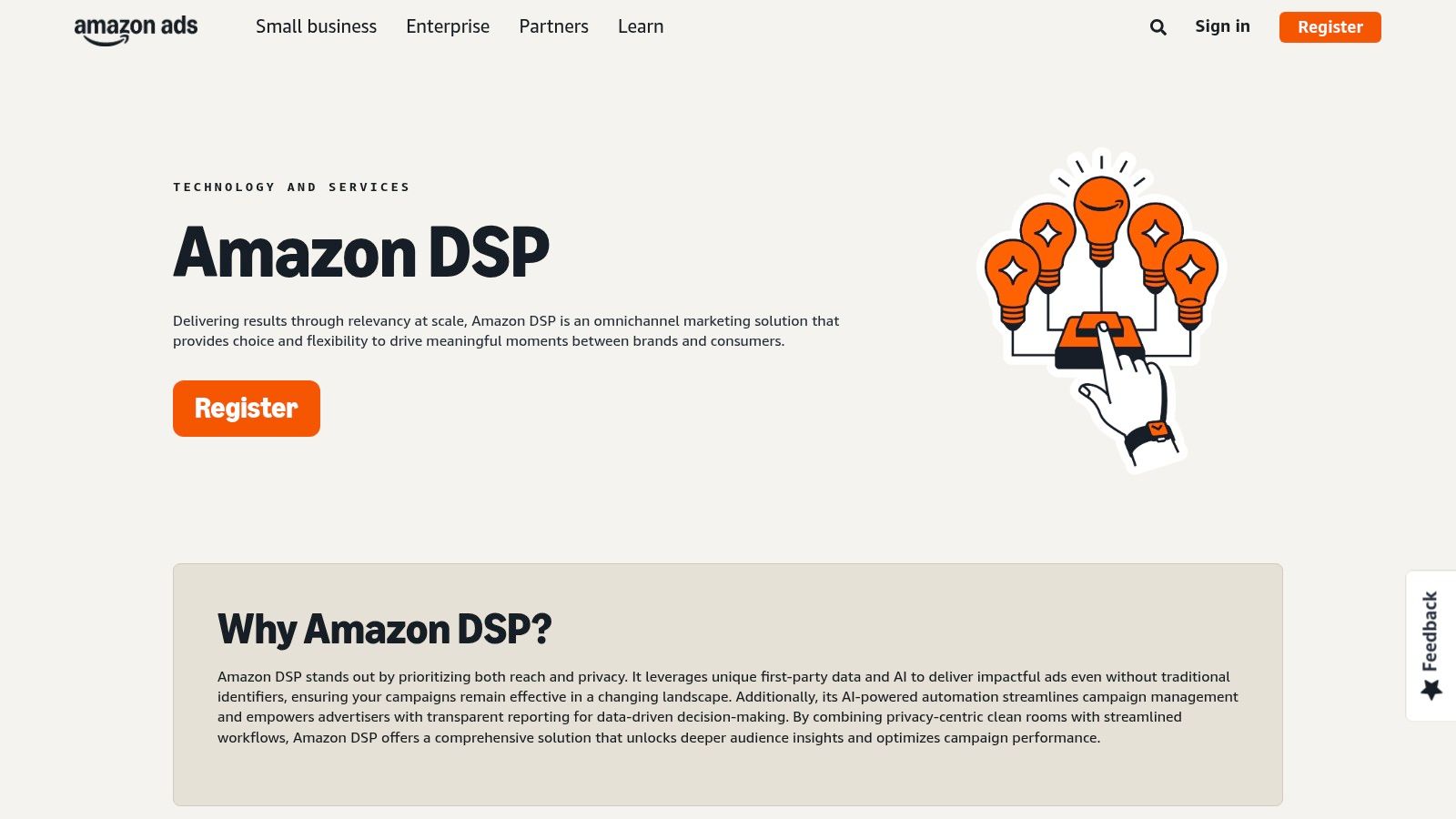
The platform offers unique access to Amazon-owned properties like Prime Video, IMDb TV, and Twitch, alongside a wide network of third-party publishers. For brands selling on Amazon, it provides powerful closed-loop measurement, directly connecting ad spend to sales on the platform. Amazon DSP's strength in Connected TV (CTV) is also significant, bolstered by its Fire TV footprint and strategic partnerships. To get a better grasp of this advertising channel, you can explore this overview of Connected TV advertising.
Access and Ideal Use Cases
Pricing/Minimums: Access often has high entry barriers. Managed service typically requires a minimum ad spend of $50,000 in the U.S., while self-service access is not publicly available and usually requires working with Amazon Ads partners.
Best For:
Brands and sellers with a significant presence on the Amazon marketplace looking to drive sales.
Advertisers aiming to use unique, first-party e-commerce and streaming data for precise audience targeting.
Large-scale campaigns focused on reaching CTV audiences through Amazon's extensive device and content network.
Pros and Cons
Quick Recommendation: For SMBs, the high minimum spend for Amazon DSP can be a major hurdle. Platforms like Adwave provide a more accessible entry point to premium programmatic inventory, including CTV, allowing smaller businesses to use powerful advertising channels without enterprise-level commitments.
5. Yahoo DSP
Yahoo DSP is a powerful omnichannel demand-side platform that uses Yahoo's vast first-party data and extensive publisher relationships. It distinguishes itself with its identity solution, Yahoo ConnectID, which helps advertisers reach audiences in a cookieless environment, and its "Backstage" feature, providing direct access to premium, curated publisher inventory. This platform is a strong contender for advertisers looking to execute sophisticated campaigns across display, video, native, audio, and especially Connected TV (CTV).
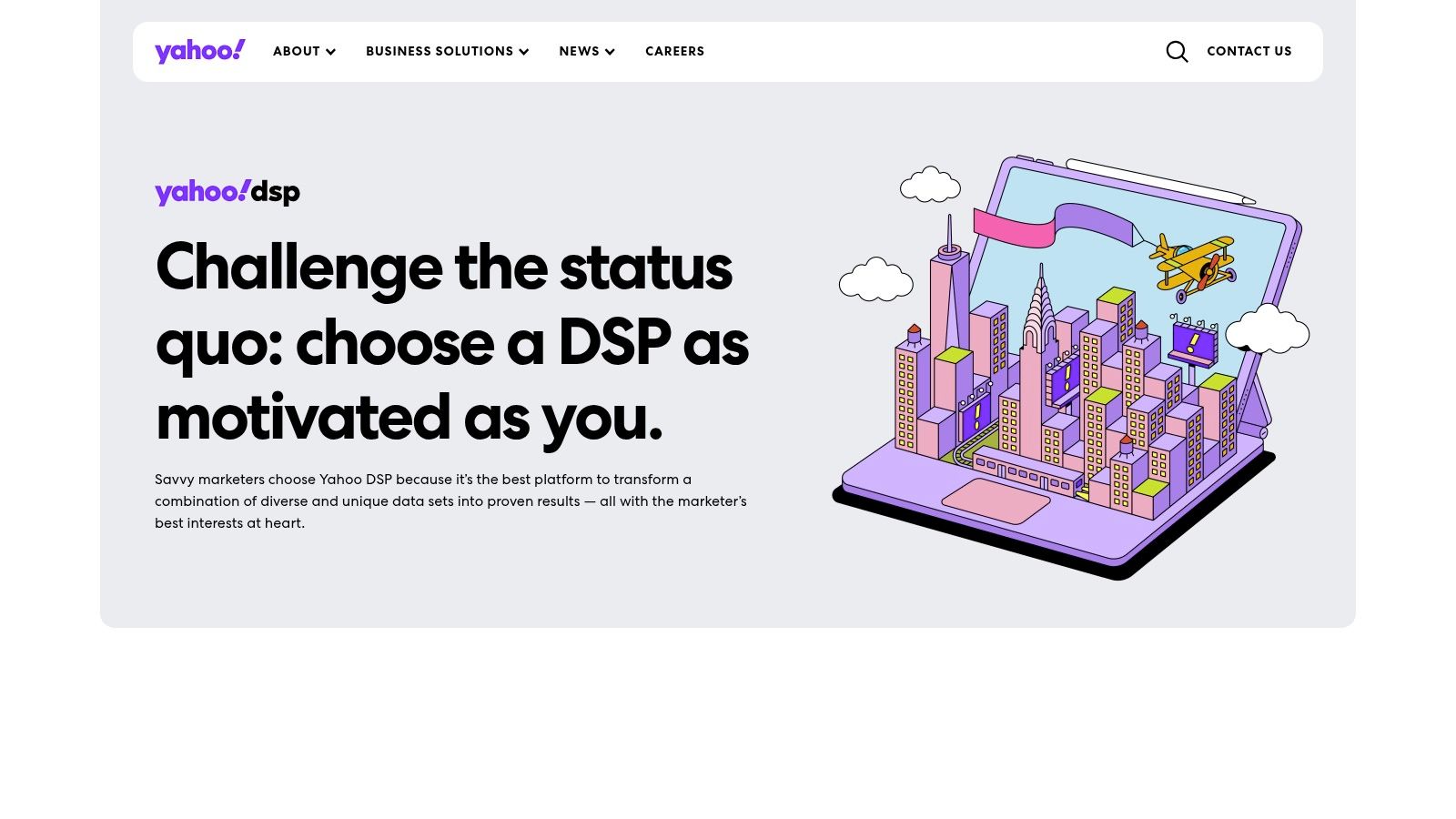
The platform is designed for agencies and advanced marketing teams, offering robust AI optimization tools and significant integrations with partners like Roku, Spotify, and DIRECTV for addressable TV. Its Blueprint AI engine helps automate campaign performance, while its Conversion API allows for detailed online and offline measurement. For advertisers prioritizing transparent supply paths and a strong foothold in emerging channels like CTV and digital audio, Yahoo DSP provides the necessary tools and inventory access.
Access and Ideal Use Cases
Pricing/Minimums: Pricing details and minimum spend requirements are not publicly disclosed and are typically geared toward larger agencies and enterprise-level advertisers with significant media budgets.
Best For:
Agencies and in-house teams managing complex, multi-channel campaigns.
Advertisers focused on CTV, addressable TV, and digital audio channels.
Brands seeking cookieless identity solutions and transparent access to premium publisher inventory.
Pros and Cons
Quick Recommendation: Like other enterprise-level platforms, Yahoo DSP's minimums and complexity are often prohibitive for small businesses. For SMBs wanting to tap into premium CTV and programmatic inventory without the hefty commitment, Adwave provides an accessible, self-serve alternative designed for manageable budgets.
6. Roku Ads Manager (Self-Serve CTV)
Roku Ads Manager lets small and midsize advertisers buy streaming placements on The Roku Channel and partner apps. Its campaign setup focuses on Roku audiences rather than a broad mix of advertising channels.
This streamlined approach allows advertisers to launch performance-oriented CTV campaigns with familiar digital controls. Key features include shoppable ad formats with Shopify integration, dynamic CPM pricing based on audience selection, and straightforward budget and scheduling management. By focusing exclusively on the streaming TV environment, Roku provides a powerful tool for businesses aiming to tap into the cord-cutting audience without the complexity of traditional programmatic platforms. To compare this with other direct-buy tools, explore this guide on the best self-serve advertising platforms.
Access and Ideal Use Cases
Pricing/Minimums: The platform is accessible via credit card with low lifetime campaign minimums, making it one of the most approachable entry points into CTV advertising.
Best For:
SMBs, local businesses, and e-commerce brands looking to test CTV advertising with modest, controlled budgets.
Advertisers who want to directly reach authenticated Roku households with high-impact video ads.
Marketers seeking simple, performance-driven campaign objectives like website visits or online purchases from their TV ads.
Pros and Cons
Quick Recommendation: Roku Ads Manager is an excellent starting point for businesses new to CTV. For advertisers needing to integrate their CTV buys into a broader, multi-channel programmatic strategy, platforms like Adwave offer a more unified solution, combining premium CTV access with an easy-to-use platform and AI-powered ad creation.
7. StackAdapt
StackAdapt is a self-serve, multi-channel demand-side platform (DSP) celebrated for its intuitive interface and detailed channel coverage. It empowers advertisers to launch and manage campaigns across native, display, video, Connected TV (CTV), audio, and even emerging formats like in-game and digital out-of-home (DOOH). The platform distinguishes itself by offering tools typically reserved for larger budgets, such as complimentary, self-serve brand lift studies, making it a strong contender among programmatic advertising platforms for performance-conscious brands.

Designed with usability in mind, StackAdapt is especially favored by in-house marketing teams and agencies that desire direct control over campaign strategy and execution. Its real-time reporting dashboard and machine-learning optimization algorithms allow for agile campaign management and data-driven decision-making. The platform's strong user reviews, often showing excellent customer support and ease of use, cement its reputation as an accessible yet powerful tool for executing sophisticated, multi-format digital advertising strategies.
Access and Ideal Use Cases
Pricing/Minimums: StackAdapt does not publicly list its pricing or minimum spend requirements. Access is typically geared toward agencies and mid-market brands, with some user reports mentioning variable minimums based on the solutions required.
Best For:
Mid-sized agencies and in-house marketing teams that need a powerful, self-serve DSP.
Advertisers focused on measuring brand impact through integrated brand lift studies.
Brands wanting to run multi-channel campaigns that include CTV, audio, and native formats from a single platform.
Pros and Cons
Quick Recommendation: StackAdapt is an excellent choice for teams ready to manage their own programmatic campaigns. For SMBs who find the minimums prohibitive or lack the resources for self-management, a platform like Adwave provides a more accessible entry point to premium CTV and display inventory without the steep requirements.
8. Basis DSP (Basis Technologies)
Basis DSP, from Basis Technologies, is an omnichannel demand-side platform designed to unify the entire digital media workflow. It stands out by integrating its powerful DSP with tools for planning, billing automation, and managing direct deals, creating a cohesive environment for agencies and in-house marketing teams. This singular interface simplifies complex operations, allowing users to activate campaigns across all channels, including display, video, mobile, native, and Connected TV (CTV), from one centralized hub.
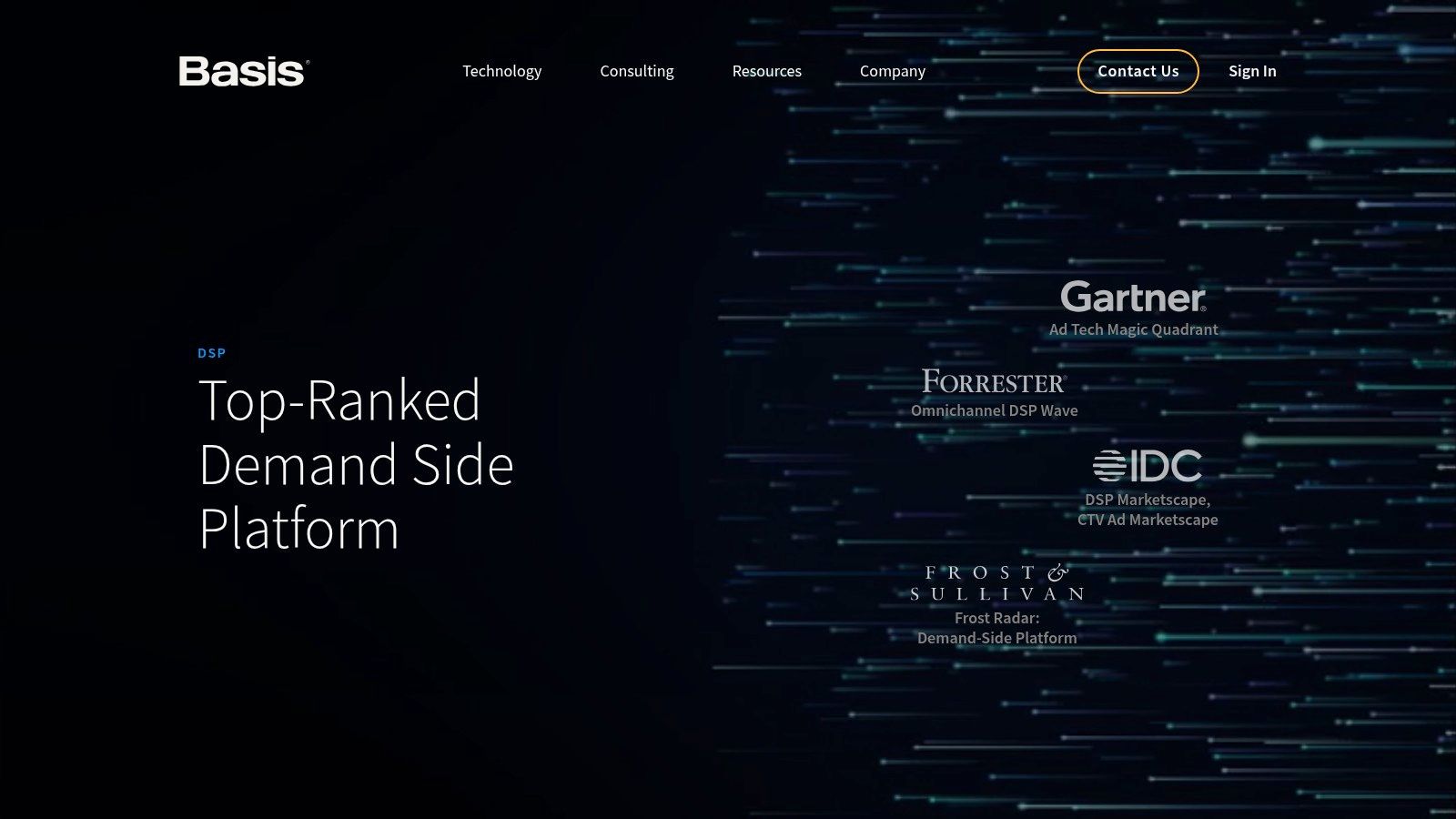
The platform is recognized for its robust access to private marketplaces (PMPs), providing advertisers with high-quality inventory and greater control over where their ads appear. By combining programmatic buying with workflow automation, Basis helps teams reduce manual tasks related to reconciliation and billing, freeing them to focus on strategy and optimization. Its AI-powered tools and extensive audience library further enhance its capabilities, making it one of the best programmatic advertising platforms for sophisticated advertisers seeking efficiency and performance.
Access and Ideal Use Cases
Pricing/Minimums: Pricing and minimum spend details are not publicly available. Access is typically arranged through a direct sales engagement and is geared toward established agencies and brands.
Best For:
Advertising agencies seeking a unified platform to manage both programmatic and direct media buys.
In-house brand teams that need to streamline operations, from planning and activation to billing and reconciliation.
Advertisers who prioritize access to premium inventory through Private Marketplaces (PMPs).
Pros and Cons
Quick Recommendation: Basis DSP is a powerful tool for agencies, but its enterprise requirements can be a hurdle for SMBs. For businesses wanting access to premium CTV and display inventory without the high minimums or complexity, platforms like Adwave provide a self-serve solution designed for direct-to-advertiser ease of use.
9. Simpli.fi
Simpli.fi has carved out a niche as one of the best programmatic advertising platforms for advertisers who require precision in localized campaigns. The platform excels at hyperlocal targeting, including ZIP code-level, geofencing, and addressable targeting, making it a go-to choice for businesses aiming to connect with specific local communities. It is especially strong in Connected TV (CTV) and offers cookieless solutions that are well-suited for reaching audiences effectively in a privacy-focused landscape.

The platform’s strength lies in its ability to translate physical locations and addresses into digital audiences. For instance, its ZIP-code targeted streaming TV (ZTV) and geofencing capabilities allow brick-and-mortar stores, real estate agents, and local service providers to serve relevant ads to potential customers in their immediate vicinity. This focus on localized performance measurement provides tangible ROI for small and medium-sized businesses that depend on driving foot traffic or local online conversions.
Access and Ideal Use Cases
Pricing/Minimums: Simpli.fi does not publicly list official pricing or minimum spend requirements. Access often involves a managed-service engagement or requires direct contact with their sales team to confirm terms.
Best For:
Small to medium-sized businesses (SMBs) and regional advertisers needing granular, hyperlocal targeting.
Brands in real estate, automotive, retail, and food service that rely on foot traffic and local sales.
Advertisers prioritizing CTV and streaming campaigns with precise geographic reach.
Pros and Cons
Quick Recommendation: Simpli.fi is a powerful tool for hyperlocal campaigns, but its managed-service model and lack of transparent pricing can be a hurdle for SMBs. For a more direct, self-serve approach to localized CTV and programmatic ads, platforms like Adwave provide clear pricing and low entry points, making it easier for small businesses to launch campaigns quickly.
10. Quantcast Platform
The Quantcast Platform is a self-serve, omnichannel advertising platform recognized for its powerful AI-driven targeting and built-in measurement tools. It differentiates itself by offering an exceptionally accessible entry point for small and medium-sized businesses. Features like credit-card billing, no long-term contracts, and frequent trial credit offers remove many of the traditional barriers associated with programmatic advertising, making it a strong contender for those new to the space.
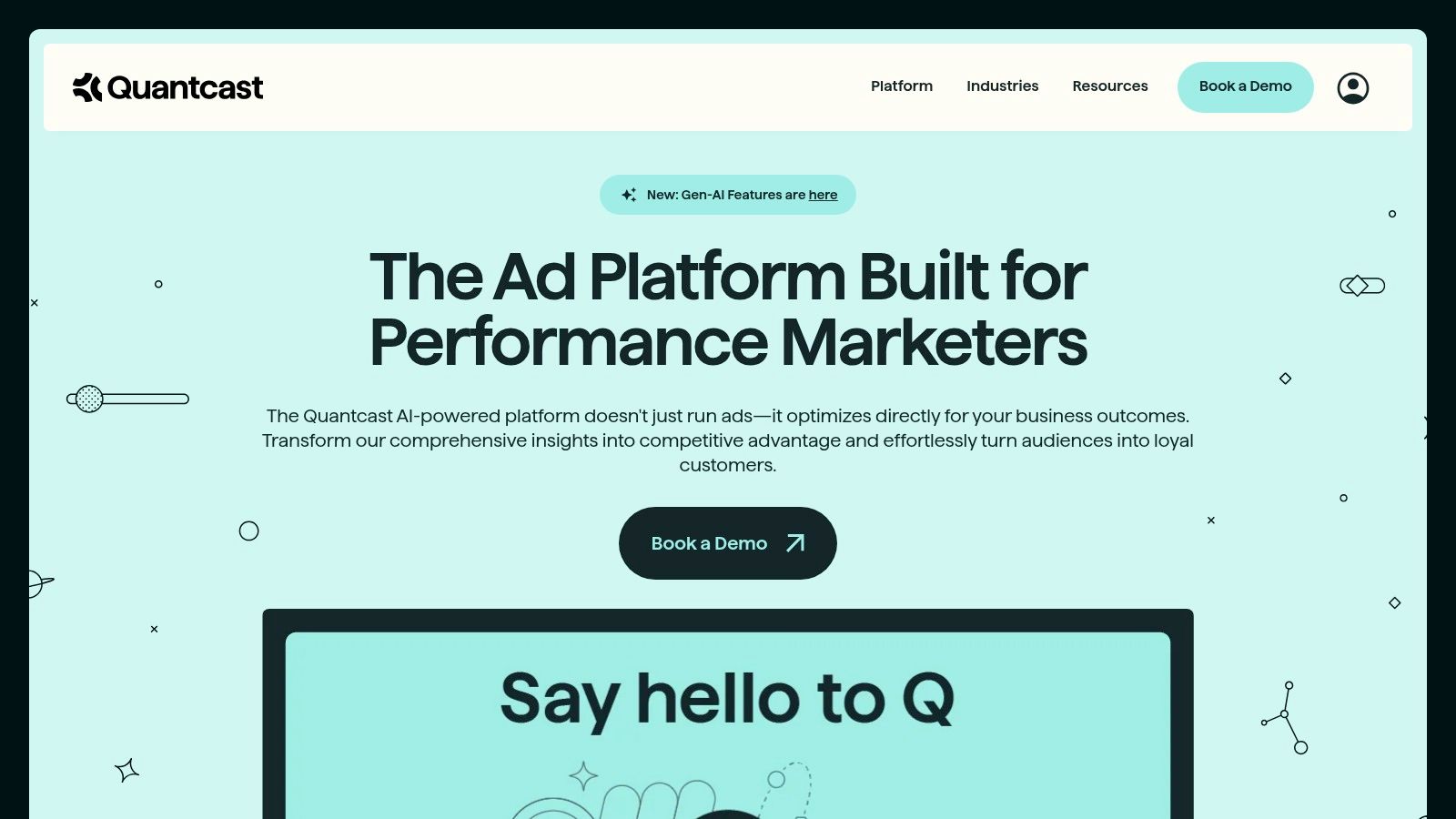
The platform provides access to a wide range of inventory channels, including display, video, native, audio, and Connected TV (CTV). Its strength lies in the Ara AI and machine learning engine, which helps advertisers find and influence audiences most likely to convert without relying on third-party cookies. This focus on predictive modeling and integrated brand-lift measurement gives businesses the tools to not only launch campaigns quickly but also understand their true impact on brand awareness and conversions.
Access and Ideal Use Cases
Pricing/Minimums: No minimum spend is required to get started. The platform operates on a self-serve basis with credit card billing and transparent documentation on media and technology fees. New accounts may be eligible for 30-day free trial promotions.
Best For:
Small to medium-sized businesses looking for a low-friction entry into programmatic advertising.
Marketers who need an all-in-one solution with built-in audience discovery and performance measurement.
Brands wanting to test campaigns across multiple channels (display, video, CTV) without large upfront commitments.
Pros and Cons
Quick Recommendation: Quantcast is an excellent platform for SMBs wanting to manage campaigns themselves. For businesses seeking a more integrated, creative-to-delivery solution, Adwave offers a unique advantage with its AI-powered ad creation for CTV, simplifying the entire programmatic TV advertising process.
11. AdRoll
AdRoll is a self-serve advertising platform renowned for its powerful retargeting capabilities and ease of use, making it a go-to choice for small to medium-sized businesses and e-commerce brands. It simplifies cross-channel campaign management by orchestrating ads across the open web, social media, and Connected TV (CTV). The platform is specifically designed for accessibility, enabling businesses to launch sophisticated remarketing and prospecting campaigns without the steep learning curve or high costs associated with enterprise-level DSPs.
Unlike complex, enterprise-focused solutions, AdRoll offers a straightforward, pay-as-you-go model with dynamic CPM pricing. This flexibility allows businesses to experiment and scale their efforts efficiently. Its strong integrations with e-commerce platforms like Shopify and account-based marketing (ABM) tools make it especially effective for driving mid-funnel engagement and conversions. AdRoll is one of the best programmatic advertising platforms for businesses prioritizing rapid campaign deployment and performance-driven remarketing.
Access and Ideal Use Cases
Pricing/Minimums: AdRoll offers a free-to-install plan with pay-as-you-go advertising. Daily minimums are very low, allowing advertisers to test campaigns with budgets as small as $5 per day.
Best For:
E-commerce and DTC brands focused on abandoned cart recovery and customer retargeting.
SMBs needing a simple, all-in-one platform for prospecting and remarketing across multiple channels.
Marketers looking for a low-risk entry point into programmatic advertising to test strategies quickly.
Pros and Cons
Quick Recommendation: AdRoll is excellent for SMBs focused on web retargeting. For businesses wanting to run more sophisticated, brand-focused campaigns on premium CTV inventory, a platform like Adwave provides greater access and control without requiring enterprise-level commitments.
12. Choozle
Choozle is a digital advertising software platform designed to make programmatic advertising accessible and effective for mid-market and SMB advertisers. It offers a user-friendly demand-side platform (DSP) that covers display, video, mobile, native, audio, and Connected TV (CTV) inventory. By blending a self-service model with managed service options and extensive training resources, Choozle effectively lowers the barrier to entry for teams looking to scale their programmatic efforts without the complexity of enterprise-level tools.
The platform stands out by providing clear, transparent minimums and a robust feature set that includes powerful geo-targeting and access to premium third-party data segments, including data from partners like Amazon. This allows smaller advertisers to execute sophisticated, data-driven campaigns typically reserved for larger budgets. The self-serve plan includes unlimited advertiser accounts, making it a cost-effective solution for agencies or consultants managing multiple clients who are exploring the best programmatic advertising platforms.
Access and Ideal Use Cases
Pricing/Minimums: The self-serve platform requires a minimum media spend of $15,000 over 90 days. The fully managed service option typically starts at a $10,000 per month minimum spend.
Best For:
Mid-market businesses and agencies growing into programmatic advertising.
Advertisers who want the flexibility to choose between self-serve control and expert managed services.
Teams that value detailed training resources and platform support to build in-house expertise.
Pros and Cons
Quick Recommendation: Choozle's minimums are accessible but may still be a hurdle for small local businesses. For those with budgets under $5,000, platforms like Adwave offer an easier entry point to programmatic CTV and display advertising without long-term commitments or high spend requirements.
Top 12 Programmatic Ad Platforms, Feature Comparison
Final Thoughts
Navigating the landscape of the best programmatic advertising platforms can feel like an overwhelming task, especially for small and medium-sized businesses aiming to make every dollar count. As we've explored, the "best" platform isn't a one-size-fits-all solution; it's the one that aligns perfectly with your specific budget, technical expertise, and most importantly, your business goals. The key is to move beyond the marketing hype and focus on the practical application of these powerful tools.
From the enterprise-grade power of Google DV360 and The Trade Desk to the niche-specific advantages of Roku for CTV or Amazon DSP for e-commerce, the options are vast. Yet, for many SMBs, the most significant barriers remain high minimum spends, complex user interfaces, and the steep learning curve required to launch and optimize effective campaigns. This is where a strategic approach becomes essential, and where purpose-built platforms like Adwave shine by simplifying the entire process.
Key Takeaways for Choosing Your Platform
Compare these factors when choosing a platform:
Accessibility is Paramount: Don't be swayed by a platform with endless features if you lack the resources to manage it. Tools like Simpli.fi and StackAdapt offer more manageable entry points, while self-serve platforms like Adwave are designed specifically to remove the complexity barrier for SMBs.
Inventory Matters: Your target audience dictates where you should advertise. If you're a real estate agent targeting affluent local households, a platform with strong Connected TV (CTV) inventory is important. If you're an e-commerce brand, access to Amazon's first-party data is a useful option. Adwave excels by providing direct access to premium, local TV and streaming inventory that makes an impact.
Budget Defines Your Options: Be realistic about your financial commitment. While platforms like Basis DSP offer robust managed services, they come with higher minimums. Conversely, AdRoll and Adwave provide flexible, low-entry-point solutions perfect for testing the waters with a modest budget.
Transparency is Non-Negotiable: Understand where your ads are running and how your money is being spent. The best programmatic advertising platforms provide clear, granular reporting that empowers you to make informed decisions and optimize for performance, not just impressions.
Your Actionable Next Steps
Armed with this information, it's time to take action. Don't fall into the trap of analysis paralysis. The most effective way to find the right programmatic partner is to start small, test, and learn.
Shortlist 2-3 Platforms: Based on our guide, select a few platforms that align with your goal, budget, and industry. For instance, a local restaurant might compare Adwave for its hyper-local CTV capabilities and AdRoll for its retargeting strength.
Launch a Pilot Campaign: Allocate a small, controlled budget to test your top choice. Focus your test on a single audience and creative message. The aim here isn't massive scale; it's to gather data and validate the platform's workflow and effectiveness for your business.
Analyze and Iterate: Review the results against your initial goal. Did you see an uplift in local web traffic? Did your cost-per-lead decrease? Use these initial findings to refine your strategy or test another platform on your shortlist.
Ultimately, embracing programmatic advertising is about using data and technology to reach your ideal customer more efficiently than ever before. It's about putting your brand on the biggest screen in the house or the most relevant website at the exact moment of consideration. By starting with a clear strategy and a willingness to experiment, any small or medium-sized business can unlock the immense potential of the best programmatic advertising platforms and compete on a much larger stage.


