More than 1 million people worldwide searched each month in 2023 for how to delete an Instagram account, according to TRG Datacenters. That search volume shows the exit urge is common. It doesn’t show that leaving is wise for every account, every user, or every local business.
Deciding when to quit a social media platform works better as a measured experiment than as a lifestyle verdict. Total minutes are a weak predictor of harm. The useful decision rests on functional impairment and on before-and-after results for sleep, mood, and business output. A feed that steals a morning meeting is a different problem from a page that books Saturday jobs in twenty minutes.
The studies don’t agree with one another, and they shouldn’t be forced into a single cutoff. Some breaks improve mood. Others land near neutral because pleasant feelings fall along with the unpleasant ones. What follows turns that mixed evidence into signs you can observe, a two-week test, a connection audit, and a practical exit if the numbers say go.
Warning Signs That Mean It Is Time to Quit
Three hours a day is the threshold most readers need, and the easiest one to misuse. Sustained use above three hours a day, especially for adolescents, is a practical warning line. A U.S. longitudinal cohort followed 6,595 adolescents aged 12 to 15 and adjusted for baseline mental health. Those who reported more than three hours of daily use faced approximately twice the risk of poor mental-health outcomes, including symptoms of depression and anxiety, as summarized in the U.S. Surgeon General’s youth advisory.
That doubling is a dose-related signal. Sleep loss, bullying, family circumstances, and offline stress can push both usage and mood in the same direction, so the figure supports a test rather than a diagnosis.
Impairment outranks the stopwatch
Clinical frameworks describe problematic use as persistent use that causes significant distress or impairment. The pattern shows up when someone can’t control onset, frequency, duration, or stopping, drops offline activities, misses work, school, or household duties, or keeps going despite physical, interpersonal, or psychological problems, as set out in clinical criteria for problematic social media use. A strong urge plus repeated failed attempts to cut back belongs to that same picture.
Raw minutes are the weaker clue. A 2024 review of 182 studies covering 1,169,396 participants found only small associations between social media use and depression and anxiety. Problematic use was the pattern tied to sleep problems and lower well-being. A platform that displaces sleep or core duties is a warning sign even near two hours a day.
A signal you can score
| Signal | Warning threshold | What it points to | Response |
|---|---|---|---|
| Daily use | Over 3 hours a day, sustained | Higher risk of poor mental-health outcomes, especially in adolescents | Run a two-week test |
| Heavy-but-moderate use | About 2 hours a day with worsening anxiety or insomnia | Symptoms eased when use dropped to about 30 minutes | Take a structured break first |
| Functional impairment | Repeated missed work, sleep loss, or skipped offline commitments | Problematic-use pattern rather than raw volume | Start the two-week test |
| Failed cut-back attempts | Two or more unsuccessful attempts to reduce use | Loss of control over onset and duration | Count it toward the two-signal rule |
| Mood after sessions | Consistent envy, irritation, or distress after use | Harmful comparison or compulsive checking | Mute, unfollow, or remove, then recheck |
| Business output | Platform hours rising while leads or sales stay flat | Opportunity cost exceeds return | Move to a defined workflow or another channel |
The young-adult evidence sits behind the second row. In a 2025 study, average daily use fell from about 1.9 hours to 30 minutes during a one-week detox. Reported anxiety symptoms declined 16.1%, depression symptoms declined 24.8%, and insomnia symptoms declined 14.5%, as reported by the Harvard Gazette. Nearly two hours a day, combined with trouble cutting back or a visible sleep and mood cost, already justifies a structured break.
Practical rule: Two or more of these signals, persisting for a month, means you stop debating and run the test. Quitting outright earns its place once the test confirms harm or the same signals survive an attempted fix.
For a business account, hours are the wrong scoreboard. The social media analytics that actually matter are leads, replies, and sales rather than time spent refreshing the feed. Flat results alongside climbing hours call for a defined workflow or a different channel.
Run a Two-Week Test Before You Decide
The published trials point in opposite directions, which is exactly why the decision needs your own data rather than a borrowed verdict. A two-week test with identical metrics on both sides of the break produces evidence no literature average can.
What the trials actually found
At Durham University, 51 participants tried to abstain for one week. Most didn’t reach full abstinence, yet average use still fell from roughly three to four hours a day to about 30 minutes. Participants reported fewer negative emotions, including sadness, anger, and misery, alongside fewer positive ones, and overall well-being stayed close to neutral, according to Durham University’s write-up of the detox. One week off can lower the emotional temperature without raising life satisfaction.
Larger reviews land in the same uncertain territory. A 2023 systematic review, summarized in that same Durham account, found full-abstinence interventions improved outcomes in only 25% of included studies, produced no measurable effect in 33%, and mixed results in 42%. Use-limitation studies were heterogeneous too, with 60% showing no effect. Blanket advice to quit everywhere does not survive that distribution.
The University of Bath trial is the strongest counterweight. Researchers assigned 154 daily users aged 18 to 72 either to stop social media for one week or to keep using it as usual, per the University of Bath announcement. Participants started at roughly eight hours of weekly use. After seven days, the break group averaged 21 minutes a week while the control group still averaged about seven hours a week, and the break group reported significant improvements in wellbeing, depression, and anxiety. Same platforms, same week, opposite outcomes depending on which condition a person landed in. That spread across studies is the argument for measuring yourself rather than averaging strangers.
One design caveat applies to every trial and to your own test. People swap one app for another. If total screen time stays flat, a “detox” can succeed on the social app while attention and sleep never move. Log the replacement activity, or the experiment is incomplete.
The protocol
- Record the baseline. For 7 to 14 days, log platform minutes, sleep duration, a daily mood score, and one output number you already trust, such as tasks finished or leads logged.
- Remove one platform. Disable or delete a single app for the next 7 to 14 days. Quitting every network at once destroys attribution, because you won’t know which one moved the metrics.
- Compare and name the substitute. Score the same metrics after the break, then write down what filled the freed hours, whether that was sleep, a customer call, or a different app at the same volume.
| Metric | How to record | Quit signal |
|---|---|---|
| Platform minutes | Daily screen-time log | Above 3 hours sustained, or near 2 hours with rising symptoms |
| Sleep duration | Sleep app or bedtime log | Shorter sleep or insomnia tied to use that improves after removal |
| Mood | Daily 1 to 5 rating after sessions | Persistent distress, envy, or irritation that eases on the break |
| Focus and output | Tasks completed or leads logged | Clear gain in completed work or leads after removal |
| Replacement activity | Log of what fills the freed time | Time moved to another app at a similar volume, with no gain in sleep or output |
Read the table as a scorecard, not a vibe check. A persistent gain in sleep or output after removal is strong practical evidence to leave, even if your baseline hours looked ordinary. A flat result, in an account that still carries relationships or customer enquiries, points to limits and muted notifications rather than deletion.
If the break only relocates the scrolling, you haven’t tested the platform. You’ve tested the habit of filling a gap.
A business account needs one extra line in the log that a personal user can skip. Count enquiries that arrived through the platform during baseline, then check whether they still arrived by phone, email, or the website during the break. If the page stays up while the personal feed goes, a social media content audit separates the posts that generate enquiries from the posts that only generate more scrolling.
What You Gain and Lose by Leaving
The evidence on leaving cuts both ways, which is why the exit works better as a measured experiment than a blanket verdict. Passive scrolling and social comparison carry most of the documented harm. Active messaging, professional networking, and local groups carry real value for many users, and deleting those channels can leave people worse off.
Run a connection audit first
Price the exit before you take it. List what disappears if the account goes quiet.
- Relationships: the people you could not reliably reach by phone, email, or a messaging app.
- Customers: enquiries, reviews, and bookings that currently start in comments or direct messages.
- Groups: neighborhood, trade, or parent groups that have no home off the platform.
- Opportunities: referrals, collaborations, or jobs traceable to the account in the last quarter.
A reduction study covered by The New York Times found anxiety, depression, and insomnia symptoms declined after one week, while loneliness stayed flat. Platforms appear to aggravate mood and sleep even while they serve a genuine social function.
The largest deactivation experiment reaches a similar result at scale. In a 2024 paper in the Proceedings of the National Academy of Sciences, Hunt Allcott, Matthew Gentzkow, and colleagues randomly assigned nearly 20,000 Facebook users and 15,500 Instagram users to deactivate ahead of the 2020 US election. Well-being scores improved on average, the clearest gains came from Facebook deactivation rather than Instagram, and overall time online dropped. Those are population averages across very different users. That is precisely why a two-week personal test carries more decision weight than any headline effect size.
Gains and losses also arrive on different clocks. Mood and sleep can improve inside a week, while the cost of a vanished parent group or a dead customer thread may take months to surface. Weigh the audit list against that lag. If loneliness was never your problem, a break will not fix it. If loneliness is why you open the app, move those people to a direct channel before the account goes quiet.
Leave, limit, or keep
| Use pattern | Risk of leaving | Recommended action |
|---|---|---|
| Passive scrolling | Low. Time and comparison costs drop | Leave, or set a hard daily limit |
| Compulsive checking | Low. Sleep and focus usually improve | Disable notifications, then leave if it persists |
| Active messaging with customers or family | High. Contacts with no other channel can be lost | Keep, or move contacts to email or phone first |
| Local community groups | Moderate. Local ties may weaken | Keep, with a time limit |
| Professional networking | Moderate to high. Opportunities may be missed | Keep, and prune the feed |
| Business page used only for posting | Low personal risk. Sales may dip | Schedule posts with a tool, or cut and reallocate the budget |
A targeted exit beats a total one. Keep the account that carries customers or close family. Drop the one that leaves you irritable and behind on work. Pruning a professional feed, muting comparison accounts while keeping the inbox, is a different action from deleting a community group you rely on.
How to Quit or Downgrade a Platform Step by Step
Leave in an order that protects contacts, records, and sleep. Each step has a reason, and skipping the early ones is how people lose a customer thread or a photo archive they meant to keep.
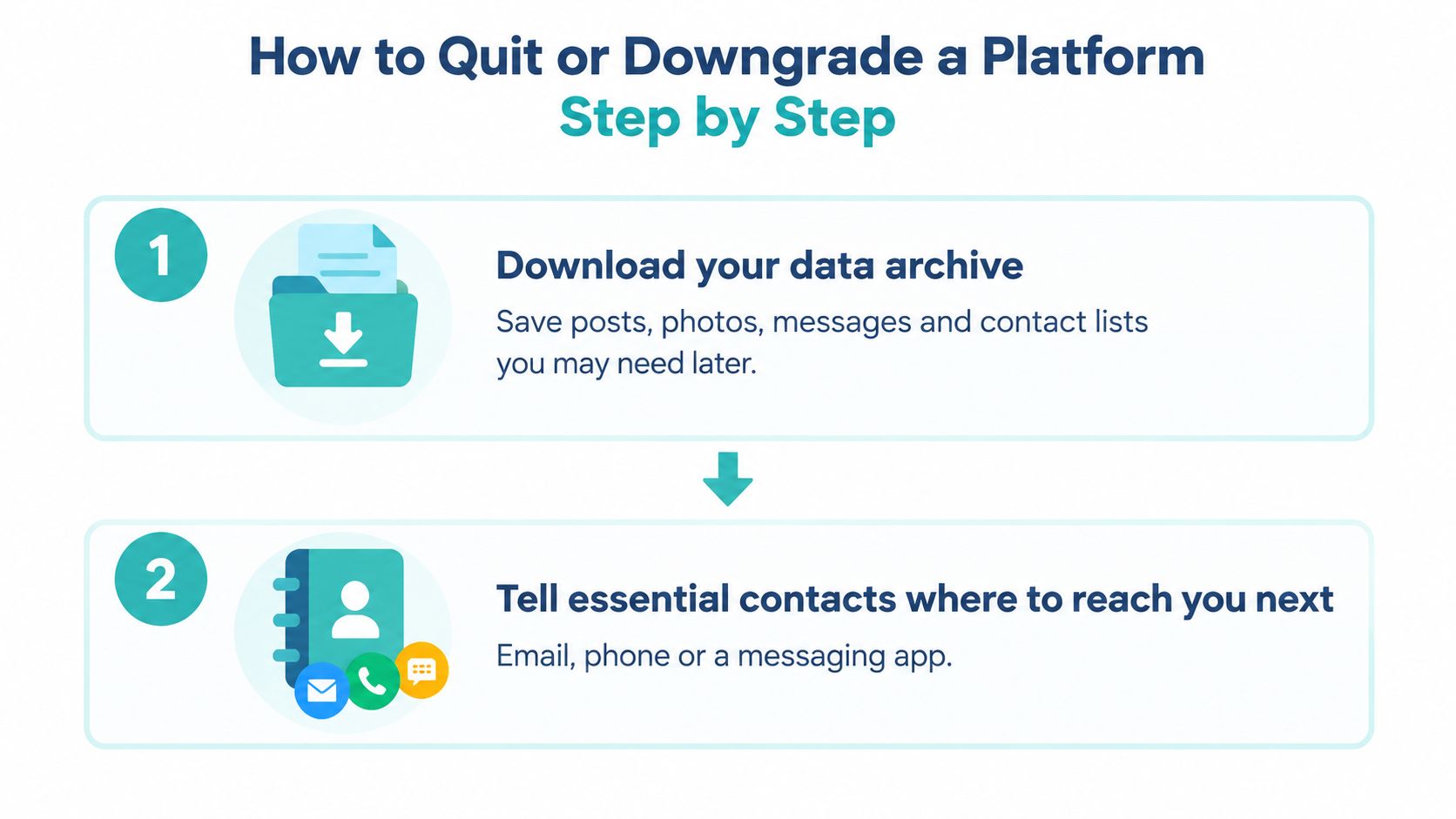
- Download your data archive and save posts, photos, messages, and contact lists you may need later. Platforms don’t owe you a convenient export after the account is gone.
- Tell essential contacts where to reach you next, by email, phone, or a messaging app, and set a date for the switch. A surprise disappearance reads as rudeness, and it drops enquiries.
- Audit who you follow and what you see, then unfollow or mute accounts that trigger distress or comparison. Many people only needed a quieter feed, which the test will confirm if mood improves before you delete anything.
- Turn off every notification and move the app off the home screen for a week. That low-cost downgrade tests compulsion without burning the account.
- Choose the exit level. Deactivation is reversible and suits a trial. Deletion is the settled decision once the metrics have already improved and the contacts have moved.
- Log out on every browser and device, and remove saved passwords. A one-tap login is how a “deleted” habit returns on a tired evening.
- Name the replacement before the gap appears. A sleep routine, a workout, or a weekly call with a customer beats an empty hour that another app will claim.
- Review the same metrics after 30 days. If sleep, mood, or output slipped back, the substitute failed or a second account took over, and you adjust that, not your memory of week one.
If the account belongs to the business
- Assign one owner. A shared login with no owner means messages sit unanswered the week you step back.
- Pin the website or booking link on the profile before any switch. People who still land there need a next step that isn’t a direct message you no longer read.
- Hand over open customer threads in writing. Deletion can erase business history, and some reviews or followers only exist while the account stays active. If the page is still producing enquiries, downgrade your personal use and keep the page on a schedule.
Direct channels need somewhere to live once the app is no longer the address book. Building an email list from zero without buying lists is the durable version of “tell people where to find you,” because a list you own doesn’t vanish when a platform changes its rules.
Replacement Channels for Businesses Including TV
Leaving a personal feed isn’t the same decision as leaving customer acquisition. Intuit’s 2025 Small Business Advertising Trends Report found that 75% of surveyed small businesses considered social media an effective advertising channel. The commercial case for the channel can stay intact while your personal use stops.
Company size changes how much the channel carries. Among EU enterprises, Eurostat reported that 60.59% of small enterprises used social media, compared with 89.09% of large enterprises. A smaller firm can rebalance its spend without pretending it runs the same operation as a national brand. It still needs a way for new customers to discover it.
Where the budget can go
| Channel | Best for | How results are measured | Typical cost |
|---|---|---|---|
| Adwave TV campaigns | Local awareness, brand recall, and footfall | Real-time performance tracking | From $50, with pacing that stays inside the budget you set |
| Google Business Profile | Local search discovery | Calls, direction requests, and reviews | Free to claim and maintain |
| Email newsletter | Repeat customers and bookings | Open rate, click rate, and replies | Cost follows the sending tool and list size |
| Local search ads | Customers already searching for your service | Clicks, calls, and form fills | Bid-based, set by the keywords you choose |
| Direct mail | Households in a defined neighborhood | Coupon or code redemption | Print and postage vary by area |
| Local radio | Regional awareness and commuters | Promo codes and call tracking | Station rates vary by market |
Television suits advertisers who need to reach a whole area rather than a narrow online segment. Adwave generates a broadcast-ready spot from a website URL, places it across more than 100 premium channels, and starts campaigns at $50 with automated pacing so spend doesn’t run past the cap you set. Real-time performance tracking shows whether the flight is reaching the viewers you bought, without a production crew or a large media department.
TV reaches a broad local audience, so the cost of a useful enquiry is harder to isolate than it is with search. That is the same limitation that makes total screen minutes a weak predictor of personal harm: reach is a proxy, not a result. Judge it the way you judged the platform, with a defined flight and a count of calls, bookings, or redemptions before and after. It works best beside channels that catch intent, such as a Google Business Profile, email, and local search ads, so the person who saw the spot can still call or book. If you want an in-person complement to that mix, building brand engagement with PSW Events is one option for meeting customers face to face.
For a side-by-side read of attention, targeting, and measurement, connected TV versus social media ads shows where a local advertiser gives up feed-level clicking and gains a format people sit through.
Confirm Your Decision Before You Leave
Quit when functional impairment or repeated failed cut-backs are still there after the test. Scale back when limits improve your metrics without losing essential contacts. Stay when the test shows no gain and the platform produces real value you would not get elsewhere.
People who have already made a clean exit, including the reflections in a farewell to FB, tend to describe a specific loss of time and attention, not a moral victory. Use that as a prompt to check your own log, not as a script you have to follow.
Tick these before you act
- Signals: At least two warning signs have lasted a month, not a bad weekend.
- Baseline: You recorded minutes, sleep, mood, and output for seven days before changing anything.
- Contacts: The connection audit is done, and essential people have a direct channel.
- Exit level: Deactivation if this is still a trial. Deletion only if the decision is settled.
- Replacement: The freed time has a name, such as an earlier bedtime or a weekly customer call.
- Review date: A 30-day check is on the calendar, using the same metrics as the test.
- Business owner: One person is responsible for the account if it stays live.
- Revenue dependence: You know which leads or sales still start there.
- Next channel: The budget has a destination, whether that is search, email, mail, radio, events, or TV.
This week, pick one platform and start the seven-day baseline. If the business is leaving or cutting social posting, test TV reach with Adwave from a website URL, with campaigns from $50, and compare attention and enquiries with the baseline you just recorded. A decision you can re-score in a month is sturdier than a deletion made at midnight.
Adwave gives local businesses a way to keep acquiring customers when personal social media use has to stop. You enter a website URL, get a broadcast-ready TV ad, and run it across more than 100 premium channels with campaigns starting at $50 and pacing that respects the budget you set. If the test says it’s time to quit the feed, visit Adwave and see whether television can carry the awareness your scrolling no longer should.