
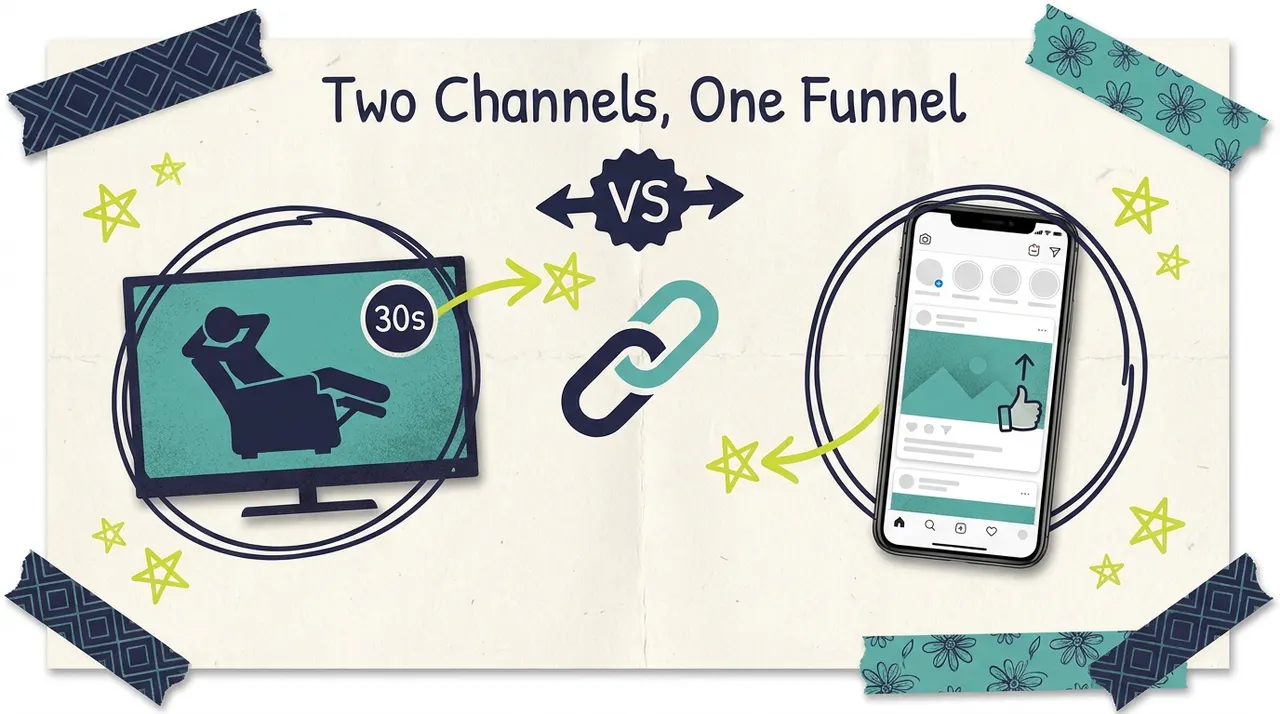
For most small businesses, the choice between connected TV (CTV) and social media advertising shows up as a budget question: "I have $2,000 a month for ads. Should I put it all in Meta, or split it with TV?" The right answer depends on what each channel does, where the audience overlap is, where they diverge, and how the channels compound when they're run together.
This guide breaks down CTV and social media ads head-to-head on the dimensions that matter for small business decision-making: audience reach, cost structure, attribution, creative requirements, conversion patterns, and combined-funnel performance. By the end, you'll have a clear framework for allocating budget between them.
The fundamental difference
CTV and social media ads are often described as "competing channels," but they're really doing different jobs. The right mental model is:
Social media ads catch attention. A user scrolling Instagram or Facebook is in a fast-flicking, decision-making state. They're processing dozens of pieces of content per minute. A great social ad pulls them out of the scroll for a few seconds and either converts them on the spot or earns a save, follow, or click for later.
CTV ads build memory. A viewer watching a streaming show is in a lean-back attention state. They're not deciding what to look at next; they're absorbing the content. The ad inherits that attention quality and lodges in memory in a way scroll-based content rarely does.
Both work. They work differently. And the right small business advertising strategy in 2026 uses both, because the combined effect compounds.
Head-to-head comparison
Where each channel wins
Where CTV wins
Building brand familiarity faster. TV's lean-back attention quality lodges brand impressions in memory more efficiently than social. A household that sees your CTV spot 4 times over 2 weeks recognizes your brand by week 3 in a way Meta impressions rarely achieve at the same exposure count.
Household-level reach. CTV is watched socially. The household that sees your ad makes the visit decision together. Most major purchase decisions (real estate, financial planning, home services, healthcare) are made by households, not individuals.
Trust transfer from premium content. Your CTV ad runs alongside the show the viewer is invested in. That context transfers credibility to your brand. A small home services business advertising on Hulu inherits some of Hulu's trust position.
Driving foot traffic. Local businesses with physical locations consistently see foot traffic lifts of 12-30% during well-targeted CTV campaigns. Social media foot traffic lift is meaningful but typically smaller, especially for businesses outside obvious "destination" categories.
Reaching households outside frequent social use. A meaningful share of homeowner-age households (40+) use social media lightly but watch substantial streaming TV. CTV reaches those households where social can't.
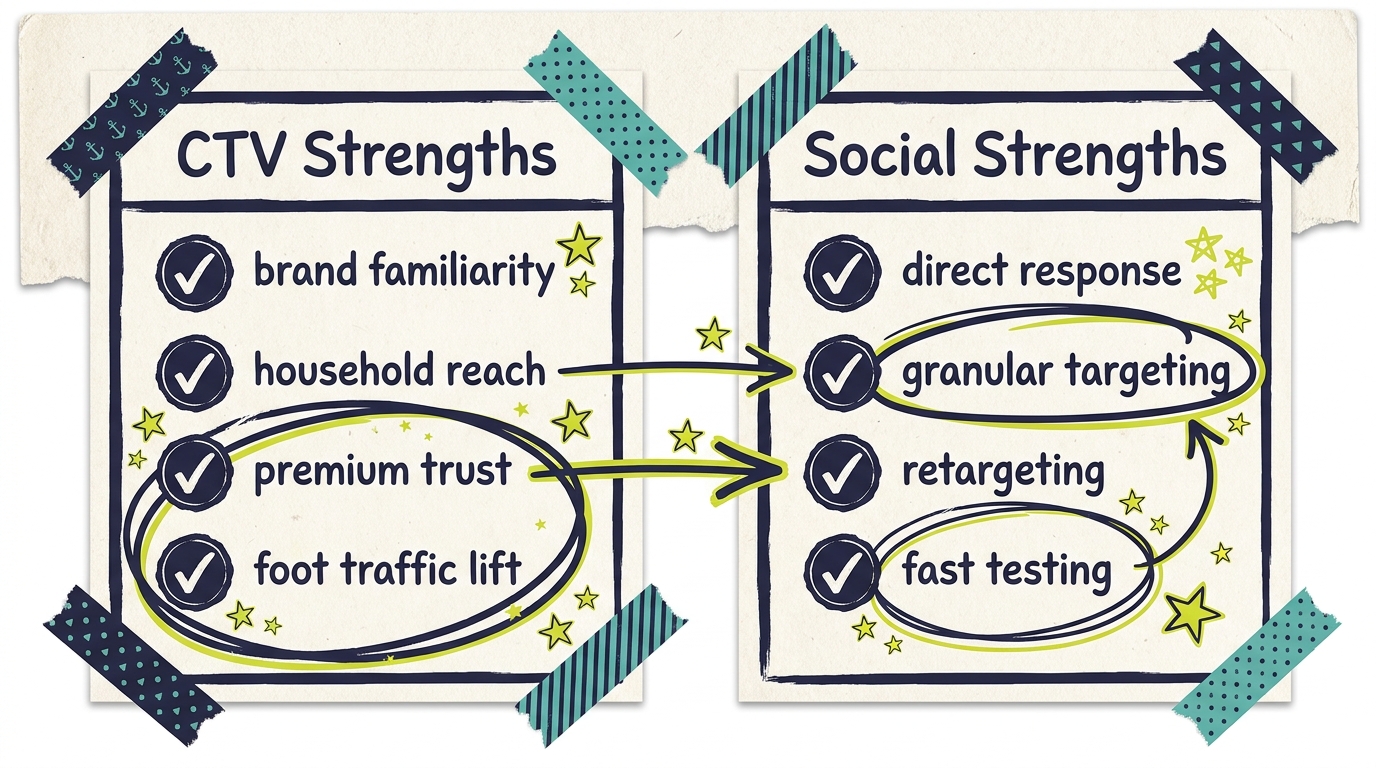
Where social media wins
Same-day direct response. A Meta ad with a specific offer and a strong landing page can convert within hours. Most CTV conversions take days to weeks; most strong Meta conversions happen within the first 72 hours.
Granular targeting. Meta's interest, behavior, and lookalike targeting is more granular than CTV's typical geographic and demographic targeting. For specialty businesses (specific hobby retailers, narrow B2B niches, very niche services), Meta's targeting depth is decisive.
Retargeting power. Visitors to your website, viewers of your past video content, abandoners of your cart, all are reachable on Meta for follow-up. CTV retargeting exists but is less mature.
Cost efficiency at small scale. Below $500/month, Meta typically produces more measurable activity than CTV. CTV's strength shows up at $800+/month when meaningful local frequency becomes achievable.
Speed of testing. Meta lets you test 4-6 creative variations in a week with hard data. CTV testing typically requires longer windows (2-4 weeks) to produce statistically meaningful read.
Long-form video formats. A 60-second Instagram Reel or a 3-minute Facebook video can do storytelling that doesn't fit the 30-second CTV format. For brands with strong long-form content, social's flexibility is a real advantage.
How they compound when run together
The most important pattern for small business decision-making: CTV and social ads aren't really competing channels. They're complementary channels that produce dramatically better combined results than either alone.
Pattern 1: CTV builds the familiarity, social converts the familiarity. A household that sees your CTV spot multiple times recognizes your brand instantly when they later encounter your Meta ad. The conversion rate on the Meta ad rises by 15-40% during active CTV flights compared to non-flight periods. This is a well-documented cross-channel lift effect.
Pattern 2: Social retargets the CTV-curious. Viewers who saw your CTV spot and visited your website (even briefly) become retargeting audiences on Meta. Combining CTV brand exposure with Meta retargeting captures the conversion at substantially lower cost than either channel alone.
Pattern 3: Synchronized creative compounds messages. When your CTV creative and Meta creative tell the same story with the same offer during the same window, viewers exposed to both convert at rates 2-3x higher than viewers exposed to only one channel.
Pattern 4: CTV unlocks branded search. A meaningful share of CTV's conversion happens through branded search lift on Google. Viewers see your ad on TV, then later search for your business by name. Google ads or organic results catch those searches and convert them. Meta and CTV both contribute to branded search lift; the combination produces the strongest lift.
Pattern 5: Different households respond to different channels. Some households are heavy social users with light TV; some are heavy TV users with light social. Running both channels reaches the full household population rather than just one slice.
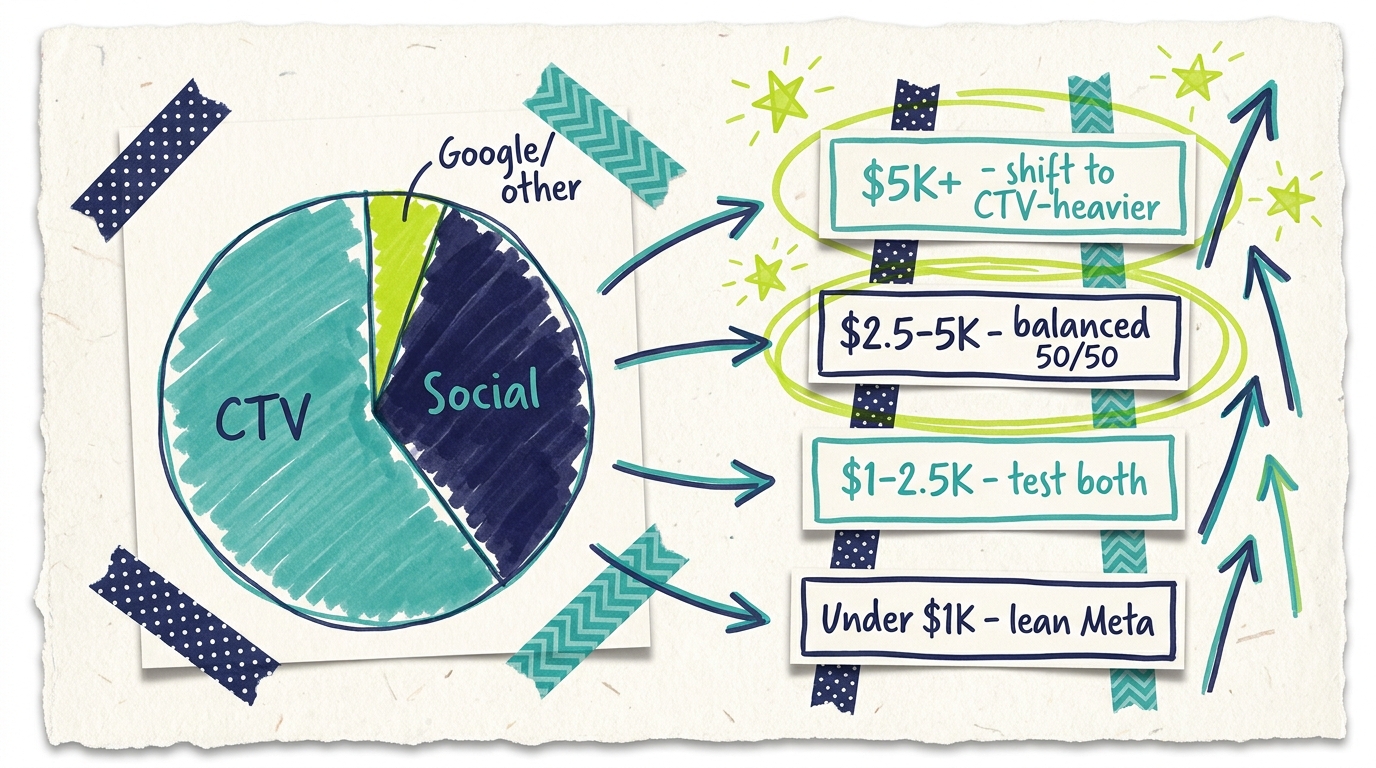
What to allocate between them
For small businesses with limited budgets, the right split depends on three factors: total budget, business stage, and category type.
Budget under $1,000/month
Lean toward Meta as the primary channel. CTV at this budget level produces too little local frequency to drive meaningful recall. Use the limited spend on Meta with strong creative and tight retargeting; consider adding small-budget CTV ($200-$400/month) as a supplemental layer only after Meta is producing reliable results.
Budget $1,000-$2,500/month
Test both, weight slightly toward whichever channel has been less explored. Most small businesses are over-indexed on Meta and under-indexed on CTV at this budget tier. A 60/40 Meta/CTV split or even 50/50 is often the right starting point.
Budget $2,500-$5,000/month
Balanced split, typically 40-50% Meta, 40-50% CTV, with the remainder in Google search and other supporting channels. This is the budget range where the cross-channel lift effects become most measurable.
Budget $5,000+/month
Many small businesses at this scale shift to 30-40% Meta, 40-50% CTV, with the rest in Google and other channels. The compounding effects of CTV's brand-building work pay off more visibly at sustained higher budgets.
Category-specific recommendations
A few patterns worth noting by business type:
Local service businesses (HVAC, plumbing, electrical, roofing). CTV is especially strong because the household-level decision dynamic matters and trust is high-stakes. Recommended split: 45-55% CTV, 30-40% Meta, balance in Google.
Retail and e-commerce. Meta typically dominates direct conversion volume; CTV provides the brand layer that lifts Meta performance. Recommended split: 50-60% Meta, 30-40% CTV, balance in Google. E-commerce-heavy DTC brands often skew further toward Meta.
Restaurants and hospitality. Both channels work strongly. Meta for visual content marketing (food photography, reels, customer-generated content); CTV for household-level recognition. Recommended split: 45-50% Meta, 35-45% CTV, balance in local platforms.
Professional services (accountants, attorneys, financial advisors). LinkedIn often replaces Meta for B2B-oriented practices. CTV adds trust at the household level (where partner co-decision matters). Recommended split: 35-45% LinkedIn/Meta, 35-45% CTV, balance in Google.
Healthcare practices. CTV's trust-building work is especially valuable. Meta supports visual content (facility tours, team videos, patient testimonials within compliance limits). Recommended split: 40-50% CTV, 30-40% Meta, balance in Google and local SEO.
Fitness studios and wellness. Visual content drives Meta strongly; CTV builds the household familiarity that converts to intro signups. Recommended split: 45-55% Meta, 30-40% CTV, balance in local platforms.
Wedding and event venues. Both channels matter. CTV reaches couples and parents-of-couples; Meta drives the visual inspiration cycle. Recommended split: 35-45% Meta, 30-40% CTV, balance in directories.
How to measure the combined channels
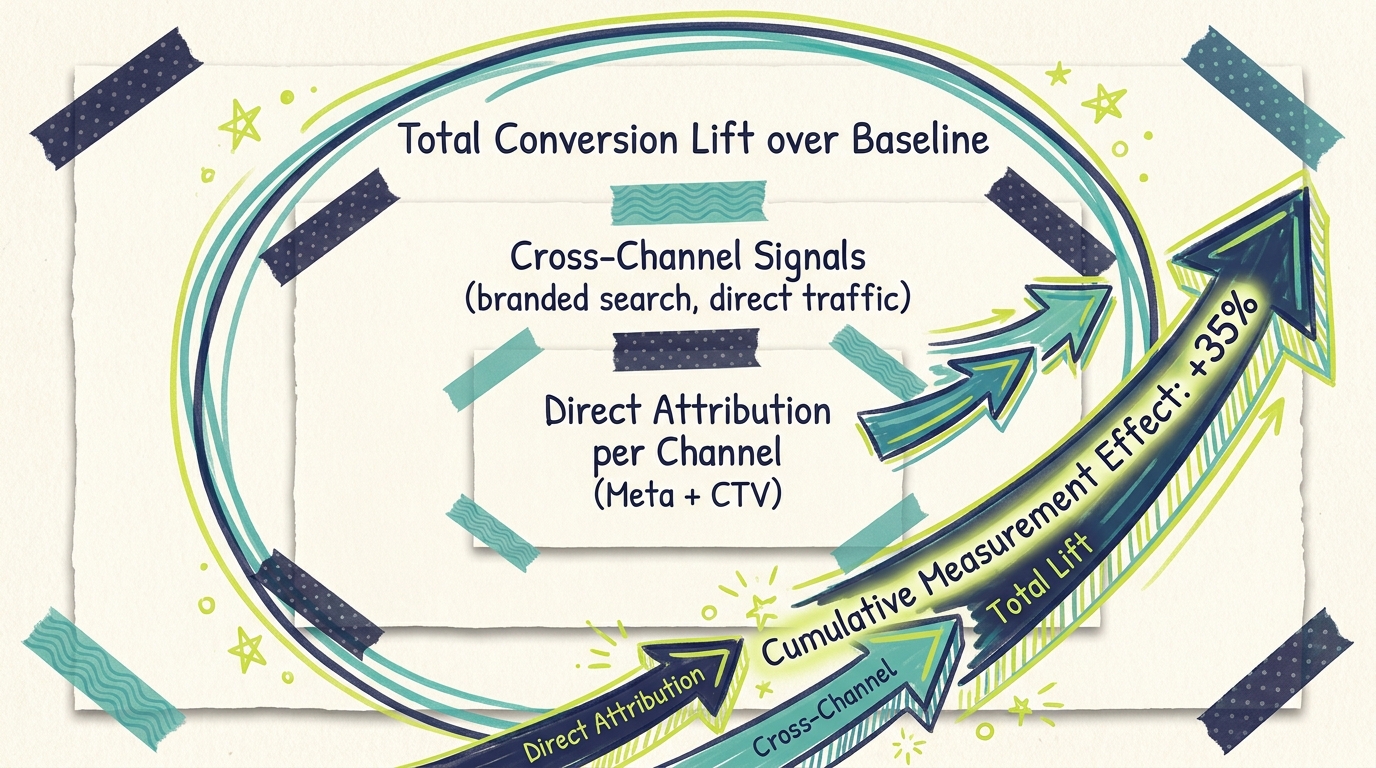
The single most important measurement habit when running CTV and social media together is the pre/post baseline across both. Three layers:
1. Direct attribution per channel. Each platform reports its own conversion data. Meta will show conversions attributed to Meta ads; CTV platforms show conversions attributed to QR scans or vanity URL traffic. These are floors, not ceilings.
2. Total conversion lift over baseline. Compare total inquiries, sales, or conversions during the combined CTV + Meta window against the pre-campaign baseline (4-6 weeks without CTV running, with Meta at steady spend). The total lift captures the combined impact of both channels.
3. Cross-channel signals. Branded search lift, direct traffic lift, Meta CTR and conversion rate during the CTV window vs. before. These signals are how CTV's brand-building work shows up in Meta's performance.
For most small businesses, this three-layer measurement framework captures 80-95% of the true combined channel impact, compared to 50-70% with direct attribution alone.
Common questions answered
Should I cut my Meta spend to add CTV?
Almost never. The cleanest approach is to hold Meta steady while testing CTV for 60-90 days. Cutting Meta to fund CTV often produces a worse net result because you've removed the conversion layer that CTV's brand-building work is feeding into. Rebalance after the test, not before.
Which channel produces faster ROI?
Compare TV and social results together over a consistent period, such as 90 days. Last-click reports can miss earlier ad exposure that influenced a purchase.
Is CTV worth it for a small business that's already doing well on Meta?
Usually yes. The cross-channel lift effect means CTV typically improves Meta's performance during the campaign window. If your Meta is at 4x ROAS and adding CTV pushes it to 4.8x ROAS while CTV produces its own 2-4x direct ROAS, the combined math is meaningfully better than Meta alone.
Can a very small business ($500-$800/month total) run both channels?
Yes, but typically with most of the budget on Meta and a small CTV layer (or none) until budget grows. At very small total budgets, splitting too thin across two channels produces weak signal on each. Build one channel to working, then layer in the second.
What's the most common mistake small businesses make in choosing between CTV and Meta?
Treating them as competing channels rather than complementary ones. The "CTV vs Meta" framing is the wrong question. The right question is "what mix of CTV and Meta produces the best combined ROAS for my business?" That answer is rarely 100% of either channel.
Do I need separate creative for CTV and Meta?
Yes. CTV creative is 30 seconds, broadcast-quality, lean-back grammar. Meta creative is 6-30 seconds, native-style, scroll-stopping grammar. The same script can inform both, but the formats and pacing should be different. AI creative tools now make it economically practical to produce both from the same source.
How quickly can I see the combined channel effect?
Cross-channel lift signals (branded search rising, Meta CTR rising) often appear in the first 2-3 weeks after CTV launches alongside steady Meta. Total conversion lift over baseline becomes measurable in 4-6 weeks. A clean 90-day comparison is the most defensible read.
Building your channel mix
The small businesses winning in 2026 don't pick between CTV and social media advertising. They run both in coordination, each doing its specific job, and measure the combined effect across both rather than attributing every conversion to one channel.
If your current ad mix is Meta-heavy or Meta-only, adding a CTV layer is one of the most used moves you can make this year. The cross-channel lift effects are well-documented, the cost of CTV has dropped dramatically (Adwave subscriptions from $50), and the combined funnel produces better results than either channel alone.


