You’re probably at the point where Yelp feels annoying and unavoidable at the same time. A contractor asks whether it’s worth the hassle, a dentist wants more booked consults, or a realtor wants to know if a profile will do anything beyond collecting opinions. That’s the right moment to evaluate Yelp for service businesses properly, because the platform is no longer just a restaurant review site, it’s a local demand engine built around intent, quotes, and trust.
Yelp’s own scale makes that hard to ignore. It now reaches more than 75 million monthly visitors, gets around 2.5 million daily searches, and has roughly 8.4 million active business pages in 2025, while home and local services make up about 20% to 21% of all Yelp reviews WiserReview’s Yelp statistics roundup. If you run plumbing, cleaning, HVAC, auto repair, beauty, dental, legal, or real estate services, that’s not a side note. It’s the part of Yelp that matters.
The key question is not whether Yelp has reviews. It’s whether your type of business can turn those reviews into leads, quotes, and booked jobs. That depends on profile quality, response speed, category fit, and how you handle the platform’s paid and unpaid paths. It also depends on how discovery is changing, because a Yelp page now does more than sit inside Yelp. It feeds AI-driven search surfaces too, which changes the value of getting the profile right the first time. For a broader look at how local discovery is shifting, this guide on Google AI Overviews for local business visibility is worth keeping open.
Why Service Businesses Are Asking About Yelp
A service owner usually shows up on Yelp after the usual channels stop carrying enough weight. Google Business Profile is already live, referrals are uneven, and paid ads feel crowded or expensive. Then a lead comes in from Yelp, and the platform stops looking like a review site and starts looking like a source of booked work.
That shift is tied to where Yelp is growing. Yelp’s own reporting says U.S. home services led new business openings in 2024, with 11% year-over-year growth and 217,000 openings, and its broader platform data shows 637,590 businesses opened in 2022 versus 566,836 in 2019 Yelp’s State of Services report. That is not restaurant traffic. That is local service demand moving into a place owners already ignore.
The decision point most owners face
For a plumber, dentist, agent, or HVAC owner, the question is simple. Do you want another profile to babysit, or a platform that can route high-intent prospects into a quote flow? Yelp can do the second job, but only if the setup is tight.
Practical rule: Yelp works best when the customer already has a problem and wants to compare providers fast.
That is why Yelp matters more for service businesses than for many retail brands. The platform fits urgent, comparison-heavy categories, and it also feeds AI-driven search and local recommendation systems. A profile that is complete, accurate, and review-ready can do more than help inside Yelp, it can shape how your business appears in broader discovery. For a closer look at that shift, keep Google AI Overviews for local business visibility open while you work on the listing.
Yelp can help, but it is not passive. Lead quality depends on profile quality, response speed, category fit, and how well you handle the paid and unpaid paths. If your team responds slowly, the platform punishes that. If your listing is thin, the value drops fast. If you expect Yelp to behave like a directory, it will disappoint you.
How Yelp Works for Service Companies
Yelp operates differently for service businesses than it does for restaurants. The platform still uses reviews and ratings, but for a plumber or roofer, the main job is discovery and lead routing, not browsing for atmosphere. Yelp says its local search and recommendation data can support finely tuned discovery with one or many search terms, and business details can include operating hours, contact information, ratings, review counts, photos, and more Yelp local search solutions.
The mechanics that actually matter
A claimed page is the starting point. Once you control the listing, you can shape categories, services, service area, photos, and response tools. That’s what lets a business show up in searches like Emergency Plumber instead of floating around as an unoptimized generic listing. The same platform can also surface a restaurant in Italian Restaurants, but the buyer intent is different. On the service side, the user is usually trying to hire, compare, and ask for quotes.
Yelp’s paid layer changes placement, not just visibility. Its ad products are positioned as prime placements that advertise your services to people searching on and off Yelp, with page upgrades like visual standouts, project photos, competitor-ad removal, and custom calls to action Yelp Ads overview. That’s useful for crowded categories, but it’s not the same thing as organic trust.
| Yelp’s Core Service-Company Features at a Glance | What It Does for Service Businesses |
|---|---|
| Claimed business listing | Gives you control over categories, services, hours, and service area |
| Reviews and ratings | Builds trust and affects how prospects sort you against competitors |
| Request a Quote | Routes high-intent users into a direct lead submission flow |
| Sponsored placement ads | Puts your business in more prominent spots when people are actively searching |
| Yelp Guaranteed | Adds a protection layer around qualifying projects |
| Photos and service details | Helps prospects evaluate work quality before they contact you |
The other distinction is lead intent. A person searching for a local pro is often much closer to hiring than someone casually browsing. That’s why Yelp can feel stronger for service businesses than its reputation suggests. The platform is built around the moment a buyer wants to compare options and make contact.
Listings, Request a Quote, and the Lead Funnel
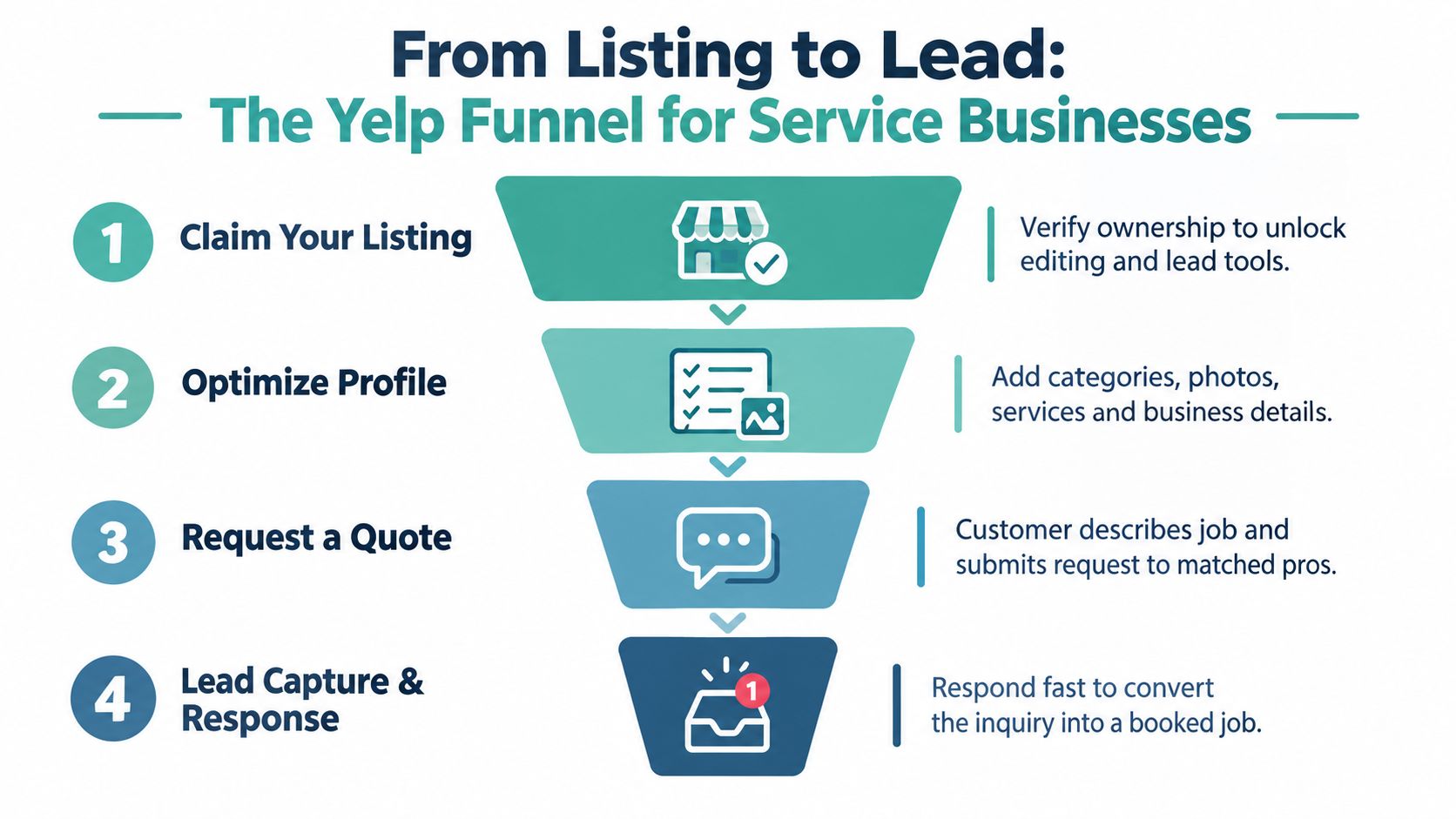
A Yelp listing for a service business works only if you treat it like a live lead funnel. Claim the page, verify ownership, fill in the categories, and turn on the quote tools. Then make the page answer the one question buyers care about, whether you do the work they need, in their area, at a level they trust.
How the quote flow moves
Yelp’s services page makes the intent clear. The Request a Quote flow sends people looking for estimates and project details straight into a lead path instead of leaving them to browse forever Yelp’s services page. That matters because service buyers are usually closer to hiring than casual searchers. They enter the job, share contact details, and expect a fast reply.
For owners who want the system view, AI receptionist local listings is useful because it shows how the same core data, hours, services, and response speed shape every inbound channel. If you already use quoting tools or lead-routing software, Yelp should fit into that workflow, not sit beside it as a separate chore.
Real-world rule: reply fast enough that the customer still remembers why they searched.
Speed matters because a service lead cools quickly. When the profile is complete and the reply confirms scope, timing, and availability, Yelp becomes a sales channel instead of a review page.
A good first test is not instant volume. It is fit. If your category is competitive and your page is complete, a few qualified quote requests can show whether Yelp deserves budget. If the profile is weak or the response time is sloppy, the channel will underperform no matter how much you spend. For owners building that lead flow into a broader process, this small-business funnel guide is a solid companion.
Honest Pros and Cons of Yelp for Service Businesses
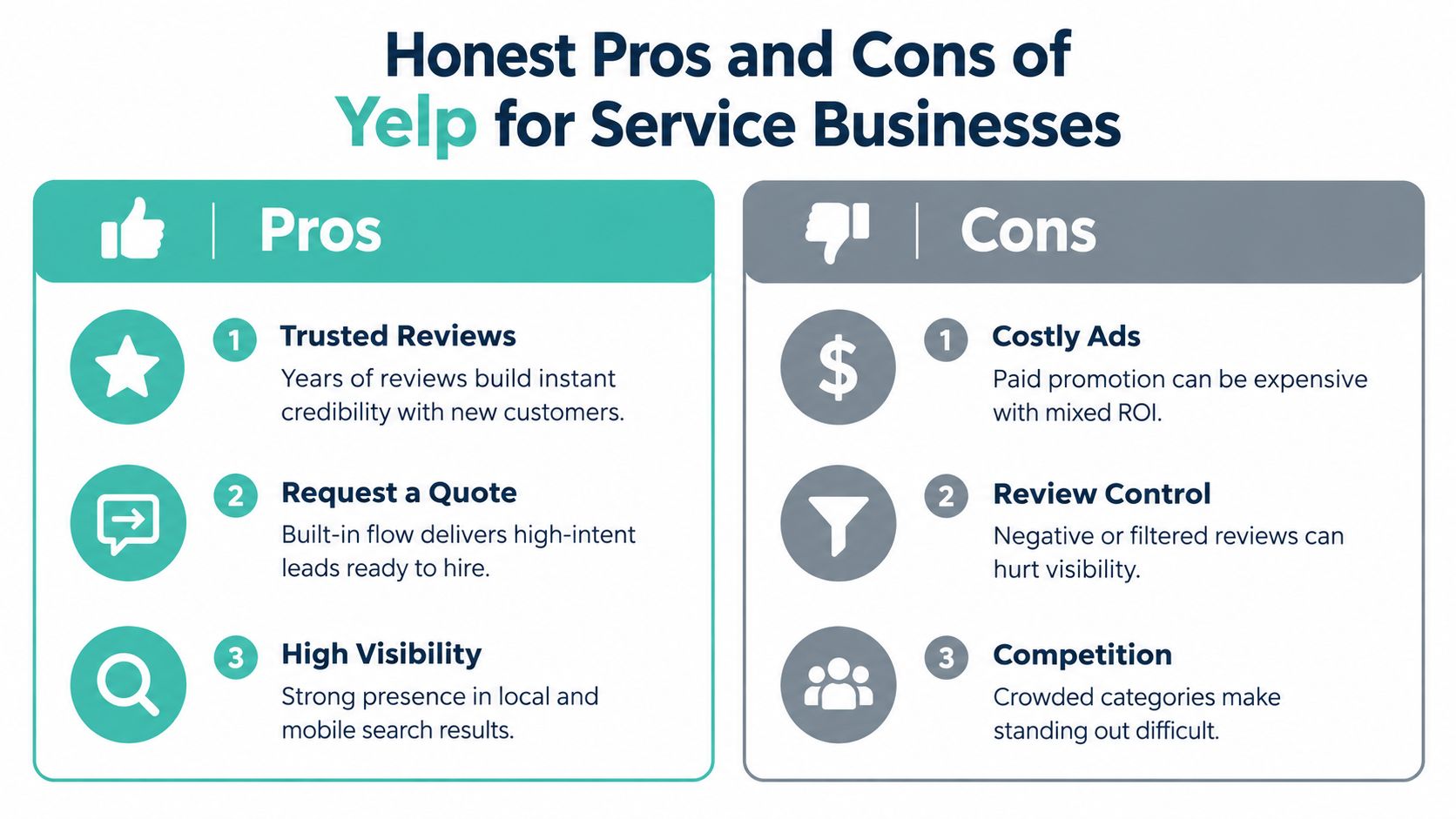
Yelp is useful because it compresses trust and intent into one place. It’s frustrating because it also compresses competition, ads, and platform control into one place. That’s the trade.
Where Yelp helps
The biggest strength is credibility. Years of accumulated reviews give a new customer a quick trust signal, especially in categories where hiring the wrong person is expensive. The second strength is the quote flow, which catches users who are already close to hiring. The third is category-specific visibility, because Yelp is built to sort service providers by what they do.
That’s why businesses in plumbing, HVAC, dentistry, law, real estate, and home repair keep showing up in Yelp conversations. The platform matches a searcher’s problem with a provider’s service description. That’s different from a directory that just lists names.
Where Yelp gets annoying
The downside is control. Yelp’s review filter can hide legitimate reviews without a clean explanation, which creates frustration when you know a client had a good experience. Paid promotion can also feel expensive, and the dashboard often pushes upgrades hard. The other issue is simple. You don’t fully own the customer relationship once the lead lives inside the platform.
If you want a sharper operational view of that tension, reputation management for service businesses is a solid reference. It maps the problem correctly. Reviews matter, but so does the system around them.
What to weigh before spending
- Trust signal: Yelp gives you visible proof that other customers hired you and reviewed the result.
- Lead intent: Request a Quote captures people who are actively comparing providers.
- Platform friction: Ads, review filters, and upsells can make the channel feel heavier than it should.
- Ownership risk: The lead may come through your page, but the platform still controls the environment.
For review operations, open source feedback survey examples can help you build a cleaner pre-review ask before you send someone to Yelp. That matters because the best Yelp strategy usually starts before the customer opens the app.
Optimizing Your Yelp Profile and Managing Reviews
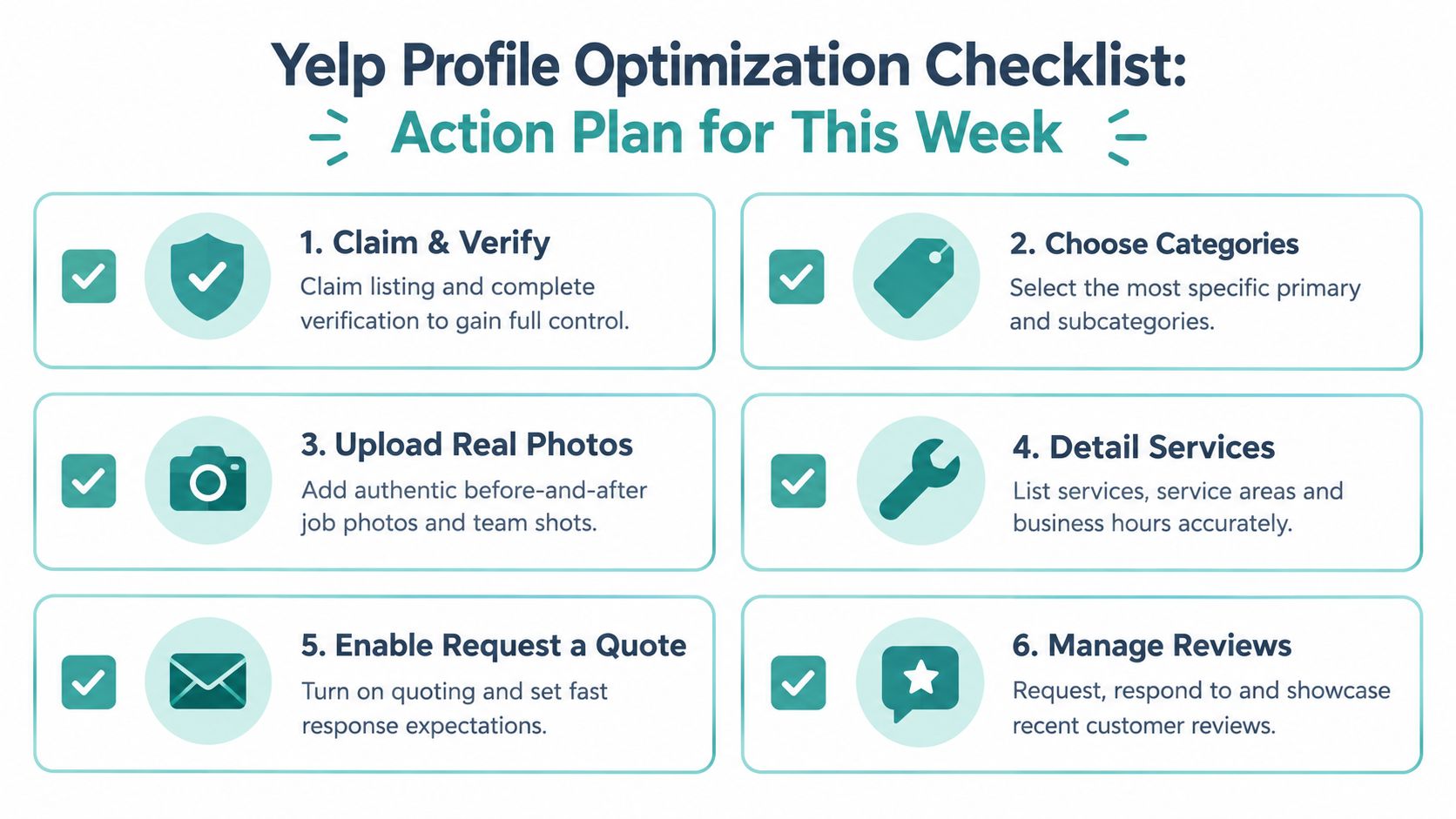
A service business profile should look like a staffed front desk, not a placeholder. Start with ownership, then fill in the details a buyer uses to decide whether to contact you. That means categories, photos, service area, business hours, and the exact kind of work you want more of.
What to fix first
Claim the listing and verify it. Then choose the most specific category you can, not the broadest one that sounds impressive. A plumber shouldn’t hide behind vague home-services wording if the page can say exactly what kind of plumbing work the business handles.
Photos matter more than most owners think. Use real job images, not stock shots. Show before-and-after work, team members on-site, and the kind of project that matches your best-margin jobs. For a roofing company, that means actual roofs. For a dentist, that means a clean, professional office and real team photos, not generic clinic art.
Keep the profile specific enough that the right customer recognizes themselves in it.
How to handle reviews without sounding fake
Respond to positive reviews like a human. Thank the customer, mention the actual service, and keep it short. On a complaint, answer publicly with accountability and then move the issue into private communication fast. Don’t turn a bad review into a long argument.
Yelp also suppresses the obvious review-spam tactic, so asking every customer to leave a review is the wrong move. A better pattern is a gentle, consistent cadence, one to two prompts per month from satisfied clients. That keeps the review stream natural and less likely to look forced.
If you need a framework for reply language, responding to negative reviews templates and best practices is the kind of resource owners use. The point is not to sound polished. The point is to sound trustworthy.
Yelp Reviews in an AI-Driven Local Discovery World
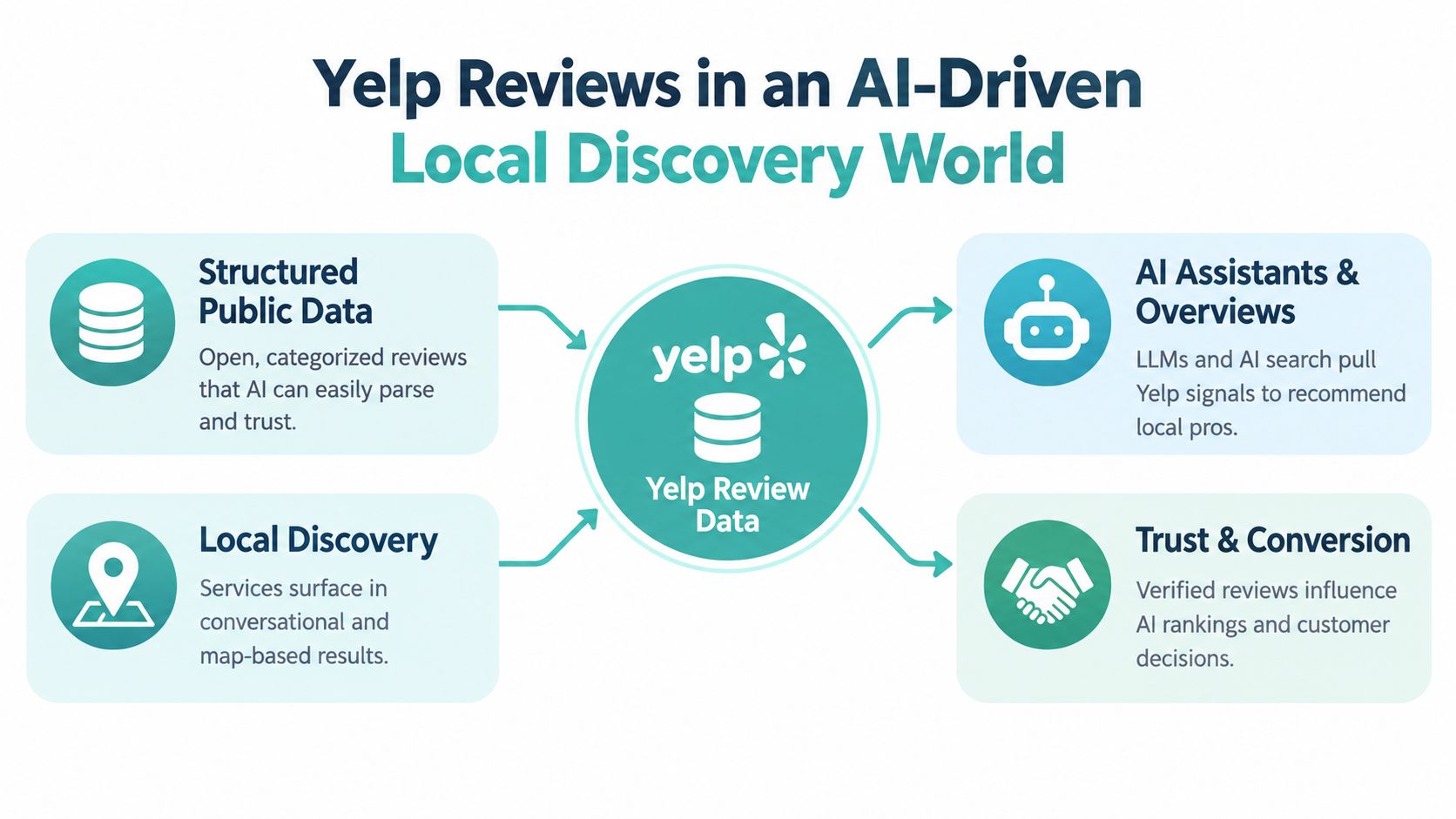
A complete Yelp profile now does more than win clicks inside Yelp. It also feeds discovery surfaces that summarize local businesses for people who never open the app. Yelp says it licenses review and business data to ChatGPT, and its fast facts page notes 330 million cumulative reviews and roughly 22 million new reviews in 2025 Yelp fast facts. That makes profile completeness more important than ever.
Why this changes the value of a Yelp page
AI assistants and search summaries need structured public data to make recommendations. That means photos, ratings, review counts, services, hours, and business details become inputs, not just profile decoration. Yelp’s local search system is built around exactly those fields, and that’s why a maintained listing can show up in conversational search environments even when the customer never lands on Yelp itself.
For service businesses, this shifts the job of the profile. It’s no longer just “get reviews.” It’s “make the page readable by humans and machines.” A neglected listing loses value in both places.
For a practical view of how to think about this layer, the generative engine optimization guide is useful because it frames discovery around structured content and trust signals instead of old-school keyword stuffing. That’s the same direction local search is moving.
The takeaway is straightforward. The discipline you build for Yelp, accurate data, real reviews, recent photos, clear services, now pays off across AI-driven discovery too. If your page is thin, those summaries get thinner. If your page is complete, you give the machine something worth surfacing.
Alternatives Worth Considering and When to Use Them
Yelp should not be your only local channel. It should sit inside a stack that matches your category and buyer behavior. The right alternative depends on how people search for your service, not on which company shouts the loudest.
The platforms that still deserve attention
Google Business Profile is the baseline, not the backup. If people search your service plus your city, you need to be there first. For home services, Angi and HomeAdvisor can make sense when the ticket is high enough to justify lead costs. Thumbtack works better when the buyer is project-based and comparing bids. Houzz fits design-build and visually driven trades better than generic directories.
For health practices, Zocdoc is often more relevant than a broad directory. For legal services, Avvo still matters in the way niche legal discovery tends to work. Apple Maps and Bing Places are worth maintaining because voice search and Copilot-style discovery don’t always route through Google.
| Yelp Alternatives by Service Category | Best For | Cost Model | Lead Quality |
|---|---|---|---|
| Google Business Profile | Nearly every local service business | Free core listing | High when the search intent is local and branded |
| Angi | High-ticket home services | Paid lead or advertising model | Can be strong in home repair and remodeling |
| HomeAdvisor | Home service contractors | Lead-based | Mixed, but useful in some home-service categories |
| Thumbtack | Project-based pros | Bid or lead model | Good when buyers want comparisons |
| Houzz | Design-build, remodeling, interiors | Ads and premium visibility | Strong for visual and aspirational work |
| Zocdoc | Health practices | Marketplace-style scheduling | Strong for appointment-driven care |
| Avvo | Legal | Directory and marketing products | Better for research-driven legal searches |
The weak move is spreading budget across dead directories just because they’re familiar. If customers don’t search there, the leads won’t matter. Rank platforms by where your buyers look, then decide what deserves setup time and ad spend.
Choosing the Right Mix for Your Service Business
The best channel mix starts with four inputs: ticket size, repeat business, urgency, and competition density. A business with high urgency and high local competition needs different tactics than a professional service with lower search frequency and stronger referral flow. That’s the difference between a channel that books jobs and a channel that only looks busy.
A simple way to choose the stack
A plumber in a dense metro usually benefits from Google Business Profile, a polished Yelp page, and Yelp ads if the category is crowded enough to justify paid placement. Add Angi only if the lead quality holds up against the cost. A solo accountant or real estate agent often gets more from Google, a strong Yelp profile, and a steady review cadence that supports branded trust than from a broad paid directory push.
Rule of thumb: spend where the buyer is already searching, not where the platform wants you to believe demand lives.
That’s also where broader media can help. Once you’ve built review credibility on Yelp and Google, TV channels like Adwave can extend that proof into local awareness campaigns without forcing you to rebuild trust from scratch. The review base does the heavy lifting first, then broader reach amplifies it.
If your business is new, stay narrow. Get the Yelp page right, keep Google tight, and measure what turns into booked work. If you already have predictable revenue, add paid layers more aggressively. The wrong move is buying every channel at once and hoping one of them works.
Yelp shines when your service is urgent, local, and trust-sensitive. It falls short when the page is empty, the response is slow, or the business treats reviews like a vanity metric instead of a sales system. Use it as a conversion tool, not a reputation trophy.
If you want a cleaner way to turn reviews, local listings, and trust signals into real demand, Adwave helps service businesses turn that foundation into broadcast-ready TV ads in minutes. It fits this topic because the stronger your Yelp and Google presence gets, the easier it is to extend that proof into broader local awareness. Visit Adwave, test a campaign, and use the visibility you already built to reach more people who are ready to hire.