
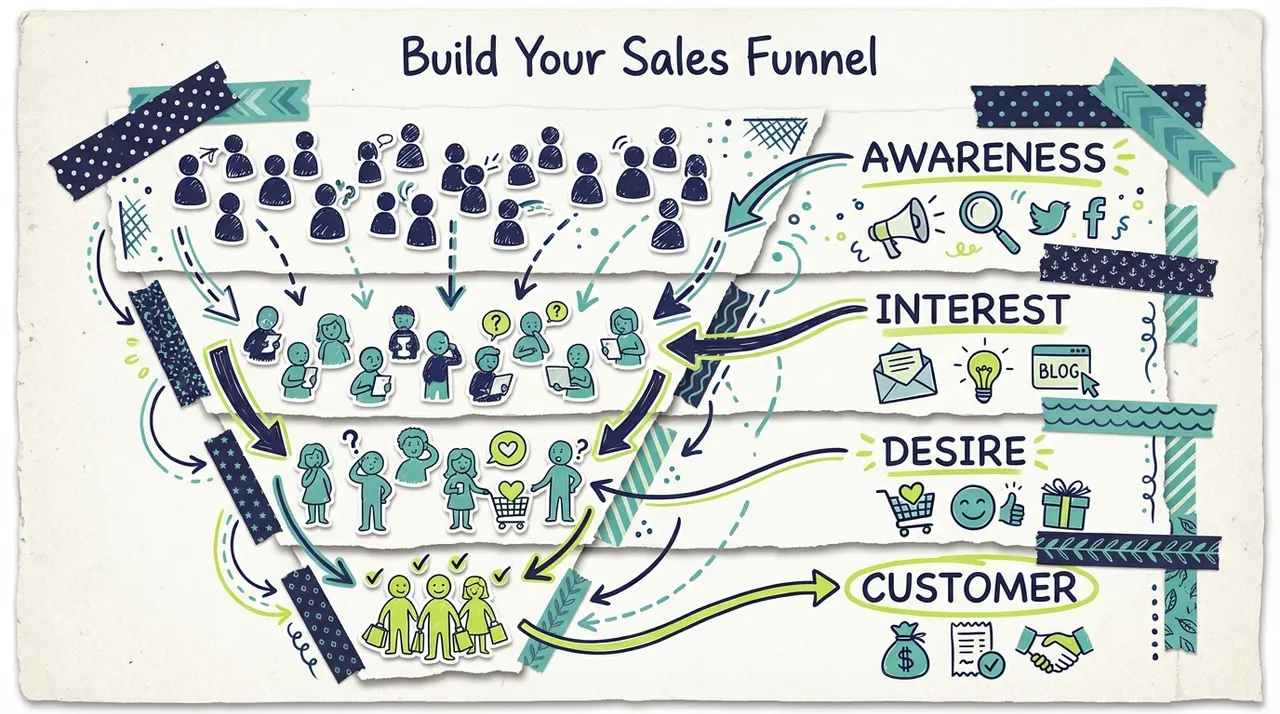
If you've ever wondered why people visit your website but don't buy, or why some marketing works and some doesn't, the answer usually comes down to your sales funnel. A funnel gives you a framework for understanding where potential customers are in their decision-making process and what they need from you at each stage.
You already have a sales funnel, whether you've built one intentionally or not. Every time someone discovers your business, considers your offer, and either buys or walks away, they're moving through a funnel. The question is whether that funnel is working for you or leaking potential customers at every stage.
This guide breaks down how sales funnels work for small businesses, what to put at each stage, and how to fix the gaps that are costing you customers.
What is a sales funnel?

A sales funnel is a model that describes the journey someone takes from first hearing about your business to becoming a paying customer. It's called a "funnel" because the number of people naturally gets smaller at each stage. Lots of people might see your ad, fewer will visit your website, fewer still will consider buying, and a fraction will make a purchase.
That narrowing is normal. The goal isn't to convert 100% of people who see your ad. The goal is to make each stage of the funnel as effective as possible so you're not losing potential customers unnecessarily.
For small businesses, a simple four-stage funnel works best:
Awareness. People learn your business exists. They see an ad, find you in a search result, hear about you from a friend, or drive past your store.
Interest. People want to know more. They visit your website, read your reviews, browse your menu or product catalog, or check out your social media.
Decision. People are comparing options and deciding whether to buy from you or someone else. They're looking at prices, reading testimonials, checking your hours, or requesting a quote.
Action. People become customers. They make a purchase, book an appointment, sign a contract, or walk into your store.
Some models add a fifth stage, retention, for turning one-time buyers into repeat customers. We'll cover that too, because for most small businesses, repeat customers are where the real profit lives.
Why your funnel matters more than your ad budget
Here's a scenario that plays out every day: a small business spends $2,000 a month on Google Ads. The ads drive 500 clicks to their website. But the website is slow, confusing, or missing key information. Only 10 of those 500 visitors take action. That's a 2% conversion rate and a $200 cost per customer.
Now imagine the same business fixes their website. Same $2,000, same 500 clicks, but now 25 visitors convert. That's a 5% conversion rate and an $80 cost per customer. The ad budget didn't change. The funnel got better.
This is why understanding your funnel matters more than simply spending more on advertising. A leaky funnel wastes every dollar you put into it. A tight funnel multiplies every dollar.
Building each stage of your funnel

Stage 1: Awareness (getting discovered)
At the top of the funnel, your job is simple: get in front of people who don't know you exist. The more people who enter the top of your funnel, the more customers come out the bottom.
What works at this stage:
TV and streaming ads. CTV advertising puts your business on the biggest screen in the house. It's one of the most effective awareness channels because TV builds trust and recall in ways that digital banner ads can't match. With platforms like Adwave, you can run streaming TV ads starting at $50.
Search engine optimization. When someone searches for what you offer, you want to be on page one. Local SEO is especially important for brick-and-mortar businesses.
Social media. Organic posts and paid ads can introduce your business to local audiences.
Word of mouth. Still the most trusted form of marketing. Every happy customer becomes a potential referral source.
Local directories. Google Business Profile, Yelp, and industry-specific directories help people find you when they're searching nearby.
Common mistake: Spending all your budget on awareness without investing in the rest of the funnel. Getting 10,000 people to see your ad doesn't help if your website drives them away.
Stage 2: Interest (keeping attention)
Once someone knows you exist, they'll usually do some research before making a decision. This is where your website, content, and online presence need to do the heavy lifting.
What works at this stage:
A clear, fast website. Your website is your digital storefront. If it takes more than three seconds to load, nearly half your visitors will leave. Make sure it's mobile-friendly, loads quickly, and clearly communicates what you do, who you serve, and why you're different.
Helpful content. Blog posts, guides, FAQs, and how-to articles demonstrate expertise and keep potential customers engaged. If someone is researching "how much does HVAC repair cost?" and you have a helpful answer on your website, you've just built trust before they even call.
Reviews and testimonials. Nearly 90% of consumers read online reviews before visiting a business, according to BrightLocal. Make sure you're actively collecting reviews on Google, Yelp, and industry-relevant platforms.
Email capture. Not everyone is ready to buy right now. Offering something valuable (a discount, a free guide, a consultation) in exchange for an email address keeps you connected with people who are interested but not yet ready to commit.
Common mistake: Having a website that looks good but doesn't answer the questions visitors have. Pretty design without clear information equals a leaky funnel.
Stage 3: Decision (winning the comparison)
At this stage, potential customers are comparing you to alternatives. They might be looking at two or three competitors, checking prices, reading reviews, or asking friends for recommendations.
What works at this stage:
Clear pricing (or pricing guidance). You don't necessarily need to list every price, but giving people a sense of what to expect removes a major barrier. "Projects typically start at $500" is more helpful than forcing them to call for a quote.
Comparison content. If customers frequently compare you to competitors or to other approaches, create content that addresses the comparison directly. A page like "Google Ads vs Facebook Ads vs TV Advertising" helps people who are evaluating their options.
Case studies and results. Show proof that your product or service works. Real numbers, real customers, real outcomes. Even a simple before-and-after story is more convincing than any marketing claim.
Risk reduction. Money-back guarantees, free trials, free consultations, and flexible cancellation policies reduce the perceived risk of choosing you. The easier you make it to say yes, the more people will.
Follow-up. If someone requested a quote or signed up for your email list, follow up within 24 hours. Speed matters at the decision stage. The first business to respond often wins.
Common mistake: Assuming people will choose you based on quality alone. At the decision stage, convenience, responsiveness, and trust signals often matter more than being the "best."
Stage 4: Action (converting the customer)
This is where money changes hands. Your job is to make the buying process as frictionless as possible.
What works at this stage:
Simple checkout or booking. Every extra step in the purchase process costs you conversions. If you're an e-commerce business, minimize form fields and offer multiple payment options. If you're a service business, make booking an appointment as easy as tapping a button.
Clear calls to action. "Book Now," "Get a Free Quote," "Start Your Free Trial." Your CTA should be specific, visible, and present on every important page of your website.
Urgency (when genuine). Limited-time offers, seasonal promotions, and genuine scarcity can nudge people from "I'll think about it" to "I'll do it now." But fake urgency destroys trust. Only use it when the urgency is real.
Multiple contact options. Some people want to call. Some want to text. Some want to fill out a form online. Offering multiple ways to reach you ensures you're not losing customers who prefer a different communication style.
Common mistake: Making the purchase process harder than it needs to be. Long forms, required account creation, unclear next steps, and slow response times all kill conversions at the finish line.
Stage 5: Retention (keeping customers coming back)
Acquiring a new customer costs five to seven times more than retaining an existing one, according to Harvard Business Review. That means your most profitable marketing isn't at the top of the funnel. It's at the bottom.
What works at this stage:
Excellent service. This should be obvious, but it's the most important retention tool you have. Deliver on your promises, respond quickly to issues, and make every customer feel valued.
Follow-up communication. A thank-you email after a purchase, a check-in call a week later, or a satisfaction survey shows customers you care about their experience beyond the transaction.
Loyalty programs. Repeat customers should get something for their loyalty. Whether it's a punch card, a VIP discount, or early access to new products, reward the people who keep coming back.
Re-engagement campaigns. Customers who haven't purchased in a while are easier to win back than new customers are to acquire. A targeted email or retargeting ad can remind them why they chose you in the first place.
Common mistake: Treating every customer interaction as a one-time transaction. The businesses that grow fastest are the ones that invest in relationships, not just conversions.
How to identify where your funnel is leaking
Most small businesses have at least one stage where they're losing a disproportionate number of potential customers. Here's how to figure out where your leak is:
Low awareness. If you're not getting enough new inquiries, leads, or foot traffic, the top of your funnel needs work. Invest in advertising channels that reach new audiences, not just the ones that target people who already know you.
Low engagement. If people visit your website but leave quickly (high bounce rate, low time on page), your interest stage needs attention. Look at your website's messaging, load speed, and mobile experience.
Low conversion. If you're getting plenty of inquiries but few are converting to customers, focus on the decision stage. Are you following up fast enough? Is your pricing competitive? Are you making it easy to buy?
Low retention. If you have lots of one-time customers but few repeats, invest in post-purchase experience. Better follow-up, loyalty incentives, and ongoing communication can dramatically increase lifetime value.
Mapping your advertising to funnel stages

Not all advertising channels work equally well at every stage. Here's how common channels map to the funnel:
Best for awareness:
CTV/streaming TV ads
Social media (organic and paid)
Billboard and outdoor advertising
Local radio
PR and community events
Best for interest:
Content marketing and SEO
Email newsletters
Social media engagement
Video content
Best for decision:
Google Search ads
Retargeting campaigns
Review platforms
Email nurture sequences
Best for action:
Google Search ads (high-intent keywords)
Direct mail (for existing leads)
Phone calls and follow-up
Best for retention:
Email marketing
Loyalty programs
CTV retargeting
Social media community
The most effective small business marketing strategies use a mix of channels that covers the full funnel. If you're only running Google Ads, you're only reaching people at the decision stage. If you're only posting on social media, you're building awareness but not capturing demand. A multi-channel approach that covers each stage produces the best results.
A real-world funnel example
Let's say you own a local dental practice. Here's what a simple funnel might look like:
Awareness: You run CTV ads targeting families within 15 miles of your practice. The ad highlights your same-day appointments and modern office. You also maintain an active Google Business Profile and encourage patients to leave reviews.
Interest: Your website features a virtual office tour, information about insurance plans you accept, bios of your dentists, and a blog with articles like "What to Expect at Your First Visit." People who visit your site can sign up for appointment reminders.
Decision: A potential patient checks your Google reviews (4.8 stars, 200+ reviews), sees that you accept their insurance, and notices you offer evening appointments. They compare you to two other dentists in the area.
Action: They book an appointment through your online scheduling tool. It takes 30 seconds. They get an automated confirmation text and email.
Retention: After their appointment, they get a follow-up email asking about their experience. Six months later, they get an automated reminder to schedule their next cleaning. You offer a referral discount: $50 off their next visit for every friend they refer.
That's a complete funnel. Each stage feeds the next, and nothing is left to chance.
How TV advertising fits into your funnel
TV has traditionally been an awareness-only channel. You run a commercial, people see it, and hopefully some of them remember your business later. But CTV advertising has changed that equation.
Awareness. Streaming TV ads reach viewers on premium content (NBC, Hulu, ESPN, and 100+ other channels). Because the ad plays on a big screen in a lean-back environment, viewers pay more attention than they do to a social media ad they're scrolling past. This makes TV one of the most effective awareness channels available.
Interest boost. Businesses that run CTV campaigns consistently see increases in branded search volume and website traffic. When someone sees your ad on TV and later searches for your business name, that's the funnel working. They've moved from awareness to interest because of the trust that TV builds.
Decision support. Seeing a brand on TV creates a credibility halo. When a potential customer is comparing you to a competitor they've never seen advertised, the fact that you were "on TV" gives you an edge. It signals legitimacy and scale, even if you're a small local business.
Retention. CTV retargeting lets you show ads specifically to people who have already visited your website or interacted with your business. This keeps you familiar with existing customers and brings back people who didn't convert on their first visit.
Common questions answered
Do I need expensive software to build a sales funnel? No. Many small businesses build effective funnels using tools they already have. Your website, email provider, Google Business Profile, and a basic CRM are enough to start. As you grow, you can add more specialized tools, but complexity isn't required. The most important thing is understanding the stages and making sure each one is covered.
How long does it take to see results from fixing my funnel? It depends on where the leak is. Top-of-funnel changes (like adding a new advertising channel) can show results in 30 to 60 days. Mid-funnel improvements (like updating your website or adding reviews) often produce faster results because you're converting more of the traffic you're already getting. Bottom-funnel fixes (like simplifying checkout) can show immediate improvement.
What's a good conversion rate for a small business? This varies significantly by industry and channel. For websites, 2 to 5% is a common range. For email campaigns, 1 to 3% click-through rates are typical. For phone inquiries, service businesses often see 30 to 50% close rates. The more useful benchmark is your own trend line. If your conversion rate is improving month over month, your funnel is getting better.
Should I focus on getting more traffic or converting more of my existing traffic? Start with conversion. It's almost always cheaper to improve your conversion rate than to buy more traffic. Once your funnel is converting well, then scaling up your awareness spending makes sense because every additional visitor is worth more.
How does CTV advertising help with my sales funnel? CTV is one of the most effective awareness channels for small businesses because it builds trust and recall on the biggest screen in the house. But its impact extends beyond awareness. Businesses running CTV campaigns consistently see higher branded search volumes, better click-through rates on their digital ads, and improved conversion rates across all channels. With Adwave, you can start testing CTV's impact on your funnel for as little as $50.


