
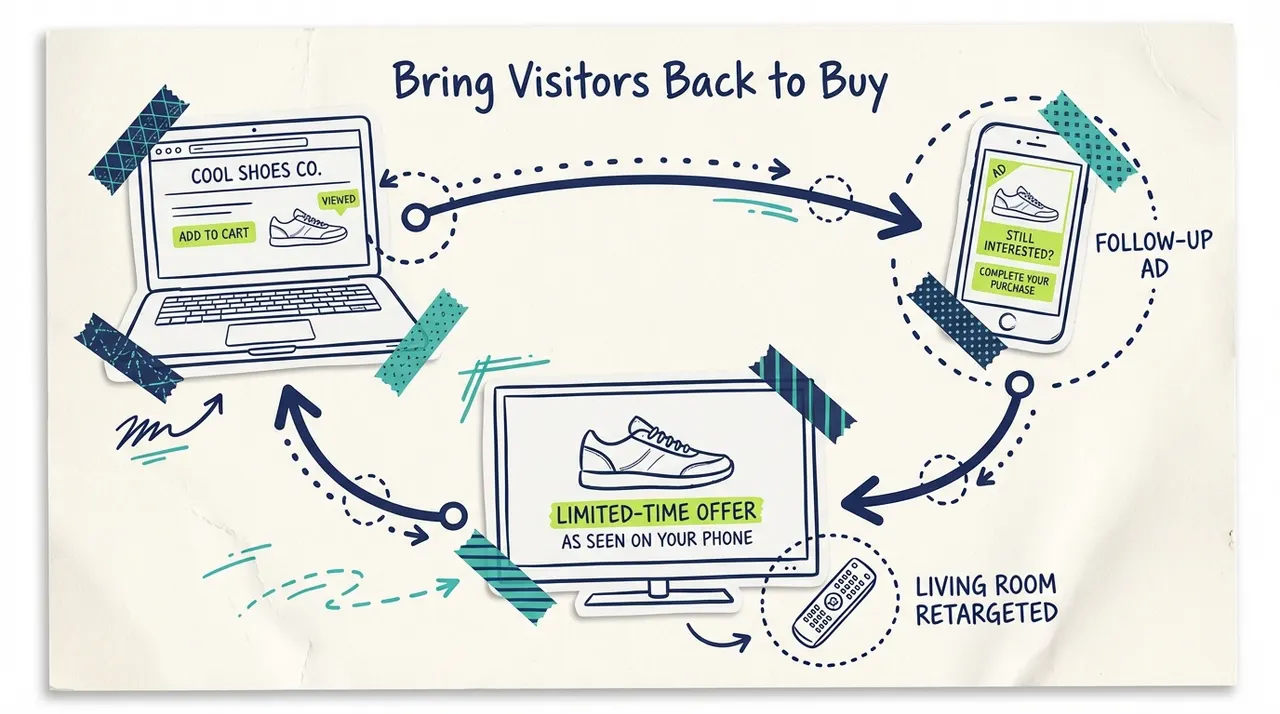
Think about the last time you visited a website, looked at a product, and then left without buying. Maybe you got distracted. Maybe you wanted to compare prices. Whatever the reason, you didn't convert, and that business lost a potential customer.
Now flip the script. That's happening to your business every single day.
Roughly 97% of first-time visitors leave a website without taking action (Mailchimp, 2024). That's not a failure of your website or your offer. It's just how people shop. They browse, they compare, they think it over. Retargeting ads give you a second (and third, and fourth) chance to bring those people back.
Whether you're running a local service business, an online store, or a brick-and-mortar shop, retargeting is one of the most cost-effective advertising strategies you can add to your marketing mix. And the best part? You don't need a massive budget to make it work.
What Is Retargeting and How Does It Work?
Retargeting (sometimes called remarketing) is a form of online advertising that targets people who've already interacted with your business. Instead of casting a wide net and hoping for the best, you're focusing your ad spend on people who've already shown interest.
The mechanics are straightforward. When someone visits your website, a small piece of code called a tracking pixel drops a cookie in their browser. That cookie follows them around the internet and signals ad platforms to show your ads to that specific visitor. So when someone checks out your pricing page and leaves, they might see your ad later while scrolling Instagram, watching a show on Hulu, or reading the news.
There are a few ways retargeting identifies and reaches your audience:
Pixel-based retargeting places a JavaScript tag on your site that tracks visitors. This is the most common method and works across display, social, and video channels.
List-based retargeting uses your existing customer data (like email addresses) to match people on advertising platforms. Upload your email list to Meta or Google, and they'll find those users for you.
Server-side tracking sends data directly from your server to ad platforms, bypassing browser restrictions. This is becoming more important as third-party cookies phase out.
The bottom line: retargeting lets you stay in front of people who already know your name. That familiarity is powerful. Studies from WordStream show that retargeted visitors are 70% more likely to convert than cold traffic (WordStream, 2024).
Types of Retargeting Ads
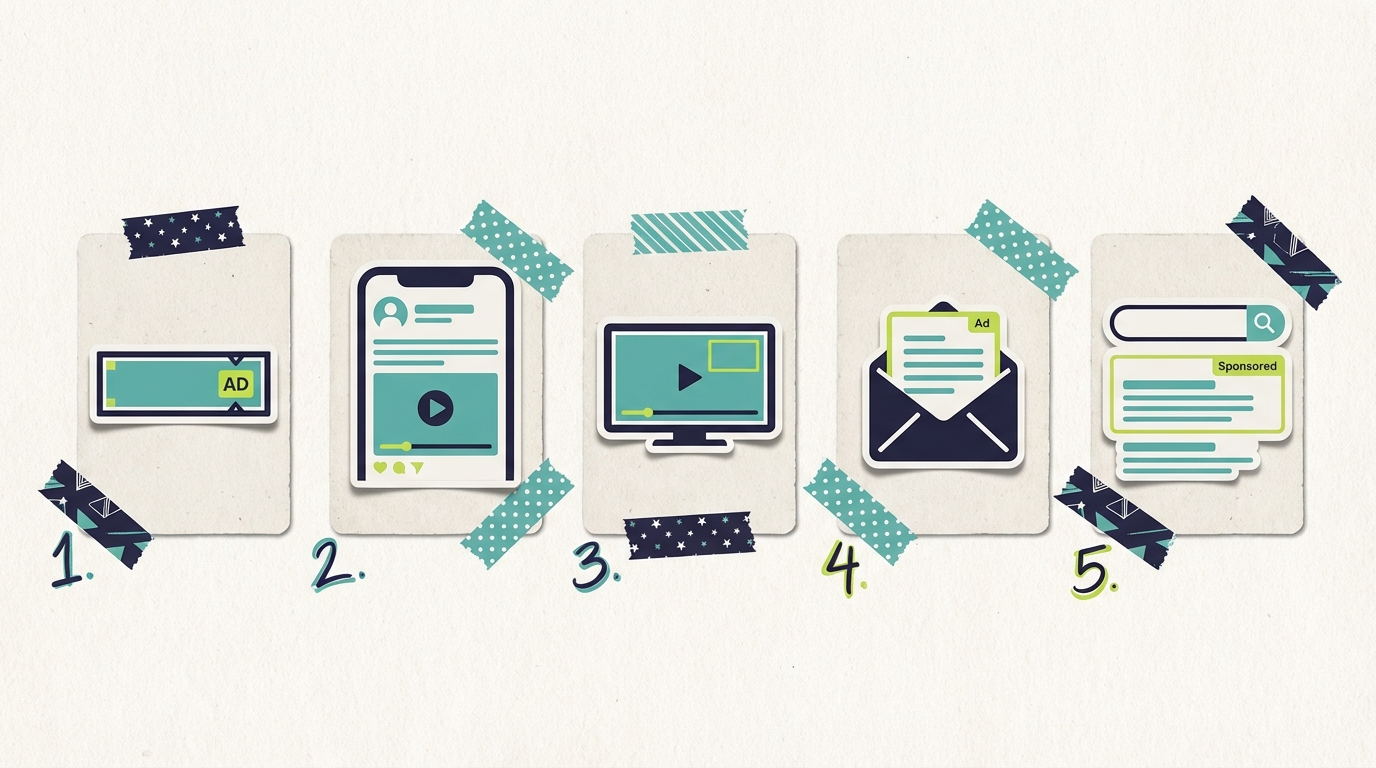
Retargeting isn't limited to one channel. Here are the main types you should know about, each with its own strengths.
Display Retargeting
Display retargeting is the original form of remarketing. Your ads appear as banners on websites across the Google Display Network (or similar networks), which reaches over 90% of internet users. Display ads are inexpensive, easy to set up through Google Ads, and great for keeping your brand visible. The downside? Banner blindness is real. Click-through rates on display ads average around 0.7%, so don't expect instant conversions. Think of display retargeting as a visibility play.
Social Media Retargeting
Platforms like Meta (Facebook and Instagram), TikTok, and LinkedIn let you retarget visitors directly in their social feeds. Social retargeting tends to perform better than display because the ads feel native to the platform. People are already scrolling, already engaged. A well-crafted retargeting ad in their feed can feel like a natural recommendation rather than an interruption. Meta's retargeting tools are especially strong for small businesses, with options to create lookalike audiences based on your retargeting lists.
CTV and Streaming TV Retargeting
This is where retargeting gets exciting for small businesses. Connected TV (CTV) retargeting lets you show video ads to your website visitors while they're watching shows on streaming platforms like Roku, Hulu, Peacock, and Tubi. Someone visits your website, leaves, and later that evening sees your 30-second ad on their TV screen.
The impact is hard to overstate. TV advertising used to be reserved for big brands with six-figure budgets. That's changed. Platforms like Adwave let you launch CTV retargeting campaigns starting at just $50, with ads running across 100+ premium networks. If you want a deep dive into how CTV retargeting works specifically, check out our CTV retargeting guide.
Email Retargeting
Email retargeting uses your existing email list to re-engage people who've shown interest but haven't converted. Abandoned cart emails are the classic example (and they work, with an average open rate of 45% according to Moosend). But email retargeting goes beyond carts. You can trigger emails based on pages visited, content downloaded, or forms started but not finished. The key advantage of email retargeting is that you own the channel. No ad spend required, just a solid email platform.
Search Retargeting
Search retargeting (available through Google Ads) lets you adjust your bids for people who've previously visited your site. When a past visitor searches for your keywords again, you can bid more aggressively to make sure your ad appears at the top. This combines the high intent of search advertising with the familiarity of retargeting. It's especially useful for service businesses where customers compare multiple providers before making a decision.
How to Set Up a Retargeting Strategy
Running retargeting ads without a strategy is like throwing darts blindfolded. You might hit something, but you're wasting a lot of effort. Here's how to build a retargeting strategy that works for a small business.
Define Your Audience Segments
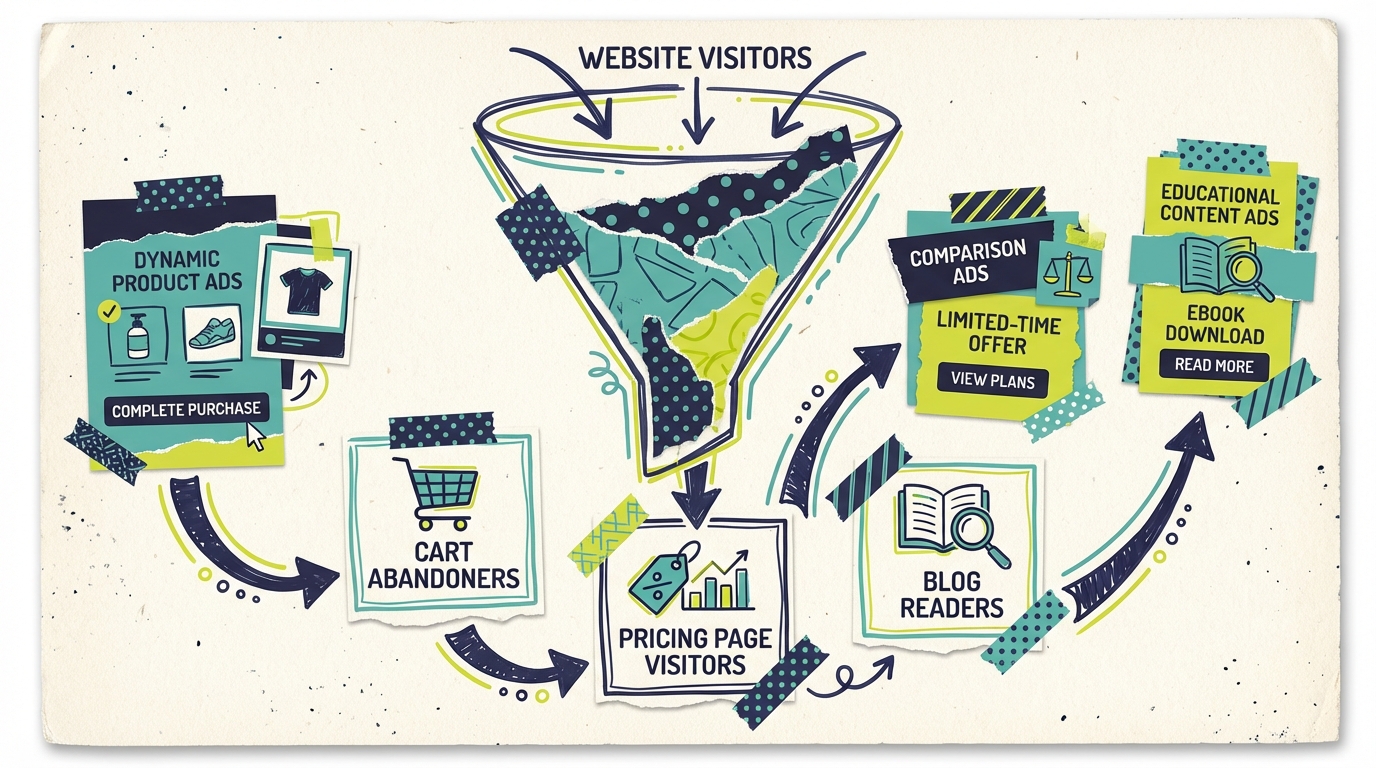
Not all website visitors are equal. Someone who spent 10 seconds on your homepage is very different from someone who added a product to their cart. Segment your retargeting audiences based on behavior:
All visitors (broad awareness, lowest priority)
Product or service page viewers (showing interest)
Pricing page visitors (comparing options, high intent)
Cart abandoners or form starters (highest intent, prioritize these)
Past customers (upsell and cross-sell opportunities)
The more specific your segments, the more relevant your ads can be. A pricing page visitor should see a different message than a blog reader.
Set Your Timing Windows
Timing matters in retargeting. Show ads too soon and you feel stalky. Wait too long and they've forgotten about you (or bought from someone else). General guidelines:
E-commerce: Retarget within 7-14 days for impulse purchases, up to 30 days for higher-ticket items
Service businesses: 14-30 day windows work well since purchase decisions take longer
B2B or high-consideration: 30-90 day windows, since sales cycles are longer
Start with a 30-day window and adjust based on your results. Most ad platforms let you customize this easily.
Set Frequency Caps
Nothing kills brand perception faster than showing someone the same ad 47 times. Frequency caps limit how often a person sees your retargeting ads. For display and social, 3-5 impressions per week is a reasonable starting point. For CTV, 2-3 impressions per week keeps you memorable without being annoying. Monitor your frequency closely. If your click-through rate starts dropping while impressions stay steady, you're probably hitting people too often.
Choose Your Channels
You don't need to retarget on every channel. Pick 1-2 channels that match where your audience spends time. A local service business might focus on social media and CTV retargeting. An online store might prioritize display and email. Start where you'll get the most visibility for your budget, and expand from there.
Retargeting Best Practices for Small Businesses
Start Small, Then Scale
You don't need thousands of dollars to start retargeting. Begin with $5-10 per day on one platform. Once you see what's working (which segments convert, which creatives perform), increase your budget on the winners. Many small businesses find that retargeting delivers their best return on ad spend across all channels because you're reaching people who already know you.
Rotate Your Creative
Ad fatigue is real. If someone sees the same exact ad for three weeks straight, they'll start ignoring it. Create 3-4 variations of your retargeting ads and rotate them. Change up the imagery, the headline, or the offer. For CTV retargeting through Adwave, you can create new ads from any URL in about two minutes, making it easy to keep your creative fresh.
Use Exclusion Lists
Always exclude people who've already converted. There's no point spending ad dollars retargeting someone who just bought from you (unless you're running a cross-sell campaign). Similarly, exclude your existing customers from acquisition-focused retargeting. Most platforms let you upload suppression lists or set conversion-based exclusions.
Match the Message to the Stage
A generic "Visit our website!" ad isn't going to convince someone who was already on your pricing page. Tailor your retargeting creative to where the visitor was in their journey:
Early-stage visitors: Share educational content, customer reviews, or brand awareness messaging
Mid-funnel visitors: Highlight specific benefits, pricing, or case studies
Late-stage visitors: Offer a time-sensitive discount, free consultation, or strong call to action
Track Conversions, Not Just Clicks
Retargeting success isn't about click-through rates alone. Set up proper conversion tracking so you can measure actual outcomes: purchases, form submissions, phone calls, or booked appointments. This data tells you which segments and channels are worth investing in and which ones need adjusting.
What Retargeting Costs
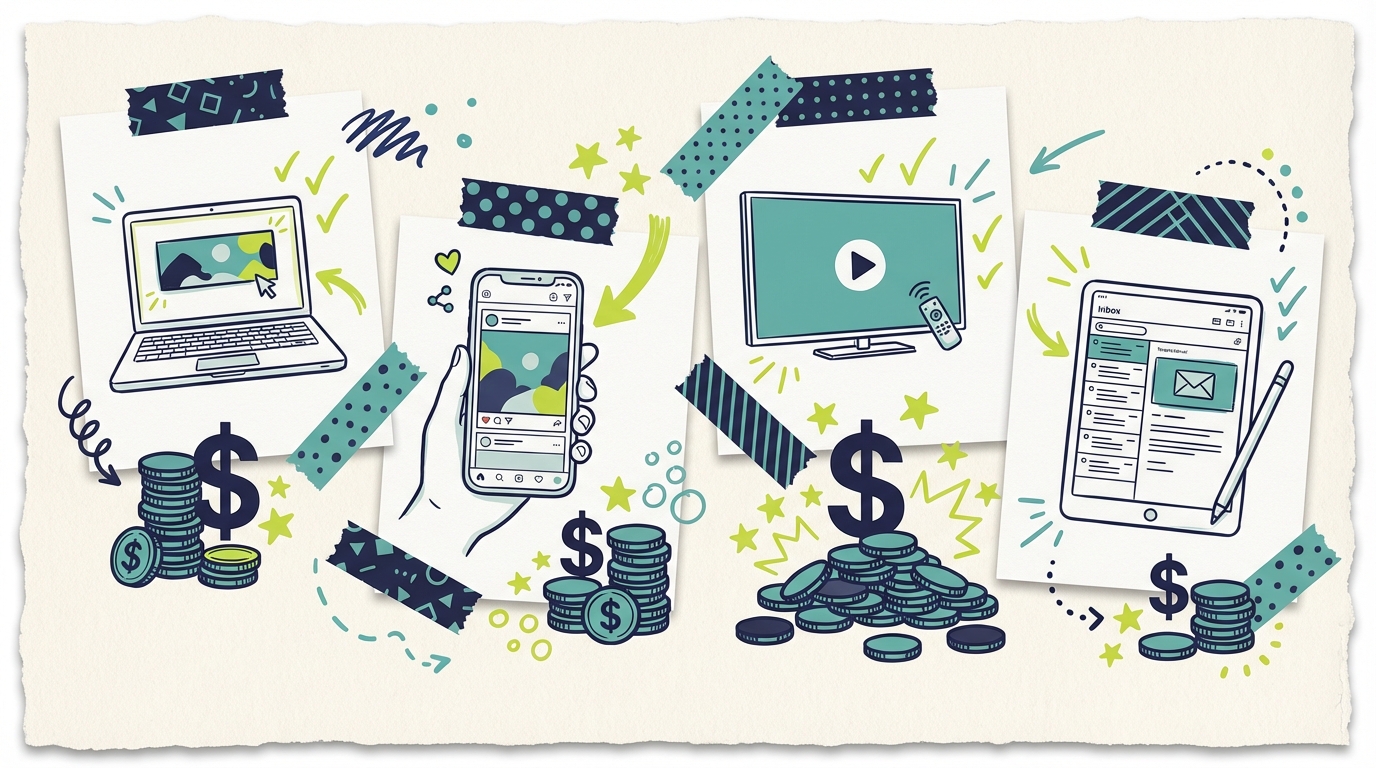
One of the biggest advantages of retargeting is its cost efficiency. Because you're targeting a smaller, warmer audience, costs per impression and per click tend to be lower than prospecting campaigns. Here's what to expect by channel:
For small businesses, a monthly retargeting budget of $200-500 can make a real impact when focused on the right segments and channels. If you're running CTV retargeting through Adwave, you can start with as little as $50 and scale up as you see results. The ad creation is free, and your ads run across 100+ premium streaming networks.
Retargeting almost always delivers better cost-per-acquisition than cold prospecting. According to a Criteo study, retargeted customers are 43% more likely to convert, which means your ad dollars stretch further (Criteo, 2024).
If you're weighing retargeting against other small business advertising options, consider starting with retargeting as a complement to whatever you're already doing. It amplifies every other channel by catching people who showed interest but didn't follow through.
Common Questions Answered
What's the difference between retargeting and remarketing? The terms are often used interchangeably, and for practical purposes they mean the same thing. Technically, "retargeting" usually refers to paid ads served to past visitors through pixel tracking, while "remarketing" originated as a Google Ads term and sometimes refers specifically to email-based re-engagement. For your small business strategy, don't worry about the distinction. Focus on reaching people who've already interacted with your brand, regardless of what you call it.
How many website visitors do I need before retargeting works? Most ad platforms require a minimum audience size to run retargeting campaigns. Meta needs at least 100 people in your custom audience, while Google recommends at least 1,000 visitors in your retargeting list for display campaigns. If your site traffic is low, focus on building traffic first through SEO, social media, or other advertising, and start retargeting once your audience reaches these thresholds.
Will retargeting still work after third-party cookies go away? Yes, but the tactics are evolving. While Chrome has delayed its cookie deprecation timeline, smart marketers are already shifting toward first-party data strategies. That means collecting email addresses, encouraging account creation, and using server-side tracking. CTV retargeting is especially well-positioned for a cookieless future because it relies on device-level identification rather than browser cookies.
Website pixels track site activity. To reach store customers online, check which customer-list integrations your platform supports and use them with the required consent.
How long should I run a retargeting campaign? Retargeting works best as an always-on strategy rather than a one-time campaign. As long as you're getting website traffic, you should be retargeting those visitors. The specific timing windows for individual visitors (how long someone stays in your retargeting audience after visiting) should vary by your sales cycle, typically 14-30 days for most small businesses.
Is retargeting worth it for a small budget? Absolutely. Retargeting is arguably the best use of a limited advertising budget because you're spending money on people who've already shown interest in what you offer. Even $150-200 per month can drive meaningful results when focused on high-intent audience segments like cart abandoners or pricing page visitors. Start small, measure results, and scale what works.


