First, let's do the math on what $100 gets you in TV advertising.
Understanding CPM:
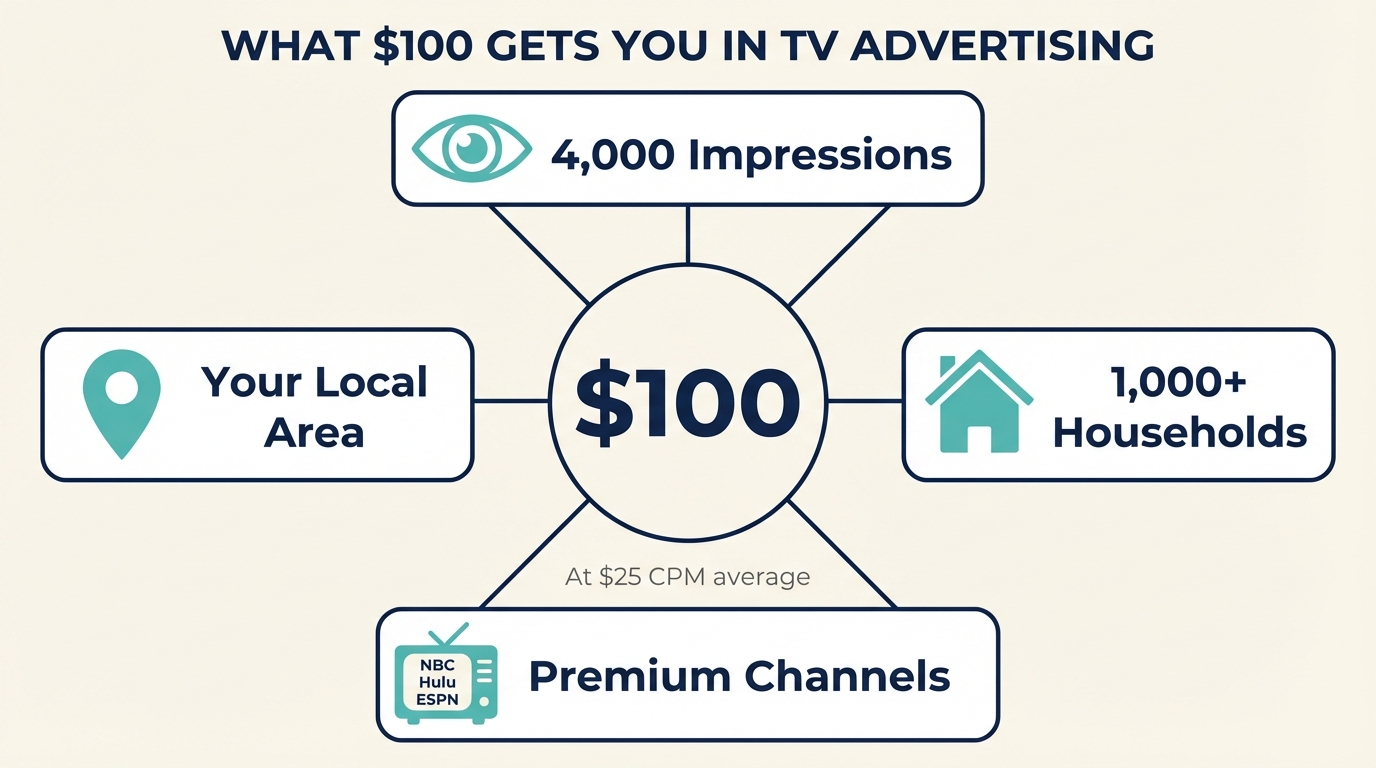
TV advertising is priced by CPM (cost per thousand impressions). On streaming platforms through services like Adwave, expect CPMs between $15-35, averaging around $25 for small business campaigns.
At a $25 CPM, your $100 budget delivers:
$100 ÷ $25 CPM × 1,000 = 4,000 impressions
That's 4,000 times your ad appears on a TV screen in someone's living room. Not scrolled past on a phone. Watched, full-screen, sound-on, non-skippable.
What 4,000 impressions means:
Approximately 1,000-1,500 unique households reached
Average frequency of 3-4 times per household
Viewers in your target geography seeing your brand on premium channels
Is this enough?
For a test? Absolutely. You're not trying to dominate your market with $100. You're trying to answer the question: "Does TV advertising make sense for my business?" Getting 1,000+ local households to see your brand on their TV during primetime is meaningful data.
Compare that to $100 on Facebook, where you might get 2,000 impressions but with 90% scroll-past rates and no sound. On TV, nearly everyone who gets served your ad watches it.
The 1-Hour Plan: Minute by Minute Breakdown
Here's how to go from zero to live TV campaign in 60 minutes or less. This isn't theoretical. This is the actual process.
Time allocation:
Let's walk through each step.
Minutes 1-15: Create Your Ad with AI
The biggest barrier to TV advertising has always been production. Traditional commercials cost $5,000-50,000 to produce. That's before you spend a dollar on airtime.
AI creative tools have eliminated this barrier. Here's how it works:
Step 1: Provide your website URL (2 minutes)
Adwave's AI scrapes your website to understand your business. It pulls images, extracts your messaging, and identifies your brand style. You can also add your social media or Yelp page for more content.
Step 2: AI generates your commercial (3-5 minutes)
The system creates a 30-second, broadcast-quality TV ad. This isn't a slideshow. It's a real commercial with:
Professional transitions and motion
Licensed background music
AI-generated voice-over
Your images and branding
Clear call to action
Step 3: Review and tweak (5-8 minutes)
Preview your ad. If something's not right, use the chat-based editor to:
Swap images (drag and drop your own)
Change the music
Adjust text overlays
Modify the voice-over
Reorder scenes
Most businesses find the first generation works well. Quick tweaks take 1-2 minutes each to process.
End of 15 minutes: You have a TV-ready commercial. No production crew. No weeks of editing. No $10,000 invoice.
Minutes 16-30: Set Up Your Campaign
With your ad ready, it's time to configure where and when it runs.
Step 4: Choose your targeting (5 minutes)
For local businesses, this is simple:
Address: Enter your business location
Radius: Set how far you want to reach (10-25 miles typical)
That's it. Your ad will serve to households within that radius when they're watching streaming TV.
For e-commerce or national businesses, you can target by:
Specific cities or states
Entire country
Don't overthink targeting on a $100 test. Geographic targeting alone is sufficient. Demographic optimization happens automatically behind the scenes.
Step 5: Set your budget (2 minutes)
Enter $100 (or start with $50 if you want an even smaller test). The platform paces your spend automatically. You'll never exceed your budget.
Step 6: Set your schedule (3 minutes)
Default is a 2-week run starting the next day. For a $100 test, this is ideal. It spreads your impressions over enough days to see patterns without stretching so thin that no single day has meaningful delivery.
End of 30 minutes: Your campaign is configured and ready to launch.
Minutes 31-45: Launch and Verify
Time to go live.
Step 7: Review and launch (5 minutes)
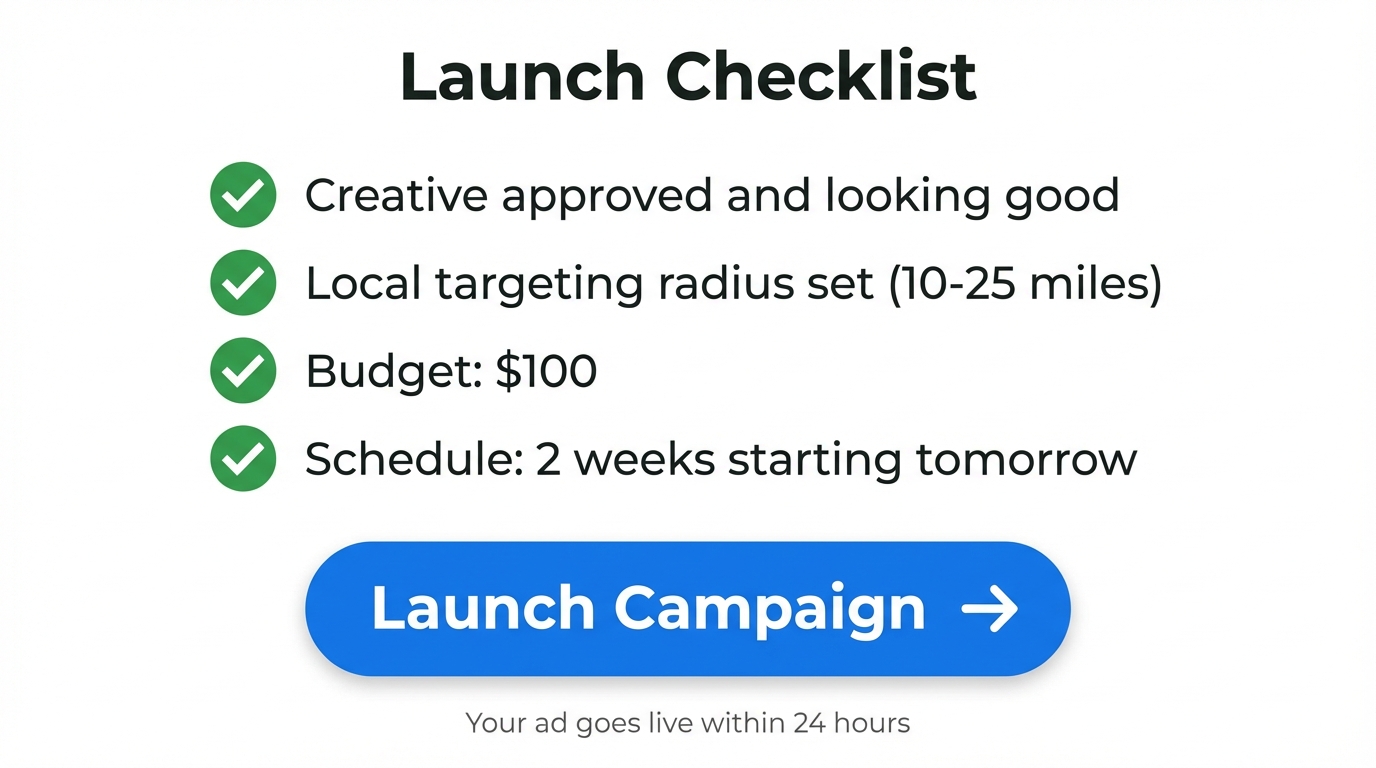
Confirm your settings:
Ad creative looks right
Targeting matches your intent
Budget is set correctly
Schedule makes sense
Add your payment method and launch. Your campaign will be live within 24 hours.
Step 8: Verify your campaign is running (10 minutes)
Check back after 24 hours (or the next day) to confirm:
Campaign status shows "Active"
Impressions are being delivered
Spend is accumulating as expected
If something looks off, campaign issues usually stem from:
Payment processing (check your card)
Geographic targeting too narrow (expand your radius)
Creative rejection (rare, but check for policy issues)
End of 45 minutes: Your TV ad is live or scheduled to go live within 24 hours.
Minutes 46-60: Set Up Basic Tracking
Your campaign is live. Now set up measurement so you know if it's working.
Simple tracking methods (no technical setup required):
Google your business name daily: Are searches for "[Your Business Name]" increasing during the campaign?
Ask new customers: Add "How did you hear about us?" to your intake process. Track TV mentions.
Watch foot traffic/calls: Note your baseline before the campaign starts, then track daily during.
Monitor website traffic: Check Google Analytics for increases in direct traffic (people typing your URL).
Slightly more advanced (if you have 10 extra minutes):
Use a unique phone number or URL in your ad to track direct response
Set up Google Alerts for your business name
Screenshot your Google Analytics dashboard before launch for easy comparison
The goal isn't sophisticated attribution. It's answering: "Did anything change when my TV ad was running?"
For more detailed measurement approaches, see our guide on advertising effectiveness.
What to Expect from a $100 Test
Let's set realistic expectations. What does success look like for a $100 TV test?
You're NOT expecting:
A flood of new customers overnight
Measurable ROI from $100 in spend
Statistical significance on conversions
You ARE expecting:
Proof that your ad can run on real TV channels
Initial data on viewer response
Validation (or invalidation) that TV makes sense for your business
Something to show your team, investors, or yourself
What good looks like:
3,000-5,000 impressions delivered
Ad ran on multiple premium channels
At least one "I saw you on TV!" mention from a customer
Slight uptick in branded search or direct traffic
What bad looks like:
Less than 2,000 impressions delivered (targeting may be too narrow)
Zero engagement signals (creative may need work)
Technical issues preventing delivery (contact support)
This is a test campaign. You're buying information about whether TV advertising deserves more investment, not trying to generate immediate ROI.
Scaling Up: What $500 and $1,000 Get You
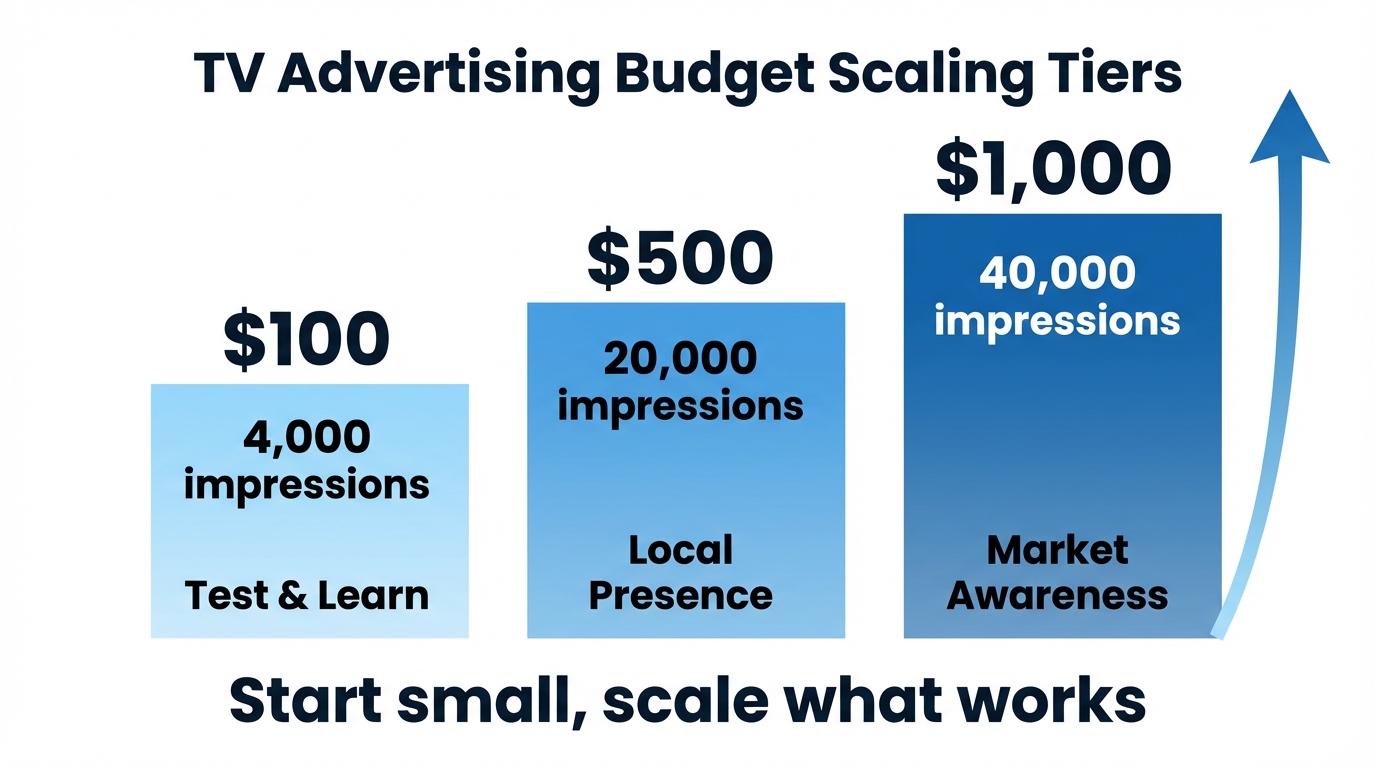
If your $100 test shows promise, here's what scaling looks like:
$500/month:
~20,000 impressions
5,000+ unique households
Enough frequency to build recognition
Meaningful local presence
At this level, you can expect customers to mention seeing your ad. Branded search should show measurable lift. This is where TV starts becoming a real marketing channel, not just a test.
$1,000/month:
~40,000 impressions
10,000+ unique households
Strong local awareness
Consistent presence on premium channels
This is what small business TV advertising typically looks like. You're reaching a significant portion of your local market multiple times per month. Brand recognition compounds over time.
Start Your $100 TV Test Today
TV advertising doesn't require a massive budget or months of planning anymore. With $100 and one hour, you can have a professional commercial running on NBC, Hulu, ESPN, and 100+ premium channels by tomorrow.
Is $100 going to transform your business? No. But it will answer the question every curious business owner has: "What if my business was on TV?"
Create your ad for free with Adwave. You only pay when you're ready to launch. Generate your commercial in minutes, see exactly what it looks like, and decide if you want to put it in front of your local audience.
Your competitors are probably on streaming TV already. For $100 and an hour of your time, you can be too.
Common questions answered
Can I really run a TV ad for $100?
Yes, platforms designed for small businesses now allow campaigns starting at $50 to $100. This isn't a bait-and-switch with hidden fees. You get your ad shown to real viewers on premium streaming content. Obviously $100 won't generate the same reach as a $10,000 campaign, but it's enough to test whether TV advertising resonates with your audience and start building local awareness. Many businesses use small initial budgets to prove the concept before scaling.
How many people will see my ad with a $100 budget?
At typical CTV CPMs of $20 to $30, a $100 budget delivers approximately 3,000 to 5,000 impressions. With geographic targeting focused on your local market, this can provide meaningful reach within your service area. For a small local business, several thousand impressions in your target neighborhood over a few days creates real visibility. It won't make you famous overnight, but it's a genuine start to TV presence.
What should I expect from a small TV budget?
Expect a learning experience more than immediate business results. You'll see your ad on real streaming content, get data on completion rates and reach, and understand how TV advertising works for your business. Some businesses see immediate response even from small campaigns, but the primary value at this budget level is validating the channel and building foundational awareness. Treat it as a test rather than a complete marketing strategy.
Is it better to spend $100 on TV or put it toward digital ads?
They serve different purposes. Digital ads drive immediate, trackable actions. TV builds brand awareness and consideration that makes all your other marketing more effective. If you've never tried TV and your digital campaigns are plateauing, testing TV with a small budget is worth trying. Many businesses find that adding TV to their mix improves performance on all channels by making their brand more recognizable.
How do I make the most of a limited TV advertising budget?
Focus your targeting tightly on your core customer geography and demographics. Run during times when your ideal customer is likely watching. Use compelling creative that communicates your unique value proposition quickly. Don't spread a small budget too thin over multiple weeks. Better to concentrate impressions in a shorter period for higher frequency than to stretch a small budget until it's invisible.