Appliance repair advertising works best in two layers. Search ads catch homeowners whose refrigerator, washer or oven has just failed. Streaming TV and social ads make your company’s name familiar before that happens. Adwave runs TV, Google Search, Facebook and Instagram together from a $30/day budget, with the ads made from your website.
How appliance repair customers find a technician
Most appliance repair jobs start with a breakdown and a phone. The washer stops mid-cycle or the fridge goes warm, and the homeowner searches right away. Those searches are local and specific, such as refrigerator repair near me or dryer not heating, and sometimes include a brand name plus the appliance, like Samsung refrigerator repair or Whirlpool washer repair. The person wants someone today, so the companies at the top of the results, with a visible phone number and recent reviews, get most of the calls.
The second moment comes earlier and is easy to overlook. When three repair companies appear in the results, the one the homeowner has already seen on TV or in their social feed has an edge. That familiarity is built over weeks, while nothing is broken, and it is the job streaming TV and social ads do well.
Many repair companies also buy leads from shared marketplaces. Appliance Repair Marketing, an agency that works with the trade, describes how one homeowner inquiry on those platforms can be sold to several appliance repair companies at once. Your own ads send the call to you alone, which is a large part of why owners build their own lead flow even when marketplace leads are quicker to start.
Appliance repair works like the other home service trades: on-site visits, a defined service area and urgent demand. The broader guide to TV ads for home service businesses covers how that group uses television.
Which ad channels fit an appliance repair business
The right mix depends on whether you want calls this week or a better-known name next season.
| Channel | What it does for appliance repair | Limit to know |
|---|---|---|
| Google Search | Shows your ad when someone searches for the repair, the appliance or the brand | You pay per click, so a broad keyword list spends faster |
| Streaming TV (CTV) | Puts a video spot in front of households in your area before anything breaks | Builds recognition over time; it rarely produces a call the same hour |
| Facebook and Instagram | Visual ads to people inside a local radius, good for showing a technician and van | Meta’s Business Help Center says location accuracy can’t be guaranteed, so some impressions reach people outside your area |
| Adds another place for your ads to reach people in your area | A smaller, supporting role for most repair companies | |
| Web and mobile apps | Display ads that keep your name in front of local households | Low intent on its own; works best alongside search |
Adwave lets you target a radius, ZIP codes or a city, and you can preview the image ads, social video and TV spot before launch. Search and the visual channels support each other: TV and social make your name familiar, and search catches the call when the appliance fails. Running these from TV, search and social from one budget avoids opening and managing a separate ad account for each platform. For a close-cousin trade with similar urgent calls, see how HVAC companies use TV.
What a realistic budget looks like
Adwave uses one prepaid daily budget, set anywhere from $30 to $10,000 a day, and that single budget covers the media, the ads and the account management, with no subscription or contract. Which channels can run depends on the daily amount:
| Daily budget | Channels available | 30 active days |
|---|---|---|
| $30/day | TV, Google (Search included), Facebook, Instagram | $30 × 30 = $900 |
| About $35/day | Adds Reddit | 30 days at this rate |
| $75/day | Same mix with more delivery per channel | $75 × 30 = $2,250 |
| About $91/day | TikTok becomes available as an opt-in channel | $91 × 30 = $2,730 |
The 30-day totals are planning figures. You can pause before 30 days, and you’re charged only for what runs. TikTok stays off unless you turn it on and connect a TikTok account.
A few billing details affect cash flow. You can review your ads before adding a card. New accounts start with an empty wallet, and you deposit funds when you’re ready to launch. According to the Adwave billing FAQ, card deposits add the processing fee shown at checkout, while ACH deposits have no added fee. A campaign pauses if the wallet can’t cover the day and restarts within the hour once you add funds, or right away if you turn on optional auto-refill.
For a one- or two-truck operation, $30/day is a sensible test that still covers search plus TV and social. Raise it once you know your schedule can absorb more calls. No budget guarantees a number of jobs; your area, your competition, and how quickly you answer the phone all affect results.
Timing campaigns around repair demand
Appliance failures follow use, and the busy months differ by area and by which appliances you fix most. Your own call log from past years is the best guide to when your demand peaks.

That pattern suggests a simple rhythm. Keep search ads running all year during the hours you can take calls, because someone always has a broken washer. Raise TV and social spend a few weeks ahead of your busiest periods so your name is familiar when the failures start. When the schedule is full, lower the budget or pause rather than paying for calls you can’t book.
Adwave’s daily budget makes that practical. A new budget on a live campaign applies the same day if your wallet covers it. There’s no proration, and pausing simply stops future daily charges. Trades with similar emergency swings handle timing the same way, as the guide to TV advertising for plumbers shows.
Ad creative that books the call
Good appliance repair creative is specific: the appliance, the area you serve, how fast you arrive and how to book. Here is an example campaign, written for illustration only, not taken from a customer or measured result.
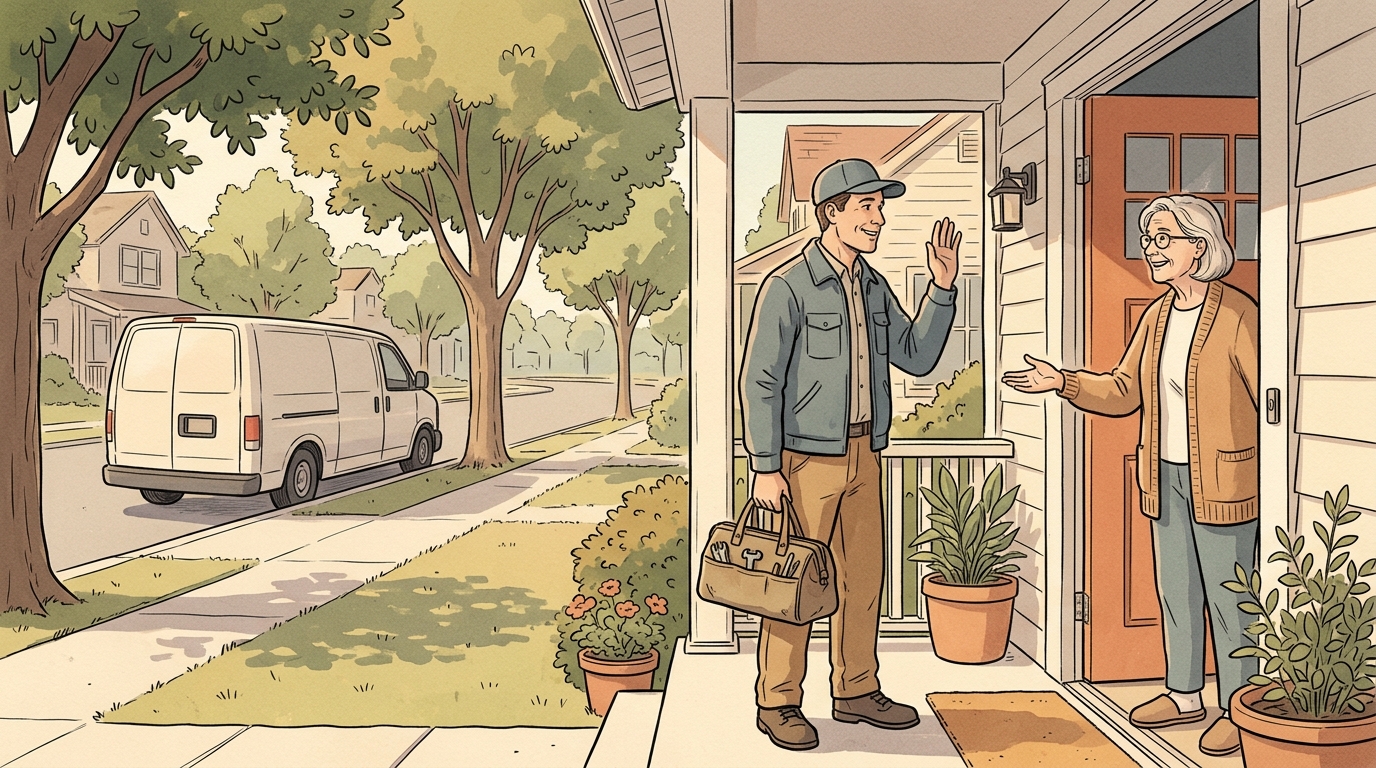
For example, the offer is same-day diagnosis for washers, dryers and ovens within a stated service area, such as homes within 15 miles of your shop. The 15-second TV spot opens on a warm refrigerator and a worried homeowner, cuts to a technician in a branded shirt arriving at the door, and ends on the company name and phone number alongside the line Same-day service in your town. The search ad lists the brands you service and the appliances you fix, so the person searching for a specific model sees a match. A vertical social video shows a technician pulling a dryer away from the wall and explaining a common fault in plain words. Every version ends with one next step: call now or book online.
Adwave builds these ads from your website, so put your service area, the brands you service, your hours and any diagnostic fee clearly on your site first. Campaign creative is included in your budget. If you want more versions, extra creation costs $6 per 15-second TV spot, $12 per 30-second TV spot, $6 per social video and $0.38 per image, as listed on the Adwave pricing page. For more on building a name in a local trade, see how electricians become the name homeowners call.
Ad rules for warranties and guarantees
Repair companies often advertise warranties on parts and labor, and those claims fall under federal rules. The FTC’s Guides for Advertising Warranties and Guarantees (16 CFR Part 239) explain how to disclose coverage and what common terms mean. Before you run an ad that mentions a warranty or guarantee, check it against these points:
- Advertise the warranty truthfully. The FTC’s Businessperson’s Guide to Federal Warranty Law states that deceptive warranty advertising violates the FTC Act.
- Use “satisfaction guaranteed” or “money back” only if you mean it. The same FTC guide says those phrases are treated as an offer of a full refund for any reason.
- Explain what “lifetime” covers. The FTC guide asks advertisers to clarify a lifetime warranty: whose lifetime, which parts, and under what conditions.
- Say what is covered and for how long, such as parts only, labor only or both, and the period in days or months.
- Back up online claims. The FTC’s advertising guide for small business says ad claims on the internet must be truthful and substantiated, with disclosures that are clear and conspicuous.
- Make sure “same-day” and response-time claims match what your schedule actually delivers in the area you target.
This checklist is general guidance, not legal advice. If your warranty terms are complex, have them reviewed before they go into ads.
Measuring which ads bring in jobs
Measurement starts on your website. In Adwave, you install the business’s tracking snippet and set the actions you want to count, such as booking-form submissions and clicks on your phone number. Give each conversion a value, such as your average repair ticket, and reports can show revenue and return on spend.
Expect imperfect credit. Adwave’s reporting includes last-touch credit, assisted conversions, and Lift experiments, and each one answers a different question. A homeowner who saw your TV spot last month and then searched your name today may be credited to search alone. Judge streaming TV partly by whether branded searches and direct calls rise over time. Meta’s Business Help Center also notes that third-party tools such as Google Analytics may not match Meta’s own reporting because they use different location methods, so compare trends rather than chasing matching numbers.
Phone calls are the hardest part for a repair business. Ask every new caller how they heard about you, and log the answer alongside the booked job. For a wider view of how contractors plan and track campaigns, read about advertising for home contractors.