
When the AC breaks in July, homeowners don't comparison shop. They call the company they remember.
That's the power of TV advertising for home service businesses. HVAC companies, plumbers, electricians, roofers, and contractors have advertised on local TV for decades because it works. TV builds the name recognition that turns into phone calls when emergencies happen.
The difference today? You don't need a massive budget or a production crew. This guide covers how home service businesses can use streaming TV advertising to become the trusted name in their service area.
The Home Services TV Advertising Opportunity
Home services and TV advertising are a natural fit. Here's why.
Trust is everything:
Homeowners are inviting strangers into their homes to work on expensive, critical systems. They want to hire someone they trust. Seeing a business on TV builds that trust before the first phone call.
Local targeting matches service areas:
TV advertising can target specific geographic areas, matching exactly how home service businesses operate. Your plumbing company serves a 30-mile radius? Target that radius. No wasted spend on viewers outside your service area.
Urgency drives decisions:
When the furnace dies in January or a pipe bursts, homeowners need help now. They call whoever comes to mind first. TV advertising puts your company in that mental shortlist.
Competing against national brands:
Home Depot, Lowe's, and national franchises advertise constantly. Local TV presence helps independent contractors compete on visibility. Your ad runs on the same screens as the big brands.

Understanding Your TV Advertising Options
Home service businesses have two main paths to TV advertising: traditional local cable and streaming TV (CTV).
Local cable TV:
Traditional TV ads that run on local cable channels. Still effective, especially for older demographics. Typically requires:
Minimum commitments (often $1,000-5,000/month)
Production costs ($2,000-10,000 for a commercial)
Lead time for scheduling (weeks)
Less precise targeting (broad geographic zones)
Streaming TV (CTV):
Ads that run on streaming platforms like Roku, Hulu, Amazon Fire TV, and Peacock. Offers several advantages for home service businesses:
Lower minimums (start at $50 with platforms like Adwave)
AI-generated creative (no production costs)
Precise geographic targeting (down to ZIP code)
Faster launch times (live within 24 hours)
Real-time performance tracking
When to use each:
Cable TV makes sense for larger home service companies with established budgets who want to reach older homeowners watching traditional channels.
Streaming TV works for any budget level and reaches the growing audience that has cut the cord. For most home service businesses starting with TV, streaming is the lower-risk entry point.
The hybrid approach:
Many successful home service companies run both. Cable reaches older homeowners, streaming reaches younger ones. The combination covers more of your potential customers.
Budget Planning for Home Service TV Ads
How much should an HVAC company or plumber spend on TV advertising? Start with your service area and goals.
Budget by business size:
Percentage of revenue approach:
Many home service businesses allocate 5-10% of revenue to marketing. TV might represent 20-30% of that marketing budget, depending on your goals and market.
For a plumbing company doing $500,000 in annual revenue:
Total marketing budget: $25,000-50,000/year
TV advertising allocation: $5,000-15,000/year
Monthly TV budget: $400-1,250/month
Seasonal budget adjustments:
Home services have predictable busy seasons. Increase TV spend before and during peak demand:
HVAC: Boost before summer (cooling) and winter (heating)
Plumbing: Steady year-round, slight increase before winter (frozen pipe season)
Roofing: Increase after storm seasons and in spring/fall
Landscaping: Heavy spring push, maintenance messaging in summer
Pest control: Increase in spring and early summer
Targeting Homeowners in Your Service Area
The foundation of home service TV advertising is reaching the right people in the right area.
Geographic targeting:
Define your service area precisely:
Address + radius: Target 15, 20, or 30 miles around your location
ZIP codes: Select specific ZIP codes you serve well
City or metro: Broader targeting for larger operations
Be realistic about where you can profitably serve. Targeting too broadly wastes budget on homeowners you can't reach quickly.
Demographic targeting:
Layer demographic filters on top of geography:
Homeowners: Essential, renters don't hire contractors
Age: 35+ typically makes household maintenance decisions
Income: Target income levels that match your service tier
Behavioral targeting (where available):
Some platforms allow targeting based on:
Recent home purchase (new homeowners need services)
Home improvement intent
Previous service searches
Targeting example for an HVAC company:
Geographic: 25-mile radius around main office
Demographic: Homeowners, age 35-65
Income: Household income $75,000+
Timing: Heavy rotation in May-June (pre-cooling season) and October-November (pre-heating season)
Creating Effective Home Service Commercials
Your commercial needs to accomplish one thing: make viewers remember your company when they need help.
Essential elements:
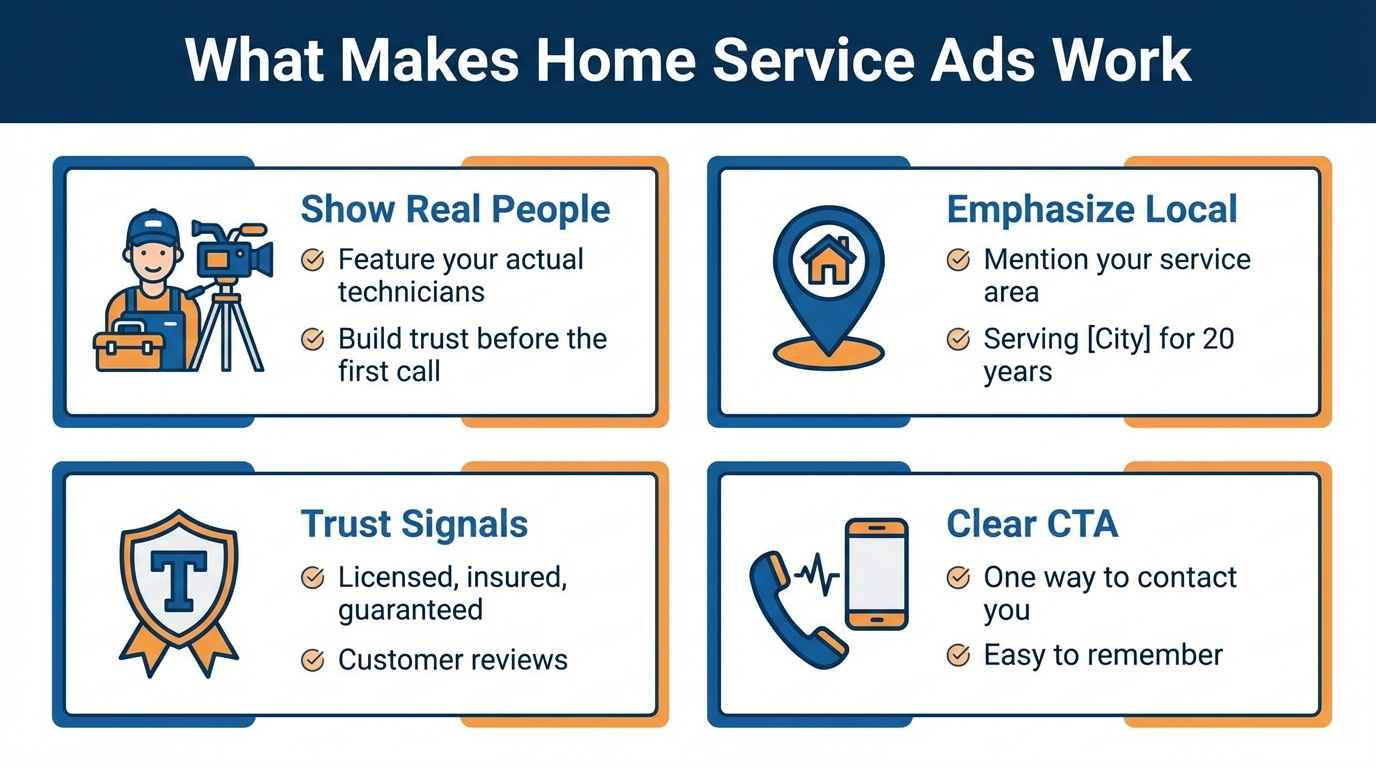
Company name and logo: Prominent, repeated, memorable
What you do: Clear service description (HVAC, plumbing, electrical)
Service area: "Serving [City] and surrounding areas"
Trust signals: Years in business, licenses, guarantees, reviews
Phone number or website: One clear way to contact you
Creative approaches that work:
The trustworthy technician:
Feature real employees in uniform. Homeowners want to see who's coming into their home. Friendly, professional, approachable.
The emergency response:
Show the problem (broken AC, leaking pipe) and the relief of your solution. Create emotional connection with the stress homeowners feel.
The local expert:
Emphasize local ownership, community involvement, years serving the area. "Your neighbors trust us, you can too."
The seasonal hook:
Connect to current concerns: "Don't let your AC fail this summer" or "Is your furnace ready for winter?"
What to avoid:
Generic stock footage that looks fake
Too much technical jargon
Complicated messages (keep it simple)
Weak calls to action
Adwave's AI tools can create professional home service commercials from your website, pulling your branding, services, and contact information automatically.
Seasonal Campaign Strategies
Home services are seasonal. Your TV advertising should be too.
HVAC seasonal calendar:
March-May: "Is your AC ready for summer?" Push maintenance and tune-ups
June-August: Emergency repair messaging, replacement for old units
September-November: "Don't wait for the first freeze" Heating preparation
December-February: Emergency heating repair, system replacement
Plumbing seasonal calendar:
Year-round: Maintain consistent presence, plumbing emergencies happen anytime
November-February: Frozen pipe prevention and emergency messaging
Spring: Outdoor plumbing, sprinkler systems
Summer: Water heater focus (high demand for hot water)
Roofing seasonal calendar:
Spring: Post-winter damage inspection campaigns
Summer: New roof installations
Fall: Pre-winter preparation, gutter services
After major storms: Emergency response messaging (have campaigns ready to activate)
Budget allocation by season:
For a heating-focused HVAC company:
October-February: 50% of annual TV budget
March-May: 25% of annual TV budget
June-September: 25% of annual TV budget
For an AC-focused company, flip those percentages.
Measuring Leads and Calls from TV
TV advertising is measurable. Here's how to track results for home service businesses.
Call tracking:
Use a dedicated phone number for TV advertising. When that number rings, you know TV drove the call. Tools like CallRail or simple Google Voice numbers work well.
Website tracking:
Add UTM parameters to your website URL in commercials, or use a vanity URL (YourCompanyTV.com) that redirects to your main site with tracking.
Ask "How did you hear about us?":
Train your team to ask every caller. Track responses in your CRM. "I saw you on TV" is valuable data.
Branded search monitoring:
Watch Google searches for your company name. Increases during TV campaigns indicate brand awareness lift.
Lead source attribution:
Tag leads by source in your CRM. Compare lead volume and quality during TV flights versus non-TV periods.
What good results look like:
Phone calls increase 10-30% during TV campaigns
"Saw you on TV" mentions from callers
Branded search volume increases
Higher close rates (TV viewers often come in pre-sold)
With Adwave's dashboard, you can track impressions, see which channels your ads ran on, and monitor geographic reach in real-time.
Case Examples: Home Services Success
HVAC company, Phoenix area:
A family-owned HVAC company spent $1,200/month on streaming TV targeting homeowners within 20 miles. During summer peak, they increased to $2,000/month.
Results after one year:
35% increase in inbound calls
Multiple daily "I saw you on TV" mentions
Improved hiring (technicians wanted to work for the "company on TV")
Plumbing company, suburban Chicago:
A mid-size plumbing operation allocated $800/month to streaming TV, focusing on homeowners in specific high-value ZIP codes.
Results after 6 months:
Became recognized as "the plumber on TV" in target area
Lead quality improved (callers were less price-sensitive)
Reduced spend on lead aggregator sites
Roofing contractor, Texas:
A roofing company maintained a $500/month baseline presence, with campaigns ready to scale up after major storms.
Results:
Post-storm campaigns generated immediate call spikes
Year-round presence kept them top-of-mind
Outpaced competitors who only advertised reactively

Ready to Become the First Call?
Home service businesses thrive on being known and trusted in their service area. TV advertising builds both.
With Adwave, you can launch professional TV commercials targeting homeowners in your service area for as little as $50. No production crews, no massive minimums, no weeks of lead time.
Create a commercial featuring your team and services, target the ZIP codes you serve, and start building the name recognition that turns into phone calls.
When the AC breaks or the pipe bursts, be the company they call first.
See how TV advertising works for home services or create your first ad free.
Common questions answered
When is the best time to advertise my home services business on TV?
Timing depends on your specific service. HVAC companies should ramp up before extreme weather seasons (early fall for heating, late spring for cooling). Plumbers benefit from consistent year-round presence but can increase spend before holiday hosting seasons. Roofers should advertise before storm seasons in their region. The key principle is reaching homeowners before they have urgent needs, so they think of you first when problems arise.
How do I target homeowners specifically with my CTV ads?
CTV platforms offer household-level targeting that can filter for homeowners using data signals like property ownership records, home improvement purchase behavior, and demographic indicators. You can also layer in geographic targeting to focus on neighborhoods with older homes that likely need more services, or target by home value to reach your ideal customer base. Most self-serve CTV platforms include these targeting options in their standard offerings.
Should I focus my TV advertising on emergency services or scheduled maintenance?
Both have value, but the messaging strategy differs. Emergency service advertising builds brand recall so homeowners think of you during crises. Maintenance advertising drives scheduled appointments and builds recurring revenue. Many successful home services businesses run awareness campaigns year-round while increasing frequency during peak seasons. If you have to choose, emergency services typically have higher margins, but maintenance builds sustainable business.
How much should a home services business spend on CTV advertising?
A reasonable starting budget for testing CTV is $500 to $1,000 per month, which provides enough impressions to see if the channel works for your business. Established home services businesses often allocate 5 to 10 percent of their marketing budget to TV advertising. The key is measuring results against your customer acquisition cost targets. If a $50 CTV spend contributes to a $5,000 HVAC installation, the math works even at higher CPMs.
Can I track phone calls from my TV ads?
Yes, through a few methods. Use a unique phone number in your TV creative that routes to your main line but tracks separately. Some CTV platforms integrate with call tracking services that can attribute calls to ad exposure. You can also train your team to ask new callers how they heard about you, with "TV" as a specific option. Many home services businesses find that TV drives significant phone volume even when digital attribution doesn't capture it directly.


