A local business owner checks the email list, sees more names than last month, and wonders why sales haven’t moved. Customers follow the social accounts, open occasional newsletters, and attend an event, but few return or recommend the business. The problem may not be a lack of attention. It may be that the business has built an audience without giving people a useful reason to connect with one another.
Community led growth turns valuable interactions among customers, prospects, and the business into a durable source of acquisition and retention. For local SMBs, it doesn’t mean choosing between relationships and advertising. It means earning trust through useful participation, then using practical channels, including local TV, to extend recognition beyond the people already in the room.
What Community Led Growth Actually Means for a Local Business
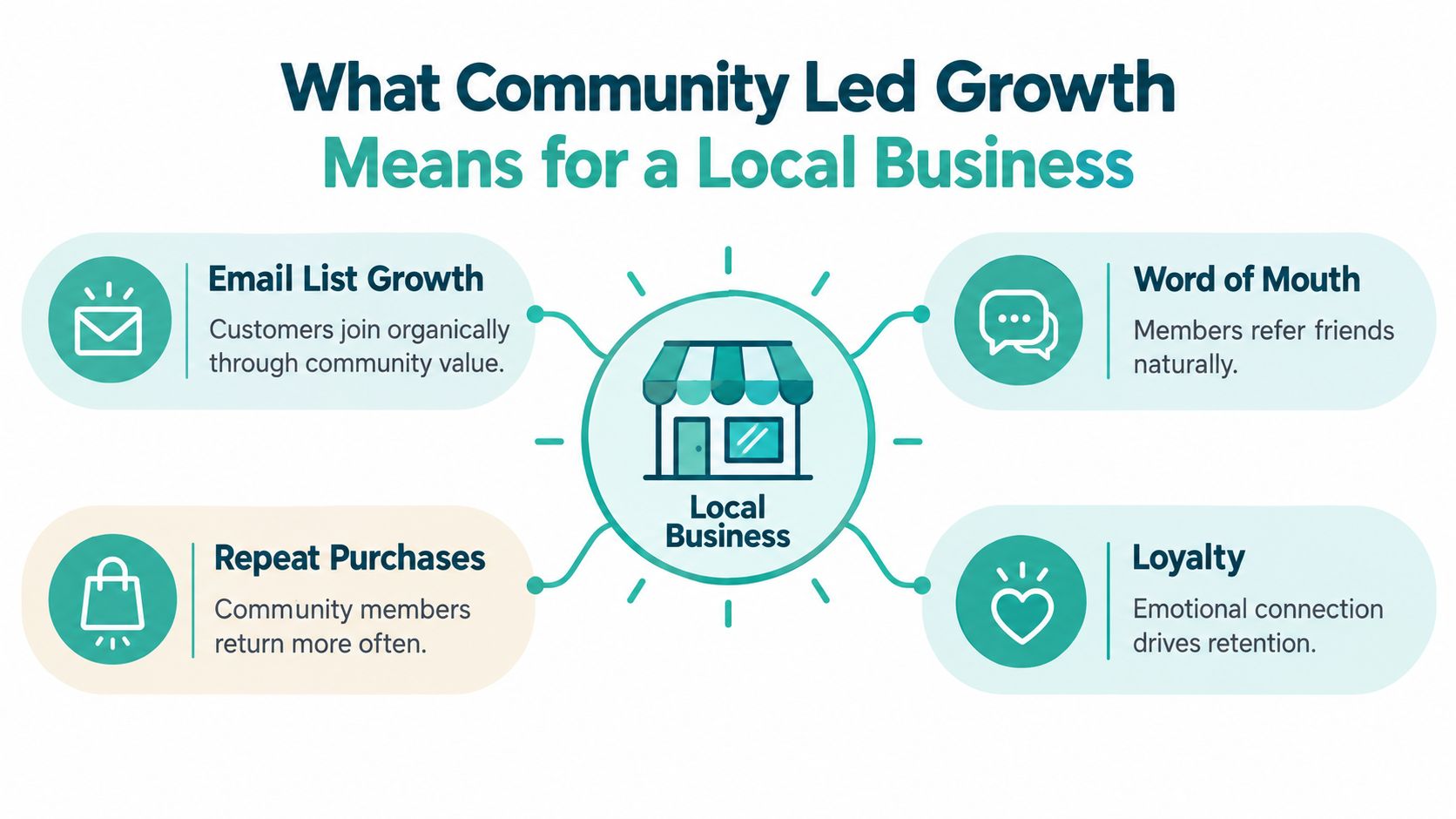
An email list is a way to reach people. A follower base is a group that can see your posts. Neither is a community by itself. A community exists when people get ongoing value through two-way interaction, including with one another, and have a reason to keep coming back.
That distinction matters when engagement isn’t converting. A home services company might invite past customers to share seasonal maintenance advice and recommend reliable tradespeople. A dental practice might help families understand treatment options, then invite satisfied patients to share their experiences. In both cases, the business creates a setting for useful exchange. Referrals and repeat appointments can follow, but they’re outcomes of trust and relevance, not proof that every interaction should be a sales pitch.
A working definition you can use
Community led growth is a way to grow by helping customers and prospects exchange useful knowledge, build trust, and advocate for a local business over time. Use this simple sequence to judge whether an activity qualifies:
- Useful interaction: Members solve a shared problem, learn from peers, or get practical guidance.
- Trust and participation: People return, contribute, ask questions, or act on what they learn.
- Commercial outcome: Some members refer others, return as customers, or choose a service with greater confidence.
Don’t skip straight to the last step. One-way promotion can create reach, but it doesn’t give members a reason to participate. A community can sit alongside paid acquisition: paid media helps introduce the business, while useful interactions give people reasons to trust and remember it.
Early evidence points to both potential and a measurement challenge. In November 2016, Leader Networks surveyed nearly 300 U.S. marketing and community leaders. 92% believed their community had a positive effect on the business, while 35% said they lacked sufficient metrics to communicate the value accurately, according to the Leader Networks survey summary. That gap is a reminder to define what success means before growing the program.
For a practical perspective on customer loyalty in a local retail setting, explore these customer retention strategies for downtown shops. The principle is straightforward: build reasons for customers to stay connected, not just reasons to receive another promotion.
Why Community Led Growth Matters for SMBs
A neighborhood retailer can spend to reach local households on TV, then give interested customers a reason to return: practical advice, peer recommendations, and useful ways to take part. The ad creates awareness; a trusted customer experience gives that attention a chance to become loyalty. For small businesses, peer recommendations can reduce acquisition friction, recognition can support retention, and customer-to-customer education can answer questions before staff repeat the same explanation.
A 2021 empirical study of online brand communities found that engagement increased participation, willingness to co-create with the brand, and positive word of mouth. Brand trust also strengthened co-creation, loyalty, and positive word of mouth, according to the study of online brand communities. A busy group does not automatically produce sales. Engagement and trust are intermediate conditions that can support advocacy and loyalty when members get real value from participating.
That distinction matters for local operators. A real estate brokerage could invite past clients to share what helped them prepare for a move. A retailer could ask customers to demonstrate a product and answer questions from prospective buyers. A local service provider could make it easy for satisfied customers to introduce neighbors with a similar need. Each activity gives customers a concrete reason to contribute, rather than merely see another promotion.
Expect value to build over time
Community is not a short campaign with a guaranteed payback date. A 2017 summary of The Business Impact of Online Communities reported that 55% of communities operating for five years or longer generated or influenced more than $1 million in annual revenue, according to PCMA’s summary. That finding describes established communities, not a forecast for a new local program. The practical lesson is that trust, reusable knowledge, and referrals can build as members keep participating.
Operator’s test: If customers have no reason to help, learn from, or recognize one another, don’t call a mailing list a growth community. Create a useful interaction first.
Connect community activity to outcomes you can track without an enterprise attribution stack. Use a local TV campaign to introduce the business, then ask new customers how they heard about you and record repeat visits, referrals, or bookings. Compare those results over time. You do not need to prove that every sale came from a single interaction; you need to see whether community participation accompanies stronger retention and credible referrals.
The mechanism is straightforward: learning from peers can build confidence, recognition gives customers a reason to stay connected, and useful experiences can prompt recommendations. For more background on why community engagement matters, focus on the quality of participation, not audience size. For an SMB, a small group that contributes to repeat business and referrals can be more valuable than a larger audience that only sees announcements.
Choosing Between a Full Community, a Referral Network, or Episodic Participation
Don’t launch a branded forum just because community led growth sounds attractive. First decide how often your customers need to interact, what they’d gain from each other, and whether you can keep providing value. A local business with time-constrained customers may do better with well-timed events and referrals than a space that expects constant posting.
Research on 358 online brand community members found that browsing, rather than participation by itself, had a positive relationship with brand loyalty. Highly active participants didn’t necessarily show stronger purchase intention, according to this research on online community behavior. Don’t design a program that assumes every customer wants to post. Some will read, attend, or refer, and those behaviors deserve to be considered on their own terms.
Match the structure to the customer’s motivation
| Structure | Best Fit Audience | Core Activity | Key Risk |
|---|---|---|---|
| Referral network | Customers who trust the business and know people with the same need | Personal introductions and tracked referrals | Asking for introductions before customers have a reason to recommend |
| Episodic participation | Busy customers who value occasional, useful contact | Events, Q&A sessions, stories, or seasonal advice | Losing momentum between activities |
| Full community | Members who share an ongoing interest or problem and want peer exchange | Regular discussion, advice, and member contributions | A small vocal core dominating while most members stay passive |
A real estate brokerage could run a listing review round where clients and local experts share observations. A service business might spotlight a customer’s project and invite practical questions. These formats give members a bounded reason to participate without requiring a year-round forum.
Choose a referral network when recommendations are the main value. Choose episodic participation when customers benefit from occasional interaction. Choose a full community only when members have a repeated reason to learn from one another. For another perspective on choosing a referral network vs peer group, compare the regular responsibilities each model asks of members. Then make the referral process easy to understand and track with a practical guide to building a referral program.
Building Community Led Growth Step by Step
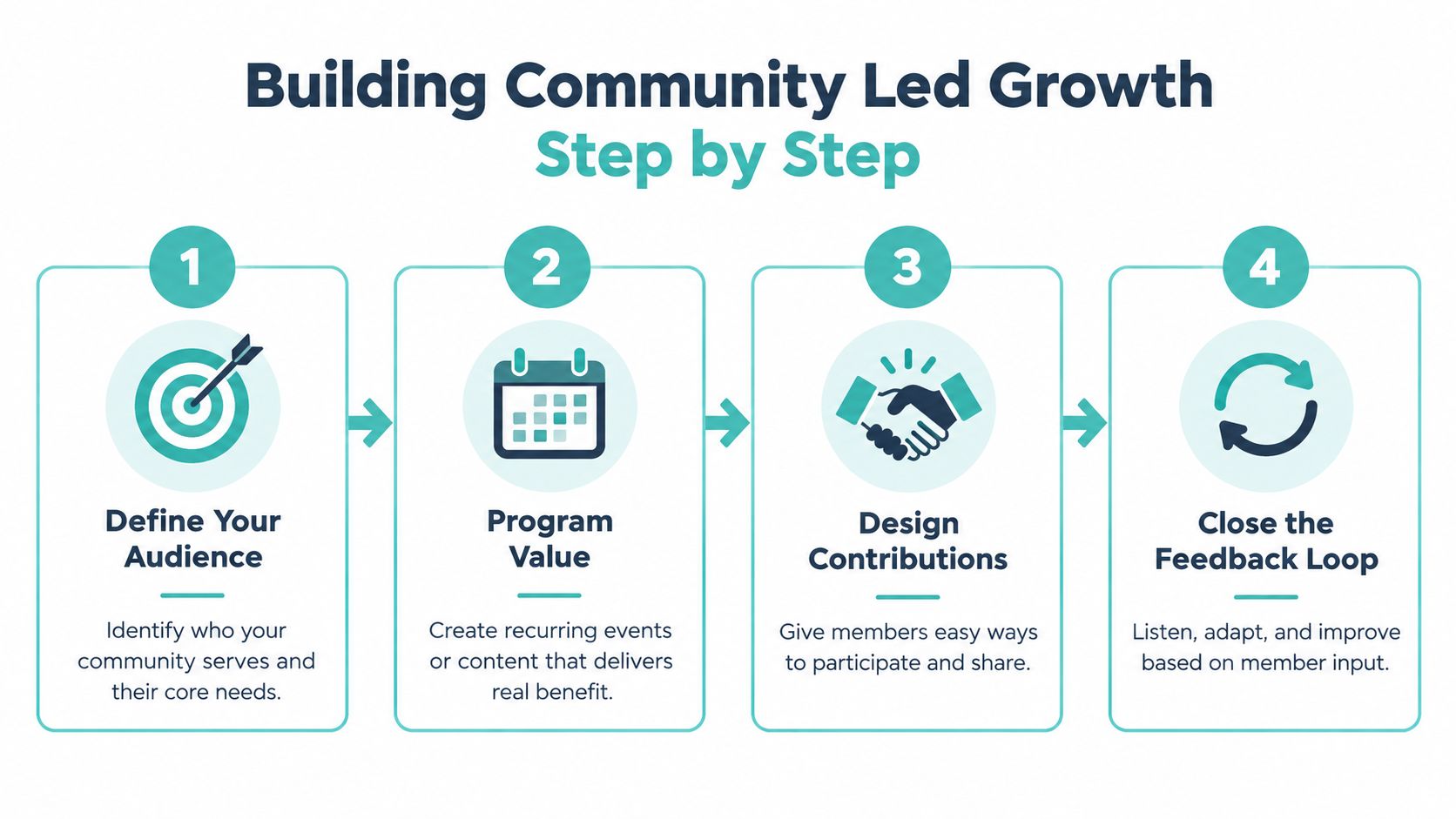
A local business can turn customer trust into repeat participation by solving a problem customers already share. Start with a useful reason to gather, then make it easy for people to contribute. A group, event, or campaign alone won’t build a community.
A sequence you can put to work
-
Define a shared audience and problem. Be specific about who benefits and what they have in common. A dental office might serve families seeking clear explanations of treatment options. An auto dealership could bring together local business owners who need practical fleet advice.
-
Program useful interactions. Schedule activities that help members make progress. For businesses considering local TV, that could mean reviewing ad creative together, comparing audience-targeting choices, or discussing lessons from a campaign. Keep each activity tied to decisions customers already need to make. A steady stream of promotional announcements gives people little reason to participate.
-
Make contributions easy and worthwhile. Give members a clear way to ask questions, offer advice, share a story, or invite someone who could benefit. A dental office could feature patient stories with permission. An auto dealership could ask local business customers to review draft campaign ideas. Recognize useful contributions and follow up; don’t pressure people to post more.
-
Close the feedback loop. Ask what helped, what was missing, and which questions keep coming up. Tell members what you changed in response. That visible follow-through shows their input matters and gives them a concrete reason to return.
As noted earlier, engagement and trust support advocacy. Put that into practice by making each interaction useful, not frequent. A high post count won’t compensate for activities members don’t trust or find helpful. For a local TV campaign, invite customers to share questions before it runs, then use their feedback to improve the message and follow up after launch. That links participation to real business decisions without requiring complex tracking tools.
For a structured way to gather customer input, use a guide to creating a customer advisory board. Keep the first program small enough to manage well. Invite people with a relevant need, run an activity that addresses it, and use what members found useful to shape the next one. A well-run pilot gives you a practical basis for deciding whether to repeat the format or adjust it.
Measuring Community Led Growth Without Enterprise Attribution
A small business doesn’t need an enterprise attribution stack to evaluate a community. It does need to distinguish leading indicators, which show whether the program is useful and active, from commercial outcomes, which show whether members are buying, returning, or referring others. Don’t treat a high member count as proof of revenue.
One 2025 industry analysis reported that 24% of organizations with active community programs could quantify their financial impact, up from 16% the previous year. Another cited survey found that 58% of SaaS community programs couldn’t attribute revenue to community engagement, according to the industry analysis of community-led growth measurement. These findings underline the practical problem: organizations often struggle to connect what people do in a community with activity in their sales and customer systems.

Use a small, explicit measurement system
| Metric category | What to track | Common failure | Better method |
|---|---|---|---|
| Leading indicators | Qualified members, weekly active members, response rate, event attendance, contribution rate | Counting every member or post as equal evidence of value | Track useful actions and participation by member segment |
| Commercial outcomes | Referrals, demo requests, activated campaigns, repeat spend, expansion revenue | Claiming all community-connected sales as community-sourced | Record whether community sourced, influenced, or merely engaged the buyer |
| Retention | Repeat purchase, churn, retained revenue per active member | Reporting engagement without checking whether customers stay | Compare customer cohorts over time and segment by behavior |
Start with a simple source tag in your CRM or spreadsheet. Record the member’s community source, meaningful content interaction, referral or inquiry, purchase or campaign activation, and renewal. Where possible, compare customers who engaged with a structured community activity with a similar group that didn’t. Look for differences in activation and retention, but don’t claim the community caused them unless your comparison supports that conclusion.
Measurement guardrail: Optimize for qualified activation and retained revenue per active member, not message volume. Use a practical marketing ROI measurement guide to keep your business outcomes connected to the costs and activity you can actually track.
Common Pitfalls and How to Avoid the Attribution Trap
The biggest mistake is asking community to behave like a short-term campaign. Trust and advocacy need time to develop, so a program may be a poor fit if leadership requires clear, campaign-level payback within a 30-day window. Don’t promise immediate revenue just to secure approval. Set expectations around the outcomes you can observe and the limits of what you can attribute.
Member count and post volume are particularly weak stand-ins for growth. A large registration list can hide a tiny active core, while a few highly vocal members may dominate the conversation. Track repeat participation, answered questions, and who contributes value. If most members only browse, make sure your content helps them and give them low-effort ways to take the next step.
Guard against fatigue and inflated credit
Constant requests for reviews, referrals, and social posts can wear members down. Emerging creator community data cited 32% of community builders concerned about unreliable or declining social reach and 45% reporting signs of member burnout, according to community-led growth guidance on participation challenges. Treat this as a reason to make participation useful and sustainable, not as an excuse to keep asking for more.
- Limit repetitive asks: Alternate requests with practical advice, peer answers, recognition, and events.
- Label influence clearly: Separate community-sourced opportunities from sales-sourced leads that later engaged with the community.
- Watch contribution concentration: If a handful of members carry every discussion, invite quieter members through specific questions or small-group activities.
- Test the fit: If members have no reason to connect and leadership needs immediate payback, use another growth tactic rather than forcing a full community.
The attribution trap is claiming every customer who joined a group came from the group. Mark customers as sourced, influenced, or engaged, and report the categories separately. That gives owners a more defensible view of what the community contributes, while leaving room for sales outreach, product quality, paid media, and brand awareness to have played a role too.
Amplifying Community Reach with Local TV Advertising Through Adwave
A community can build trust among people who interact directly. Local TV can extend a business’s recognition to prospective customers and existing customers across the surrounding area. The two approaches do different jobs: community creates reasons to believe; broadcast exposure helps more local people recognize the name.
A 2018 BIA Advisory Services report found that 26% of small and medium-sized businesses actively used local television advertising, making it the fourth-most-used channel. Television represented 31.8% of marketers’ local advertising budgets, the largest share among the local media categories covered in the BIA Advisory Services report on local TV advertising.
For a real estate brokerage, a customer story or referral can reveal what buyers value about the service. A TV ad can then reinforce the brokerage’s name across the local market while it continues to earn referrals. A home services business can share helpful work examples with customers, then use broadcast exposure to keep its brand visible to people who may need those services later. These are complementary roles, not a claim that advertising creates community trust by itself.
Adwave helps small businesses create broadcast-ready ads and place them across premium TV and streaming inventory without needing a traditional production crew or a six-figure budget. Its audience-targeting and campaign-pacing features fit a local plan where the business wants to reach relevant viewers while staying within a set spend. For a practical overview of local television advertising, connect the campaign to the same outcomes you track elsewhere: qualified inquiries, activated campaigns, repeat business, and referrals. Keep community influence labeled clearly, and use TV as a reach channel that supports local recognition.
If you’re building a local growth plan, use Adwave to create broadcast-ready TV ads and reach local viewers across premium TV and streaming inventory while keeping campaigns within your set spend. Visit Adwave to explore how local TV can extend the recognition your community earns.