
You already have an advisory board. It's just disorganized.
It shows up as a great customer who sends a thoughtful email after a project wraps. It shows up in a sales call where a prospect explains why they hesitated. It shows up when a loyal account tells your team which message landed, which offer felt weak, and what almost made them buy from someone else.
Most small businesses know those conversations matter. The problem is that they happen randomly, and random feedback rarely turns into repeatable decisions.
That's why learning how to create a Customer Advisory Board matters. Not the enterprise version with flights, hotels, and a polished offsite. The useful version. The one a founder or lean marketing leader can run without burning time or budget.
Your Best Customers Have More to Say
A lot of SMB founders hesitate when they hear the phrase Customer Advisory Board. It sounds expensive. It sounds corporate. It sounds like something a software company with a large events budget does after it has already “made it.”
That reaction makes sense because most CAB advice is built for companies with more money, more staff, and more room for process. In fact, a common reason SMBs fail to launch CABs is that 90% of published guides assume enterprise budgets for perks like travel and venues, while a micro-CAB of 4 to 5 customers meeting monthly by video can deliver 3x higher retention than traditional annual boards according to this discussion of SMB-friendly CAB models.
Why the enterprise model breaks for small teams
Small businesses don't need a grand program. They need a reliable way to hear from the right customers before making decisions about offers, messaging, pricing presentation, onboarding, retention, and expansion.
A big formal board can get in the way. It creates pressure to overproduce. Founders wait until they have the perfect deck, the perfect guest list, and the perfect incentive package. Then nothing happens.
Practical rule: If your CAB design requires an event planner, it's probably too heavy for your first version.
The better move is to build a board that fits your current operating reality. If you have a small customer base, a short sales cycle, or limited admin support, a lean format is often stronger because it forces focus. You ask fewer questions, invite fewer people, and get to decisions faster.
What a good-enough CAB looks like
For an SMB, a CAB should do three things well:
Create pattern recognition: You stop reacting to one loud customer and start hearing repeated themes.
Improve decisions before launch: You test positioning, offers, and campaigns before spending real money.
Strengthen loyalty: The customers you invite feel seen, respected, and invested in your direction.
That last point matters more than most founders realize. Your best customers often want to contribute if the conversation is serious and their time is respected. They don't need a luxury experience. They need evidence that their advice shapes what happens next.
There's also a retention angle here. Businesses that already care about loyalty tend to do better with CABs because they treat the relationship as ongoing, not transactional. That same mindset shows up in practical retention systems like turning one-time buyers into lifelong repeat customers.
Start smaller than you think
If you're waiting for a “real” board, stop waiting. A working CAB can begin as a recurring video session with a handful of customers who know your business well and aren't afraid to tell you the truth.
That's enough to surface the insights you're currently missing.
Set Goals Beyond Simple Product Feedback
Give your customer advisory board a specific purpose before inviting members.
If your objective is “get customer feedback,” you'll get a polite conversation and a messy note doc. If your objective is “learn how buyers describe our value, where our sales process stalls, and which campaign ideas sound credible,” you'll get something you can use.
Product feedback is too narrow for most SMBs
A lot of CAB content still treats the board as a product roadmap exercise. That can work for software companies, but it leaves money on the table for local businesses, agencies, service firms, and growth-stage brands.
Recent trends show 62% of B2B startups now use CABs for sales validation and go-to-market strategy, not just product input, and boards focused on how to sell to target buyers generate 2.4x more revenue growth than boards focused purely on product roadmaps, according to Insight Partners' guidance on great advisory boards.
For an SMB, that's a significant opportunity. Your board can help you sharpen:
Sales messaging
Offer packaging
Pricing presentation
Channel selection
Creative direction
Referral language
Objection handling
Four useful goal buckets
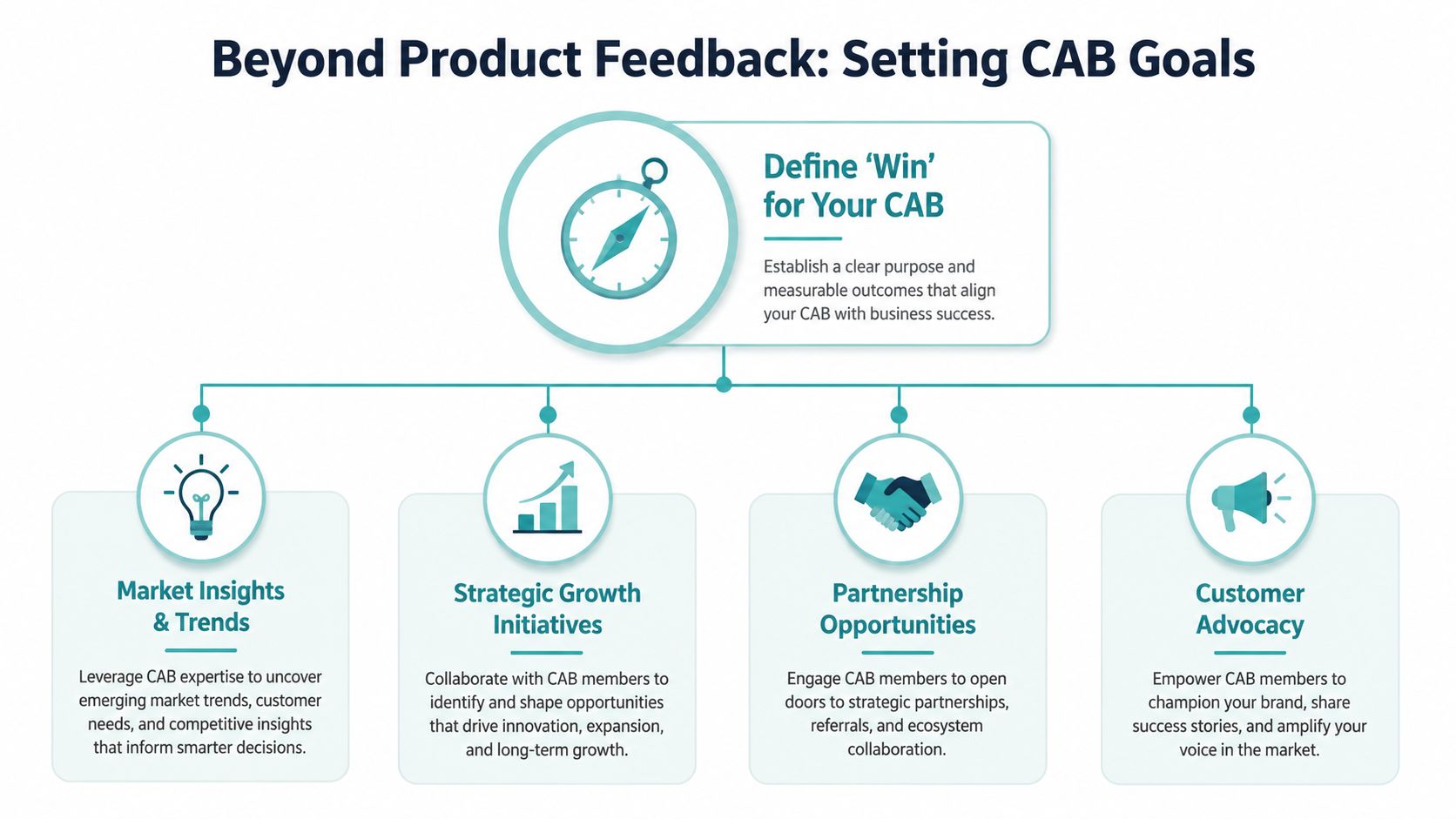
When founders ask me what a CAB should do, I usually push them into one of four categories.
Market insight
Use the board to understand what customers are seeing before you see it. Ask what's changing in buying behavior, budget pressure, seasonal demand, or competitor positioning.
This is especially useful if your team is making decisions from pipeline data alone. Pipeline tells you what happened. Customers tell you why.
Strategic growth
Some of the best CAB questions are commercial, not operational. Which audience is easiest to convince? Which value prop creates urgency? Which service line feels easiest to refer?
These discussions often surface simple fixes. A phrase on the homepage that sounds clever internally may sound confusing to customers. A bundled offer may create more friction than a simpler core package.
Partnership opportunities
Your best customers usually understand adjacent markets, vendors, and local relationships better than you expect. A CAB can uncover co-marketing angles, channel partnerships, and trust-building moves that don't show up in standard customer interviews.
Advocacy
Advisory members can become your strongest advocates, but only if the role feels meaningful. They're more likely to refer, speak on your behalf, or validate your story when they've helped shape it.
A CAB should answer business questions that affect revenue, not just questions that make the product team feel informed.
A simple way to define win
Before you invite anyone, write down the few decisions your CAB needs to improve over the next operating cycle. Keep it specific.
For example:
Refine messaging: Which headline or promise best matches how customers describe the problem?
Improve sales calls: Which objections show up late because the team isn't addressing them early?
Test campaigns: Which offer or creative concept feels most believable?
Support retention: Which moments in the customer journey make people trust you more?
If your company invests in customer loyalty work, this planning also connects well with practical systems for building a customer loyalty program on any budget.
The board doesn't need to solve everything. It needs to help you make a few better decisions, faster.
Recruit Your Dream Team of Advisors
The wrong members will make your CAB feel pleasant and useless. The right members will make it occasionally uncomfortable and extremely valuable.
That's the point.
Start with revenue, not friendliness
A solid rule for member selection is the 80-20 principle. Invite participants from the 20 percent of customers that generate 80 percent of revenue, as recommended in UserVoice's CAB best practices. This keeps the board anchored to customers whose needs, priorities, and buying behavior affect your business most.
For SMBs, this matters because customer variety can be misleading. The loudest account is not always the most strategic account. A board built around convenience tends to overrepresent friendly customers, edge cases, or people who like talking. That's not the same as getting insight from customers who represent your strongest revenue base.
Use a short selection checklist
You don't need a scoring model with ten tabs. You need a practical filter.
Ask these questions:
Revenue fit: Is this customer part of the group that drives meaningful revenue?
Strategic fit: Do they resemble the kind of customer you want more of?
Communication fit: Will they speak candidly, even if the feedback is uncomfortable?
Perspective fit: Do they add industry, geography, or company-size perspective you'd otherwise miss?
Relationship fit: Can you ask them for honest advice without turning the meeting into account management?
If a customer only tells you that everything is great, they may be loyal. They are not automatically advisory-board material.
Write an invitation that respects their time
Busy customers don't join because the subject line sounds exclusive. They join because the role is clear and the value exchange is fair.
A simple invitation works better than a polished one. Include:
Why they were selected
What kind of questions you want help answering
What the time commitment looks like
What they'll gain from participating
How their input will influence decisions
Here's a concise structure you can adapt:
We're forming a small customer advisory group made up of a few of our most important customers. We want your candid input on how we improve our messaging, customer experience, and growth strategy. This isn't a sales presentation. It's a working session where your perspective will shape real decisions.
That framing is direct. It also filters out people who want perks but not participation.
Low-cost incentives that still feel meaningful
Most SMBs don't need expensive gifts. They need thoughtful reciprocity.
The best incentives don't feel like bribery. They feel like access, relevance, and respect.
Don't ignore legal and trust basics
If your board will discuss sensitive roadmap, pricing, customer data handling, or co-marketing ideas, get your paperwork in order early. It helps to review confidentiality expectations and participation language with proven legal counsel so the relationship starts cleanly.
That same trust mindset also applies to referrals. Advisory members often become referral sources, but only when you ask in a way that feels natural and earned. If your team struggles there, this guide on how to ask for referrals without being awkward is a useful companion process.
Run Meetings That Members Value
A CAB meeting should feel like a strategic conversation among peers. If it feels like a webinar, you've already lost the room.
Industry best practices call for a CAB size of 8 to 12 members meeting quarterly for 90 minutes, with 80% customer talk time and internal presentations limited to less than 20% of the meeting, according to CRV's guidance on customer advisory boards. That structure works because it protects the one thing members care about most, which is meaningful discussion.
Build the rhythm before the agenda
Consistency matters more than novelty. Put the dates on the calendar well in advance and protect them like you would a board meeting or a major sales review.
The quarterly rhythm works because it gives you enough time to act on what you heard between sessions. Monthly can work for a micro-CAB, but only if the scope is narrow and the prep is light. Otherwise people start showing up without much to say.
Use pre-meeting interviews to shape the conversation
The best CAB meetings are not built from your internal wish list alone. They're shaped by what members care about right now.
Before each session, have short one-on-one conversations with members or send a tight pre-meeting prompt. Ask:
What's changed since the last session
Which growth challenge feels most pressing
Which customer or market signal they're watching
What question they want the group to discuss
Those inputs give you a cleaner agenda and help members feel ownership before they even join the call.
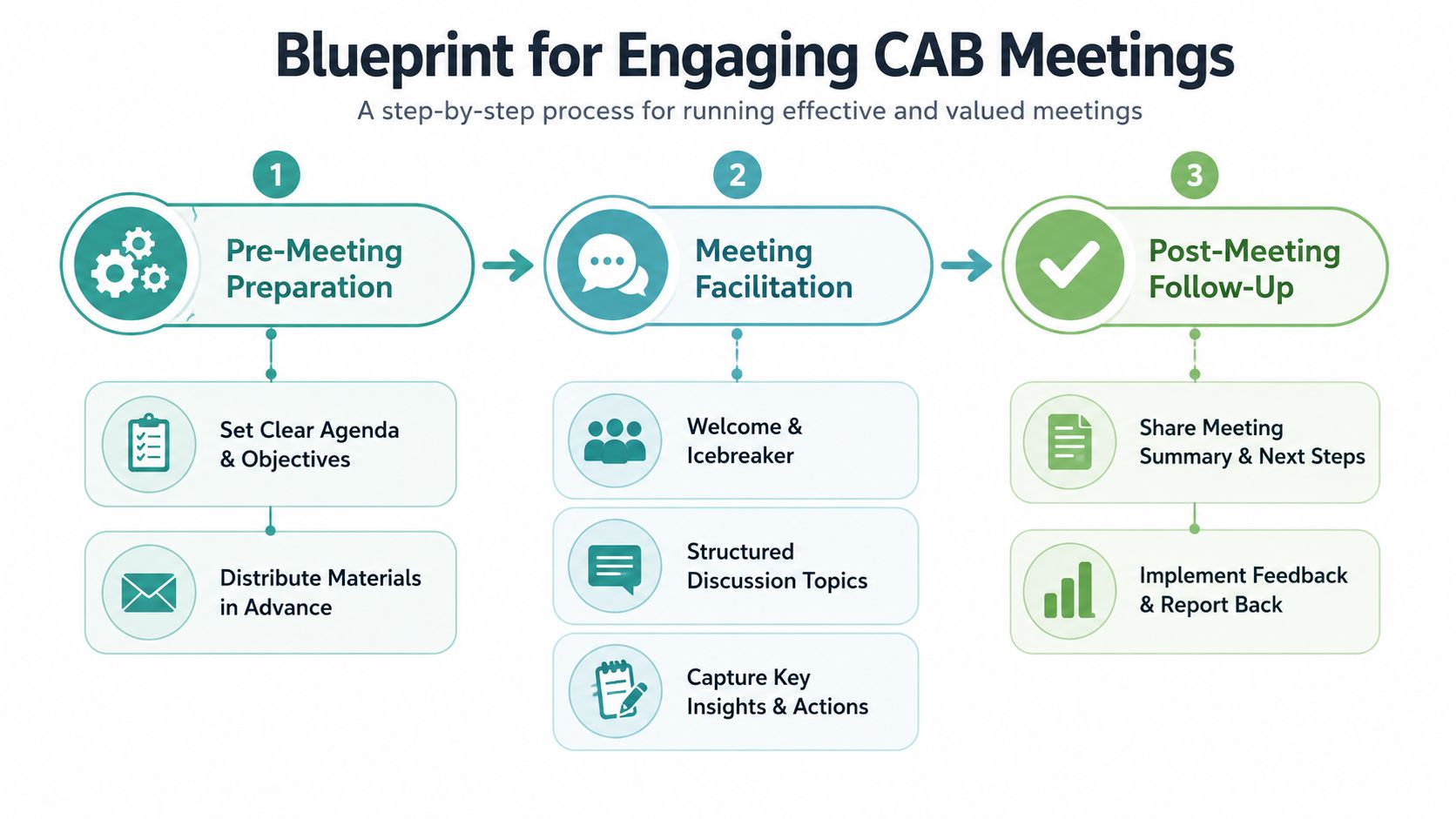
A sample 90-minute agenda
This doesn't need to be fancy. It needs to move.
Welcome and context Briefly restate the purpose of the group and what decision you need help with.
Member roundtable Ask each participant to share one shift they're seeing in their market or customer base.
Focused discussion Bring one or two big questions, not six small ones.
Reaction to concepts Test messaging, offers, campaign themes, or strategic options.
Wrap-up Summarize what you heard and what you'll evaluate next.
A strong CAB agenda is built around decisions, not updates.
Facilitation mistakes to avoid
Founders often overtalk because they want to prove they're prepared. That instinct kills discussion.
A better approach:
Ask shorter questions: Long setup usually produces shallow answers.
Call on quieter members: Don't let one confident voice define the room.
Probe for examples: “Can you give me a recent case?” is better than “Interesting.”
Park side issues: If a topic matters but doesn't fit, note it and move on.
End with confirmation: Repeat the key takeaways back to the group so they can correct you.
A member should leave thinking, “That was worth my time.” If they leave feeling they attended your pitch, they won't stay engaged for long.
Measure Success and Close the Feedback Loop
The meeting is not the product. The follow-through is the product.
A CAB only creates value when your team turns conversation into decisions, communicates what happened next, and tracks whether those decisions improved anything important.
The first report your members should get
Send a short follow-up within a reasonable window after the meeting. Keep it simple and concrete.
Include three categories:
What we heard
What we're acting on
What we're not changing right now
That third category matters. Customers don't expect you to say yes to everything. They do expect clarity. When you explain why a suggestion isn't the right move now, you show respect for the input rather than pretending it disappeared.
Silence is what makes customers think their advice went into a black hole.
This kind of transparency also improves the quality of future meetings. Members stop trying to guess what you want to hear and start giving sharper advice.
Tie ROI to the goals you set earlier
The easiest way to lose confidence in a CAB is to measure it with vague language. “Good discussion” is not an outcome. “We changed our homepage headline after hearing the same objection from multiple members” is.
Your measurement approach should match the kind of board you're running.
If your CAB is sales-focused, review:
Changes in objection handling
Shifts in sales messaging
Movement in win-loss themes
Referral conversations that started after sessions
If your board is marketing-focused, look at:
Which value props members consistently validated
Which campaign concepts sounded credible
Which offers created confusion
What language customers themselves used repeatedly
If your board supports retention, evaluate:
Which moments in the customer journey members say matter most
Where expectations aren't being set clearly
Which service or communication improvements customers notice
The key is to connect advisory input to a business decision, then review whether that decision improved performance qualitatively or quantitatively within your own reporting.
Use a lightweight internal scorecard
You don't need a dashboard monster. A one-page internal summary is enough.
A practical template might include:
This is also where good survey design helps. If you need a cleaner way to gather candid input between meetings, use question formats that reduce politeness bias and surface specifics. This resource on customer feedback surveys and the questions that get honest answers is useful for that in-between layer.
Measure the board by the quality of decisions it improves. That's the standard.
Common Pitfalls That Sink SMB Advisory Boards
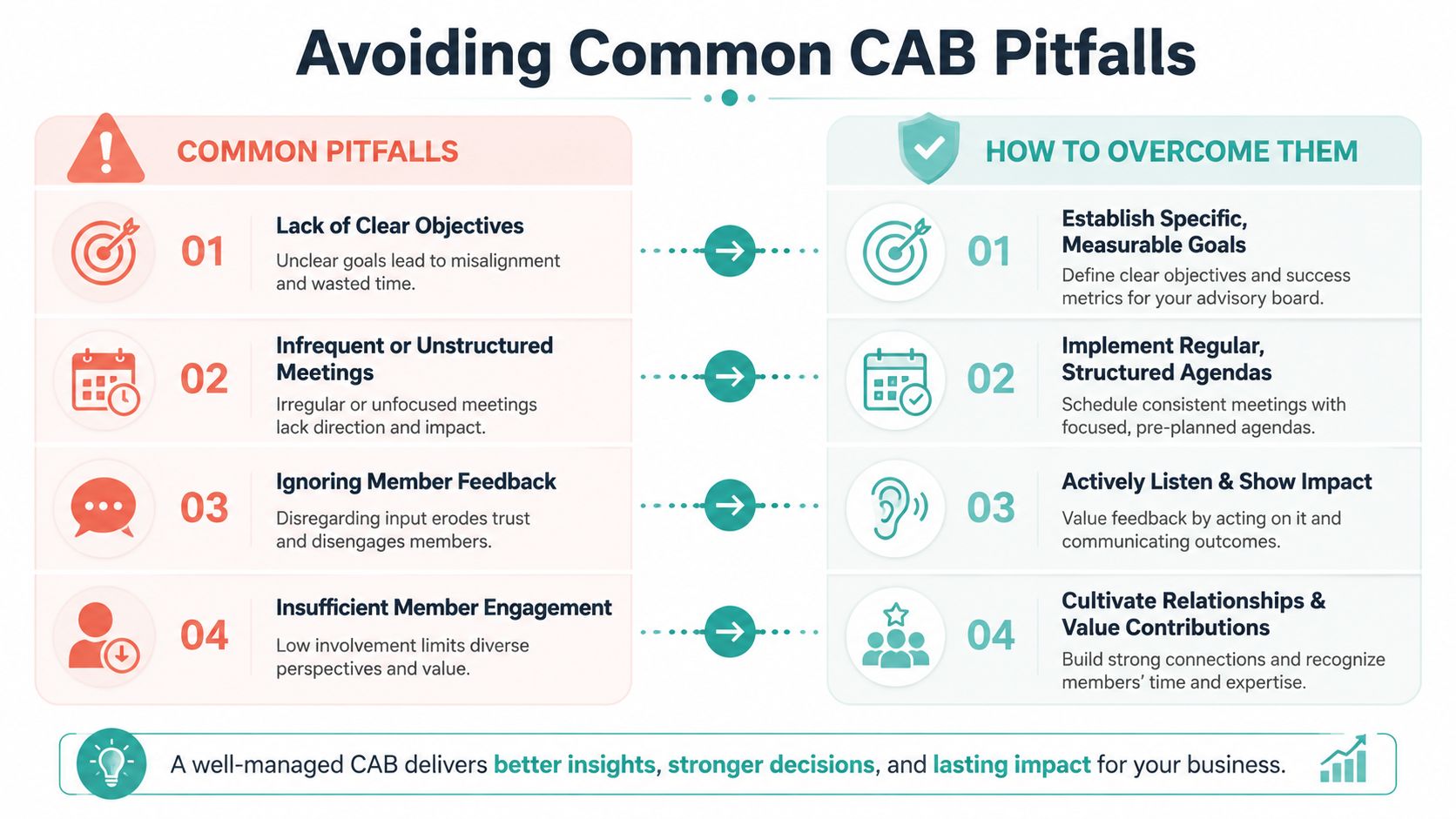
Most failing CABs don't collapse because the idea was wrong. They collapse because the execution drifted.
Data shows 30% to 40% of CABs fail within the first year, often because companies don't secure peer-level executive attendance and don't build a formal post-meeting process. The same source notes that weak follow-up can drive a 50% higher drop-off rate in later quarters, according to Opus Agency's CAB guidance.
Those aren't enterprise-only problems. SMBs hit them fast because everyone is busy and the board can start feeling optional.
Pitfall one goes straight to leadership
If the founder, CEO, or senior decision-maker doesn't attend as a peer, members notice. They may still be polite, but the quality of feedback drops because people assume the final decisions happen elsewhere.
This is one of the biggest misconceptions in first-time boards. Owners think showing up will make the session feel too formal or too high stakes. Usually the opposite happens. Senior presence signals that the conversation matters.
Fix it by having the top decision-maker attend, listen, and avoid dominating the room. Their job is to hear, clarify, and respond thoughtfully. Not to defend every current choice.
Pitfall two is turning the CAB into a presentation
A surprising number of boards fail because the company treats the meeting like a stage. Slide after slide. Update after update. Lots of talking. Very little learning.
When that happens, members conclude they were invited to validate decisions that have already been made.
A better discipline is to arrive with fewer slides and sharper questions. If you need to share context, do it briefly. Then move into discussion while people still have energy.
Pitfall three is vague value exchange
If members can't tell why they're there beyond “help us improve,” engagement fades. Smart customers want to know what kind of influence they have.
That doesn't mean you need expensive gifts or elite treatment. It means you need a clear promise. Maybe they get early access to new initiatives. Maybe they influence campaign direction. Maybe they gain useful peer discussion with other business operators.
The value has to be real, and it has to be visible.
Don't ask customers to act like board members if you treat them like an audience.
Pitfall four is weak post-meeting process
This is the silent killer. A session goes well, everyone leaves feeling positive, and then nobody hears anything meaningful afterward.
The fix is operational, not inspirational:
Hold an internal debrief quickly: Assign owners while the discussion is still fresh.
Decide what changed: Name the few actions that made the cut.
Communicate back to members: Tell them what moved, what didn't, and why.
Prepare the next session early: Carry unresolved questions forward instead of resetting from scratch.
SMB advisory boards don't fail because they're small. They fail when the company treats them casually. A compact board can be stronger than a big one if leadership stays engaged, the questions are commercial, and the follow-up is disciplined.
Adwave is a strong fit for SMBs that want to turn customer insight into action without enterprise-level ad budgets. Its AI-powered TV advertising platform helps businesses create, launch, and measure broadcast-ready ads across premium channels with a simple workflow and a low entry point. If your advisory board is helping you refine messaging, validate offers, or pressure-test creative, Adwave gives you a practical way to put those findings into market quickly.


