
Referral programs win where a lot of SMB marketing loses: trust.83% of consumers say they trust recommendations from friends and family over all other forms of advertising, and referred customers have a 16% higher lifetime value according to Impact's referral growth analysis. That should change how you think about referrals.
A referral program isn't a cute add-on for your footer. It's a growth system. Done well, it turns customer satisfaction into a repeatable acquisition channel. Done badly, it becomes a forgotten discount code that barely gets used and still eats margin.
That gap matters even more for service businesses and brands that sell through traditional media. Most referral advice assumes you're selling a digital product with instant gratification. A local roofer, dentist, realtor, med spa, or business buying TV ads doesn't have that luxury. The value is often delayed. The buying cycle is longer. The reward has to feel relevant enough to prompt action, even when the product itself isn't instantly shareable.
That's where most first referral programs go wrong. They copy a template built for apps, not for real local businesses.
Why Referrals Are Your Untapped Growth Engine
Most SMB owners underestimate referrals because they lump them into “word of mouth” and treat them as something that just happens. That's a mistake. Organic referrals happen by accident. Referral programs create them on purpose.
The case for building one is simple. Referrals carry built-in credibility that paid media can't manufacture. If a customer tells a neighbor, coworker, or friend that your business solved a problem, that lead arrives warmer than someone who clicked an ad cold. You spend less time proving legitimacy and more time closing.
Trust changes the economics
The strongest argument for referrals isn't that they feel good. It's that they improve unit economics.
When referred customers are worth more over time, a business can justify investing in a reward structure that might look expensive at first glance. If you're only comparing referral rewards to the cost of sending one email, you'll underinvest. If you compare them to the cost of acquiring a customer through paid channels, the math usually looks much better.
That's why the best referral programs are designed like acquisition channels, not loyalty perks.
Practical rule: If you already have happy customers and no referral system, you're leaving growth unstructured.
Start with your happiest customers
Not every customer should be your first target. A referral program works best when you begin with people who already show signs of satisfaction and advocacy. Repeat buyers, long-term clients, and customers who leave strong feedback are the obvious starting point.
If you need a way to identify them, it helps to understand whether your business is measuring advocacy well. Adwave's guide on whether small businesses should track Net Promoter Score is useful here because referral readiness usually shows up in the same customers who already want to recommend you.
For a local business, that matters. You don't need a giant audience. You need a small group of customers who trust you enough to put their name behind you.
Phase 1 Laying Your Strategic Foundation
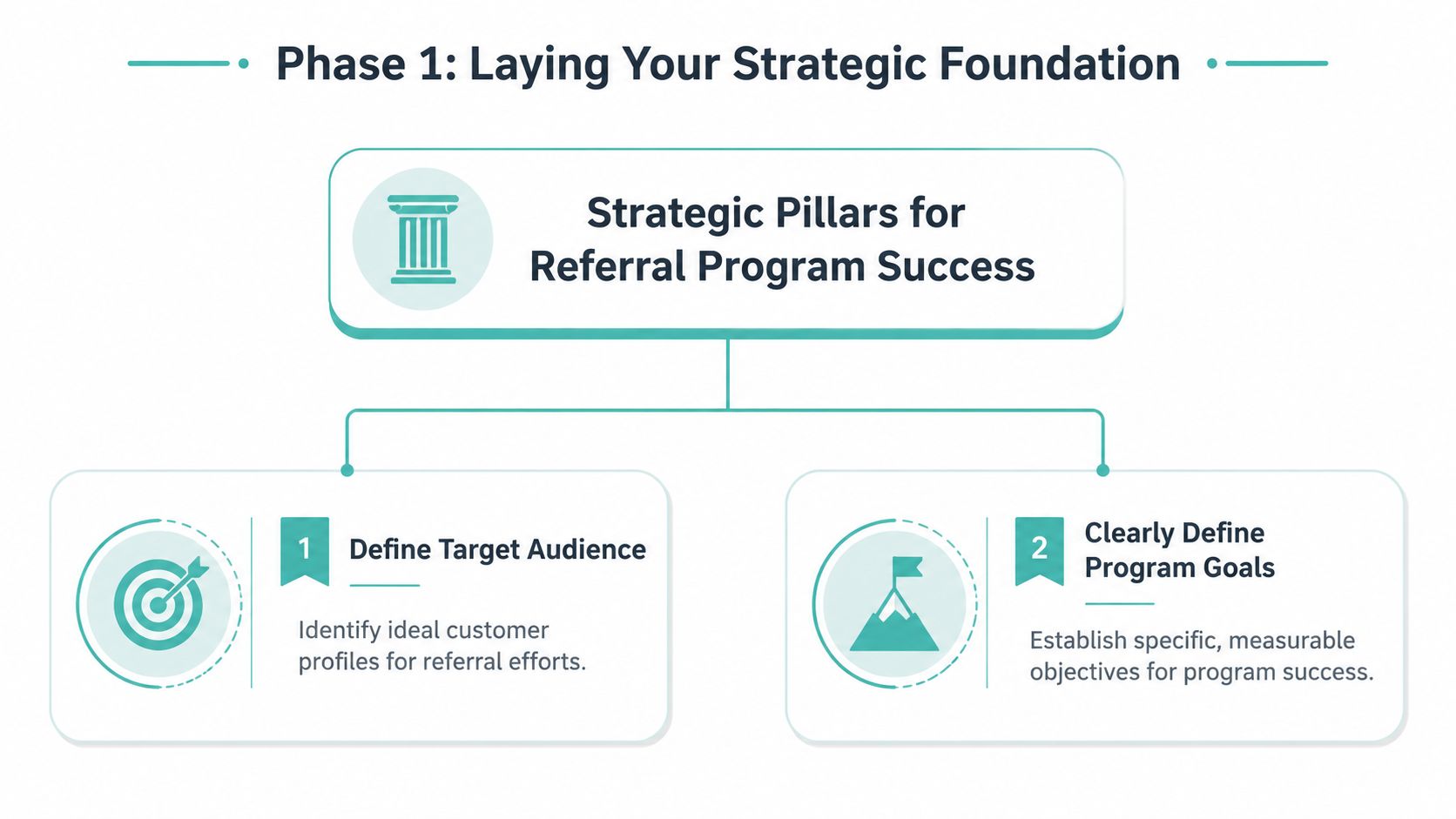
A referral program fails long before launch if the strategy is fuzzy. Most SMBs skip straight to the reward. They ask, “Should we offer cash, credit, or a gift card?” before they answer the more important question: “What outcome are we paying for?”
Pick one outcome first
A first referral program should optimize for one primary result. Not awareness, loyalty, engagement, and new sales all at once. One.
That primary outcome usually falls into one of these buckets:
Qualified leads: Best for home services, legal, real estate, and high-ticket local services where the sale happens later.
First purchase: Best for retail, restaurants, med spas, and e-commerce brands where there's a clear transaction.
Booked appointment: Best for clinics, salons, dentists, consultants, and service businesses with a scheduling step.
If you blur those together, you create bad incentives. A lead reward can flood you with low-intent names. A purchase reward can be too hard for customers to influence in longer sales cycles. An appointment reward may work well if showing up is the key bottleneck.
Set guardrails before writing copy
Your reward has to fit the economics of your business. That means you need rough answers to three questions before you build anything:
What is a new customer worth over time?
What does it currently cost you to acquire one through other channels?
What reward can you afford while staying profitable?
You don't need a finance degree for this. You need a realistic range.
For a service business, customer value often includes repeat visits, renewals, upsells, and referrals that customer may generate later. For a business with a long buying cycle, lead quality matters more than lead volume. For a business with strong repeat purchase behavior, store credit may outperform cash because it keeps margin inside the business.
Don't build a program around what sounds generous. Build it around what you can sustain.
Define the audience with precision
A referral program shouldn't be offered the same way to every customer. Your best referrers usually share a few traits: they've had a clear win, they understand what makes your business different, and they know people who fit your target buyer.
That means segmenting by behavior, not by broad demographics.
Recent positive experience: Customers right after a successful job, delivery, closing, or appointment.
Repeat engagement: Clients who've bought again, renewed, or expanded.
High-confidence fit: Customers who clearly understand who your service is for and can explain it to others.
Many first-time programs get sloppy. They place a referral link in a footer and hope everyone shares it. That isn't strategy. It's wishful distribution.
For service businesses, a narrow launch beats a broad one. The strongest early signal comes from customers who've already shown they trust you enough to recommend you informally.
Phase 2 Designing Incentives That Motivate Action
The incentive is where theory meets behavior. This is also where lazy programs die.
A reward only works if two people understand it instantly. The current customer needs to feel it's worth sharing. The referred person needs to feel they're getting a genuine benefit, not being dragged into a promotion.
Why double-sided incentives usually outperform
The clearest proof is still Dropbox. Dropbox grew from 100,000 to 4 million users in 15 months by offering 500MB of free storage to both the referrer and the new user, and this double-sided model is used by 72% of top-performing referral programs according to Base's referral program breakdown. The lesson isn't “copy Dropbox.” The lesson is that rewarding both sides reduces friction.
When only the referrer gets the reward, the invitation can feel self-serving. When both people benefit, the message feels more like a favor.
That matters even more for local SMBs. A homeowner is more comfortable sending a roofer's referral offer to a friend if the friend gets something meaningful too. A patient is more comfortable referring a clinic if the referred person receives a useful first-visit benefit. Reciprocity lowers the social risk.
Why generic discounts often fail in service businesses
The hard part is that many SMBs don't sell something instantly consumable. A TV campaign, a legal consult, a home renovation, a wellness plan, or a real estate service has delayed value. The reward can't rely on instant product utility the way Dropbox did with storage.
That's why a lot of service-based referral programs end up too generic. “Give a friend 10% off” sounds easy, but it often isn't compelling enough, especially if the customer doesn't think in percentage discounts when describing your value.
For businesses using traditional media, including TV, the challenge is even sharper. The customer isn't referring a simple digital tool. They're referring a service outcome, visibility, or expertise. The incentive has to connect to that outcome.
If your business uses TV as part of its growth mix, old referral playbooks become ineffective. The smarter move is to design an incentive around business value, not around retail convention.
A practical companion to that conversation is Adwave's article on how to ask for referrals without being awkward, because incentive design and the ask itself need to feel natural together.
Choosing the right referral incentive
Match the reward to the buying behavior
For a dentist, a future service credit may work because there's ongoing value. For a realtor, a referral reward may be better tied to a closed deal milestone. For a home service company, the referred customer may need a first-visit incentive while the referring customer gets a maintenance credit later.
The point is simple: the reward should fit how customers buy from you, not what some SaaS template says is standard.
Phase 3 Building a Connected User Experience
Even a strong incentive can flop if the experience is clumsy. Customers won't hunt for your program, decode complicated rules, or fill out a form that feels like paperwork.
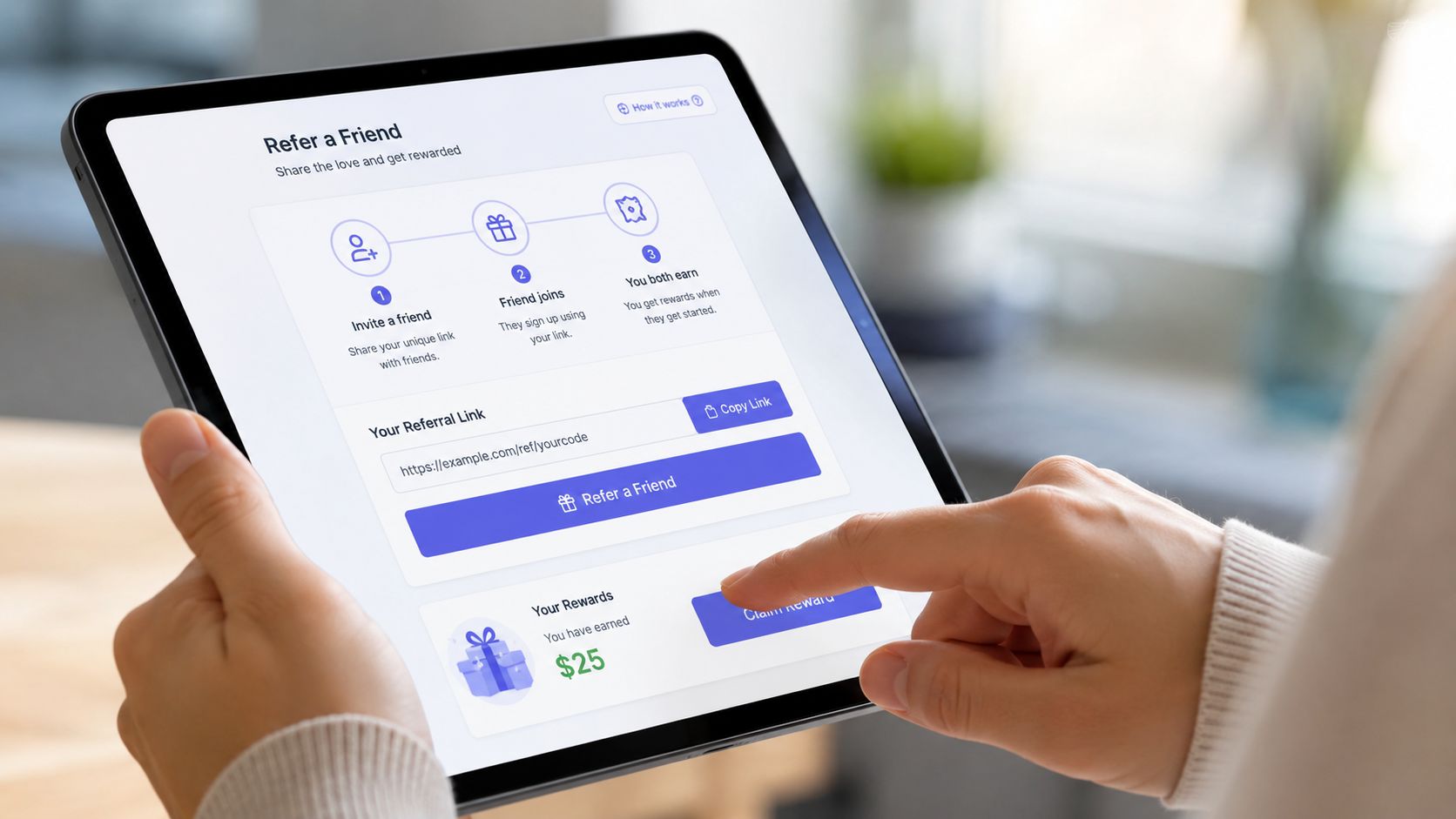
The build should feel boring in the best way. Clear page. Clear benefit. Clear next step.
Keep the customer path short
A basic referral user flow for an SMB should include:
A dedicated landing page: One page that explains the offer, who it's for, and when the reward is delivered.
A simple share method: Referral link, form, code, or direct intro request. Pick one main path.
A confirmation step: Customers need to know their referral was received.
A status process: Even if handled manually at first, someone should track pending, approved, and rewarded referrals.
For local service businesses, a referral form often works better than pretending you need a full software stack on day one. If your sales process already includes consultation, quoting, or follow-up, your referral flow should connect to that reality.
Build the page around relevance
A lot of businesses lose momentum because the reward sounds disconnected from the actual value they sell. A 2025 survey of 1,200 SMB marketers found that 68% abandoned referral programs because rewards felt irrelevant to their core business goals according to Shopify's referral ideas article. That problem gets worse with non-digital offers, where the customer benefit may arrive later.
So your page has to answer three questions fast:
What does the current customer get?
What does their friend get?
What counts as a successful referral?
If a local business is promoting through multiple channels, the thank-you page becomes one of the easiest places to surface the referral offer. Adwave's guide to turning a confirmation into a marketing opportunity with thank-you pages is useful because referral prompts perform better when they appear right after a positive action.
A referral ask works best right after the customer feels they made a good decision.
Use copy that sounds human
Bad referral copy sounds like brand-speak. Good referral copy sounds like something a customer would forward.
Try this structure:
Lead with the friend benefit: “Know someone who needs a reliable HVAC team? They'll get priority scheduling.”
Add the referrer benefit: “And when they book, you'll receive a service credit.”
Clarify the trigger: “Rewards are issued after the first completed appointment.”
For traditional media advertisers, there's a useful extra move here. If your business runs TV, your referral page can echo the exact promise from the ad so the customer experiences continuity. The ad creates familiarity. The referral page gives them a way to act on it and share it.
Promote it in the moments that matter
Don't hide your referral offer under “Resources” or “Account.”
Place it where intent is already high:
After purchase or booking
Inside follow-up emails
On thank-you pages
In customer service closeout messages
After successful project completion
Customers don't need more exposure to the program. They need exposure at the right moment.
Phase 4 Launching and Measuring Your Program
The fastest way to waste time on a referral program is to overbuild it before you've proven anyone wants it.
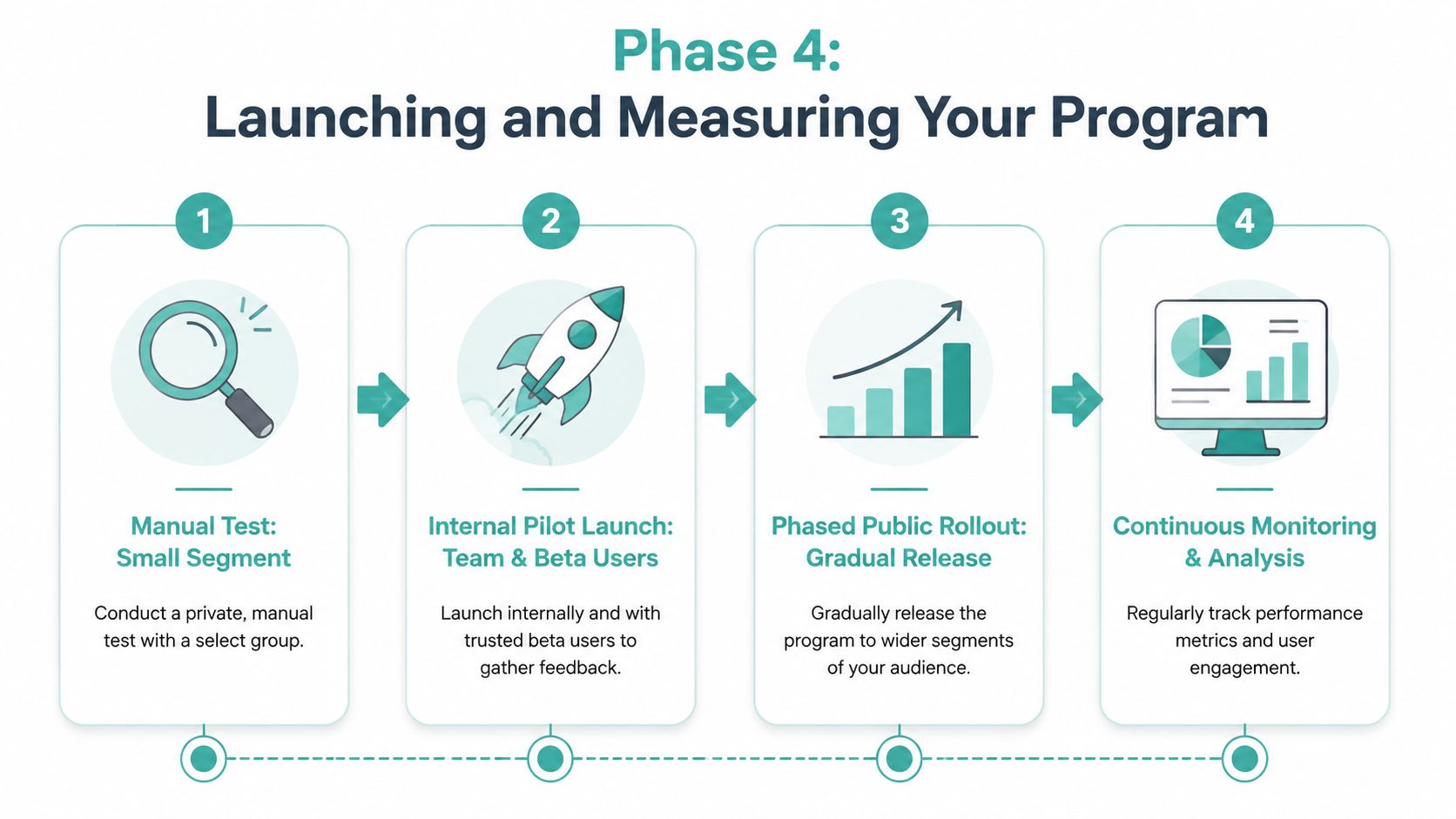
The better approach is slower at the start and faster later.
Start manual, then automate
Expert methodology recommends a three-phase process of Testing, Proven, and Scaling, and businesses should manually process referrals for their top 10-20% most engaged customers for weeks or months before investing in automation software according to Osmu's referral program guide. That advice is especially good for SMBs.
A manual launch tells you things software won't:
Are customers confused by the offer?
Are your team members able to verify referrals consistently?
Does the reward feel strong enough to prompt action?
Are the referred leads qualified?
If those answers are messy, software won't save you. It will just scale the mess.
Use a phased rollout
A clean launch sequence usually looks like this:
Private test group Start with your most satisfied customers. Reach out personally. Process each referral by hand.
Internal pilot Let your team and trusted customers run through the process. Break the flow on purpose and find where it fails.
Limited public rollout Add the referral offer to selected pages, emails, or follow-ups.
Broader release Expand only after the process is predictable and your team knows how to handle volume.
Field note: If the first ten referrals create confusion inside your business, the first hundred will create frustration outside it.
Track the few metrics that matter
You don't need a complex dashboard to judge the first version. Watch these signals:
Participation rate: How many eligible customers try to refer?
Referral volume: How many submitted referrals are you receiving?
Qualified conversion: How many referred prospects become the action you care about, such as a booked appointment or purchase?
Reward cost: What are you paying out relative to the business generated?
These metrics show different failure points. Low participation usually means the offer is weak or invisible. High participation but weak conversion usually means the reward is attracting poor-fit leads or the referred experience is weak.
Don't ignore fraud
Referral fraud sounds like a big-company problem until a small business starts issuing rewards for fake or low-quality referrals. Self-referrals, duplicate submissions, and family-loop abuse can drain budget fast.
The practical safeguards are basic:
Require a real conversion event: Not just a form fill if your business cares about completed appointments or purchases.
Verify identity manually in the test phase: Check customer records before issuing rewards.
Write simple eligibility rules: One reward per new customer, no self-referrals, no duplicate households if that fits your business.
Hold rewards until the qualifying step is complete: This reduces abuse and aligns reward timing with actual value.
Keep the rules tight enough to protect margin, but not so complicated that honest customers give up.
Optimizing for Growth and Avoiding Common Pitfalls
Most referral programs don't fail because referrals “don't work.” They fail because the business stops managing them after launch.
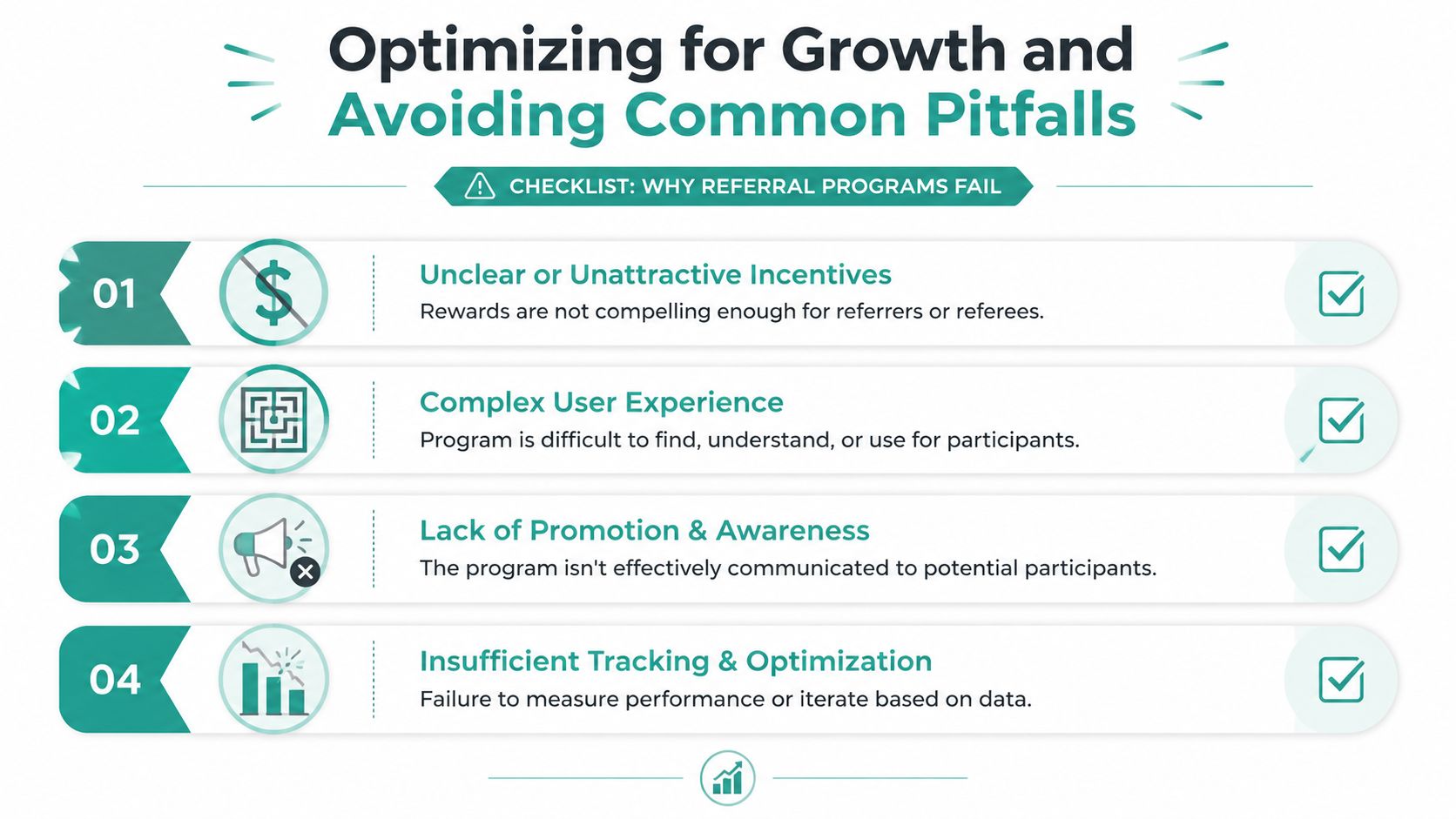
The growth comes from iteration. You learn what customers will share, what referred leads respond to, and where the process loses momentum.
Match the program to the real business goal
A referral program should match the incentive structure to the primary outcome it's trying to drive. E-commerce brands often use store credit, while SaaS companies often use free months, because the reward needs to line up with what the customer already values, as explained in Tapfiliate's guide to strong referral programs.
That same logic applies to local services and media-driven businesses. If you want consultations, reward qualified consultations. If you want purchases, reward purchases. If you want stronger local credibility, tie your referral motion to post-purchase advocacy instead of just top-of-funnel volume.
This is also where reviews and referrals start feeding each other. If you're tightening your reputation system at the same time, a practical resource is this guide to DigiVisi Ltd review optimisation, which helps businesses strengthen the public proof that makes referrals convert better.
Fix the four failure points first
Weak incentive fit: Customers won't share a reward that doesn't feel useful. Rewrite the offer around actual customer value, not around what's easiest for accounting.
Too much friction: If the process has too many steps, people stop. Shorten forms, remove extra clicks, and make qualification rules easy to understand.
Poor promotion: A good program hidden in one email won't produce much. Surface it after positive customer moments and repeat it in your normal communication flow.
No follow-through: Customers stop trusting referral programs when rewards are delayed, disputed, or forgotten. Assign ownership inside the business.
Build the loop, not just the offer
The best referral systems compound because they sit inside a broader growth loop. A customer sees your business, buys, has a good experience, leaves with confidence, and refers someone else.
For local businesses using TV, that loop gets stronger. Awareness created by TV can make referral conversations easier because the referred prospect has already seen the brand. The recommendation doesn't land in a vacuum. It lands on top of existing familiarity.
That's one reason businesses using affordable TV platforms such as Adwave have an interesting advantage. TV can create broad local recognition, while referrals add trust and intent. One channel builds reach. The other converts confidence.
Keep improving after the launch
A referral program isn't finished when the page goes live. It improves when you ask a few practical questions every month:
Which customer segment refers best?
Which incentive gets shared most often?
Where do referred prospects drop off?
Which team member owns reward fulfillment and communication?
If you're also working on retention, Adwave's article on how to build a customer loyalty program on any budget is worth reading because loyalty and referral behavior often rise together. Customers who stay engaged are the ones most likely to advocate.
A strong referral program doesn't just drive one more lead source. It gives your best customers a structured way to sell your business for you, without sounding like salespeople.
Adwave helps small businesses turn local visibility into measurable growth. If you want TV advertising that's accessible, fast to launch, and built for real SMB budgets, explore Adwave.


