
You've had the moment. A client is happy. The project went well. They thank you, maybe even praise your work, and you know this is the right time to ask for an introduction. Then your stomach tightens.
You don't want to sound needy. You don't want to turn a good relationship into a weird sales exchange. So you say nothing, smile, and move on.
That hesitation is common, but it's also fixable. Learning How to Ask for Referrals Without Being Awkward has less to do with finding a magic sentence and more to do with changing the emotional frame of the conversation. When the ask feels like a natural extension of a positive result, both sides relax.
Why Asking for Referrals Feels So Awkward
The awkwardness usually shows up after a win.
A real estate agent gets a buyer under contract. A dentist finishes a smooth treatment plan. A home services owner wraps a job on time and hears, “You made this so easy.” The business owner knows a referral ask would make sense right there, but instead of speaking, they pivot to small talk or end the call.
That reaction has a name. Referral guilt.
According to Brent Veazey's discussion of referral guilt among SMBs, 68% of SMBs hesitate to ask due to perceived awkwardness, yet 82% of clients would refer if asked confidently after a win. That gap matters because it tells you the discomfort is happening more in your head than in the client's experience.
The fear underneath the ask
Most owners think they're asking for a favor. That's what creates the cringe.
If the internal script is, “I hope this doesn't annoy them,” your voice changes. You start rambling. You soften the ask so much that the client can't even tell what you want. Or you blurt out something vague like, “Let me know if you know anyone,” which sounds casual but rarely produces anything useful.
Asking awkwardly usually isn't a wording problem first. It's a meaning problem. You think you're imposing.
Clients usually don't experience it that way when you've already helped them. They experienced relief, progress, or a solved problem. Referring you can feel like passing along something useful.
What business owners get wrong
Two mistakes drive most of the tension:
They ask too early: Before the client has clearly felt value, the request feels premature.
They make it about themselves: “Can you help me grow?” is emotionally heavier than “Who comes to mind that could use this same help?”
That difference matters in every local business category. A financial advisor, salon owner, roofer, chiropractor, broker, or med spa owner all face the same truth. People don't resist referrals because they hate helping. They resist pressure, vagueness, and bad timing.
Once you stop treating the referral as a favor request, the conversation gets cleaner fast.
The Mindset Shift From Asking to Enabling
The strongest referral asks don't feel like taking. They feel like enabling.
That shift sounds subtle, but it changes your tone, your timing, and your confidence. You're not trying to extract a name from someone. You're giving a happy client a simple way to connect another person to something useful.

Referral asks work best after emotional proof
Timing does more work than clever phrasing.
The best moments come right after a client feels a positive milestone. In practice, that might be offer acceptance, a smooth closing, a successful install, a glowing review, a completed treatment, or a thoughtful post-project check-in. At that point the client doesn't have to imagine your value. They just lived it.
That's why referral requests belong inside your client experience, not as random outbound asks. The same principle shows up in strong advocacy systems and customer storytelling. Adwave's piece on getting customers to create marketing for you through user-generated content fits this idea well. People share when the experience gave them something worth talking about.
Think service, not solicitation
A better internal script is this:
Old frame: “I need referrals.”
Better frame: “This client knows what good help looks like now.”
Best frame: “If someone they know is facing the same issue, I can make that person's life easier too.”
That shift removes the begging energy. You don't need to become pushy. You need to become clear.
Practical rule: Ask when gratitude is already in the room.
This matters even more in SMB industries where trust is local and reputation travels fast. In home services, people refer businesses that solved stress. In real estate, they refer professionals who lowered uncertainty. In health and wellness, they refer providers who made them feel safe and understood.
Brand building strengthens this dynamic. The more clearly your business is known for something, the easier it is for clients to describe you. People don't refer vague businesses well. They refer businesses with a memorable lane.
A Three-Part Formula for the Perfect Referral Ask
Many overcomplicate the ask. They hunt for a clever one-liner when what they need is a repeatable structure.
The most reliable framework is a simple three-part formula drawn from
: affirm the relationship, plant the seed, then make a direct no-pressure ask. It works because it follows the emotional order of a natural conversation.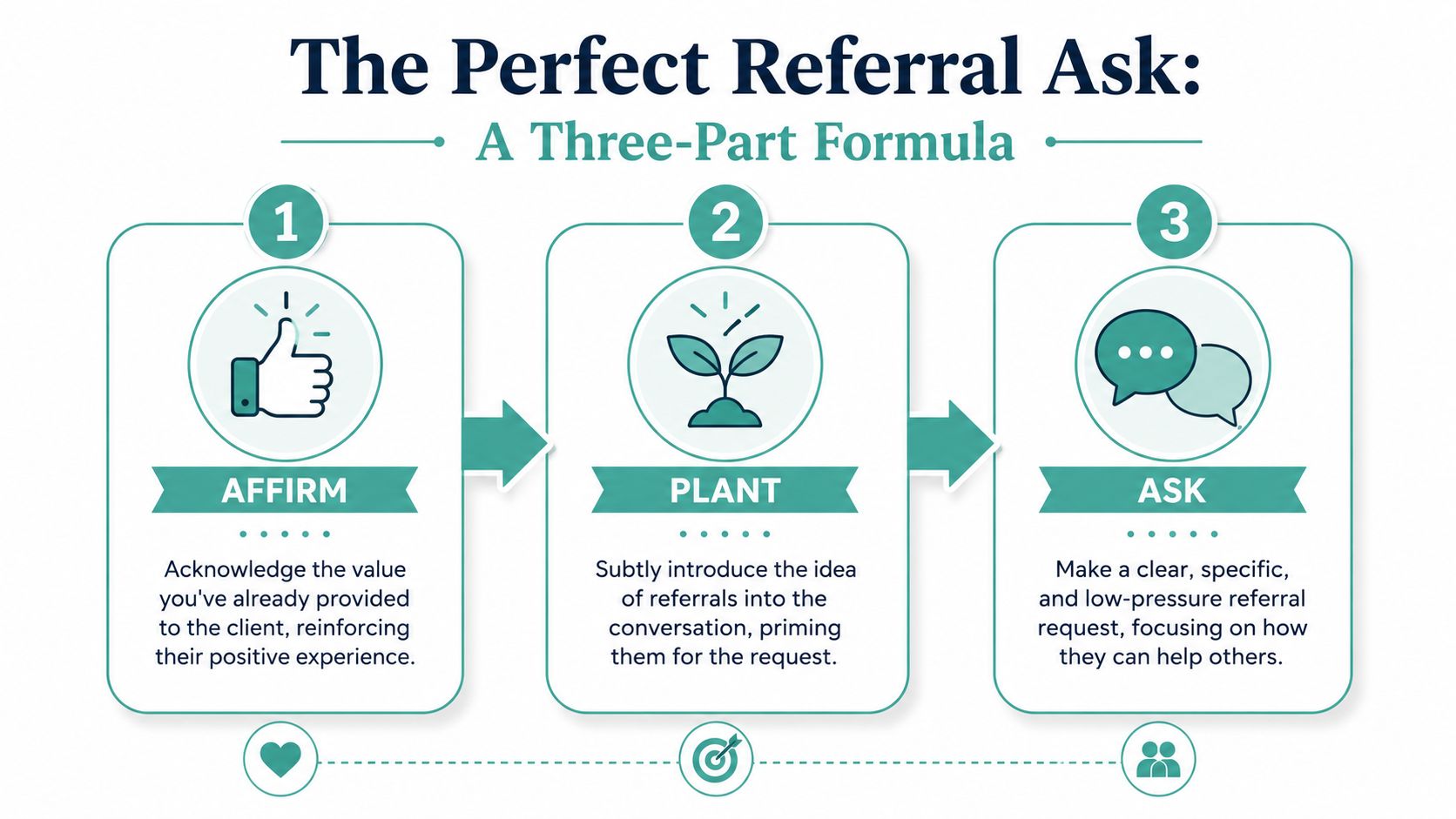
Affirm
Start by naming the positive result or experience you've already shared.
This lowers tension because you're grounding the conversation in something real, not leaping straight into a request.
Base script: “Working with you on this has been great. I'm glad we got this handled smoothly.”
For different SMB settings, that sounds like:
Real estate: “I'm really glad we got you through this closing cleanly.”
Home services: “I'm glad we could get this fixed without dragging the project out.”
Health and wellness: “I'm happy you're feeling better and that the plan is working.”
Professional services: “I'm glad we were able to simplify this and get you a clear outcome.”
Plant the seed
Now remind them what you do and who you help. Many owners at this point skip a step and lose the moment.
Don't assume the client can instantly translate your work into referral language. Give them the category and the type of person.
Base script: “A lot of the people I help are dealing with the same kind of situation you were dealing with at the start.”
That sentence helps the client search their memory. It also keeps the conversation focused on relevance instead of obligation. This is the same reason strong trust assets matter. If you want clients to speak about you clearly, your business has to present itself clearly. Adwave's guide to testimonial pages that build trust and drive sales is useful on that front because good testimonials teach clients how to describe your value.
Ask
Make the request simple, direct, and low pressure.
Base script: “Who comes to mind that might appreciate the same kind of help?”
Keep it short. Don't pile on qualifiers. Don't apologize for asking.
Then use one of the most overlooked tactics in referral conversations: break eye contact and stay silent. That pause matters. If you keep staring at the client, you increase social pressure. If you rush in to rescue the silence, you interrupt their thinking.
After the ask, stay quiet long enough for them to search their memory.
Another small tactic works especially well in meetings. Use a pre-filled referral pad or note page so the act of writing names feels normal, not dramatic. It signals that introductions are a regular part of your process.
What not to do
A few habits create friction fast:
Don't lead with the word referral: It can feel formal and loaded.
Don't ask during a stressed deal: Timing drops when the client is distracted or frustrated.
Don't request details too early: Let the first name land before turning it into a logistics discussion.
The formula works because it doesn't sound like a pitch. It sounds like a professional helping people connect useful outcomes to other people who may need them.
Referral Scripts for In-Person Email and Social Media
The script should match the channel. A coffee meeting allows for warmth and silence. Email needs brevity. Social messaging needs tact.
Bad referral asks usually sound either too generic or too intense. Good ones sound grounded, specific, and easy to answer.
Do this, not that
Awkward in person: “Hey, do you know anybody who needs my services?”
Better in person: “I'm glad this worked out well for you. I spend a lot of time helping other homeowners deal with the same issue. Who have you talked with lately that might need that kind of help too?”
Awkward email: “Just checking in. If you know anyone, send them my way.”
Better email: “Glad we were able to get this wrapped up smoothly. I often work with other business owners who run into the same challenge you had. If someone comes to mind, I'd be happy to be a resource.”
Awkward social DM: “Can you refer me to your network?”
Better social DM: “Glad to see things are going well after we worked together. If someone in your circle mentions dealing with a similar problem, feel free to connect us.”
Referral Request Channel Comparison
Copy-and-paste versions
For local business owners, these are easy to adapt:
After a closing call: “I'm glad everything came together the way it did. If someone in your circle is about to buy or sell and wants a calm process, I'm happy to help.”
After a completed service job: “I appreciate the trust. If a neighbor mentions the same issue, feel free to connect us.”
After a successful treatment or consultation: “I'm glad you're in a better place with this. If someone close to you is trying to figure out the same thing, I'm always happy to talk.”
The best script is the one you can say without sounding like you borrowed it from a sales seminar.
Keep referral requests brief and specific. See our guide to marketing emails that don’t sound like spam for examples of direct wording.
Building a Referral Engine Not Just a Contact List
One referral is nice. A system is better.
The businesses that get steady introductions don't rely on occasional courage. They build a repeatable process around people who already trust them, and they keep those relationships warm over time.
Multiply the moment
One of the simplest upgrades comes after someone gives you a name. Don't immediately switch into logistics mode.
According to Southwestern Consulting's referral process guidance, asking for pre-approach details too quickly causes 80% to stop at one referral, while asking “Who else?” after securing the name and writing down as much information as possible can lead to 10+ contacts. The same source notes that 70% of new business comes from existing referral sources who have referred in the past year, and nurturing those relationships has been shown to accelerate client growth by 150% in five weeks.
That changes the goal. You're not collecting isolated names. You're identifying active connectors.
Build a real cadence
A referral engine has a rhythm. Not a burst.
Use a simple outreach plan across the year for people who've referred before. Check in after wins. Share a relevant update. Thank them when they make an introduction. Keep them close enough that referring you stays easy.
For industry-specific client acquisition, Ashby and Graff's client acquisition guide offers useful perspective on staying visible in relationship-driven markets, especially real estate where trust compounds over repeated touchpoints.
Referrals work better when your brand is easier to remember
This is where brand building matters. A client may trust you deeply, but if they can't quickly explain what you do and why you're different, they won't refer you as often or as clearly.
That's why referrals should sit alongside loyalty and retention work, not separate from it. Adwave is a strong fit for businesses that want broader local visibility because it helps small businesses build awareness in the same markets where word of mouth spreads. Pairing referrals with visible brand presence makes the introduction easier. The prospect has often heard of you before the conversation starts. Adwave's article on building a customer loyalty program on any budget supports the same principle. Stay memorable, and advocacy gets easier.
Handling Hesitation and Following Up Gracefully
Even good asks won't always get an immediate yes. That's fine.
Your first job is to protect the relationship. If the client hesitates, don't fill the silence with persuasion. Keep the interaction light and respectful.
What to say when they pause
Use responses like these:
If they say “Let me think about it” “Absolutely. No rush at all. If someone comes to mind later, I'd be glad to help.”
If they say “I can't think of anyone right now” “That's completely fine. If a conversation comes up down the road, feel free to mention me.”
If they say no directly “No problem. I appreciate you even considering it.”
A clean exit preserves more future goodwill than a clumsy second attempt.
A non-pushy follow-up
If they said they'd think about it, a short follow-up a few days later works:
“Thanks again for the conversation earlier this week. If anyone comes to mind who could use the same kind of help, I'm always happy to be a resource.”
That's enough. No guilt. No repeated nudges.
If you want another model for structured advocacy without pressure, even outside classic client referrals, programs like T-Shirt Envy's affiliate option show the value of making participation simple and voluntary. The principle carries over. People respond better when the path is clear and the pressure is low.
If you want more people to refer you, make yourself easier to remember before the ask ever happens. Adwave helps small businesses build that kind of visibility with AI-powered TV advertising across premium channels, giving your market more familiarity with your brand before a client ever makes an introduction. That combination of trust, recognition, and timing is what turns referrals into steady growth.


