
You already know the page I'm talking about. A prospect fills out your contact form, books an appointment, or claims an offer. Then they land on a blank message that says, “Thanks, we'll be in touch.”
That page feels harmless. It isn't.
It's one of the few moments in your marketing when a customer has just acted, just trusted you, and is still paying attention. If your thank-you page does nothing except confirm submission, you're letting momentum die at the exact point it's strongest.
For local businesses, that missed opportunity is expensive in a very practical way. You already paid for the click, the visit, the phone call, or the form fill. A stronger confirmation page can turn that same action into a review request, a booked consultation, a referral, a second offer, or a better-qualified lead without raising your acquisition cost.
Why Your Thank You Page Is a Wasted Asset
Most SMB thank-you pages are dead ends. They confirm the action, then stop. No guidance. No next step. No attempt to turn fresh intent into another meaningful action.
That's the wrong way to treat the page.
CRO specialists describe the thank-you page as a post-conversion asset that can move a user to the next step, such as an upsell, email signup, webinar registration, or social follow. They place it inside the broader conversion funnel because it appears right after the user has completed a desired action, when intent is highest and trust is already established, as explained in ThriveCart's guide to high-converting thank-you pages.
Why this moment matters more than most pages
A visitor on your homepage is browsing. A visitor on your pricing page is comparing. A visitor on your thank-you page has already committed to something.
That difference changes the job of the page.
Instead of persuading from scratch, the page should channel momentum. If someone just requested an estimate, they may be willing to upload project photos. If they just booked a cleaning, they may be ready to join your email list for maintenance reminders. If they just downloaded a guide, they may be open to scheduling a consultation.
Practical rule: Don't treat the thank-you page like a receipt. Treat it like the first page of your follow-up sequence.
What a wasted page usually looks like
You've seen the pattern:
Generic copy that says almost nothing beyond “thank you”
No reassurance about what happens next
No call to action tied to business goals
No social proof to reinforce the decision
No intentional tracking of the next action
That's not just bland. It breaks the journey.
If you've already worked on stronger landing pages, the same discipline should continue after the conversion. Many of the same principles in landing page best practices that increase conversions still apply here, especially message clarity, visual continuity, and a single clear objective.
The simple reframing
A thank-you page isn't the end of the funnel. It's the handoff point between acquisition and retention.
When you view it that way, the page becomes much easier to design. Confirm the action. Reduce uncertainty. Then offer one logical next step that helps both the customer and your business.
That's where thank you pages, turning a confirmation into a marketing opportunity, stops being a slogan and starts becoming a practical growth tactic.
The Anatomy of a High-Converting Thank You Page
A strong thank-you page doesn't try to do everything. It does a few things in the right order.
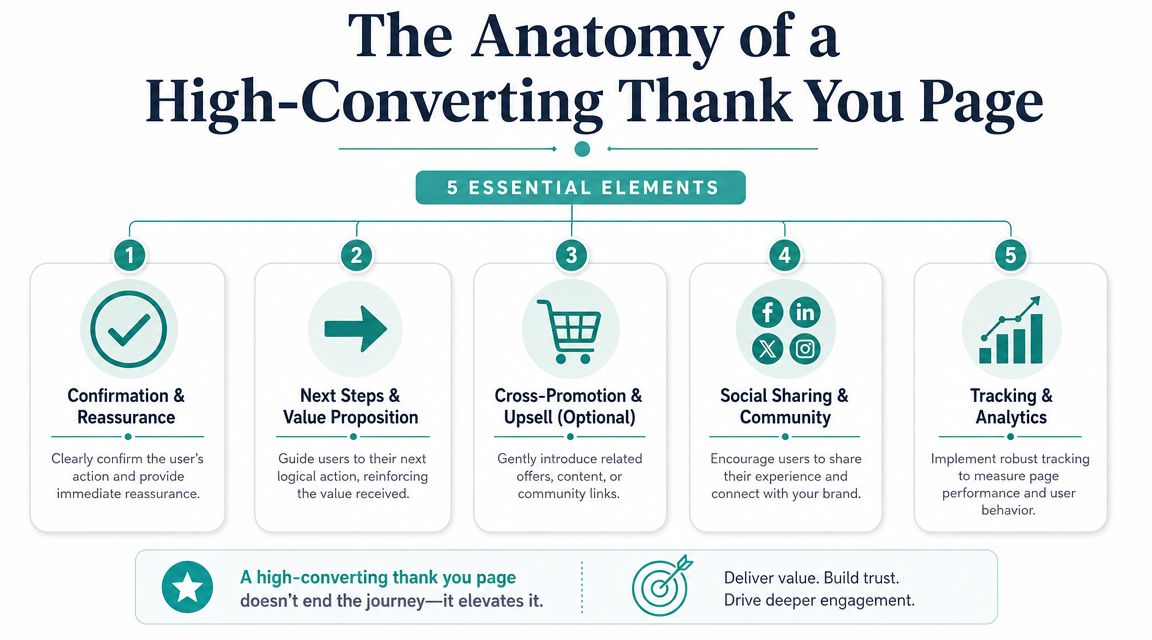
Guidance from Thrive Themes recommends building the page as a single next-step decision point, not a menu. Confirmation, next-step instructions, and one primary CTA should sit above the fold, with the page limited to one or at most two actions so people don't split attention or leave without doing anything useful, as outlined in their article on thank-you page optimization.
The core structure
Here's the order that works best for most SMBs:
Confirm success immediately Tell people their form, booking, or purchase went through.
Explain what happens next Set expectations. Will you call them? Email them? Send a quote?
Present one primary CTA This is the business-growth move. It should be relevant to the action they just took.
Support the CTA with proof or context Add a testimonial, short explanation, or benefit-driven sentence.
Track the next action as an event Don't rely on pageviews alone to judge performance.
What to put above the fold
Above the fold, keep the page simple and functional:
A clear confirmation headline like “Your request is in”
A short expectation line like “Our team will contact you soon”
One button that advances the relationship
Minimal distractions so the next step stands out
What doesn't work is cramming in blog links, a social feed, navigation clutter, and three unrelated offers. That turns a focused moment into a messy one.
A thank-you page should feel like a guided handoff, not a mini homepage.
CTA options that make sense for SMBs
Not every business should ask for the same next action. The best CTA depends on the original conversion and your sales cycle.
If you want to improve the actual button language, CTA button wording and placement best practices can help you tighten the copy without overcomplicating the layout.
What good page copy sounds like
Weak:
“Thank you for submitting your information.”
Better:
“Thanks. Your estimate request is in. Want to speed things up? Upload a few project photos and we'll come to the conversation prepared.”
Weak:
“Your appointment has been booked.”
Better:
“Your consultation is confirmed. Before you arrive, watch this short overview so you know exactly what to expect.”
The difference is direction. Good thank-you pages don't just acknowledge. They guide.
Implementation Templates for Local Businesses
Theory is useful. Templates get pages built.
Below are simple before-and-after examples that fit the way local businesses sell. The point isn't fancy design. It's matching the next step to the customer's current intent.
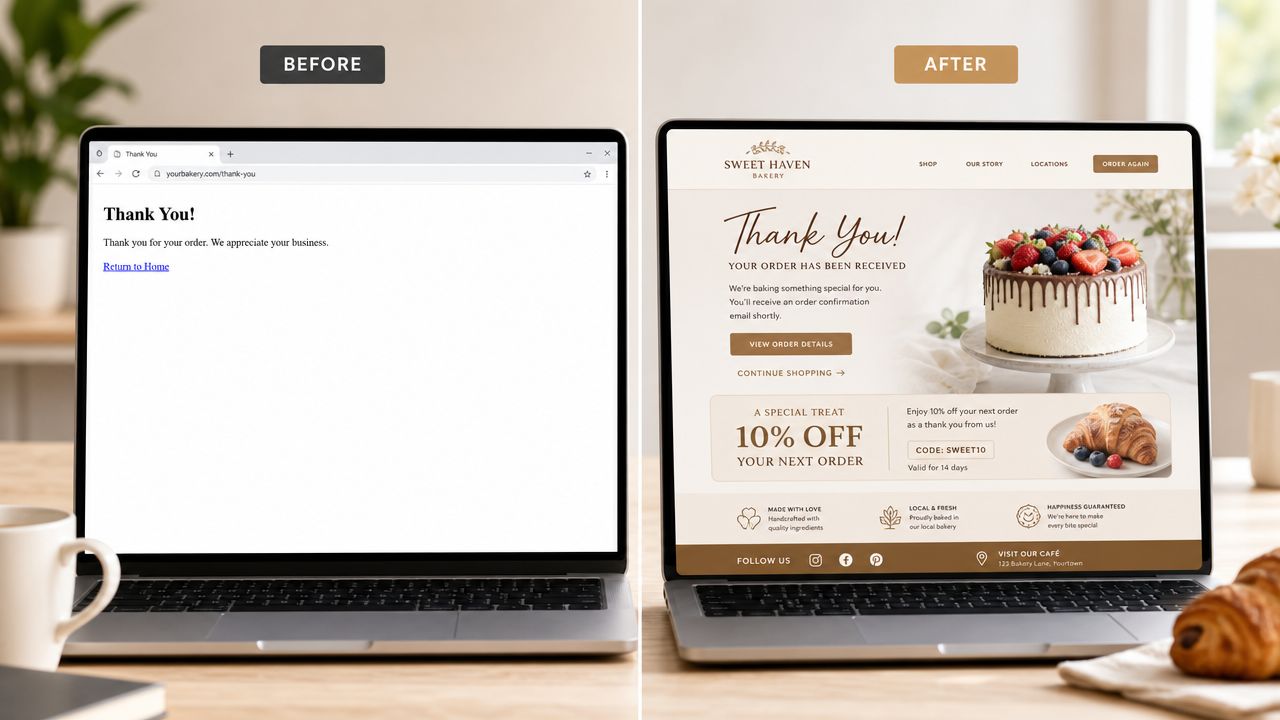
Dental practice
Before “Thank you. We received your appointment request.”
That confirms the action, but it doesn't reduce anxiety or move the relationship forward.
After “Thanks, your appointment request is in. Our team will contact you to confirm your time. New patient? Complete your intake form now to save time at check-in.”
Why it works:
It reassures the patient that the request went through
It explains the next step clearly
It offers one useful action that helps both patient and staff
A dental office could also use the page to invite patients to read a “What to expect at your first visit” page or join an email list for care reminders.
Real estate agent
Before “Thanks for contacting us.”
That's polite, but it wastes the lead's attention.
After “Thanks for requesting property details. While we prepare the full info, take a virtual tour of a featured listing in your target area.”
This works because the user is still in browsing mode. They raised their hand for one property, but they may be willing to view another relevant listing, download a neighborhood guide, or schedule a buyer consultation.
Useful test: If the CTA helps the prospect make a buying decision faster, it belongs on the thank-you page.
Home services company
Think roofing, HVAC, plumbing, landscaping, or remodeling.
Before “Thank you. We'll be in touch shortly.”
After “Your estimate request is confirmed. Want a faster, more accurate quote? Upload photos of the area and tell us the main issue.”
This is one of the best low-cost thank-you page moves for service businesses. It qualifies the lead without adding friction to the original form. The customer already converted. Now you can ask for supporting details on the confirmation page rather than risking abandonment earlier.
Bakery, salon, or local retailer
These businesses often miss simple retention opportunities.
Before “Thanks for your order.”
After “Your order is confirmed. Want first access to seasonal specials and pickup promos? Join our text or email list.”
This doesn't need a complicated funnel. A well-placed opt-in or a “follow us for weekly specials” CTA can turn a one-time order into an ongoing channel.
A quick copy formula for SMBs
Use this formula when writing your own page:
Line 1 confirms the action
Line 2 explains what happens next
Line 3 presents one next step that feels helpful
Examples:
“Your quote request is in. We'll review it and follow up. In the meantime, upload photos so we can prepare.”
“Your table is reserved. We'll see you soon. Join our VIP list for special event announcements.”
“Your home valuation request is received. We're pulling the details now. Browse recent local listings while you wait.”
If you need more ideas beyond the page itself, these local business marketing strategies pair well with strong post-conversion experiences.
Measuring Success and Optimizing Your Page
Most advice about thank-you pages focuses on headlines, offers, and CTA buttons. That matters. But the technical setup matters just as much.
If your measurement is sloppy, the page can create misleading conversion data. One analysis warns that thank-you page refreshes can create false positives, which is one reason many teams shifted from simple page-load counting to event-based tracking, as discussed in Tortoise and Hare Software's breakdown of why thank-you pages can distort conversion tracking.
Why pageviews can fool you
A pageview tells you the page loaded. It doesn't always tell you a real conversion happened cleanly.
Problems show up when:
Users refresh the page and fire duplicate confirmations
Indexed thank-you pages get discovered when they shouldn't
Multiple tracking systems count the same action differently
Paid media platforms optimize toward noisy signals instead of real outcomes
For a local business, this can turn into bad decisions fast. You think a campaign is producing quality leads. In reality, your reporting may be counting the confirmation page in a way that inflates success.
The cleaner setup
Apexure highlights a newer best practice that many SMBs still miss. Noindex thank-you pages so they don't appear in search results and skew conversion tracking data, especially when clean reporting matters for paid media and lead quality, as noted in their guide to post-form thank-you page examples and measurement design.
What to track instead:
Primary conversion event tied to the actual form completion or purchase
CTA click event for the next-step button on the thank-you page
Secondary actions like video plays, review clicks, referral shares, or document downloads
Lead enrichment events such as photo uploads or second-step form submissions
Measurement rule: Count the main conversion separately from the marketing actions that happen after it.
That gives you a clearer view of what the page is doing. The original form tells you acquisition worked. The thank-you page events tell you whether your post-conversion strategy is working.
Smart optimization ideas
Once tracking is clean, test small changes:
Headline clarity versus a softer brand-led headline
CTA format like button text, placement, or supporting copy
Proof near the CTA such as a testimonial or trust badge
Friction level for second-step forms, especially if you ask for extra details
Don't test five things at once. Change one element, watch downstream actions, and keep what improves the quality of follow-up.
Connecting to Your Post-Conversion Strategy
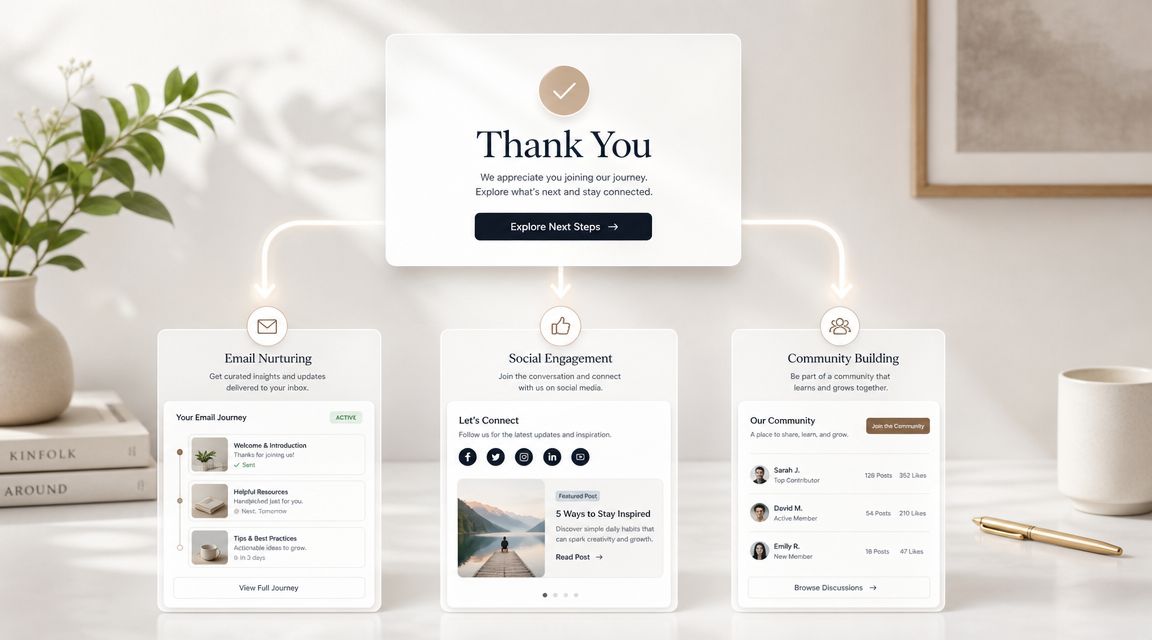
A thank-you page works best when it triggers something beyond itself. The page is the moment of attention. The system behind it is what turns that attention into revenue.
The follow-up chain
A good setup looks like this:
Visitor completes the original action Form submitted, appointment requested, purchase made.
Thank-you page presents one next step Book, upload, watch, review, refer, or subscribe.
That action triggers the next system An email sequence starts, a sales rep gets notified, or the user joins a retargeting audience.
Your team follows up based on intent People who watched a financing video may need a different call than people who uploaded job-site photos.
Many SMBs often lose momentum here. They collect the first lead, but they don't route the next action anywhere useful.
Match the CTA to the channel
The best thank-you page CTA often depends on where the user came from.
From paid search they may want a fast next step, such as booking or calling
From social they may respond better to a guide, video, or community join
From offline advertising they often need reinforcement and a simple path forward
That last point matters more than many businesses realize. If someone responds to a broad awareness campaign, the thank-you page becomes the bridge between interest and action. It can confirm that they're in the right place and steer them into a more trackable, high-intent behavior.
For businesses building stronger follow-up systems, the same thinking applies to confirmation emails. These transactional email ideas for turning confirmations into marketing opportunities complement the page rather than replacing it.
Keep the handoff tight
The easiest way to waste this page is to treat it as separate from the rest of your workflow.
Make sure:
Sales knows which thank-you page actions signal stronger intent
Marketing tags users based on the CTA they clicked
Automation reflects context instead of sending the same follow-up to everyone
Your offer sequence stays consistent with the original ad or landing page promise
When all of that lines up, the thank-you page stops being a courtesy screen and starts acting like a real growth asset.
Frequently Asked Questions
What if I don't sell products online?
That's fine. Most local businesses don't need an ecommerce-style upsell.
Use the page to offer a logical next action such as booking a consultation, uploading project details, downloading a guide, watching a short explainer, requesting financing information, or joining your email list. The key is relevance, not complexity.
How is a thank-you page different from a confirmation email?
The thank-you page appears immediately after the action, while attention is still high. The confirmation email supports the same journey later in the inbox.
Use the page for instant next-step action. Use the email for reinforcement, records, reminders, and follow-up content.
What's the single most important thing to add if I only have time for one improvement?
Add one clear next-step CTA that fits the original conversion.
If someone asked for a quote, ask for supporting photos. If they booked a service, invite them to complete intake details. If they downloaded a guide, offer a consultation. One useful step beats a prettier design every time.
Start with one next action that helps the customer and helps your team qualify, close, or retain.
Can I have multiple CTAs on my thank-you page?
You can, but you usually shouldn't.
In most cases, one primary CTA performs better because it keeps attention focused. If you include a second action, keep it visibly secondary and closely related. Don't put “book a demo,” “read our blog,” “follow us,” and “shop now” on the same page unless confusion is your goal.
Should I ask for more information on the thank-you page?
Sometimes, yes.
This works well when the extra information improves lead quality but would create friction if you asked for it before conversion. Project photos, preferred appointment times, insurance details, and property preferences are all examples. Keep it optional or tightly scoped so the user doesn't feel trapped in another long form.
Should thank-you pages be indexed by search engines?
Usually, no.
If confirmation pages are indexed, they can create tracking and reporting issues. Keep them out of search results and track the meaningful next actions with events so your reporting stays clean.
What makes a bad thank-you page?
A bad page does one or more of these:
Confirms the action vaguely and leaves the user unsure what happens next
Presents too many choices and weakens focus
Breaks message continuity from the ad or landing page
Tracks only pageviews and assumes the data is trustworthy
Feels generic instead of tied to the customer's actual intent
A good page feels like the natural next step, not an afterthought.
If you're investing in demand generation and want the clicks, visits, and responses from your campaigns to turn into measurable business outcomes, Adwave is a smart fit. Adwave helps small businesses create, launch, and measure TV advertising across premium channels without the traditional production burden, and that makes post-conversion strategy even more valuable. Strong thank-you pages give you a cleaner path from attention to action, while Adwave gives you an accessible way to generate that attention at scale.


