You're probably in one of two situations right now.
A customer tells your team they're happy, leaves a nice review, smiles at checkout, then disappears. Or you're spending money on marketing, seeing some movement, but you can't tell whether you're attracting loyal customers or just buying short-term attention.
That's where Net Promoter Score becomes useful. Not because it's trendy, and not because big companies love dashboards. It matters because small businesses live or die on repeat purchases, referrals, and local reputation. If you want a practical answer to Net Promoter Score: Should Small Businesses Track It?, the short version is yes, most should. But only if they use it to make decisions, not admire a score.
What Is Net Promoter Score and Why Should You Care
A lot of small business owners confuse customer satisfaction with customer loyalty. They're not the same.
A satisfied customer may have no complaints and still never come back. They may like you, but not enough to talk about you. That gap is expensive. It means you're constantly paying to replace customers you thought you had already won. If you care about referrals, repeat revenue, and retention, you need a way to measure loyalty directly.
The question that gets to the point
Net Promoter Score is built around one simple question:
How likely are you to recommend us to a friend or colleague?
That question works because recommendation is a stronger signal than “Were you satisfied?” Satisfaction is soft. Recommendation puts your customer's reputation on the line. If they're willing to refer you, they usually trust you, remember you, and expect a good experience for the next person too.
For a small business, that matters more than vanity metrics. A decent click-through rate won't save a weak local reputation. A burst of traffic won't fix churn. Loyalty does.
Why small businesses should pay attention
NPS is useful when your business depends on any of the following:
Repeat business: salons, clinics, agencies, trades, retailers, restaurants, and service firms
Word of mouth: local brands that grow because people talk
Customer lifetime value: any model where the second, third, or tenth purchase is where profit shows up
Reputation: businesses where one bad experience can spread fast
If that sounds like your company, tracking loyalty isn't optional. It's operational.
A practical starting point is to pair NPS with other retention work, like these customer retention strategies that cost less than new acquisition. That's the primary use case. NPS should help you keep more of the customers you already paid to acquire.
What NPS tells you
NPS won't tell you everything. It won't replace sales data, margin data, or campaign reporting. What it does tell you is whether your customer base is filling with advocates or with quiet defectors.
That's a big distinction. If people are buying once and drifting away, revenue gets fragile fast. If people are recommending you, repurchasing, and defending your brand, growth gets cheaper.
Understanding the Net Promoter Score Formula
A small business runs a local TV campaign, foot traffic ticks up, and sales look decent for two weeks. Then the obvious question hits. Did the ads build a stronger brand, or did they just create a short spike?
That is where the NPS formula earns its keep. It gives you a simple way to see whether more customers are becoming advocates or critics after your marketing runs. For small businesses spending real money on brand-building, especially channels like TV that do not always produce instant, trackable conversions, that matters.
How the scoring buckets work
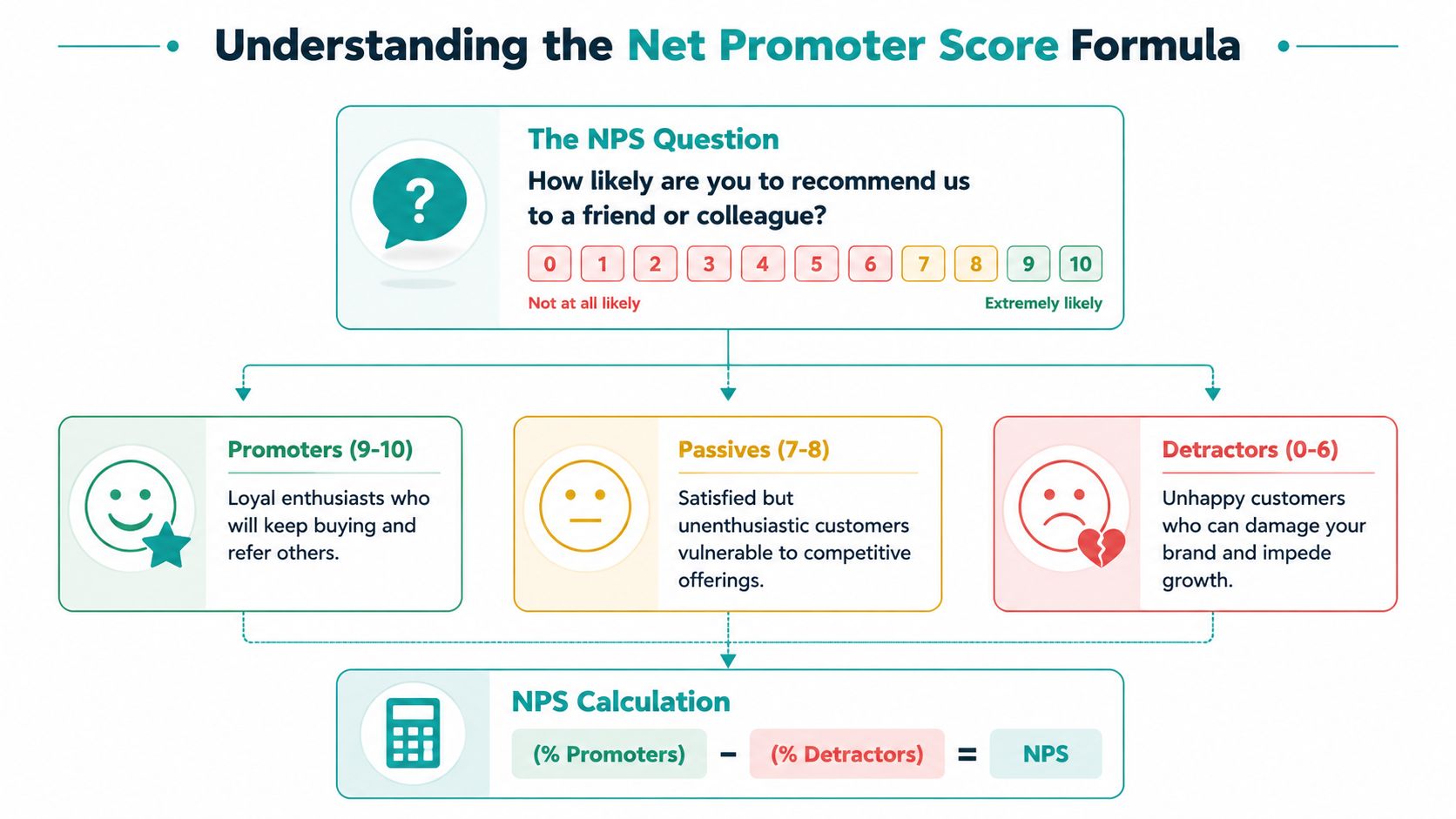
You ask one question: how likely is the customer to recommend your business on a 0 to 10 scale?
Then you sort responses into three groups:
Promoters: scores of 9 to 10
Passives: scores of 7 to 8
Detractors: scores of 0 to 6
Promoters are the customers most likely to buy again, leave reviews, and send other people your way. Passives are satisfied enough to stay for now, but not impressed enough to help you grow. Detractors are the expensive group. They create churn, complaints, bad word of mouth, and wasted acquisition spend.
That last point matters. If you paid to get the customer through Google Ads, direct mail, or local TV, a detractor is not just unhappy. They are a poor return on your marketing budget.
The formula is simple
% of Promoters - % of Detractors = NPS
The final score ranges from -100 to +100.
Here is a basic example:
That gives you an NPS of 60.
Passives do not count in the formula. That is deliberate. NPS is not trying to measure general satisfaction. It is measuring whether your customer base is tilting toward advocacy or resistance.
For an owner, that is the useful question. Advocacy lowers future acquisition costs. Resistance raises them.
Why passives still matter
Passives sit outside the formula, but they should not sit outside your analysis.
If a TV campaign increases awareness and brings in more first-time buyers, you may see passives rise before promoters do. That is normal. Brand-building often works in stages. People notice you first, try you next, and recommend you only after a good experience confirms the promise. Women Listed on customer acquisition makes the broader point well: small businesses are found through more than one channel, and word of mouth still carries weight. NPS helps you see whether your marketing is feeding that engine.
So do not read passives as irrelevant. Read them as unfinished value.
What the formula should tell you financially
The use of NPS is not scorekeeping. It is deciding where revenue is getting stronger or weaker.
Use the categories like this:
Promoters get review requests, referral asks, and upsell offers.
Passives get better onboarding, follow-up, and clearer reasons to come back.
Detractors get fast service recovery before they turn one bad experience into lost future sales.
Pair the score with spend and customer value. If your NPS rises after a campaign, and your best segments also show stronger repeat purchase behavior, your marketing likely did more than drive awareness. It improved future revenue potential. That is why smart owners connect NPS to customer lifetime value for small businesses instead of treating it like a soft brand metric.
Use the formula for what it is: a blunt but useful filter. It will not explain every sales change. It will show whether your marketing is producing more people who help your business grow.
The Business Case for NPS in a Small Company
If you run a small company, every metric has to answer one question. Does this help me make more money or avoid losing it?
NPS can do both. Used well, it helps you identify whether your customer base is strengthening or leaking. That's why I recommend it for most businesses that rely on retention, referrals, or local reputation.

The revenue link is real
In most industries, NPS explains 20% to 60% of the variation in organic growth rates, and NPS leaders outgrow rivals by a factor greater than two times according to Ringly's NPS statistics roundup. That matters because small businesses don't have endless acquisition budgets. Organic growth is cheaper, stickier, and usually healthier.
The same source notes that companies with an NPS of 75 or higher see at least 13% higher Customer Lifetime Value. That's the part many owners miss. A better loyalty profile doesn't just make customers feel warm and fuzzy. It changes what they're worth.
Promoters are not just happy customers
Promoters are usually the customers who:
Buy again: they come back without needing constant discounting
Refer others: they reduce your dependence on paid acquisition
Complain less destructively: they're more likely to give you a chance to fix problems
Support pricing power: they're less likely to leave over small price differences
That last point is a big one for local businesses. If your margins are tight, loyal customers protect you from the race to the bottom.
If you want a grounded look at how buyers discover local brands, this piece on Women Listed on customer acquisition is worth reading. It's a useful reminder that word of mouth and discovery channels overlap. People don't separate brand reputation from how they found you.
NPS is not a vanity number if you use it correctly
A vanity metric makes you feel informed without changing what you do. NPS becomes operational when you connect it to:
Retention trends
Referral volume
Repeat purchase behavior
Campaign quality
Segment performance
A strong NPS doesn't mean your business is healthy by itself. It means you have more people willing to pull growth forward for you instead of forcing you to buy every next sale.
That's why it belongs in the same conversation as how to measure marketing ROI. If your marketing brings in customers who become promoters, your spend is doing more than generating transactions. It's building future revenue.
When NPS Can Be a Misleading Metric
NPS is useful. It's not magical.
A lot of small businesses misuse it because they expect one score to explain current sales, future growth, brand strength, customer service quality, and campaign performance all at once. That's lazy thinking, and it leads to bad decisions.
The biggest problem is timing
NPS is often a lagging indicator. It tells you how customers feel after they've had an experience with you. That's valuable, but it's not the same as a live forecast of next month's revenue.
That distinction matters. According to Net Promoter System's discussion of measurement pitfalls, 68% of small business owners misinterpret NPS as a direct sales predictor and end up misallocating marketing budgets based on outdated scores. That's exactly how a useful metric becomes a dangerous one.
If your score drops this month, the answer isn't automatically “cut marketing.” If your score rises, the answer isn't automatically “sales will surge.” You still need context.
Small samples create fake confidence
Many local businesses don't get huge response volume. That creates a practical problem. If only a small slice of your customer base responds, the score can swing sharply based on a handful of people, especially if the experience was unusually good or unusually bad.
That doesn't make NPS worthless. It means you shouldn't react dramatically to every bump. Look for patterns, not mood swings.
A misleading NPS setup often looks like this:
You only survey your happiest customers: the score gets inflated
You only ask after a service recovery: the score gets distorted
You survey at random times with no consistency: trends become hard to trust
You ignore written comments: you miss the reasons behind the number
The score can distract from the real question
The wrong question is “Is our NPS good?”
The right questions are:
Are detractors increasing?
Are passives failing to become promoters?
Are our best customer segments becoming more loyal or less?
Did a service issue, staffing issue, pricing issue, or marketing promise create the shift?
If NPS changes and you can't explain why, the score isn't your problem. Your measurement process is.
Treat NPS as one input. Pair it with retention, repeat sales, review trends, and what your frontline staff hears every day. That's how you keep it useful.
A Practical Guide to Launching Your NPS Program
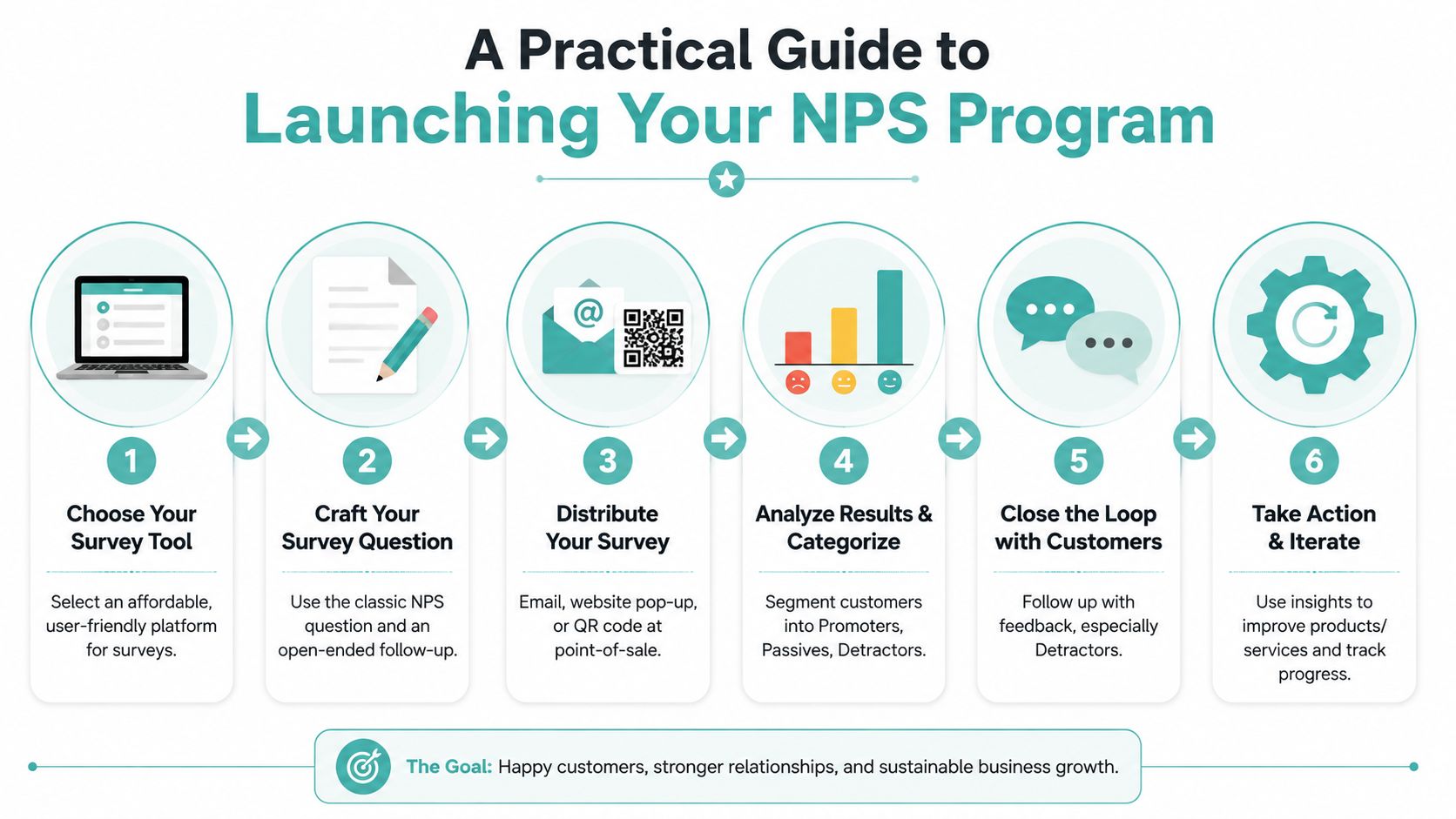
Most small businesses don't need enterprise software, a research team, or a six-month rollout. You need a simple system your staff will use.
Start with a two-question survey
Keep it short. The standard format works for a reason.
Ask:
How likely are you to recommend us to a friend or colleague?
What's the main reason for your score?
That second question is where the money is. The number tells you what happened. The comment usually tells you why.
Email is a strong channel for NPS distribution, and surveys work best when they stay lean. CustomerGauge's NPS survey best practices recommends keeping them to 2 to 3 questions, with the score question and a driver question that explains the reason behind it.
Send it at moments that matter
Timing matters more than most owners realize. Ask when the experience is fresh and specific.
Ortto's NPS survey best practices recommends sending surveys immediately post-purchase or after customer service interactions, then re-surveying every 90 to 180 days to maintain consistency without causing fatigue.
That gives you a practical cadence:
After purchase: great for retail, e-commerce, and food service
After service completion: ideal for home services, legal, health, automotive
After support interaction: useful when service recovery is part of retention
Quarterly or semiannual check-ins: good for ongoing client relationships
Use low-cost tools you already have
You don't need a fancy stack to start. You can run a basic NPS program through tools your team likely already knows:
Email platforms: send a simple follow-up with the score question
Google Forms or Typeform: useful for lightweight collection
SMS follow-ups: effective for local service businesses
POS receipts or QR codes: practical for in-person businesses
The tool matters less than consistency.
Build a follow-up rulebook
Don't collect feedback without a response plan. That trains customers to talk and teaches your business to ignore them.
Use a simple rulebook:
One habit matters most: call detractors back fast, while the experience is still fixable and before the complaint becomes a public story.
Keep the program lightweight
Your first version should be boring and repeatable. That's good. Don't overbuild it.
Track responses in a sheet if you have to. Tag comments by theme. Look for recurring words like wait time, communication, billing, staff attitude, product quality, or scheduling. The goal isn't elegance. The goal is turning feedback into action every month.
Measure Your TV Ad Impact with NPS and Adwave
One of the hardest parts of brand advertising is proving what it did. Direct response channels are easy to love because they give you clicks, forms, and last-click conversions. TV doesn't always behave that way, especially when the core value is awareness, recall, and trust.
That's where NPS becomes more interesting.
Why brand-building needs a different scoreboard
If you run a TV campaign, some people won't buy right away. They'll remember your name, mention seeing you, trust you faster, and choose you later when the need becomes urgent. That means direct sales alone can understate the campaign's impact.
NPS helps you capture part of that missing picture.
A practical approach looks like this:
Record your baseline NPS before the campaign.
Launch your TV campaign and keep your survey process consistent.
Tag new customers by source where possible.
Compare post-campaign feedback from customers who mention the campaign or arrived during the campaign window.
Read the comments, not just the score.
If newer customers sound more confident in your brand, mention awareness-driven reasons for choosing you, or score as promoters more often than before, your advertising likely improved customer quality, not just customer volume.
This is where small businesses usually miss ROI
Many SMBs judge advertising too narrowly. They ask, “Did this ad produce an immediate sale?” Fair question. In brand media, it's incomplete.
You also need to ask:
Did the campaign bring in better-fit customers?
Did brand familiarity reduce resistance during the sale?
Did new buyers come in already trusting us?
Did more customers become willing to recommend us?
That's why how to measure advertising effectiveness should include loyalty signals, not just lead counts.
What Adwave adds to the equation
Adwave fits this topic well because it gives small businesses access to TV advertising without forcing them into the traditional agency-heavy process. That matters when you want to test brand-building, measure it, and iterate without making TV feel like a once-a-year gamble.
The right way to use NPS alongside Adwave is not to expect a magic spike after one campaign. Use it as a quality check on the audience and the brand experience your ads are creating. If awareness rises but customer sentiment weakens, your message may be attracting the wrong people. If sentiment improves among new customers, your campaign may be building a stronger business than direct attribution alone shows.
A good TV campaign doesn't just create attention. It creates customers who arrive pre-sold on your credibility.
That's the connection. NPS gives small businesses a practical way to measure whether brand advertising is producing loyalty, not just impressions.
So Should Your Small Business Track NPS
A customer sees your TV ad, visits your site a week later, buys a month later, and refers a friend three months after that. If you only measure immediate sales, you miss most of the value your marketing created.
So yes, most small businesses should track NPS.
Track it because it answers a business question that revenue reports cannot answer on their own. Are your marketing and customer experience creating buyers who stay, spend again, and bring other people with them? For any business investing in brand awareness, especially channels like TV that often work with a delay, that answer matters.
Track NPS if it helps you make more money
NPS deserves a place on your dashboard when it supports one of these goals:
Increase repeat purchases
Generate more referrals
Protect pricing power
Spot service problems before churn rises
Measure whether brand marketing is attracting the right customers
That last point is where small businesses often miss the opportunity. A TV campaign may not produce a clean line from ad exposure to same-day sales. It can still improve sales efficiency by increasing trust before the first conversation. If your post-purchase NPS rises after a campaign, especially among new customers, that is a useful signal that your advertising is doing more than creating awareness. It is improving the quality of demand.
Skip the obsession
Do not run your business around one score.
If you sell a one-time emergency service with little referral value and almost no repeat purchase potential, NPS is not your first priority. Fix lead volume, close rate, pricing, and response time first. Those will move revenue faster.
But many owners use that logic too broadly. Plenty of local businesses say they are transactional when they depend on reputation, reviews, repeat visits, and referrals. In those businesses, ignoring loyalty measurement is careless.
Use a simple decision rule
Use NPS if at least two of these are true:
That is enough to justify a simple program.
Keep the process lean. Send the survey after a meaningful customer interaction. Read the open-ended comments. Call unhappy customers. Look for patterns by location, offer, campaign, or customer type. Review trends on a regular schedule and tie them back to retention, repeat revenue, referral volume, and sales conversion.
That is the point of the metric. NPS is not there to make your reporting look impressive. It is there to help you decide whether your business is creating loyalty that turns into revenue.
If you want to connect brand advertising with real business outcomes, Adwave is a strong place to start. It gives small businesses a practical way to launch TV campaigns without the usual production burden, then measure impact with a broader lens than last-click sales alone. Pair that visibility with disciplined NPS tracking, and you get a clearer read on whether your advertising is attracting customers who stay, spend, and recommend.