Daily email senders had a 30.04% average open rate, compared with 33.48% for brands sending one to three emails per month. That doesn’t mean monthly email is always right, but it does challenge the assumption that sending more messages automatically creates more engagement.
Email frequency optimization is a tolerance problem, not a volume contest. Your most active subscribers may welcome frequent, relevant updates, while marginally engaged readers may need more space between messages. The right cadence depends on engagement, lifecycle stage, inbox placement, message quality, and the role email plays alongside other channels.
Why More Emails Are Not Always Better
Sending more often feels efficient because it creates more chances for clicks, replies, purchases, and bookings. In practice, every extra send also asks for more attention, and subscriber attention runs out faster than many teams expect.
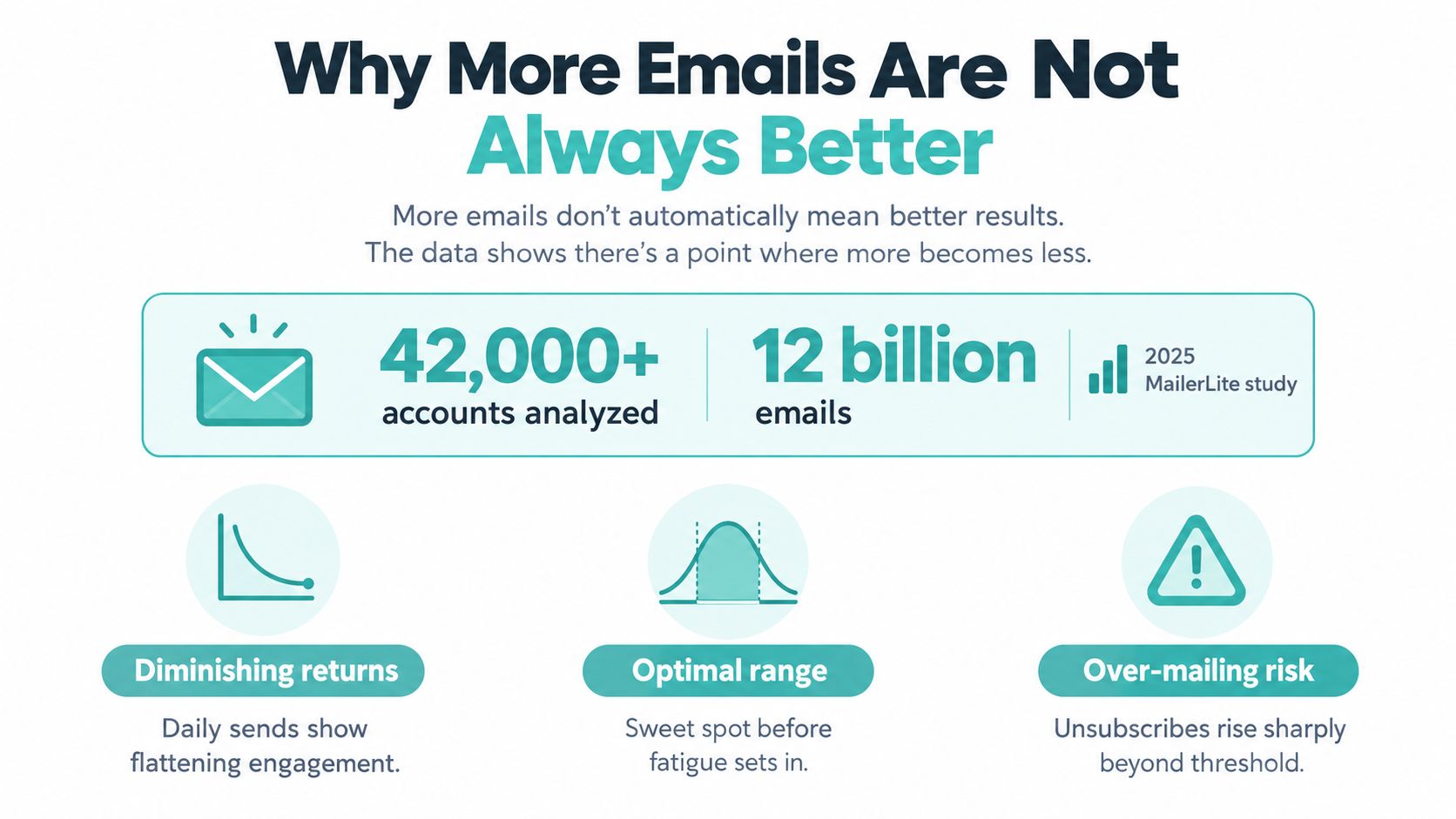
A large 2025 MailerLite analysis covering more than 42,000 email accounts, 1.4 million campaigns, and 12 billion emails found that daily senders had a lower average open rate of 30.04%, compared with 33.22% for weekly senders and 33.48% for brands sending one to three emails per month. The same dataset showed that 52% of businesses send at least one email per week, while 29.5% send exactly weekly and 10.8% send daily.
The hidden cost of a fuller calendar
Those results do not prove that daily sending caused every difference. High-promo brands, different industries, and different subscriber expectations can all shape the outcome. They do show that frequency and list fatigue move together.
The same MailerLite analysis found a practical middle ground between monthly and twice-weekly sends, where open and click performance stayed relatively strong while unsubscribe risk stayed low. For SMBs, that range is a sensible starting point because it keeps contact consistent without forcing every subscriber into a high-volume program.
One mistake I see often is judging cadence by open rate alone. A heavier send schedule can produce more total opens only because more emails went out, while response per message slips. The audience may also stop clicking, ignore future messages, or mark unwanted email as spam.
Practical rule: More sends only help when each additional send creates enough value to justify another interruption.
Cadence is also a deliverability decision
Fatigue affects more than campaign engagement. Subscribers who repeatedly ignore your messages can weaken the quality of your active audience, and weak reactions can create deliverability problems. Before changing cadence, review your email deliverability tactics and why emails go to spam and how to fix deliverability alongside your content and segmentation process.
Your frequency plan should answer three questions:
- Who should receive the next message? Active clickers and recent customers may deserve a different schedule from inactive subscribers.
- What does the message add? A useful product update, local offer, or educational resource earns more attention than a repetitive promotional blast.
- What happens after disengagement? A subscriber who stops clicking should not stay on the same high-frequency track indefinitely.
For many businesses, the practical answer is not “send weekly to everyone.” It is “start with a manageable baseline, then let subscriber behavior decide who gets more or fewer messages.” That turns frequency optimization into a measurable audience strategy, not a calendar preference.
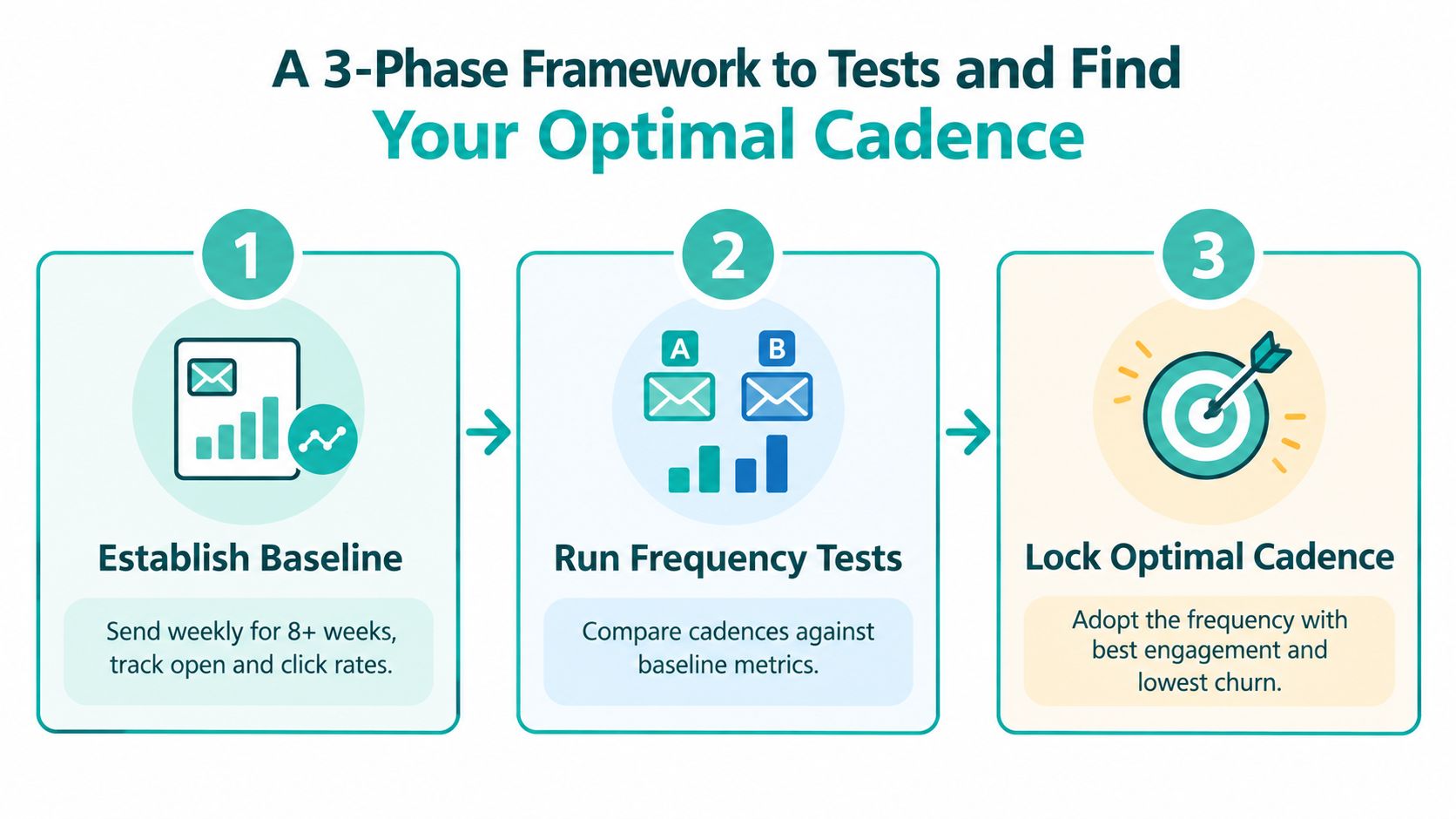
A 3-Phase Framework to Test and Find Your Optimal Cadence
A frequency test works best when it is simple enough for a small marketing team to run and disciplined enough to produce a decision you can trust. Start with one clean baseline, test controlled differences by segment, then validate the winner before you change the full program.
Phase one establishes a clean baseline
Begin with one email per week for at least eight weeks. Keep the audience definition, core content quality, and reporting method stable so you can separate a cadence effect from a change in campaign strategy.
Track the same signals on every send. Watch the open rate trend, not a single campaign. Check click rate, including whether the click led to a useful destination. Monitor unsubscribe rate per send so list churn stays comparable. Keep an eye on spam complaints, because they often warn you sooner than a slow drop in opens.
That baseline gives you a reference point. Without it, you can see that one version performed differently, but you cannot tell whether either cadence is healthy for the business.
Phase two tests frequency by engagement
Build segments from your own behavioral data. A practical split includes highly active subscribers, moderately active subscribers, and dormant subscribers. Use the same rules each time, based on recent opens, clicks, purchases, or meaningful website activity.
Then test a different cadence for each group while keeping the campaign theme and offer as close as possible. Active subscribers might receive two relevant messages per week, while dormant subscribers move to a lower-frequency track. The schedule is a hypothesis, not a universal rule.
The Adwave guide to A/B testing emails helps when you need to separate cadence testing from subject lines, creative, or send-time changes. Change one major variable at a time, or the result will be hard to interpret.
Give subscribers a preference center when your platform supports one. For a broader benchmark on send cadence, see this guide to boost newsletter engagement. Choice will not replace behavioral testing, but it can show whether an inactive reader wants fewer emails, different content, or no promotional messages at all.
Phase three validates before rollout
Hold the test long enough to observe repeated behavior, then compare each group with the baseline. A practical sequence looks like this.
- Weeks one through eight: Send the weekly baseline and record the four core metrics.
- Weeks nine through sixteen: Run the segment-specific cadence test.
- After week sixteen: Compare trends, complaints, unsubscribes, and clicks, then adopt the schedule that gives you the best balance.
The guidance behind this method recommends a weekly baseline for at least eight weeks, comparison across test groups, and a lower-frequency track for less-engaged subscribers. It also notes that 49% of consumers want to choose their own email frequency and 63% of marketers already adjust cadence for less-engaged subscribers, while weekend sends tend to underperform Monday through Wednesday windows on engagement. Those figures are documented in guidance on email frequency testing.
The right cadence rarely looks the same for every segment. Active customers can absorb more contact, dormant readers need a lighter touch, and some audiences will respond better when email cadence fits a broader mix that already includes paid media, events, or TV spots.
Understanding Segment-Specific Tolerance and Engagement Ceilings
A single list-wide cadence hides important differences. Two subscribers can receive the same message, see the same subject line, and have completely different reactions because one actively wants product news while the other barely remembers joining the list.
Historical research illustrates the trade-off clearly. A Return Path study of 13,836 subscribers from eight major apparel retailers, analyzed between December 2014 and February 2015, found the highest expected read rate at one email per week. Customers read almost every third email at that cadence, represented as 0.32. At five emails per week, the expected read rate fell to 0.21, and at seven emails per week it dropped to 0.15. Complaints rose sharply after five messages per week, and once frequency exceeded seven messages per week, about one in ten customers could be expected to report messages as spam, according to the Return Path frequency analysis.
Use the segment, not the average
The historical weekly benchmark is a useful control, but it shouldn’t become a rigid rule. Large-scale deliverability research found that highly engaged subscribers can tolerate up to about five emails per week before complaints rise sharply, making that a practical ceiling for many programs with strong segmentation. Less-engaged subscribers, by contrast, can fatigue much earlier.
| Subscriber segment | Starting cadence | What to watch |
|---|---|---|
| Highly engaged | Weekly, then cautiously higher if behavior supports it | Click quality, complaint trend, and continued purchase or inquiry activity |
| Moderately engaged | Weekly or less frequent, depending on response | Falling clicks, repeated non-response, and unsubscribes after promotional sends |
| Dormant | Lower-frequency track with a clear re-engagement purpose | Whether the subscriber returns, ignores the sequence, or should be suppressed |
These ranges are operating hypotheses, not promises about expected performance. The Return Path findings support weekly as an early benchmark, while the later deliverability research supports a higher ceiling for active audiences. Together, they make the case for modeling tolerance by engagement rather than applying one schedule to everyone.
Frequency should follow intent
A recent buyer may tolerate onboarding and usage guidance that would feel excessive to a cold prospect. A repeat customer may welcome replenishment reminders, while a dormant subscriber may need one useful reactivation message rather than a stream of offers.
Use email list segmentation to separate behavioral intent from simple list membership. Then assign a cadence rule that can change as the subscriber’s behavior changes. Someone who begins clicking regularly can move into a more active track. Someone who stops responding should move down before complaints accumulate.
The practical ceiling isn’t a target. It’s a boundary that protects the program from assuming active subscribers represent the entire database. If your team can’t explain why a segment deserves another email, that send probably belongs in the test queue rather than the calendar.
Integrating Email Cadence with Multi-Channel Campaigns
Email doesn’t operate in a vacuum. A subscriber may see a television ad, visit a website, hear about the business from a colleague, and then receive an email that completes the memory loop. If the email calendar ignores those other contacts, the business can either underuse a valuable moment or overwhelm people with disconnected messages.
The useful question isn’t just how often to email. It’s how email frequency should change when another channel is creating awareness or demand.
Coordinate campaign moments
Suppose a local service business launches a television campaign around a new offer. Email can reinforce the message, provide details, and give existing subscribers a direct response path. That doesn’t mean adding several generic emails on top of the TV schedule. It means assigning each channel a job.
A coordinated plan might look like this:
- Awareness: A TV spot introduces the business and the offer to local viewers.
- Consideration: Email explains the service, answers objections, or shares a useful next step with subscribers who already know the brand.
- Action: A focused email gives the audience a clear booking, purchase, or consultation path.
- Follow-up: The business uses behavior to decide whether a subscriber needs education, a reminder, or less communication.
This approach helps prevent a common mistake, sending the same creative and call to action through every channel. The TV ad earns attention broadly. Email can work more selectively because the business already has permission and behavioral information.
Why Adwave fits the operating model
Adwave is an AI-powered TV advertising platform for small businesses. A business enters its website URL, and the platform’s AI generates a polished, broadcast-ready spot that can be placed across more than 100 premium channels, including NBC, Hulu, and ESPN. The workflow is designed to remove the need for a production crew or a six-figure production budget.
Campaigns start at $50, with automatic pacing that keeps spend within the set budget. Adwave uses audience data and viewing patterns to reach local viewers at an estimated $15 to $35 CPM. Documented outcomes supplied by the platform include 150% client growth in five weeks for Kaimuki Dental and significant revenue gains for Farrow Harley-Davidson.
For an SMB, the relevant connection is planning discipline. A TV campaign can create a period of heightened awareness, but the email team still needs to control pressure on the list. Active subscribers might receive a timely follow-up tied to the campaign. Less-engaged subscribers can remain on their lower-frequency track, while new leads enter a separate nurture path.
The comparison of SMS marketing and email can help clarify channel roles as you build the sequence. Email generally gives you room for explanation and education, while faster channels can handle reminders or immediate actions. TV adds broad local reach, and the combination works best when every touchpoint has a distinct purpose.
A multi-channel campaign shouldn’t make every channel louder. It should make each message more relevant.
Treat TV launch dates as context in your frequency model, not as permission to broadcast to the entire list. Record the campaign period, monitor response by segment, and check whether the added awareness changes clicks or conversions without worsening complaints. That’s how email cadence supports broader growth instead of competing with it.
Monitoring KPIs and Recognizing Fatigue Signals
A cadence decision isn’t finished when the test ends. Subscriber behavior changes as offers, seasons, inbox rules, and customer relationships change. Keep a weekly monitoring routine that distinguishes a real frequency problem from an isolated weak campaign.
Use a practical health checklist
Review these indicators together:
- Open rate trend: A gradual decline across comparable sends can signal reduced interest, but it can also reflect inbox placement or unreliable open tracking.
- Click rate: Clicks show whether the message creates enough relevance to prompt action. Compare the rate by segment, not just across the whole list.
- Unsubscribe rate per send: Stable programs typically keep this around 0.1% to 0.3% per campaign, according to Validity’s frequency research.
- Spam complaints: A rising complaint trend deserves immediate attention, especially after a cadence increase.
- Inbox placement: Check whether messages reach the inbox, because a lower open rate may reflect delivery problems rather than subscriber preference.
The same research suggests that roughly one in six marketing emails never reaches the inbox. That makes inbox-placement monitoring essential. If you judge cadence only through opens, you might reduce sending when the actual problem is delivery, or increase sending because a small engaged group is masking poor reach.
Respond to patterns, not panic
Don’t react to one campaign’s weak result by changing the entire schedule. Compare similar messages, audience groups, and time periods. A complaint spike after a new promotional sequence carries a different diagnosis from a gradual decline among dormant subscribers.
When fatigue appears, take a measured response:
- Pause the increase for the affected segment.
- Review the content mix and remove repetitive promotional messages.
- Move marginally engaged subscribers to a lower-frequency track.
- Check inbox placement before interpreting open-rate changes.
- Re-test later after the audience has received more relevant communication.
An unsubscribe rate above an arbitrary threshold isn’t the only warning sign, and no single number proves causation. Look for a cluster of signals, such as lower clicks, more complaints, and rising unsubscribes after a cadence change. A tool such as an email marketing calculator can help organize campaign performance, but your decision still needs segment-level context.
Implementing and Scaling Your Optimized Frequency Strategy
The strongest frequency program is operationally boring. It has a documented baseline, clear segment rules, a testing calendar, and an owner who reviews results before the team adds another campaign.
Start with the weekly baseline and hold it for at least eight weeks. During that period, don’t chase every fluctuation. Establish how active, moderate, and dormant subscribers respond to your normal content, then use those observations to design the segmented test.
Turn the test into a system
Document the rules in plain language:
- Entry criteria: What behavior moves a subscriber into an active, moderate, or dormant group?
- Cadence limits: How often can each group receive marketing messages?
- Suppression rules: When does a subscriber pause promotional email or enter re-engagement?
- Review schedule: When will the team examine clicks, unsubscribes, complaints, and inbox placement?
- Change control: Who approves a frequency increase, and what evidence must support it?
Keep transactional, service, and promotional communication distinct in both planning and reporting. A customer may need a service confirmation regardless of marketing cadence, but that doesn’t mean the business should count every operational message as permission for additional promotions.
Scale relevance before volume
As your list grows, automation can move subscribers between tracks based on behavior. That prevents the common failure mode where a successful campaign is sent to more people, including subscribers who never showed interest in that topic.
Coordinate email with other channels in the same calendar. If Adwave is running a TV campaign for a local business, map the awareness period, the email follow-up, and the response window without forcing every segment into the same sequence. The result should feel like one customer journey, not a stack of unrelated interruptions.
Email frequency optimization is ongoing because tolerance is dynamic. Test deliberately, let behavior determine cadence, and reduce pressure before fatigue becomes a deliverability problem. The first step is practical: export your current sending schedule, classify subscribers by engagement, and choose a weekly baseline you can measure consistently.
Adwave helps small businesses create, launch, and measure broadcast-ready TV ads from a website URL, giving your email calendar a broader awareness channel to coordinate with. Visit Adwave to explore a controlled way to connect local TV exposure with more deliberate, segment-specific email follow-up.