
SMS gets opened at a rate of 98%, with 90% of messages read within three minutes, while email open rates sit at 20 to 30% with an average response time of 90 minutes according to Omnisend’s SMS marketing statistics roundup. That gap changes how a small business should think about customer communication.
Most owners still ask the wrong question. They ask whether SMS is better than email, or whether email is cheaper than SMS. The more useful question is simpler. What are you asking the customer to do, and how fast do you need them to do it?
If you need someone to act today, SMS usually wins. If you need someone to understand, compare, trust, or remember, email usually earns its place. After a TV ad campaign, that distinction gets even sharper. Broadcast creates awareness. Direct channels capture and convert it. A viewer sees your ad, visits your site, scans a QR code, or searches your business name. What happens next determines whether that ad spend turns into booked appointments, store visits, quote requests, or abandoned interest.
Small businesses do not have the budget to waste messages on the wrong channel. They need a tight system. Use SMS when speed matters. Use email when context matters. Use both when the customer journey has more than one step.
Choosing the Right Tool for the Right Job
A strong SMS Marketing vs Email: When to Use Each Channel strategy starts with accepting that these channels do different jobs.
SMS is the fastest route from attention to action. It lands on a phone screen, feels personal, and works best when the message is short and the next step is obvious. If a restaurant wants to fill tables tonight, a service business needs to reduce no-shows, or a retailer wants to push a same-day offer, SMS fits the moment.
Email does the heavier lifting. It gives you room to explain an offer, show images, answer objections, and stay in touch without creating the same level of interruption. That matters because 69% of consumers prefer email as their communication channel with brands, while 43% find SMS useful according to Emarsys. Email also has a lower unsubscribe rate than SMS, which makes it more forgiving for ongoing communication.
The practical takeaway is not “pick one.” It is match the medium to the customer’s decision stage.
Here is the simplest version:
TV advertising makes this even more useful. A broadcast message creates broad local attention, but it does not finish the sale on its own. Direct response channels do that. When a business runs TV and follows with smart SMS and email sequences, the campaign moves from awareness into measurable action.
SMS vs Email The Core Performance Metrics
After a TV spot airs, timing changes what counts as a good result. The first question is not which channel gets the prettiest dashboard. It is which one captures demand while interest is still high, and which one keeps working after that first spike fades.
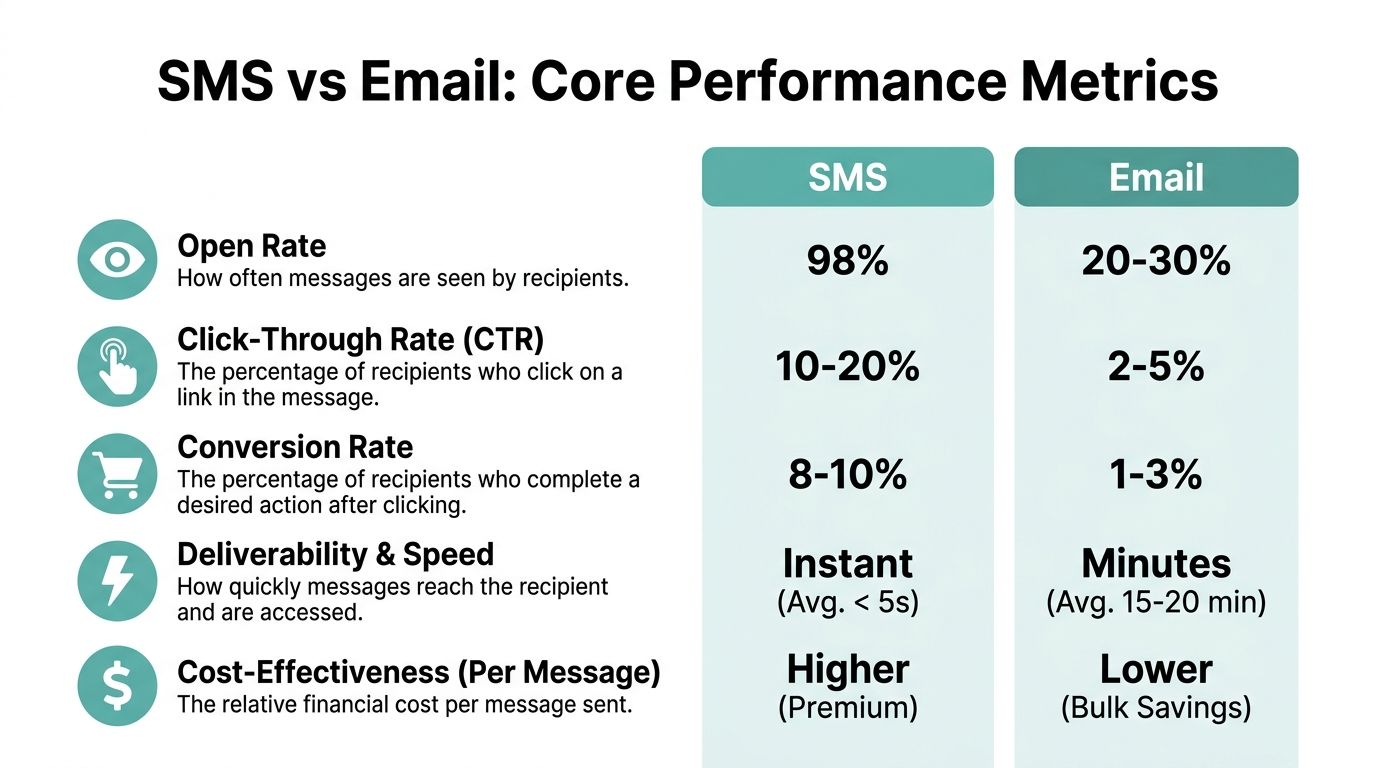
Speed and visibility
SMS wins on immediacy. That advantage matters most when a customer has already seen your brand somewhere else first, especially on TV.
A local TV ad creates awareness at scale, but that attention is brief. If someone searches your business, signs up for an offer, or requests a quote right after the ad runs, SMS is often the best follow-up channel for the first message. It gets seen quickly and asks for one clear action.
Email works on a different clock. People may check it later, compare options, and return when they have time. That makes it less dependable for same-day urgency, but stronger for offers that need explanation, testimonials, photos, pricing context, or a sequence of touches. If you want a clearer view of how to judge those results, this guide to email marketing metrics, open rates, and click rates explained gives useful context beyond raw opens.
Response and click behavior
For small businesses, the essential question is not whether a message was delivered. It is whether the customer moved.
SMS usually produces more direct action when the ask is simple. Confirm an appointment. Claim a code. Book today. Reply with availability. The shorter the decision path, the more SMS tends to justify its higher cost.
Email usually produces a softer first interaction. People skim, click selectively, save the message, or come back later. That is not a weakness. It is part of email's job. Email supports comparison and consideration, which is why it often performs better after the initial TV-driven surge has passed and the customer needs more reasons to choose you.
Kixie’s comparison of SMS and email performance also points to stronger click behavior from SMS than email in many campaigns. That lines up with what I see in practice. A text with one link and one deadline is hard to beat for urgent action.
Conversion and revenue role
Conversion rates are where channel choice gets expensive.
SMS often looks better when the offer is immediate and the audience already has context. That context might come from a previous purchase, a quote request, or a TV ad that introduced the offer before the text arrives. In those cases, SMS acts as the prompt that turns awareness into action.
Email earns its keep across a longer sales cycle. It can explain financing, show before-and-after examples, answer common objections, and reinforce credibility over several touches. For a service business running Adwave TV ads, that usually means SMS captures the hand-raisers first, then email does the follow-up work for everyone who needs more than a single reminder.
Use SMS to convert attention quickly. Use email to build enough conviction for the customer to act when the purchase takes more thought.
Cost and list economics
Budget discipline matters more with SMS because every send costs more and every mistake is more noticeable.
That does not make SMS risky. It makes precision required. Send texts to the segment most likely to act now, such as recent leads, appointment holders, past buyers, or viewers who responded right after your TV ad aired. Use email for broader nurture, repeat exposure, and content that would feel cramped or intrusive in a text.
That division of labor usually gives small businesses the best return. SMS handles urgency. Email handles scale. TV creates the demand that makes both channels work harder together.
A Framework for Choosing Your Channel
The right channel depends less on industry than on intent. Start there.
Use SMS when speed decides the outcome
SMS is best when delay reduces value.
That includes:
Same-day promotions: A lunch special, a last-minute opening, or a sale that ends tonight.
Appointment reminders: Hair salons, dentists, real estate agents, and home service companies all benefit from quick reminders.
Short confirmations: “Reply Y to confirm.” “Tap to book.” “Use this code before close.”
Action after high intent: Someone started a booking, requested a quote, or asked for availability.
SMS also works when the customer already knows enough to act. You are not educating them. You are prompting them.
If you need a response in minutes, use SMS.
Use email when detail shapes the decision
Email is the better channel when the message needs room.
That includes newsletters, educational content, product comparisons, policy updates, service explanations, seasonal campaigns, before-and-after examples, and any message where images or structured copy help the customer make sense of the offer.
The customer preference data supports that role. 69% of consumers prefer email as their primary communication channel with brands, while 43% find SMS useful, and email’s unsubscribe rate is 1.35% compared with SMS’s 3.5% according to Emarsys.
That lower unsubscribe rate matters. It gives email more room to build a long-term relationship without wearing out the list.
A simple decision filter
Use this filter before sending anything:
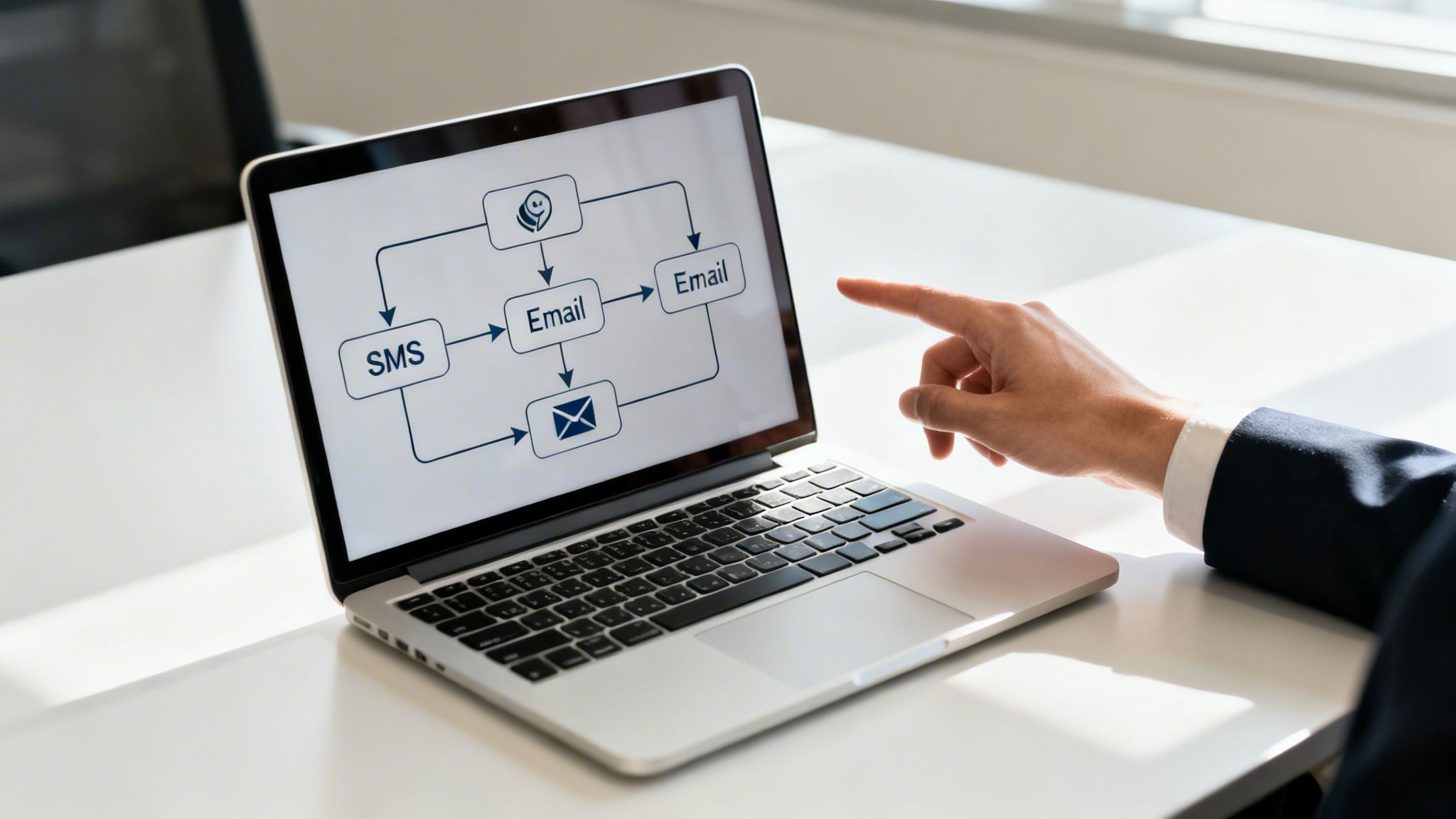
A broader multi-channel marketing approach works best because the customer journey rarely stays in one lane. Someone may discover the business through one touchpoint, research through another, and convert through a third.
What does not work
A lot of underperforming campaigns fail for predictable reasons.
Using SMS like a newsletter: Long, cluttered texts feel intrusive.
Using email for urgent offers: The offer expires before many subscribers even see it.
Blasting both at once with the same message: This creates noise, not coordination.
Ignoring customer stage: New prospects need explanation. Existing customers often need a nudge.
The strongest operators keep one rule in mind. SMS interrupts. Email invites.
Industry Playbooks in Action
A TV spot can create demand fast. What happens next determines whether that spend turns into booked appointments, orders, and repeat revenue.

For small businesses running Adwave TV campaigns, the practical question is not SMS or email. It is which channel should handle the next step after someone sees your ad, searches your name, visits your site, or opts in for more information. SMS works best once intent is already present and the action is simple. Email does the heavier lifting when buyers need context, proof, or a reason to choose you over a competitor.
Real estate
TV can broaden awareness for an agent or brokerage, but real estate still closes through follow-up. Prospects usually need photos, pricing context, neighborhood details, financing information, and a reason to act now.
Use email for:
New listing roundups
Price change alerts with property details
Area market updates
Open house previews with photos and agent notes
Use SMS for:
Showing confirmations
Open house reminders on the day of the event
Fast follow-up after a lead form submission
Short alerts for high-demand listings
A strong sequence is simple. Let the TV ad drive branded search or a home valuation page. Send the listing package or market update by email, then use SMS to confirm the appointment or prompt the next response.
Restaurants and hospitality
Restaurants win or lose on timing. A seat that goes empty tonight is gone for good.
Email should carry the brand story:
Seasonal menu launches
Event calendars
Loyalty updates
Chef features and higher-quality visuals
SMS should drive near-term demand:
Same-day offers
Reservation reminders
Limited seating alerts
Weather-based promotions when traffic drops
This pairing gets stronger after local TV. A viewer sees your ad during afternoon news, visits your site, joins your list for a first-visit offer, then gets an email that sells the experience and a text that fills tonight's slower shift.
Retail and e-commerce
Retail needs both presentation and speed. Email sells the product story. SMS closes the gap between interest and purchase.
Use email for:
New collection launches
Gift guides
Bundles and curated picks
Win-back campaigns with richer creative
Use SMS for:
Flash sale alerts
Back-in-stock messages
Cart recovery
Expiring offer reminders
For retailers using TV, this matters a lot. Broadcast can create a spike in direct traffic and branded search, but many visitors will browse without buying on the first session. Email gives you room to continue the pitch. SMS is best reserved for the moments where urgency is real and the customer already showed intent.
Automotive
Dealers and service shops usually manage two very different buying cycles. Service customers often need a prompt and a scheduled time. Vehicle shoppers need more explanation, more comparison, and more trust.
Email fits:
Service education
Inventory updates
Financing explanations
Trade-in information
Follow-up content after a showroom visit
SMS fits:
Appointment confirmations
Service reminders
Missed call follow-up
Weekend promotion alerts
Lead response after a form fill
If a TV campaign promotes a seasonal service offer, SMS can help capture and schedule demand quickly. If the campaign promotes inventory or brand positioning, email should carry more of the follow-up because the buyer usually needs several touches before visiting the lot.
Professional services
Law firms, clinics, accountants, med spas, and consultants usually convert on trust first. Timing matters later, once the prospect is close to booking.
Email works well for:
FAQs
Service explanations
Case studies or testimonials
Intake preparation
Educational content that answers common objections
SMS works well for:
Consultation reminders
Scheduling nudges
Document prompts
Waitlist openings
Short follow-up after an inquiry
This is one category where I rarely advise leading with SMS unless the prospect has already requested an appointment. A TV ad can create awareness and credibility, but the next step often requires education. If your team needs help setting up those nurture sequences, this guide to email automation for small business and the campaigns to set up first is a useful starting point.
The pattern across all five industries is consistent. Let TV create reach. Let email build consideration. Let SMS capture the moments where speed, confirmation, or a direct response matters most.
Personalization and Automated Workflows
Manual campaigns help, but automated workflows produce the most dependable returns because they react to behavior instead of relying on fixed calendars.
Why triggered SMS matters more than broadcast SMS
The most important SMS insight for small businesses is this. SMS flows account for just 7.6% of total SMS sends but generate 45.2% of total SMS revenue, according to Klaviyo benchmarks. That should immediately change how you allocate effort.
A lot of businesses obsess over promotional blasts. The smarter move is to build behavior-based flows first.
Klaviyo’s data also shows that behavior-triggered messages achieve click rates nearing 10% on average, with top performers exceeding 16%. Those numbers support a simple rule. Send fewer texts, but send them at the moment the customer’s intent is highest.
The first workflows to build
A practical setup usually starts with a few core automations. For email-first teams, this guide on email automation for small business and the campaigns to set up first is a useful companion because the same logic applies when SMS is added.
Here are the flows worth prioritizing:
Welcome flow When someone joins your list, send an immediate SMS only if the signup clearly asked for text offers or alerts. Follow with an email that introduces the brand, expectations, and next steps.
Abandoned cart or abandoned inquiry If someone starts a purchase or quote request and drops off, send the reminder while interest is fresh. This is one of the strongest uses of SMS because the customer already showed intent.
Appointment and booking reminders Service businesses should automate reminders, confirmations, and short post-visit follow-ups. These messages are useful, expected, and operationally valuable.
Back-in-stock and product availability If a customer asked for an update, send the alert quickly. These are high-intent moments.
How to personalize without becoming annoying
Use SMS for:
Action-ready prompts
Confirmations
Location-specific urgency
Direct links to one next step
Use email for:
Recommendations
Onboarding
Post-purchase education
Content tied to category interest or service type
A common mistake is duplicating the same message across both channels. Better practice is sequencing them. Email can deliver the richer explanation. SMS can deliver the shorter prompt when timing matters.
The best automation feels timely, not busy. Customers should feel recognized, not chased.
Navigating SMS and Email Compliance
Compliance is not paperwork for later. It shapes which channel is realistic for your business right now.
SMS carries more risk, so treat it with more discipline
TCPA regulations impose penalties of $500 to $1,500 per unsolicited SMS message, according to Textbolt’s comparison of SMS marketing vs email marketing. For a small business, that is not a technical footnote. It is a budget issue.
This does not make SMS a bad channel. It makes sloppy SMS a bad idea.
If you use SMS, keep the operating standard high:
Get explicit consent: Do not assume a past customer wants promotional texts.
Store consent records: You need proof of how and when the customer opted in.
Honor opt-outs immediately: If someone says stop, stop.
Separate transactional and promotional thinking: Customers are more tolerant of useful reminders than random promotions.
Control send timing: Respect reasonable hours in the customer’s local time.
Email is easier to manage, but it still needs structure
Email compliance is generally more forgiving than SMS, but it still requires process.
Use this checklist:
Many small businesses should build their relationship in email first, then invite subscribers to join SMS for alerts, reminders, or VIP offers. That sequence is often safer and more sustainable than pushing for phone numbers before trust exists.
Compliance also improves performance. When your list is built from real consent, engagement quality usually rises because the audience expects to hear from you.
Amplify Your Adwave TV Campaign with Direct Marketing
TV creates demand differently than search and social. It builds memory first, then action later. That is exactly why follow-up channels matter so much.
A viewer sees your ad while watching a premium channel, remembers the brand, then visits your website from their phone later that day. If the site only offers a generic contact form, you waste momentum. If it offers a clear next step, you start building a conversion path.
What a practical post-TV funnel looks like
A strong setup after a TV campaign usually includes three pieces:
A simple capture path Offer two choices. Join email for updates and offers. Join SMS for alerts, appointments, or VIP promos.
An immediate response A short welcome text is useful when the visitor opted in for SMS, as 75.4% of consumers expect transactional messages within five minutes of an interaction, according to Sinch.
A structured follow-up Email should carry the richer story after the initial response. That can include your service process, product range, location details, testimonials, or current offers.
TV is especially effective when the response path is made frictionless. A landing page tied to a QR code helps because the viewer moves from screen to phone in one step. This guide to using an ad with QR code is a practical example of how to reduce that friction.
How SMS and email divide the work after TV
Think about post-TV follow-up in two layers.
SMS handles recency. The person just saw your brand, searched your name, and showed fresh interest. This is the right moment for a welcome offer, a booking link, a confirmation, or a short local promotion.
Email handles reinforcement. Once interest exists, email can deepen familiarity with the business and keep the lead warm if they are not ready to buy that day.
This matters even more for local businesses with uneven purchase timing. A homeowner may see a TV ad for a roofer but not need the service immediately. Email keeps the brand present. If a storm hits and urgency appears, SMS can do the closing work.
The smartest small businesses do not force TV to act like a direct-response ad every second it runs. They let TV create awareness at scale, then use direct channels to turn that awareness into trackable actions.
Measuring Multi-Channel Success
When you use TV, SMS, and email together, channel-by-channel reporting can mislead you.
A customer may see the TV ad first, join the email list on day one, receive a text on day three, and convert on day five. If you only credit the last click, you miss the complete picture.
What to track instead
Focus on business outcomes that reflect the full journey:
Customer acquisition cost: What did it cost to generate a customer across all channels together?
Lead-to-booking or lead-to-sale rate: Are captured leads turning into real revenue?
Time to conversion: Are SMS and email shortening the gap between interest and purchase?
Customer lifetime value: Do buyers acquired through the combined funnel come back and buy again?
A workable attribution approach for small businesses
You do not need an enterprise stack to get value from attribution. Start with a few basics:
Use distinct signup paths for email and SMS.
Tag traffic from your TV landing page or QR code.
Track which offer or workflow triggered the final action.
Review performance by campaign, not just by channel.
The point is not to prove that one channel won. The point is to understand how each channel contributed. TV builds awareness. Email builds trust. SMS drives timely action. When you measure them together, budget decisions get much easier.
If you want to turn local TV exposure into a measurable customer funnel, Adwave is a strong place to start. It helps small businesses launch TV ads without the traditional production overhead, then connect that top-of-funnel awareness to the direct-response tactics that convert interest into leads and sales.


