
Why Your Next Ad Campaign Needs a QR Code
Let's be honest, the biggest challenge in marketing today isn't just getting in front of customers; it's getting them to do something. People expect instant, interactive experiences, and the old-school, one-way ad just doesn't hit the same way anymore. This is where the humble QR code comes in, having evolved from a techy gimmick into a must-have tool for making that immediate connection.
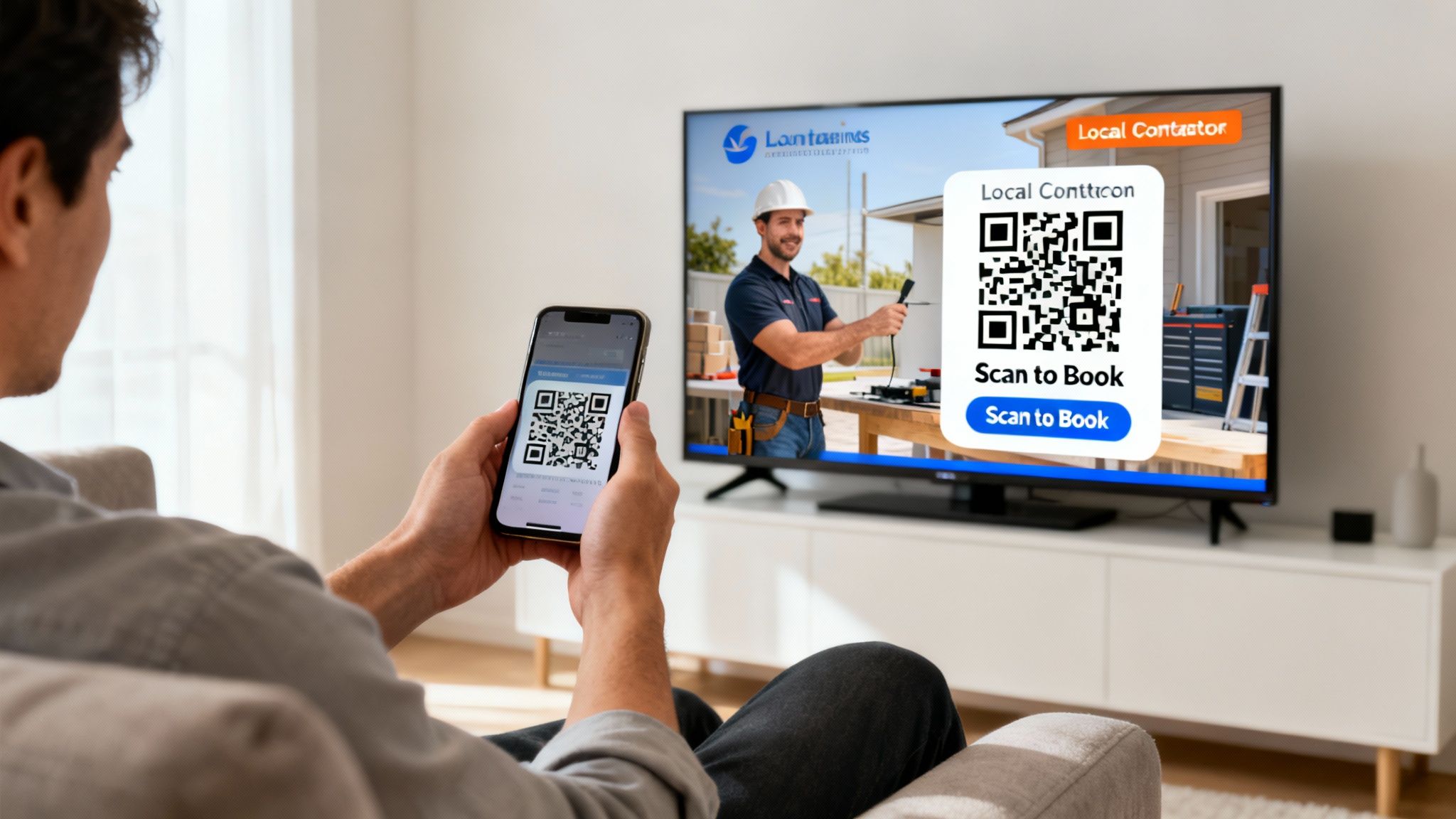
Think about it. A local contractor runs a TV spot. Instead of just flashing a phone number and hoping someone writes it down, they pop a QR code on the screen. A homeowner, watching from their couch, simply points their phone at the TV, scans the code, and lands directly on a page to book a free estimate. That’s a smooth, frictionless journey from interest to action.
Connecting With the Modern Consumer
This isn't just a fleeting trend. It reflects a major shift in how people interact with brands. The whole "second-screen" thing (where people are on their phones while the TV is on) is just normal life now. QR codes are a brilliant way to tap right into that behavior, giving viewers a direct line to:
Book an appointment or a consultation on the spot.
Go straight to a product page and make a purchase.
Download an app or snag a special discount.
Follow your brand on social media with a single tap.
The data backs this up, big time. Between 2021 and 2023, the marketing and advertising world saw a staggering 323% jump in QR code scans. And in the U.S. alone, an estimated 91 million smartphone users scanned a QR code last year. You can dig into even more QR code trends over at qrcodechimp.com.
For small and medium-sized businesses, this is a useful option. You can turn a fleeting moment of attention into a real, trackable lead without needing a massive marketing budget.
Making TV Advertising Accessible and Measurable
For a long time, TV advertising felt like an exclusive club for big brands. But platforms like Adwave are changing that, making it simple and affordable. With Adwave, you can create and launch a professional-looking TV ad in minutes, and it comes with a trackable QR code built right in.
This means you can get your ad on major channels and see exactly how many people scanned it. No more guessing. You get clear, measurable ROI, which is a core benefit of using the Adwave platform.
To get the most out of this, it helps to explore different actionable QR code marketing ideas to see what fits your business best. By adding that simple black-and-white square, your ad stops being just a message and starts being a powerful conversion tool.
Designing a QR Code That People Scan
Place the QR code where viewers can see and scan it. Include a short label that tells them what the link opens.
The first thing to nail down is size and clarity. A QR code in a magazine can be fairly small, but on a billboard or a TV screen, it has to be big enough for someone to easily scan from a distance. The complexity of the code itself also plays a huge role. A shorter destination URL makes for a simpler, less dense code that’s easier for cameras to read, which is a big reason why dynamic QR codes are the way to go.
Beyond the Basic Black and White
For any serious campaign, dynamic QR codes are non-negotiable. Unlike a static code where the destination link is permanently baked in, a dynamic code uses a short redirect URL. This is a useful option because you can update the final destination anytime you want without changing the QR code itself. It’s perfect for switching out a promotion or fixing a broken link after your print ad is already out in the wild.
Even better, dynamic codes give you the tracking data you desperately need. You can see how many people scanned your code, their general location, and when they scanned it. This is the only real way to measure if your ad is working. Platforms like Adwave automatically provide these dynamic, trackable codes, making the process connected for businesses.
Think of your QR code as a tiny billboard for your brand. Customizing it with your logo and brand colors doesn’t just make it look better; it builds instant recognition and trust. A generic code feels anonymous, while a branded one feels like a deliberate part of your campaign.
Crafting a Compelling Call to Action
You have to give people a reason to pull out their phone. A lazy "Scan Me" just isn't going to cut it. A powerful call-to-action (CTA) dangles a carrot and tells people exactly what they'll get for their effort.
Here are a few CTAs that work:
Scan for a Free Quote: Direct, valuable, and perfect for service-based businesses.
Scan to See the Menu: A no-brainer for restaurants placing local ads.
Scan for 20% Off Your First Order: This creates urgency and an immediate incentive to act.
Scan to Book a Tour: Ideal for real estate, venues, or local attractions.
Your CTA sets an expectation. If you promise a discount, the landing page better deliver that discount immediately, not just drop them on your homepage to fend for themselves. This clarity is even more important for TV ads, where you only have a few seconds to grab someone's attention. Nailing the on-screen creative is everything, and you can dig deeper into what works by reviewing these CTV ad creative best practices.
Avoiding Common Design Pitfalls
I've seen plenty of well-placed codes fail because of simple design mistakes. The number one killer? Low color contrast. A light yellow QR code on a white background or a navy blue code on a black background is going to be invisible to most phone cameras. Always stick to high-contrast pairings.
Another rookie mistake is linking to a webpage that isn't mobile-friendly. Think about it: 100% of the people scanning your code are on a phone. Sending them to a clunky desktop site that requires pinching and zooming is the fastest way to lose them forever.
To make sure your QR code is both on-brand and scannable, it can be worth bringing in some outside help. Working with professional graphic design services can ensure you get a code that looks great while maintaining the technical integrity needed for reliable scanning. After all, you want to make sure your investment in an ad with a QR code pays off.
Where to Place Your QR Code for Maximum Impact
You can design the perfect QR code, but if you stick it in the wrong place, it’s a total waste of effort. The real secret is getting inside your customer’s head. Where are they seeing your ad? What are they doing at that moment? How much time do they really have to pull out their phone?
Answering those questions is the key to making your ad with qr code work, and the right approach changes with every channel.
Print vs. Out-of-Home: A Tale of Two Timelines
When you're working with print like magazines or direct mail, you have a bit of a luxury: time. Your audience is usually stationary and can engage at their own pace. This gives you some flexibility, but you still need to place the code where it feels natural. Think next to a powerful headline, a special discount, or an image that begs for more information. Just be careful to keep it away from page edges or deep in the fold of a magazine where it’s nearly impossible to get a clean scan.
Out-of-home (OOH) ads like billboards and bus stop posters are a completely different game. Here, you're fighting for fractions of a second.
Someone driving past a billboard won't have time to fumble for their phone if the code is tiny or hidden. For these high-speed environments, your QR code needs to be huge, bold, and set against a high-contrast background. Keep the call-to-action dead simple, think "Scan for Directions" or "Scan for 20% Off Now." The entire interaction has to be almost instantaneous.
This infographic lays out a few of the core design principles that really make a difference.
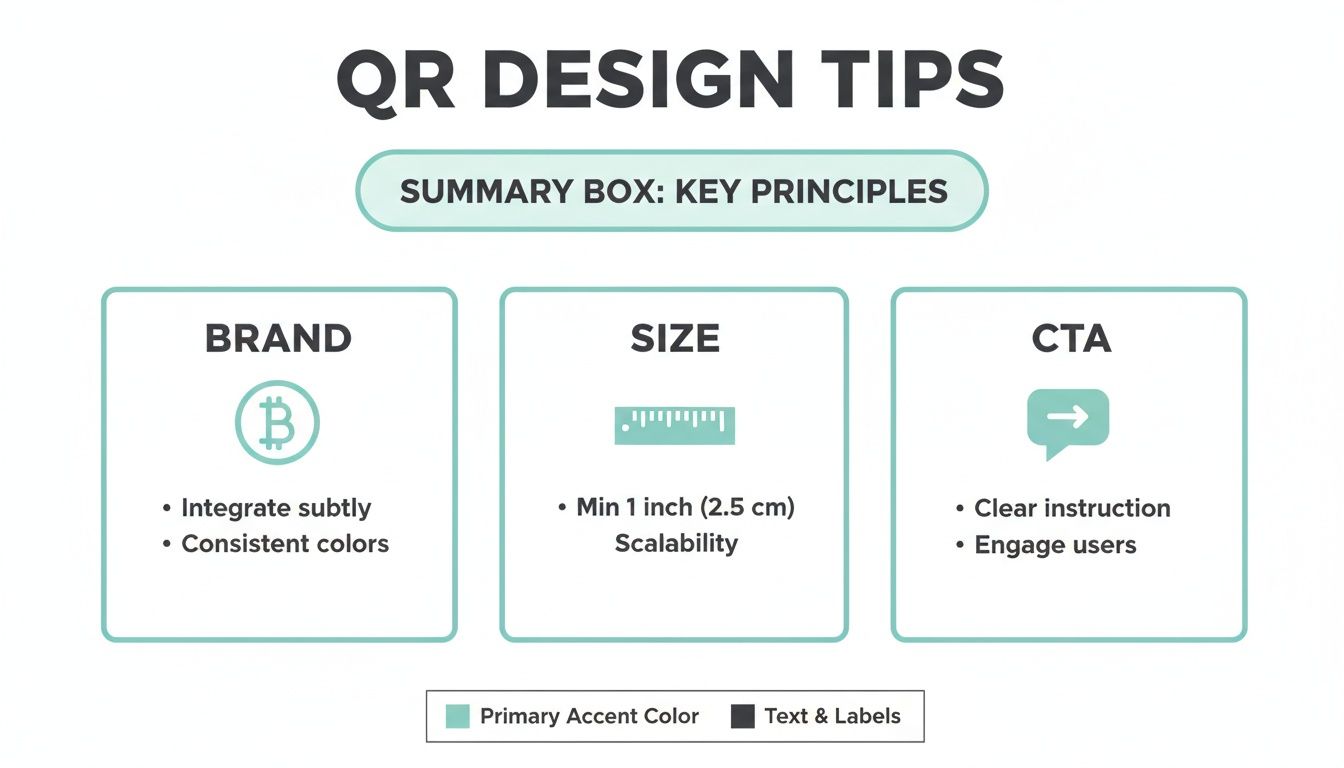
Ultimately, great branding, the right size, and a clear call-to-action are what turn a simple black-and-white square into a powerful marketing tool.
Choosing the right placement and CTA is important. The table below breaks down how to think about QR codes for different channels.
QR Code Placement Strategies by Ad Channel
As you can see, the user's context is everything. What works on a brochure will fail on a billboard.
The Unique Opportunity of TV Advertising
TV is a fantastic, and often overlooked, home for QR codes. Think about it: your audience is relaxed on the couch, and their phone is almost always at hand. It's the perfect setup to turn a passive ad viewer into an active participant.
But on TV, timing is everything.
A QR code in a TV commercial needs to be on screen for at least 8 to 10 seconds. This gives people enough time to notice it, grab their phone, open the camera, and make the scan without feeling frantic.
This is where a platform like Adwave really makes a difference for small businesses. Adwave’s AI-driven system doesn't just help you build a professional TV ad; it strategically handles the QR code placement for you. It calculates the optimal size, on-screen duration, and clarity to ensure viewers can easily scan it from across the room.
Your TV spot instantly becomes a powerful tool for driving website visits or generating leads. We dive deeper into how this fits into a larger strategy in our guide on building a multi-channel marketing approach.
The numbers show this isn't just a gimmick. QR code use is exploding, with the U.S. now responsible for 43.96% of all scans worldwide, a figure that grew by 10.72% in just one year. Much of that growth comes from TV and OOH, where dynamic, trackable codes now represent a 65% market share. Adwave is designed to help you capture a piece of that action and make sure your ad with qr code delivers real results.
Getting Your Ad on TV with a QR Code (The Easy Way)
A lot of small business owners I talk to think TV advertising is completely off the table. They see it as this huge, expensive mountain to climb, reserved for brands with deep pockets. And when you mention adding a QR code? It just sounds like another layer of complexity.
But creating a professional-looking TV ad with a QR code is easier and more affordable than it's ever been. You just need the right platform.
Tools like Adwave are changing the game. They’re specifically designed to strip away the usual cost and complexity of TV advertising, opening it up for local businesses that are serious about growth. Honestly, the whole process is so intuitive that you can knock out what used to take months of production in just a few minutes.
Go From Website to TV-Ready Ad in Minutes
From that single link, the platform's AI gets to work. It scans your site, grabbing your branding, key messages, and images to automatically build a broadcast-quality video ad. The first draft is usually pretty solid, but you have complete control to refine it until it’s perfect.
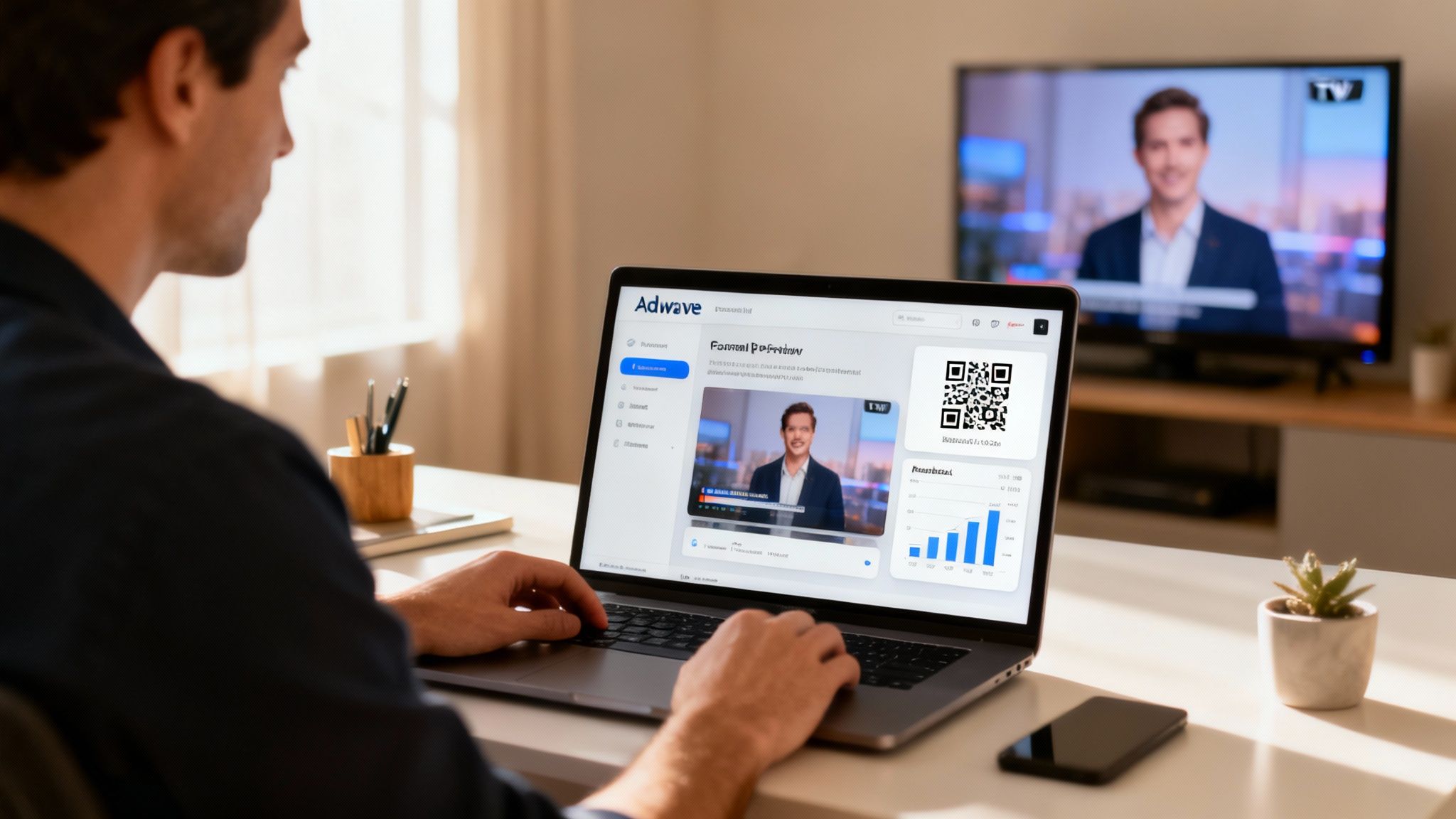
As you can see, the interface is clean and walks you right through the workflow, from generating the creative to getting your campaign live.
When your video is set, adding the QR code is built right in. Adwave makes sure it’s placed correctly, big enough for someone on their couch to scan and on-screen for at least 8-10 seconds. Getting this placement right is absolutely important for turning viewers into actual website visitors.
We have a full walkthrough on this, which you can check out in our guide on how to create and air a TV ad for your business using Adwave.
Big-League Advertising on a Small Business Budget
Let's talk about the biggest barrier Adwave knocks down: cost. You can get a targeted TV campaign running for as little as $50. And we’re not talking about those weird channels in the middle of the night. You get access to the big-name networks where your customers are watching.
We're talking about spots on channels like:
ESPN
Hulu
NBC
HGTV
Discovery
Adwave has made premium TV advertising accessible. It combines AI-powered ad creation with affordable, targeted campaigns, giving local businesses a real chance to compete on a bigger stage without the old-school costs and headaches.
What’s more, the platform’s targeting is laser-focused. It ensures your ad only runs for viewers within your specific service area, so you aren't wasting money on people who can't buy from you. By pairing a pro-quality video with a scannable QR code, you can turn TV into a measurable tool that brings in real leads.
How to Measure and Optimize Your QR Code Campaign
First thing’s first: you absolutely must use a dynamic QR code. Static codes are a dead end, they can't be tracked. Dynamic codes, on the other hand, unlock a treasure trove of data. You’ll see how many people scanned your ad, but more importantly, you can get a sense of who they are (based on general location) and when they’re engaging. This is your starting point for making real improvements.
Connecting Scans to Business Outcomes
Scan counts are nice, but they don't pay the bills. The real question is: what did those scans accomplish for your business? Did they lead to a purchase? A newsletter signup? A completed contact form? That's the data that matters.
Add campaign parameters to the QR-code destination URL, then test that visits and conversions appear in your analytics. See our guide to how to measure advertising effectiveness.
This powerful combination of QR codes and advertising is why the market is exploding, with projections showing it will hit USD 33.14 billion by 2031. And it's no surprise that dynamic QR codes dominate with a 65% market share, they give businesses the data they need to compete. You can read more on this trend over at Mordor Intelligence.
Fine-Tuning Your Campaign with Adwave
By comparing your QR code scan data with your Adwave dashboard, you can connect the dots. You'll see precisely which TV spots, channels, and times of day are getting people to pull out their phones and scan.
Let’s say you see a big jump in scans every Tuesday night around 8 PM. A quick look at your Adwave dashboard reveals your ad was running on HGTV at that exact time. Boom. You've just discovered that the HGTV audience is highly engaged with your offer.
Use the results to decide whether to change the channel mix, timing, or budget.
Answering Your Top Questions About QR Code Advertising
As you get ready to put a QR code in your next ad, you're bound to have a few questions. I've seen these come up time and time again. Getting the details right here can make a huge difference in your campaign's performance.
How Long Should a QR Code Be on a TV Ad?
For a standard 30-second TV spot, the magic number is around 8 to 10 seconds. This is the sweet spot. It gives people enough time to see the code, pull out their phone, open the camera app, and scan it without feeling rushed.
If you’re using a platform built for TV ads, like Adwave, they’ve already figured this out. They typically place the code in a static corner during a key moment and keep it there just long enough to maximize scans. It takes the guesswork out of the equation.
Can I Change a QR Code Link After My Ad Airs?
Absolutely, but there's a catch: you have to use a dynamic QR code. A static one has the destination URL permanently baked in. If you use a static code and the link breaks or the offer changes, you're out of luck. It's a massive risk for any ad campaign.
Dynamic QR codes use a redirect URL that can be updated when the destination changes. Test the code after every update.
The biggest mistake I see with QR code ads is linking to a page that isn't mobile-friendly. Think about it: 100% of the people scanning are on their phones. If they land on a clunky desktop site, they're gone. You've just killed your conversion rate.
Are Free QR Code Generators Safe to Use?
Free sounds great, but it often comes with hidden strings attached. Some free services, like the free plan from Bitly, have started putting their own ads on the redirect page. Imagine a customer scanning your code only to see an ad for a competitor before they even get to your site. It's a brand killer.
When you're running a professional ad with a QR code, stick to a trusted, paid service. Or, even better, use an integrated platform like Adwave that gives you clean, trackable, and ad-free QR codes as part of the package. This ensures your customer journey is smooth and direct.


