
A buyer leans back at the kitchen table, glances at the quote, and says, “It's just too much.” That moment feels like a wall, but the move that usually backfires is jumping straight into a defense of the number. Confidence comes from slowing down, diagnosing what the buyer means, and answering the core objection instead of the one they used as shorthand.
In SMB sales, that matters because owners often protect cash flow first and buy later. They're not just comparing your price to a competitor's price, they're comparing it to payroll, ad spend, equipment, and the risk of making the wrong call. If you treat every “too expensive” as the same objection, you end up discounting when you should be clarifying, trading, or reframing.
Why Price Objections Are Rarely About Price
A small business owner can hear a quote and still like the idea, the outcome, and even the salesperson. Then the pause comes. The issue is often not the sticker price itself, it's what the price is competing against in the buyer's head, whether that's cash on hand, timing, approval, or a cheaper-looking alternative. Sales guidance on price objections consistently recommends shifting the discussion from sticker price to total value, payback period, and cost per unit, because those frames make the economics easier to defend in budget-sensitive markets Rework sales guidance on price objections.

The kitchen-table reality
A contractor owner, a med spa founder, or a local retailer rarely says, “I need a deeper value framework.” They say, “I wasn't expecting that,” or “I've got to watch spend this month.” That's why the first instinct should be curiosity, not counter-argument. If you defend too early, you turn a solvable conversation into a debate.
Practical rule: treat “too expensive” as a signal, not a verdict.
The most useful mental shift is this. A price objection usually hides one of four things, budget pressure, cash-flow timing, approval friction, or a scope mismatch. Once you hear it that way, you stop replying with a generic script and start listening for the true blocker. That's a different conversation, and it's usually a more winnable one.
For SMBs, this matters even more because many buying decisions aren't governed by formal procurement rules. They're governed by gut feel, working capital, and whether the owner can justify the spend before the next check clears. The best response is rarely a lower number. It's a clearer business case.
For a practical way to map the buyer's journey before the pricing conversation gets tense, this customer journey mapping framework for small business is a useful companion.
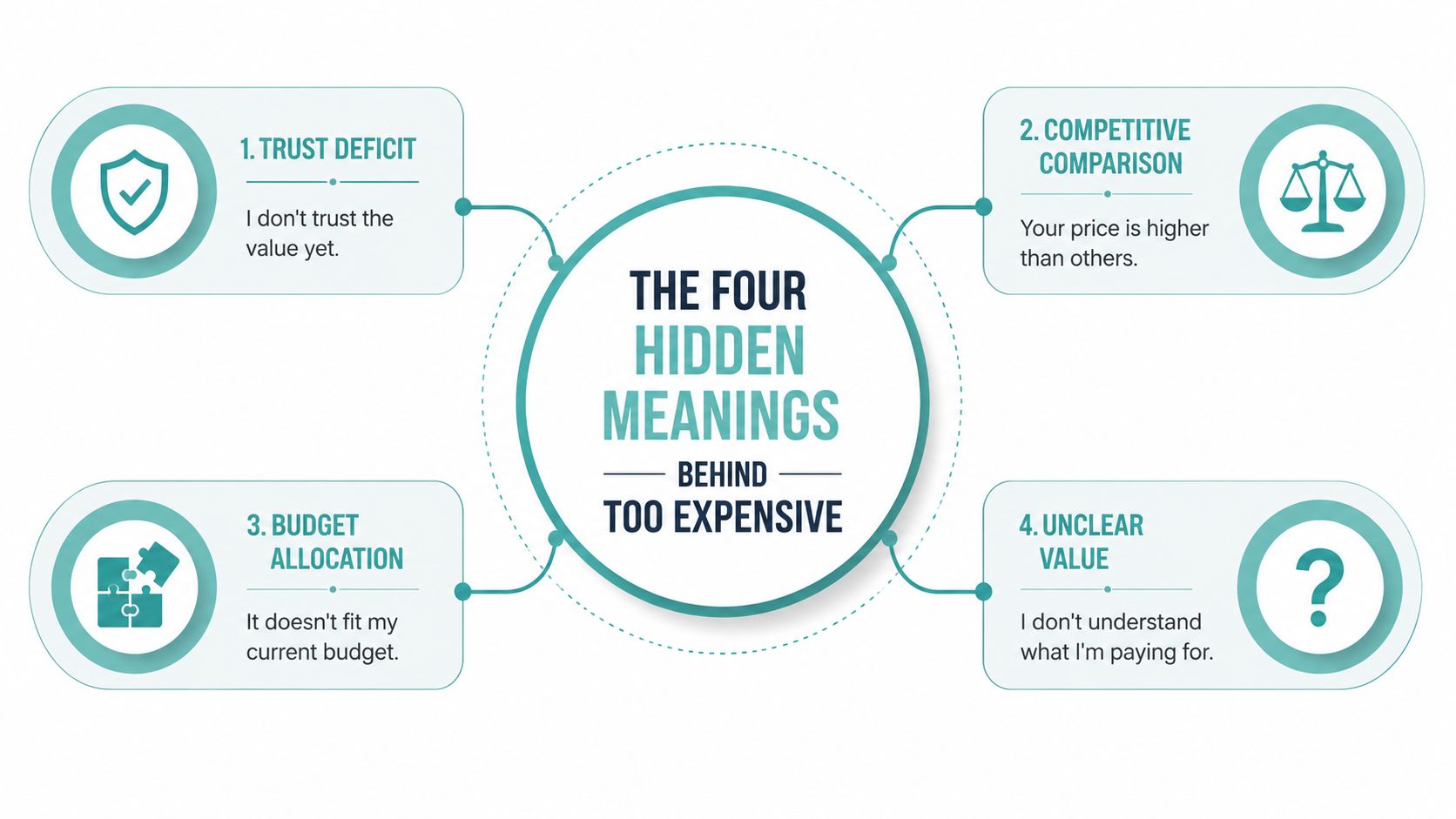
The Four Hidden Meanings Behind Too Expensive
Many teams collapse every objection into one bucket and then wonder why the same answer lands flat. That's the mistake. “Too expensive” can mean four very different things, and each one needs a different response.
A quick decision lens
Here's the short read on what you're hearing:
True budget constraint: The prospect wants it, but the money isn't there right now. The tell is usually some version of “we just don't have room this month.” The wrong move is overselling or arguing that they should “find the budget.”
Cash-flow timing: The buyer likes the offer, but the timing doesn't match their cycle. The tell is, “Can we revisit next month?” or “I need to line up cash first.” The wrong move is treating timing like rejection.
Internal approval gap: The buyer isn't the last stop. The tell is, “I need to run this by my partner,” “I need finance to look at it,” or “I have to get sign-off.” The wrong move is pressing for a yes before the internal process is ready.
Comparison to a different scope: The buyer is benchmarking your offer against a cheaper package, narrower scope, or different outcome. The tell is, “Another vendor quoted less,” or “I saw something similar for less.” The wrong move is defending your price without comparing scope, deliverables, or result.
Sales frameworks recommend asking diagnostic questions early, including whether the issue is budget constraints, timing, or fit, and explicitly separating price from other objections before you respond Kixie on distinguishing price from other objections. That's the core skill.
“Too expensive” is often a proxy. The buyer is protecting something else, not just objecting to a number.
The diagnostic question to ask before you answer is simple. “What part feels out of line, the budget, the timing, or what's included?” That question forces the conversation out of the fog and into a decision. Once the core meaning is clear, the right response gets much easier.
The Listen Understand Respond Confirm Sequence
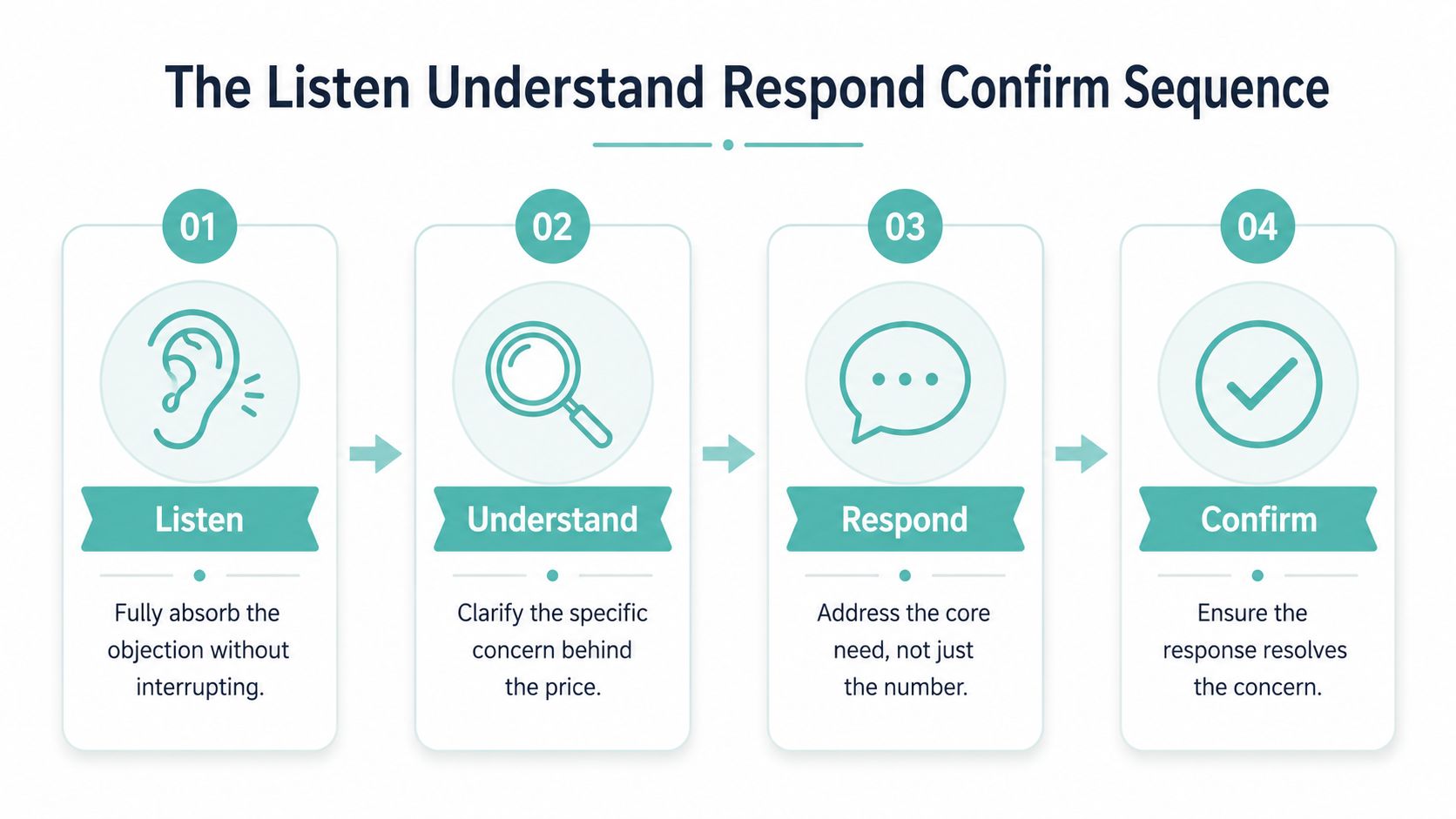
A confident reply starts with restraint. Sales guidance recommends pausing for 3-5 seconds, asking what specifically feels too high, and confirming whether budget is the issue or whether the prospect is comparing against a different offer, scope, or outcome HubSpot's price objection guidance. That pause matters because it keeps you from talking over the concern before you know what the concern is.
Listen and understand first
Listen means exactly that, no interrupting, no rushing, no rescue line. A clean pause signals composure. A lot of reps ruin this moment by filling the silence because they're uncomfortable, but silence often gives the buyer enough space to say the thing they were thinking.
Understand is the first clarifying question. “What specifically feels too high?” works because it narrows the objection without sounding combative. If they answer with budget, timing, or comparison language, you now know which lane you're in.
Respond and confirm
Respond with the smallest answer that addresses the issue. If it's budget, speak to value and options. If it's timing, talk about phasing. If it's scope, compare scope, not just price. The mistake is trying to win everything with one broad paragraph.
Confirm by checking whether the concern is resolved. “Does that make the pricing make more sense?” is better than charging ahead. If the buyer says yes, you move forward. If they hesitate, you've learned something useful before the deal drifts.
Coaching note: a calm second question usually beats a fast explanation.
A simple notecard version looks like this.
“Got it. What part feels too high, the budget, the timing, or what's included?” “Thanks. If we adjust that piece, does the offer make more sense?” “Good, then let's look at the best fit.”
For quick-response discipline across different buyer channels, this Adwave resource on fast customer service replies is a handy reference point, especially when the objection arrives in a short-message format.
Reframing Value in Dollars Hours Risk and Reach
Once you know what the buyer means, the next move is to translate the offer into the units a small business owner uses to make decisions. That means dollars, hours, risk, and reach. Sales guidance consistently recommends reframing the conversation from sticker price to total value, payback period, and cost per unit because those frames make the economics easier to defend in budget-sensitive markets Rework's price objection guidance.
Build a one-line value statement
Start with revenue. If the offer can help capture more demand, say how in plain language. Then move to time saved, because owners care about getting hours back. Add risk reduced, especially if the service prevents a bigger operational problem later. Finish with reach, because visibility can be a hard thing to price but an easy thing to feel.
A local TV example makes this concrete. If a low-entry campaign is designed to reach local viewers, the question isn't “Why does it cost this much?” The better question is, “What does a modest spend buy me in attention, calls, and local visibility compared with doing nothing?” That's the frame low-cost TV platforms are built for, and Adwave fits naturally here because it gives SMBs a way to test broadcast reach without the usual barrier of a large upfront commitment.
For a service business owner comparing marketing options, even a kitchen remodel decision can be framed this way. The Boston kitchen remodel advice from Aureli Construction is useful because it shows how owners think about return, not just cost, when the job affects the way they live and work.
Use the payback lens
The reason this works is simple. A buyer can argue with a sticker price. It's much harder to argue with a cost framed as a business outcome, a time saving, or a risk reduction. Once you've made the value visible, the original number stops feeling like the whole story.
Don't ask, “Is it expensive?” Ask, “Expensive compared with what outcome?”
If you want a deeper guide to structuring offers around practical economics, this pricing strategies resource for small business is worth keeping nearby. It pairs well with the value conversation because it helps you think in terms of offer design, not just quote defense.
Trading Instead of Discounting
Discounting usually backfires because it solves the objection by shrinking your margin and weakening your position. A better move is to trade. If the buyer needs a lower barrier, change scope, timing, or commitment, and ask for something in return.
Sandler recommends uncovering whether the project is funded, what allocation exists, and what ballpark number the buyer is comfortable with, because that makes the pricing conversation more specific and reduces guesswork Sandler on overcoming price objections. That advice matters because a vague budget conversation invites vague concessions.
Use trade-offs to protect the deal
The goal is not to be rigid. The goal is to keep the conversation fair. If you lower price, get something back. If you remove scope, preserve the core outcome. If you offer flexibility, secure commitment. That's how you keep the deal healthy instead of training the buyer to wait for a discount.
Adwave is a useful example of a payment-plan-style approach because campaigns start at $50 and use automatic pacing to keep spend within the buyer's set budget. That kind of structure helps small businesses start modestly without forcing the conversation into a pure price cut. For package design ideas that preserve margin, this guide to creating package deals and bundles is a solid reference.
Three Real Objection Role Plays
Theory is useful only if it sounds like something you'd say on the phone. The best sellers keep the response short, calm, and specific. Matt Haycox recommends quantifying value in revenue, hours, risk, and speed, presenting options so buyers choose a fit instead of arguing about a number, and not dropping price without trading for scope, terms, or commitment Matt Haycox on price objections.
A true budget objection
Buyer: “I like it, but it's over what we can spend right now.” Seller: “That makes sense. If we trimmed the scope to the core pieces, would that put it inside budget?” Buyer: “Probably, yes.” Seller: “Good, then let's keep the part that drives the result and remove what's optional.”
Why it works. The seller doesn't argue that the budget is wrong. They respect the limit, then move straight to a trade that protects the outcome.
A timing objection
Buyer: “We're interested, we just can't start this month.” Seller: “Understood. Is the issue timing, or is there anything about the offer itself that doesn't fit?” Buyer: “Timing. The offer is fine.” Seller: “Then let's map a phased start and lock in the next milestone.”
Why it works. The seller doesn't mistake timing for rejection. That keeps the deal alive without forcing a premature close.
A comparison objection
Buyer: “Another quote came in cheaper.” Seller: “That's helpful to know. Are they quoting the same scope and level of support?” Buyer: “Not exactly.” Seller: “Then let's compare apples to apples, because price only makes sense when the outcome is the same.”
That same comparison logic applies to low-cost TV options. A buyer may compare Adwave to a six-figure agency buy, but the question is what the buyer gets for the spend, broader channel access, AI-generated creative, pacing control, and local reach versus a much larger production and media commitment.
A clean comparison is better than a defensive speech.
If you want the cleaner answer, don't try to “win” the objection. Identify the objection type, answer that exact issue, and confirm the buyer is ready to move ahead.
Practice Tracking and a 30 Day Confidence Plan
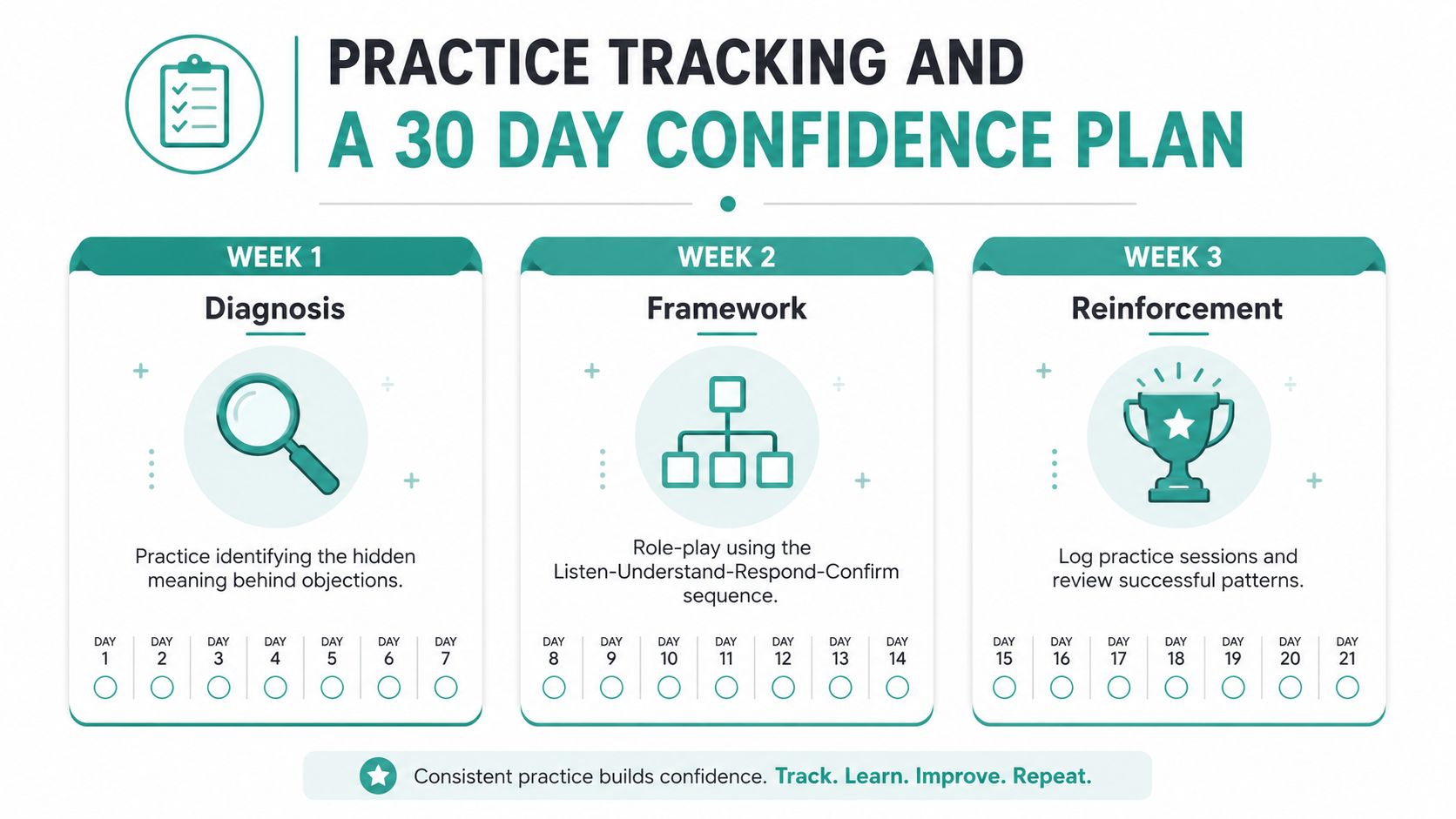
Confidence comes from repetition, not personality. Track objection-to-next-step conversion, average price held without discount, and average deal size so you can see whether your response is improving. A simple 30-day plan works well, week one for diagnosis, week two for the Listen Understand Respond Confirm sequence, week three for value framing, and week four for trade-offs without discounting.
Before the next pricing conversation, run this checklist. Identify the hidden objection. Pause before answering. Ask one clarifying question. Reframe value in business terms. Trade, don't cave. That's the habit that turns “too expensive” into a real next step.
If you want a simpler way to bring that same confidence into your own offer, Adwave helps small businesses create, launch, and measure TV campaigns without the usual overhead. It's a practical fit for budget-conscious owners who need to start small, control spend, and still make a serious case for value.


