
You're probably in one of two situations right now.
You've set prices by gut feel, and every quote feels like a small act of courage. Or you've copied the market, only to realize that matching competitors doesn't guarantee profit, cash flow, or growth.
That tension shows up everywhere. A bakery owner wonders if a higher price will scare off regulars. A home services company keeps winning jobs but still feels cash-tight at the end of the month. A consultant lands new clients, then realizes the fee barely covered delivery time, admin, software, revisions, and the marketing required to get the lead in the first place.
Pricing is where strategy becomes reality. It determines whether each sale gives you room to hire, advertise, improve service, and survive mistakes. It also exposes weak assumptions fast. If your numbers are wrong, sales volume won't save you for long.
Introduction Why Your Pricing Is More Than Just a Number
Most small businesses don't have a pricing problem. They have a decision problem.
They react instead of design. They look at a nearby competitor, shave a little off the price, and hope volume will make up the difference. Or they raise prices suddenly after costs rise, without a system for explaining the change or measuring the result. Both approaches create the same outcome. Uncertainty.
I've seen this pattern in product businesses, agencies, trades, local retailers, and service firms. The owner usually knows their craft well. What they haven't built yet is a pricing method that accounts for real cost, buyer perception, and the cost to acquire the customer in the first place.
Practical rule: If you can't explain why your price is what it is in one clear sentence, you probably don't control it yet.
Your prices affect margins, demand, and workload. Before lowering them to attract more customers, calculate whether the extra volume would cover your costs.
Good pricing gives you options. Bad pricing steals them.
A complete guide to pricing strategies for small business has to go beyond cost-plus formulas and competitor checks. It also has to answer the question many guides skip. How do you price in a way that funds customer acquisition, especially modern advertising, without destroying margin?
That's where many owners get trapped. They calculate materials and labor, maybe some overhead, then treat marketing like a separate expense that somehow has to work itself out later. It rarely does. If you want sustainable growth, your price has to support delivery and demand generation.
What works is a disciplined approach. Know your floor. Choose the right model. Build in room for profit and marketing. Then monitor what happens after the price goes live.
The Three Pillars of Smart Pricing
Pricing gets easier when you stop treating it like a mystery and start sorting it into three core approaches. Almost every pricing decision sits on one of these pillars, or a blend of them.
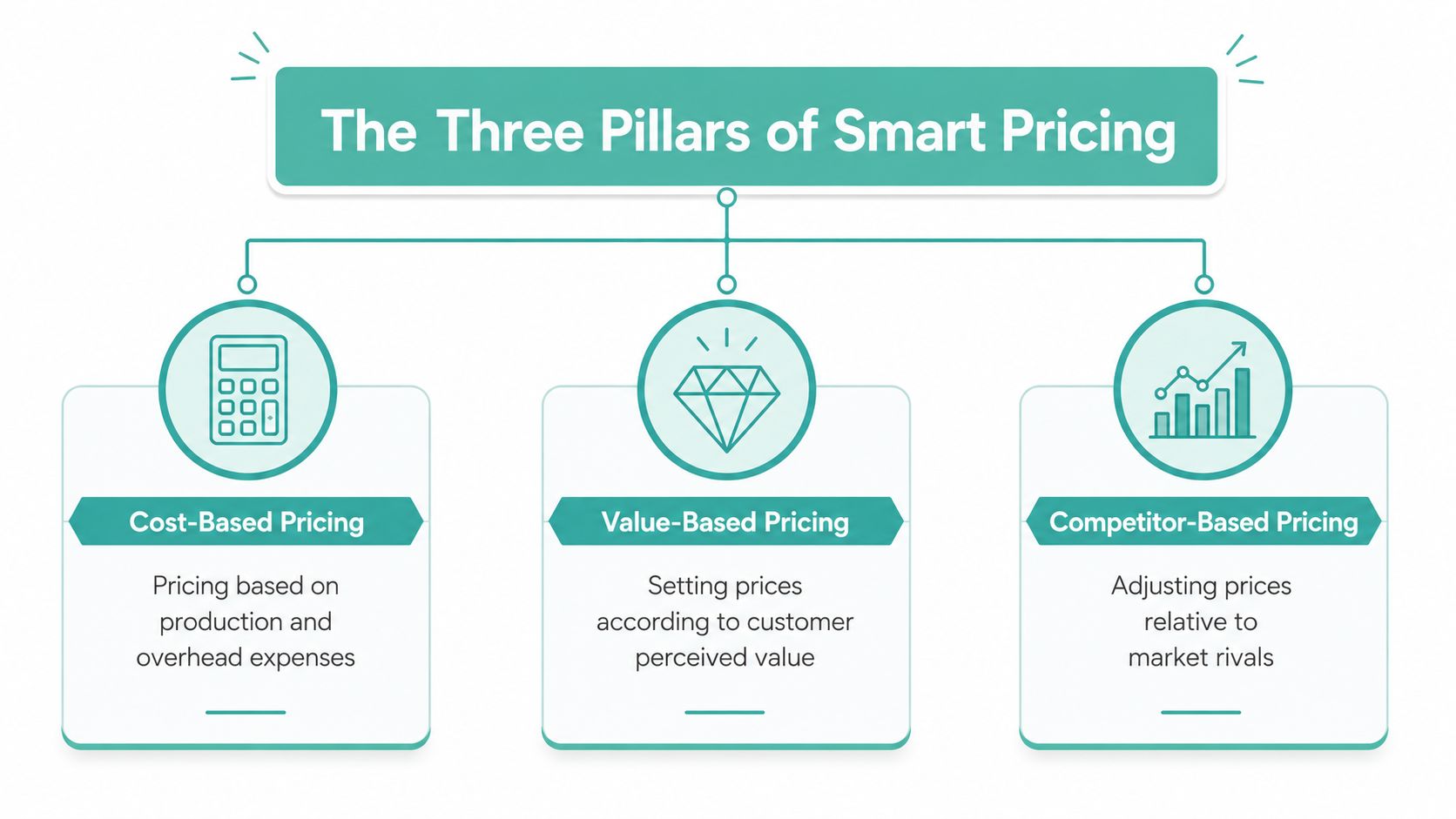
Cost-based pricing
This is the most straightforward method. You total what it costs to produce and deliver the product or service, then add margin.
Building a house brick by brick offers a useful comparison. If you miss a brick, the structure is weaker than it looks. In pricing, those missing bricks are often indirect costs such as rent, software, payment processing, admin time, refunds, owner compensation, and marketing.
Cost-based pricing works best when:
Your costs are stable: Manufacturing, food production, and repeatable services often fit here.
You need a hard floor: It tells you the minimum price below which the sale becomes harmful.
You're early in the business: It creates discipline before more advanced pricing methods are layered in.
The weakness is just as important. Cost-based pricing tells you what you need to charge. It doesn't tell you what the market will bear or what buyers think the outcome is worth.
Value-based pricing
This model starts from the buyer's perspective. The question isn't “What did this cost us?” It's “What is this worth to them?”
A tax advisor who helps a business avoid expensive mistakes isn't selling hours alone. A garden designer isn't only selling materials and labor. A lawyer, consultant, coach, or specialist often creates outcomes that are worth more than the direct time spent delivering them.
Value-based pricing works when:
The result matters more than the inputs
Your expertise clearly changes the outcome
Customers can see the difference between you and cheaper alternatives
This is why two businesses can sell similar services at very different rates. One is selling activity. The other is selling confidence, speed, reduced risk, or a better commercial result.
Pricing by value works only when your sales process can communicate value clearly. If the offer sounds generic, buyers compare on price.
Competitor-based pricing
This approach uses the market as the reference point. You look at comparable alternatives and decide whether to price below, near, or above them.
That makes sense in crowded categories where customers can compare quickly. Retail shelves, commodity services, and common local offers often require this lens. But it's a dangerous model if it becomes your only lens.
Competitor-based pricing works if you use it as context, not as instruction. Competitors can have different cost structures, a different customer base, or a different retention profile. They may even be underpricing and not know it yet. That's one reason customer retention matters so much. If you keep buyers longer, you can support acquisition and service costs more effectively, which changes what a rational price looks like. This is the same commercial logic discussed in Adwave's breakdown of customer retention economics.
How to use the three pillars together
Strong pricing usually blends all three.
A practical sequence looks like this:
Start with cost: Know your floor.
Pressure-test against value: Ask what the buyer is really paying for.
Check the market: Make sure your price makes sense in context.
If you skip cost, you can sell profitably only by accident. If you skip value, you leave money on the table. If you skip the market, you risk pricing in a vacuum.
Choosing Your Core Pricing Model
Once you understand the three pillars, you need a working model. However, many owners get stuck at this stage because they try to pick the “best” pricing strategy in the abstract. There isn't one. There's only the model that best matches your offer, your market, and your current business objective.
For many small businesses, cost-plus pricing is the first reliable model because it forces discipline. The average recommended profit margin for small businesses falls between 7% and 10%, though it varies significantly by industry, and that range is a foundational benchmark when building a cost-plus model, as explained in Beancount's small business pricing guide. That doesn't mean every business should target the same margin. It means you need a rational starting benchmark instead of guesswork.
The models that matter most
A local bakery often succeeds with cost-plus pricing because ingredient costs, labor, packaging, and overhead can be tracked with reasonable accuracy. The owner still needs judgment, but the structure is clear.
A new software product entering a crowded market may use penetration pricing. The business accepts lower early pricing to reduce buyer resistance and build a customer base. That can work if the company has a plan to raise prices later or expand customer value through add-ons, tiers, or retention.
A specialist consultant, legal practice, or premium home services firm often leans toward value-based pricing. The more customized and high-stakes the outcome, the less useful a pure hourly or cost-plus model becomes.
A retailer with many similar alternatives may use competitive pricing because shoppers can compare quickly and switch easily.
Then there's skimming. This model starts high and comes down later. It's useful when you launch something distinct, scarce, or especially desirable to early buyers. It fails when customers don't see enough differentiation to justify the premium.
Comparison of Common Pricing Models
How to choose without overthinking it
Use three filters.
First, ask how standardized your offer is. The more repeatable and comparable it is, the more useful cost-plus or competitive pricing becomes. The more customized it is, the more value-based pricing matters.
Second, ask what your growth objective is right now. If you need immediate cash discipline, cost-plus may be the best foundation. If you need market entry, penetration may make sense. If you want margin improvement without increasing workload, value-based pricing usually deserves a closer look.
Third, ask how clearly buyers understand your difference. If they can't see why you're better, premium pricing will be harder to hold.
A pricing model should reduce confusion inside your business. If your team can't quote consistently, the model is too fuzzy.
What usually doesn't work
Some habits show up again and again in struggling businesses:
Copying the cheapest competitor: This wins price-sensitive customers and compresses your margin at the same time.
Using one model for everything: A business may need one structure for core offers and another for premium or promotional offers.
Setting prices once and ignoring them: Costs change, competitors move, and buyer expectations evolve.
Basing prices on fear: Owners often ask, “What if I lose the sale?” They should also ask, “What happens if I win too many low-margin sales?”
A strong starting point is simple. Pick one primary model, define why it fits, and test it against your actual numbers. Complexity can come later.
Essential Pricing Calculations You Must Know
If pricing feels intimidating, it's usually because the math is mixed with emotion. Strip out the emotion and three calculations do most of the heavy lifting: break-even point, profit margin, and customer lifetime value.
Consider a home services company that sells recurring maintenance and invests in local advertising. Use its service costs, renewal rates, and ad budget to work through the pricing decision.
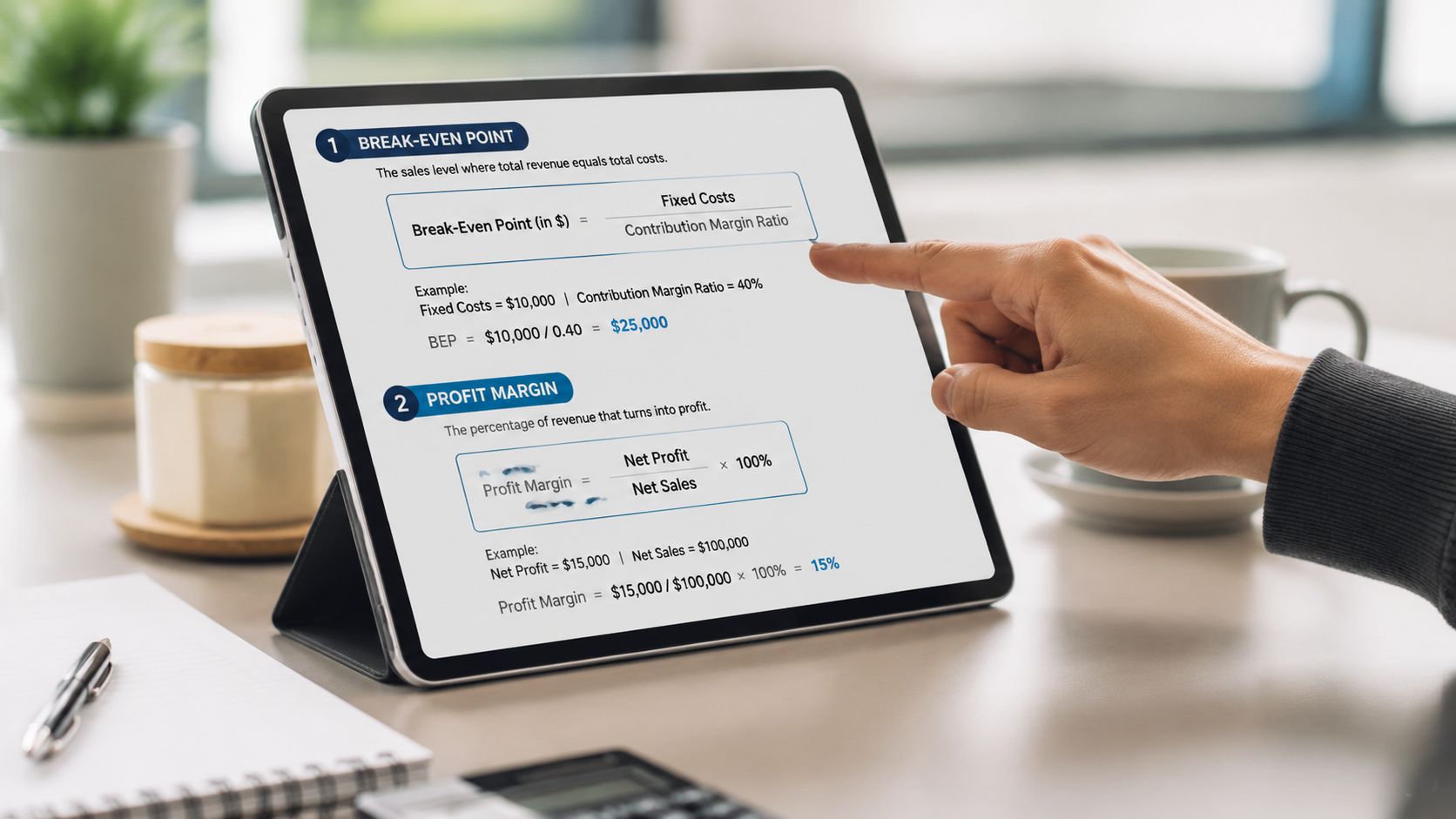
Break-even point
Break-even tells you when revenue covers total costs. Before that point, the business is funding operations out of cash reserves, debt, or owner patience.
At a simple level, you need:
Fixed costs: Rent, software, insurance, salaries, admin, and similar ongoing expenses
Variable costs per sale: Labor, materials, travel, packaging, card fees, and delivery costs
Selling price per job or unit
The logic is straightforward. Each sale contributes a certain amount after variable costs. That contribution pays down fixed costs until you break even.
If you want a clean walkthrough with worked examples, the Bookkeeping and Accounting Inc. break-even guide is a useful reference for owners who want to check their math outside a spreadsheet.
Profit margin
Profit margin tells you how much of each sale remains after costs. It's often at this point that owners fool themselves by excluding indirect expenses.
A service business might quote a job based on labor and materials alone, then forget fuel, scheduling time, software subscriptions, owner admin work, follow-up calls, warranty callbacks, and marketing. The sale looks profitable on paper and underwhelming in the bank account.
A practical process looks like this:
List direct costs first
Add indirect operating costs
Allocate acquisition and retention costs
Compare the final number against your selling price
If the margin is too thin, don't just cut costs automatically. Revisit the offer, scope, positioning, and sales process.
Customer lifetime value
Customer lifetime value matters because not every sale stands alone. Some businesses can spend more to acquire a customer because repeat purchases, renewals, referrals, or recurring service make that customer worth more over time.
That's why acquisition cost has to be viewed alongside expected customer value, not in isolation. If you're trying to connect ad spend to return more clearly, use a framework that links campaign cost, closed revenue, and repeat customer behavior. A practical starting point is this guide to calculating return on ad spend.
If you don't know what a customer is worth after the first sale, you'll either overspend recklessly or underspend fearfully.
One more reason this matters in modern pricing is attention quality. Connected TV ads achieve video completion rates of 90 to 97%, with 30-second ads at 95.92%, compared with 65% completion on mobile, according to Adwave's TV ad completion rate benchmark. For a small business, that changes how you think about advertising cost. You're not just buying impressions. You're buying a high likelihood that the message gets watched.
How to Factor Advertising Costs into Your Price
Most pricing guides stop too early.
They tell you to count labor, materials, overhead, and profit. That's useful, but incomplete. If you need to spend money to get customers, and most businesses do, then customer acquisition is part of your cost structure. Treating it as a separate afterthought is one of the fastest ways to create a business that looks busy and stays fragile.
Why marketing belongs inside pricing
A sale doesn't begin when a customer pays. It begins when the business spends to become visible.
That cost may come from search ads, direct mail, local sponsorships, referrals, content, or TV. However you generate demand, the spending has to be funded somewhere. If it isn't built into price or supported by customer lifetime value, growth starts to cannibalize margin.
This is especially important because many owners still struggle to connect ad spend to return. The result is defensive pricing. They underinvest in marketing because they can't see the payoff clearly, or they spend inconsistently and hope revenue catches up.
A better way to think about acquisition cost
Use a simple operational sequence:
Define your average acquisition channel mix: Which channels generate inquiries and sales?
Estimate the acquisition cost per new customer: Don't aim for perfection. Aim for a useful working number.
Decide where that cost belongs: Entirely in the first sale, spread over expected repeat purchases, or absorbed at the category level.
Check whether your price still supports margin after acquisition cost is included
When setting prices, account for the cost of acquiring customers as well as delivering the product.
If you want a structured way to calculate this, this customer acquisition cost calculation resource is worth reviewing before your next price update.
Why Connected TV changes the equation
Connected TV has become far more relevant for small businesses because it offers a channel that is measurable, local, and easier to budget than many owners assume.
Connected TV advertising commands an average CPM of $15 to $35 for small business advertisers, with campaigns starting at $50, making it possible to access 100+ premium channels like NBC and Hulu without six-figure budgets, according to Adwave's CTV advertising benchmarks.
That matters for pricing strategy because it gives you a more concrete way to plan acquisition spend. Instead of treating advertising as a vague monthly drain, you can model it as part of your commercial engine.
For example, a local business can decide that a portion of each sale will fund visibility in a target geography. That doesn't mean every product needs the same acquisition burden. It means the business should know which offers can carry acquisition cost and which ones exist mainly to open the door to higher-margin or repeat business later.
What businesses get wrong
The biggest mistakes are operational, not mathematical.
They ignore marketing in the cost stack: This creates fake profitability.
They spread acquisition cost evenly over everything: Entry offers, premium offers, and repeat purchase offers often play different roles.
They judge channels too quickly: A channel that supports strong repeat business may look weak if you only measure the first transaction.
They refuse to raise prices because acquisition feels optional: It isn't optional if growth matters.
Pricing should fund demand, not merely fulfill demand.
That's one reason Adwave fits this conversation well. It gives small businesses a practical way to think about TV advertising as a controllable acquisition input rather than a channel reserved for large brands. When campaigns can start small and remain bounded by set spend, owners can model advertising into price with far more confidence.
Advanced Pricing Tactics for Growth
Once the foundation is stable, pricing becomes an optimization tool. Pricing allows you to shape buyer behavior, increase average order value, and protect margin without relying on blunt, store-wide price hikes.
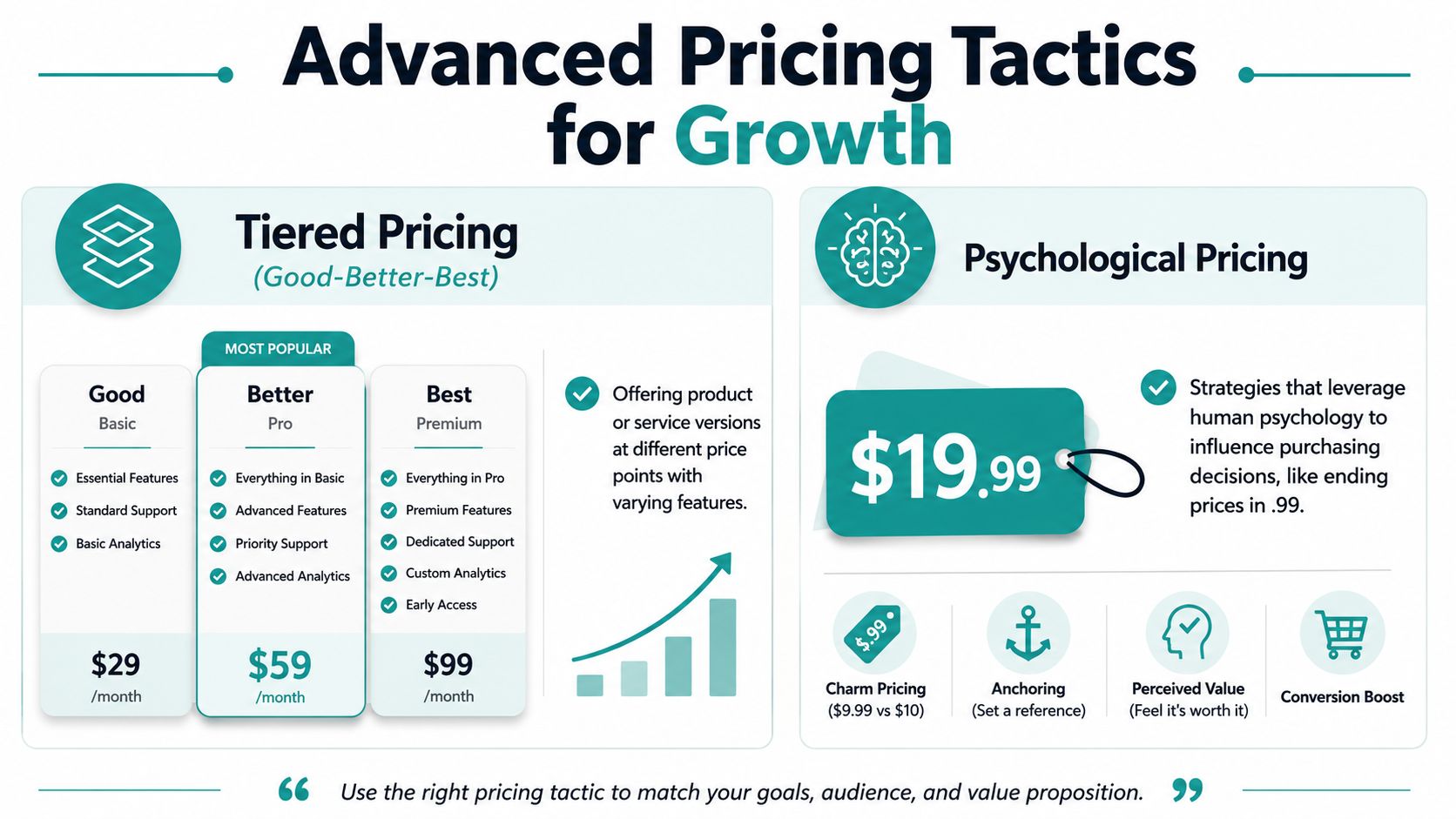
Tiered pricing
Tiered pricing works because it gives buyers context. A single offer forces a yes-or-no decision. A three-tier structure guides comparison and often makes the middle option feel safer and more rational.
A data-driven three-tier architecture can optimize revenue by placing offers into Entry at the lowest 20 to 25% of category prices, Core in the middle 55 to 65%, and Premium in the top 15 to 25%, with Core acting as the primary revenue and margin engine, as outlined in Chapters' pricing analytics guide.
That framework works well for:
Services: Basic, standard, and premium packages
Retail assortments: Opening price point, core bestseller, premium option
Digital offers: Starter, professional, and advanced plans
The mistake is building three tiers that are too similar. If the customer can't see a meaningful difference, you haven't created choice. You've created friction.
Psychological pricing
Psychological pricing is often treated as gimmicky, but in practice it's about presentation, not trickery.
Small changes in how prices are framed can influence buyer response:
Charm pricing: Prices ending in .99 can make an offer feel lower at a glance
Anchoring: A premium option can make the middle tier feel more reasonable
Bundling: Buyers often accept a higher total when the offer is packaged around convenience or outcome
Decoy offers: A strategically weaker option can push attention to the offer you intend to sell most
These tactics don't fix a weak offer. They work best when the underlying proposition is already clear.
Buyers rarely judge price in isolation. They judge it against the alternatives you place in front of them.
Dynamic pricing for service businesses
Dynamic pricing isn't just for airlines and hotels. Service-based small businesses can use it carefully, especially when demand, urgency, complexity, or scheduling constraints vary.
A common example is a home services company charging differently for same-day emergency work than for routine scheduled work. A consultant may price strategy work differently when scope is uncertain or turnaround time is compressed. A real estate or legal practice may adjust fees based on complexity rather than forcing every client into a static menu.
The need is growing. 62% of SMBs raised prices in 2025 due to inflation, but only 14% used automated pricing tools, according to Small Business Charter's pricing insight. That gap explains why so many service businesses still rely on slow manual updates and instinct-heavy quoting.
Guardrails for using advanced tactics well
Use these tactics to improve clarity, not to confuse buyers.
Keep tier names intuitive: Buyers should understand the logic immediately.
Tie higher prices to visible value: More access, faster response, broader scope, or better outcomes.
Set rules for dynamic adjustments: Especially in service businesses, consistency protects trust.
Review actual mix: If nobody buys premium, the issue may be value communication, not price.
Advanced pricing works when it helps customers self-select into the right offer and helps the business protect its strongest margins.
Implementing and Monitoring Your Pricing Strategy
A pricing decision isn't finished when you publish the new number. It's finished when you've seen how buyers, sales, margin, and retention respond over time.
That sounds obvious, but many businesses still treat pricing as a one-time event. They update a price list, notify a few customers, and move on. Then they react emotionally to the first objection.
Roll out changes with control
If you're changing prices, do it deliberately.
Set an effective date: Give customers and staff a clear timeline.
Prepare a short explanation: Focus on value, service quality, input costs, or scope clarity.
Train whoever quotes or sells: Inconsistent explanation creates distrust faster than the increase itself.
Segment existing and new customers carefully: Longstanding customers may need a different communication approach.
This is especially important for service firms. The same source noted earlier shows that 62% of SMBs raised prices in 2025 while only 14% used automated pricing tools, which helps explain why many businesses still make slow, manual changes that lag behind market reality.
Watch the right signals
After implementation, track what changed in practice:
Sales volume: Did demand hold, soften, or improve?
Profit margin: Did the increase improve profitability?
Close rate by offer type: Which packages or tiers gained traction?
Customer feedback: Are objections about price, or about unclear value?
Marketing efficiency: Did customer acquisition still make sense at the new price?
For owners who want a broader operational lens on margin discipline and cash flow, Everglow Prosperity on profitability offers a useful companion read.
You also need a feedback loop between pricing and marketing. If you're investing in acquisition, you should measure whether those efforts still produce acceptable returns after your pricing changes. A practical place to tighten that loop is this guide on measuring marketing ROI.
The best pricing strategy is rarely the boldest one. It's the one you can explain, execute, and improve without losing control.
A strong system stays alive. You review costs, watch buyer behavior, test packaging, and refine regularly. That's how pricing stops being a source of anxiety and starts acting like a growth lever.
If you want a practical way to include TV advertising in your growth model without needing a massive budget, Adwave is a strong option. It helps small businesses create, launch, and measure AI-powered TV campaigns on premium channels with accessible entry pricing, which makes it easier to plan acquisition costs alongside your pricing strategy instead of treating marketing as a guess.


