-
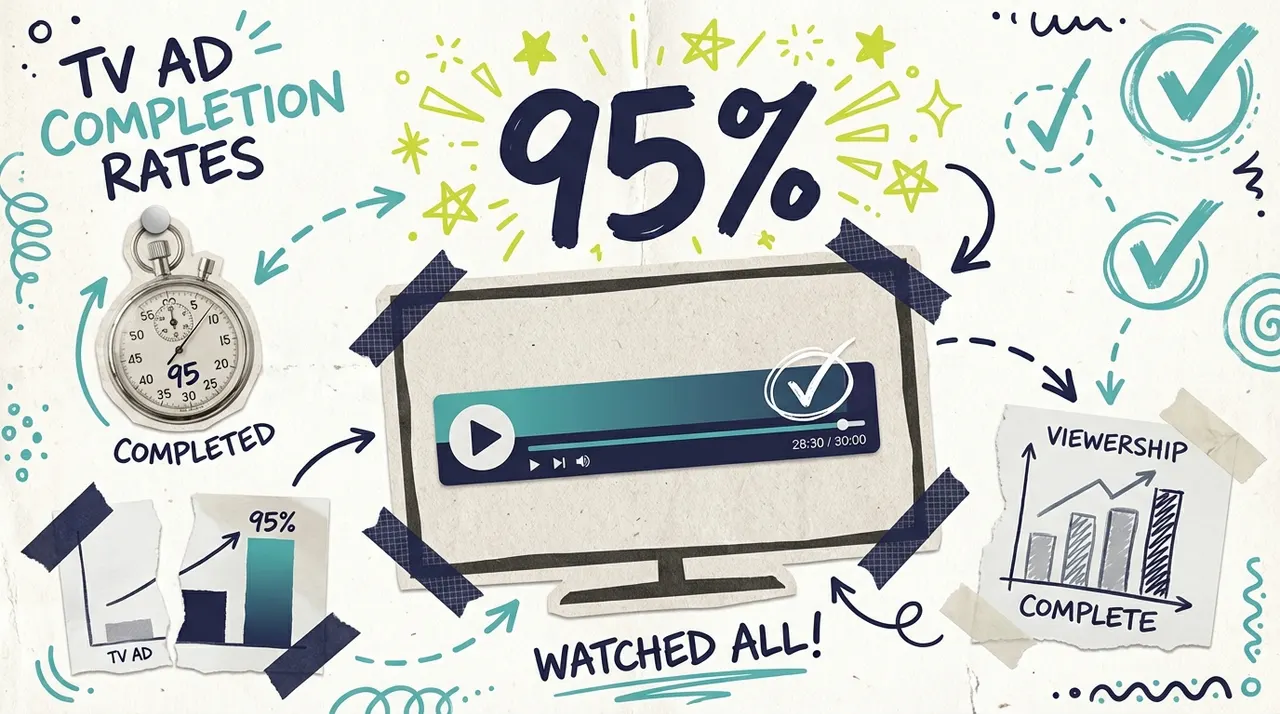
95%+
Average CTV ad completion rate
-
62%
Mobile video ad completion rate
-
33%
Higher completion on CTV vs mobile
Connected TV advertising delivers completion rates that digital marketers can only dream about. While mobile and desktop video ads struggle to keep viewers engaged past the first few seconds, CTV ads achieve completion rates above 95%, according to Innovid's 2024 Global Benchmarks Report. This stark difference reflects a fundamental truth about viewer attention: when people settle into their living rooms to watch content on the big screen, they're far more engaged than when scrolling through feeds on phones or clicking through websites on laptops.
For advertisers, completion rate represents one of the most important metrics in video advertising. A viewer who watches your entire 30-second commercial absorbs your complete message, sees your call to action, and forms a stronger impression of your brand than someone who skips after three seconds. Understanding completion rate benchmarks helps businesses set realistic expectations, choose the right platforms, and optimize their advertising investments for maximum impact.
What the data shows
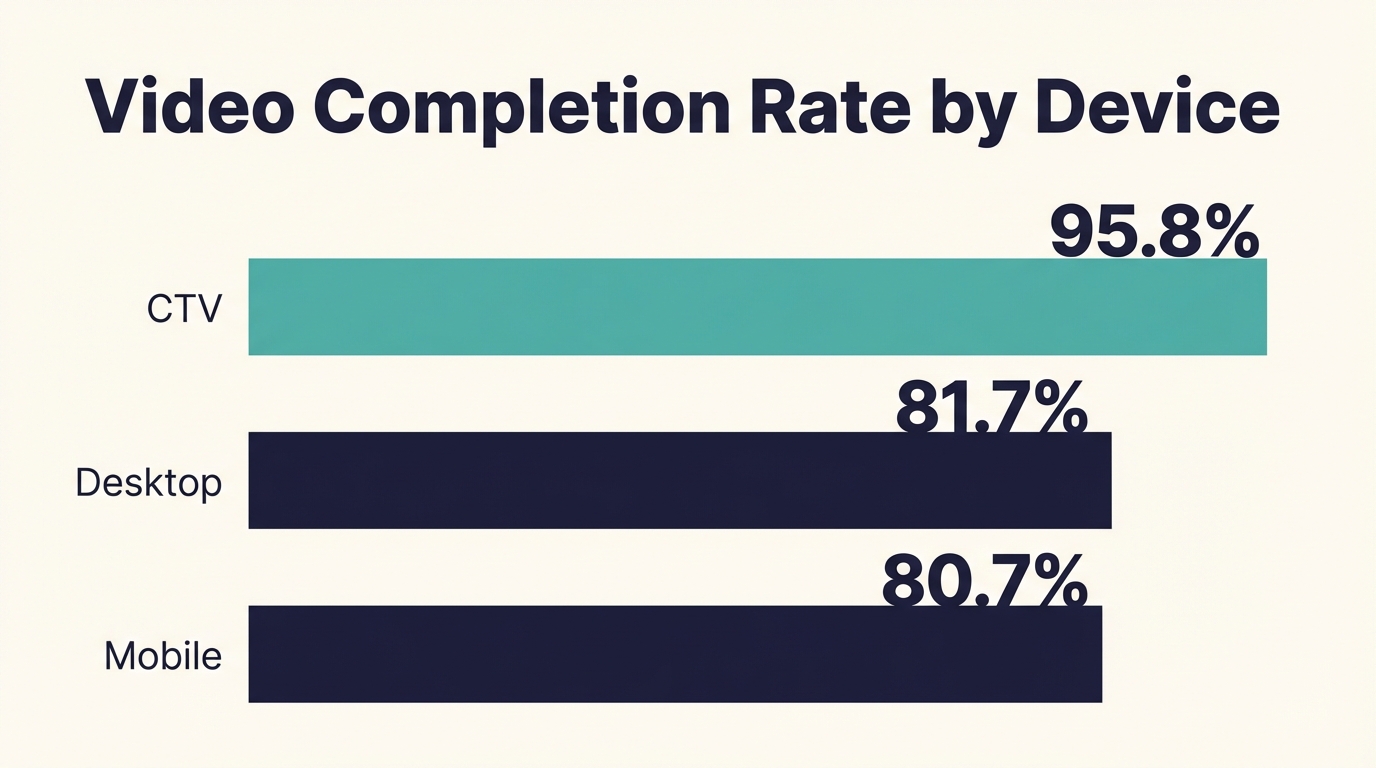
Video completion rate (VCR), sometimes called view-through rate, measures the percentage of viewers who watch a video ad from start to finish. According to Innovid's 2024 research, the average video completion rates by device in 2024 were:
Connected TV: 95.80%
Desktop: 81.70%
Mobile: 80.70%
These numbers reveal a significant engagement gap between CTV and other digital platforms. When viewers watch ads on connected TV devices like Roku, Amazon Fire TV, or smart TVs, they complete the ad at rates nearly 15 percentage points higher than mobile or desktop viewers. This difference has profound implications for advertisers allocating budgets across channels.
The high completion rates on CTV reflect several characteristics of the viewing environment. Unlike mobile browsing, where users multitask and quickly scroll past content, CTV viewing typically occurs during dedicated entertainment time. Viewers have made a conscious decision to watch content, they're often in a relaxed "lean-back" position, and they're generally less likely to reach for a remote to skip ads than to swipe past an ad on their phone.
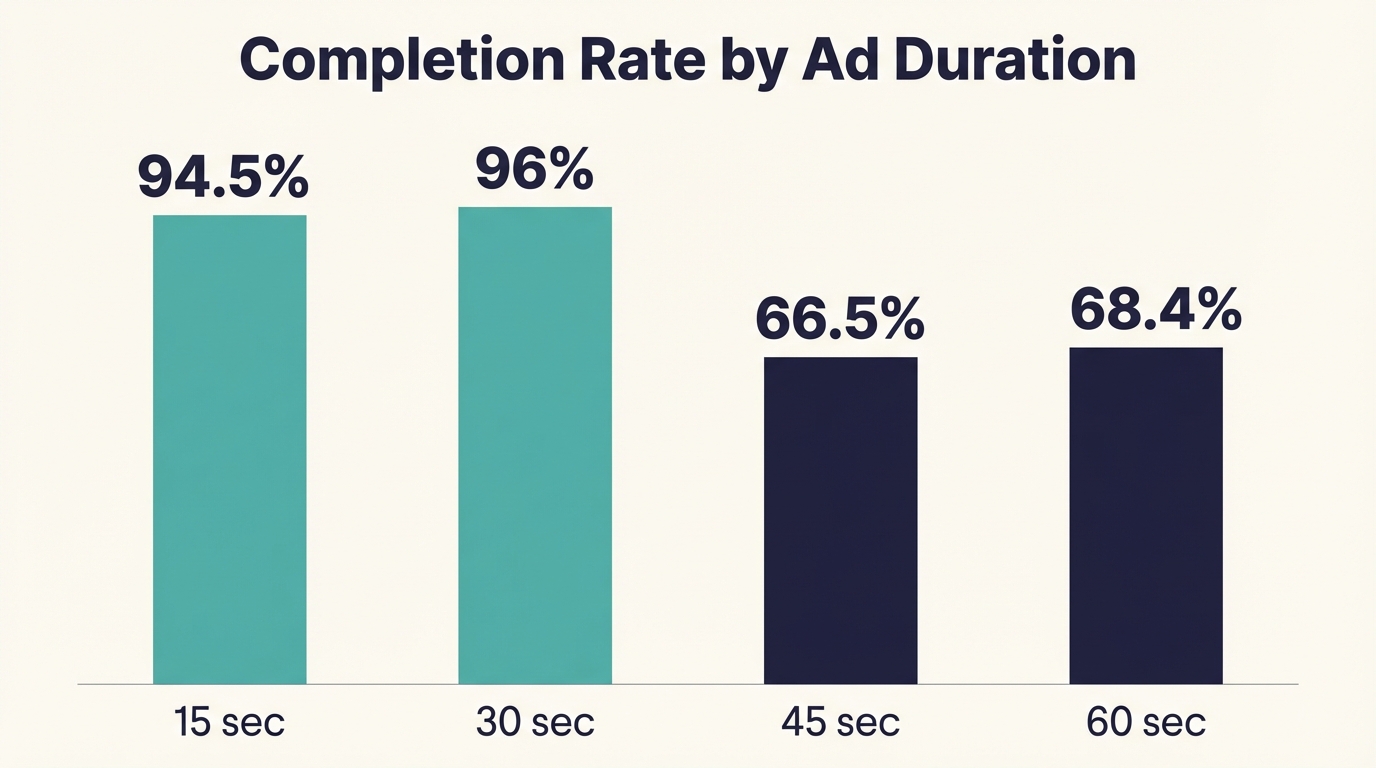
Ad duration also significantly impacts completion rates. According to IAB research, shorter ads generally achieve higher completion rates:
15-second ads: 94.5% completion rate
30-second ads: 92-96% completion rate (varies by platform)
45-second ads: 66.5% completion rate
60-second ads: 68.4% completion rate
The 30-second format remains the industry standard for good reason. It provides enough time to tell a compelling brand story while maintaining strong completion rates. The sharp drop-off for ads longer than 30 seconds suggests that viewer patience has clear limits, even in the more engaged CTV environment.
Interactive CTV ads represent a growing category that achieves even higher engagement. According to PR Newswire citing Innovid data, interactive CTV ads achieved a video completion rate of 96.4%, surpassing standard video ads by approximately 3 percentage points. These interactive formats allow viewers to engage with ads through their remote controls, exploring product details, signing up for offers, or accessing additional content.
Understanding these benchmarks helps advertisers set appropriate expectations for their campaigns. A CTV campaign achieving 93% completion rates is performing within normal ranges, while a mobile campaign at 75% might be underperforming relative to benchmarks. Context matters when evaluating performance metrics.
Breaking down the numbers
By platform type
Different streaming platforms and CTV environments produce varying completion rates based on their ad formats, content types, and viewer demographics.
Premium ad-supported streaming services like Hulu, Peacock, and the ad tiers of Netflix and Disney+ typically achieve completion rates at or above the 95% benchmark. These platforms offer professional content in controlled environments where ads appear at natural breaks in programming. Viewers who choose ad-supported tiers have implicitly accepted advertising as part of their viewing experience, leading to higher tolerance and completion rates.
Free ad-supported streaming TV (FAST) channels like Pluto TV, Tubi, and Roku Channel also achieve strong completion rates, though sometimes slightly below premium services. The higher ad loads on some FAST platforms (up to 15 minutes per hour compared to 9-10 minutes on premium services) can create some viewer fatigue, but completion rates generally remain above 90%.
YouTube on CTV represents an interesting middle ground. While YouTube offers skippable ad formats that theoretically allow viewers to bypass ads after 5 seconds, CTV viewing on YouTube tends to produce higher completion rates than mobile or desktop YouTube viewing. The lean-back CTV environment makes viewers less likely to reach for a remote to skip compared to tapping a skip button on their phone.
Linear television, while not technically measured by the same "completion rate" metric, historically achieved high attention rates because viewers had no skip option. However, DVR usage introduced ad-skipping behavior, and studies suggest that a significant portion of DVR viewers fast-forward through commercials. This makes streaming TV advertising increasingly attractive for advertisers seeking guaranteed viewership.
By ad format
The format and creative execution of video ads significantly impacts completion rates, even within the same platform.
Standard pre-roll ads (ads that play before content begins) typically achieve slightly higher completion rates than mid-roll ads (ads that interrupt content). Viewers are often more willing to wait through an ad to access content they want than to have their viewing interrupted. However, mid-roll ads benefit from viewer investment in the content, making them less likely to abandon entirely.
Non-skippable ad formats, common on most CTV platforms, naturally achieve higher completion rates than skippable formats. When viewers cannot skip, they must either watch the ad or abandon the content entirely. Most choose to watch, especially for ads 30 seconds or shorter.
Interactive and shoppable CTV ads achieve completion rates of 96% or higher, according to Innovid data. These formats engage viewers actively, creating a participatory experience rather than passive viewing. Interactive elements might include QR codes, remote-control navigation to explore products, or direct-response options.
Sequential ad pods (multiple ads shown in sequence during a single break) can impact individual ad completion rates. Viewer attention typically decreases through an ad pod, with the first ad in a sequence achieving higher engagement than subsequent ads. This makes premium placement within ad pods valuable for advertisers.
By industry vertical
Completion rates can vary by industry based on creative quality, relevance to the viewing audience, and category interest levels.
According to Innovid's automotive industry report, automotive advertising achieved these completion rates in 2024:
Standard video ads: 89.61%
Dynamic creative optimization (DCO) ads: 79.20%
Interactive video ads: 78.96%
Interactive CTV ads: 84.89%
These automotive-specific rates fall slightly below overall CTV benchmarks, possibly because automotive purchases are high-consideration decisions that don't apply to all viewers. Someone not in the market for a car may be less engaged with automotive advertising than with categories more universally relevant.
Consumer packaged goods (CPG) advertising typically achieves strong completion rates due to broad relevance. Most viewers use household products, food, and beverages, making these ads more universally applicable than niche category advertising.
Entertainment advertising (movie trailers, streaming service promotions, video game ads) often achieves above-average completion rates because viewers are interested in entertainment content. A compelling movie trailer can feel more like content than advertising.
Local business advertising completion rates vary widely based on creative quality. Professional, well-produced local ads can achieve rates comparable to national advertising, while amateur-quality creative may underperform. This makes production value important for local TV advertising success.
Why it matters for your business
Video completion rate directly impacts the effectiveness of your advertising investment. Understanding why this metric matters helps businesses make smarter decisions about platform selection, creative development, and budget allocation.
When a viewer watches your complete ad, they receive your full message. A 30-second commercial typically includes an opening hook, a value proposition, supporting points, and a call to action. If viewers skip or abandon after 5 seconds, they've only seen the hook and missed everything else. The difference between 80% and 95% completion rates means the difference between most viewers receiving your complete message versus a significant portion missing critical information.
TV advertising builds brand awareness through repeated exposure to complete messages. Research consistently shows that brand recall and purchase intent increase with ad exposure frequency and completion. Viewers who see complete ads multiple times develop stronger brand associations than those who see partial ads more frequently.
For businesses measuring return on advertising spend, completion rate impacts cost efficiency. If you're paying CPM (cost per thousand impressions) and 95% of those impressions result in complete views on CTV versus 80% on mobile, CTV delivers more complete message deliveries per dollar spent. The math becomes even more favorable when considering the attention quality differences between platforms.
Local businesses benefit especially from CTV's high completion rates. When a restaurant, dental practice, or home services contractor runs a 30-second commercial, they need viewers to see the entire ad to understand the offer, remember the business name, and know how to take action. CTV's high completion rates ensure that local advertising investments deliver complete messages to viewers in the service area.
The completion rate advantage of CTV also affects measurement and attribution. When nearly all viewers see complete ads, it's easier to attribute subsequent business outcomes to advertising exposure. Lower completion rates introduce uncertainty about whether viewers received the advertising message.
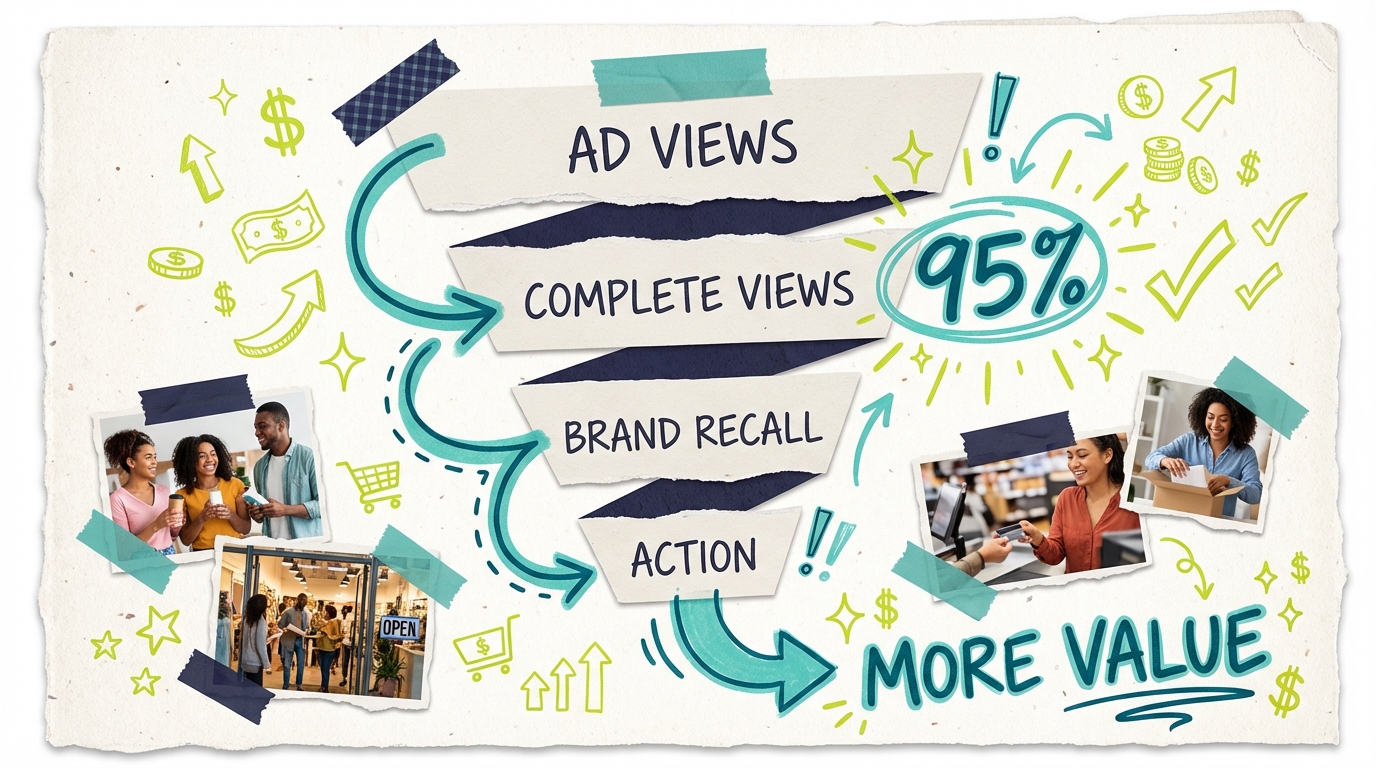
How to take advantage of this trend
Businesses can take advantage of CTV's high completion rates through several strategic approaches that maximize the value of this engaged audience.
First, prioritize CTV in your video advertising mix. If you're currently running video ads across mobile, desktop, and CTV, consider shifting budget toward CTV to take advantage of higher completion rates. The 15-percentage-point completion rate advantage means more complete message deliveries per advertising dollar. For businesses new to video advertising, starting with CTV rather than social video provides a more engaged audience from day one.
Second, optimize your creative for the 30-second format. Since 30-second ads achieve strong completion rates while providing adequate storytelling time, build your core creative around this duration. Front-load your key message in case some viewers do skip (on platforms that allow it), but use the full 30 seconds to tell a complete story. Avoid the temptation to create 60-second ads thinking more time equals more impact; the completion rate data suggests otherwise.
Third, consider interactive ad formats when available. Interactive CTV ads achieve completion rates above 96% while also driving direct engagement. Features like QR codes let viewers take immediate action, bridging the gap between TV viewing and digital response. Even simple interactivity, like allowing viewers to request more information via their remote, can boost engagement.
Fourth, invest in production quality. While CTV audiences are generally more engaged than mobile viewers, creative quality still matters. Professional production, clear audio, and compelling visuals help maintain attention throughout the ad. Platforms like Adwave offer AI-generated creative that achieves broadcast-quality production without traditional production costs, making professional advertising accessible to businesses of all sizes.
Fifth, target strategically to maximize relevance. Completion rates improve when ads are relevant to viewers. Use geographic targeting to reach viewers in your service area, demographic targeting to reach likely customers, and interest-based targeting when available. Irrelevant ads, even on high-completion platforms, waste impressions and budget.
The bigger picture
The attention economy
Video completion rates reflect broader trends in the attention economy, where consumer attention has become the scarcest resource in advertising. The dramatic difference between CTV and mobile completion rates illustrates how viewing context shapes attention quality.
Mobile devices, while ubiquitous, compete for attention against countless other apps, notifications, and real-world distractions. Users have trained themselves to scroll quickly, skip aggressively, and multitask constantly. Video advertising on mobile must fight for attention in an environment designed for fragmented consumption.
Connected TV represents a different attention paradigm. The living room remains a dedicated space for entertainment consumption. The large screen commands focus in ways that small screens cannot. The physical separation between viewer and device (compared to holding a phone) reduces the impulse to skip or swipe away. These environmental factors create natural advantages for advertising attention.
Streaming's continued growth
The completion rate advantage of CTV gains significance as streaming continues to capture viewing share from traditional television. As more households adopt streaming as their primary video consumption method, the opportunity to reach engaged audiences through CTV advertising expands.
Traditional linear TV, while still reaching large audiences, faces challenges from DVR ad-skipping and declining viewership among younger demographics. CTV combines the attention quality of television viewing with the targeting precision and measurability of digital advertising, offering advertisers the best of both worlds.
The growth of ad-supported streaming tiers on premium services like Netflix and Disney+ expands CTV advertising inventory. These platforms offer high-quality content environments with strong completion rates, creating new opportunities for advertisers to reach engaged audiences.
Measurement evolution
As CTV matures as an advertising channel, measurement capabilities continue to evolve. Completion rate represents just one metric in a broader measurement ecosystem that increasingly includes attention metrics, brand lift studies, and conversion attribution.
Attention measurement adds information about whether viewers watched an ad attentively, beyond whether it played to completion.
What experts are saying
Industry analysts and advertising professionals have noted the significance of CTV's completion rate advantage in shaping advertising strategies.
Media measurement experts point to completion rates as evidence of CTV's superior engagement environment. Unlike social video platforms where ads compete against infinite scrolling content, CTV presents advertising in a controlled, immersive environment that commands attention.
Advertising agency professionals increasingly recommend CTV as a core component of video strategies, citing completion rates as a key differentiator. The ability to guarantee that most viewers see complete ads makes CTV especially attractive for brand-building campaigns where message completion matters.
Streaming platform executives highlight their completion rates as evidence of advertising effectiveness, using these metrics to attract advertising budgets. Premium streamers emphasize the quality of their advertising environment, pointing to completion rates as proof that their audiences engage with commercial content.
Small business advertising advocates note that CTV's high completion rates make television advertising more accessible and effective for local businesses. When a small business can be confident that viewers will see their complete message, the value proposition of TV advertising becomes clearer.
Common questions answered
What is a good video completion rate?
A good video completion rate depends heavily on the platform. For CTV advertising, completion rates above 90% are considered normal, with many campaigns achieving 95% or higher. For mobile video advertising, completion rates around 75-80% represent solid performance. For desktop video, 80-85% completion rates indicate good engagement. Always evaluate completion rates relative to platform-specific benchmarks rather than applying a single standard across all channels.
Why are CTV completion rates so much higher than mobile?
CTV completion rates exceed mobile rates primarily due to viewing environment differences. CTV viewers are typically in a dedicated entertainment mindset, watching on a large screen in their living room, with fewer competing distractions. Most CTV ads are also non-skippable, meaning viewers must watch to continue their content. Mobile viewing, by contrast, occurs in fragmented attention environments where users can easily scroll past, skip, or ignore video ads while multitasking with other apps and activities.
Do completion rates affect advertising costs?
Completion rates indirectly affect advertising value rather than directly changing costs. Most CTV advertising is priced on a CPM (cost per thousand impressions) basis, meaning you pay for ad delivery regardless of completion. However, higher completion rates mean more complete message deliveries per dollar spent, improving cost efficiency. Some advanced buying methods may incorporate completion rate guarantees, and completion rates factor into performance evaluations that influence future budget allocation decisions.
How do I improve my video ad completion rates?
To improve completion rates, focus on creative quality, appropriate ad length, and platform selection. Keep ads to 30 seconds or shorter for optimal completion. Front-load your key message to capture attention immediately. Invest in professional production quality. Choose CTV placements over mobile when possible. Ensure creative relevance to your target audience through proper targeting. Test different creative approaches and optimize based on completion rate data from your campaigns.
What's the difference between completion rate and view-through rate?
The terms are often used interchangeably but can have slightly different definitions depending on the platform or measurement provider. Completion rate typically measures what percentage of ad impressions resulted in the full ad being viewed. View-through rate sometimes refers to the same metric, but can also describe users who saw an ad and later visited a website or converted without clicking directly. Always clarify definitions when comparing metrics across different platforms or reports.
Do shorter ads always have higher completion rates?
Shorter ads generally achieve higher completion rates, but the relationship isn't perfectly linear. 15-second and 30-second ads both achieve strong completion rates on CTV (often above 90%). The significant drop-off occurs for ads longer than 30 seconds, where 45-second and 60-second ads may see completion rates fall to 65-70%. For most advertisers, the 30-second format offers the optimal balance of storytelling time and completion rate performance.
Supporting data
Additional context on video ad completion rate benchmarks and trends:
CTV video completion rate: 95.80% (Innovid 2024 Global Benchmarks Report)
Desktop video completion rate: 81.70% (Innovid 2024)
Mobile video completion rate: 80.70% (Innovid 2024)
Interactive CTV ad completion rate: 96.4% (PR Newswire/Innovid)
15-second ad completion rate: 79.6-94.5% (varies by source and platform)
30-second ad completion rate: 85.9-96% (varies by source and platform)
45-second ad completion rate: 66.5% (IAB/Innovid)
60-second ad completion rate: 68.4% (IAB/Innovid)
CTV brand recall advantage vs mobile: 20% higher (Marketing LTB)
Automotive standard video completion rate: 89.61% (Innovid 2024 Auto Report)
Automotive interactive CTV completion rate: 84.89% (Innovid 2024 Auto Report)
All sources linked above. Data current as of September 2025.
Get started with TV advertising
Ready to reach viewers who watch your ads? CTV advertising delivers completion rates above 95%, meaning your message reaches engaged audiences on the biggest screen in the house.
Adwave makes TV advertising accessible for businesses of all sizes. Create professional commercials in minutes using AI, target viewers in your local area, and launch campaigns starting at just $50. Your ads run across 100+ premium streaming platforms where viewers pay attention.