
A 5% increase in customer retention can lead to a 25% to 95% increase in profits, according to Bain & Company research cited in this analysis. That single number should force most small business owners to rethink where they spend their time and budget.
Many SMBs still treat customer loss like background noise. A few cancellations. A few buyers who never come back. A few accounts that drift away. But the full cost of losing a customer goes far beyond the sale you didn't make. It affects your acquisition efficiency, your cash flow, your team's focus, and the value of every marketing dollar you spend.
That's why retention deserves a sharper lens. In Cost of Losing a Customer: Why Retention Matters More Than You Think, the useful question isn't just “How many customers did we lose?” It's “What did each loss cost our business?”
The Profit Multiplier You Are Ignoring
Most owners obsess over lead flow. That makes sense. New customers feel like growth. But the more important lever often sits inside your existing customer base.
The Bain finding matters because it changes the economics of growth. If a business can improve retention even modestly, profit can rise disproportionately because repeat buyers don't require the same level of selling effort, education, or trust-building as first-time buyers. They already know your business. They've already crossed the hardest threshold.
Why retention beats constant replacement
A customer who stays does more than buy again. That customer helps you recover your original acquisition cost faster, smooths out revenue volatility, and gives your business more room to plan with confidence.
A customer who leaves does the opposite. You lose future purchases, and you have to fund another acquisition cycle just to get back to where you were before.
Practical rule: If your business is growing in sales volume but not in profit, retention is one of the first places to look.
Lifetime value proves useful. If you don't know how much a customer is worth across the full relationship, you can't make sensible decisions about service, follow-up, or re-engagement. For a clean way to think about that number, this founder's guide to LTV is worth reading.
The small-business mistake hiding in plain sight
SMBs often underinvest in retention because it doesn't look urgent. Acquisition has visible inputs and visible outputs. You buy ads, generate leads, and watch inquiries arrive. Retention is quieter. It happens in follow-up cadence, customer experience, service recovery, reminders, and relevance.
That quietness is deceptive. Retention is often the difference between a business that needs constant prospecting and one that compounds value over time. If you want a practical starting point for that lens, Adwave's resource on customer lifetime value for small business is a useful reference.
The True Cost of a Lost Customer
Most churn calculations are too shallow. Owners usually count the missed sale and stop there. That gives them a number, but not the actual one.
For most SMEs, losing a single mid-tier client costs between 3 and 8 times what they initially estimate, because standard formulas miss disrupted workflows, lost referrals, and staff time spent on preventable churn, according to Dynamic Business.
The iceberg under every lost account
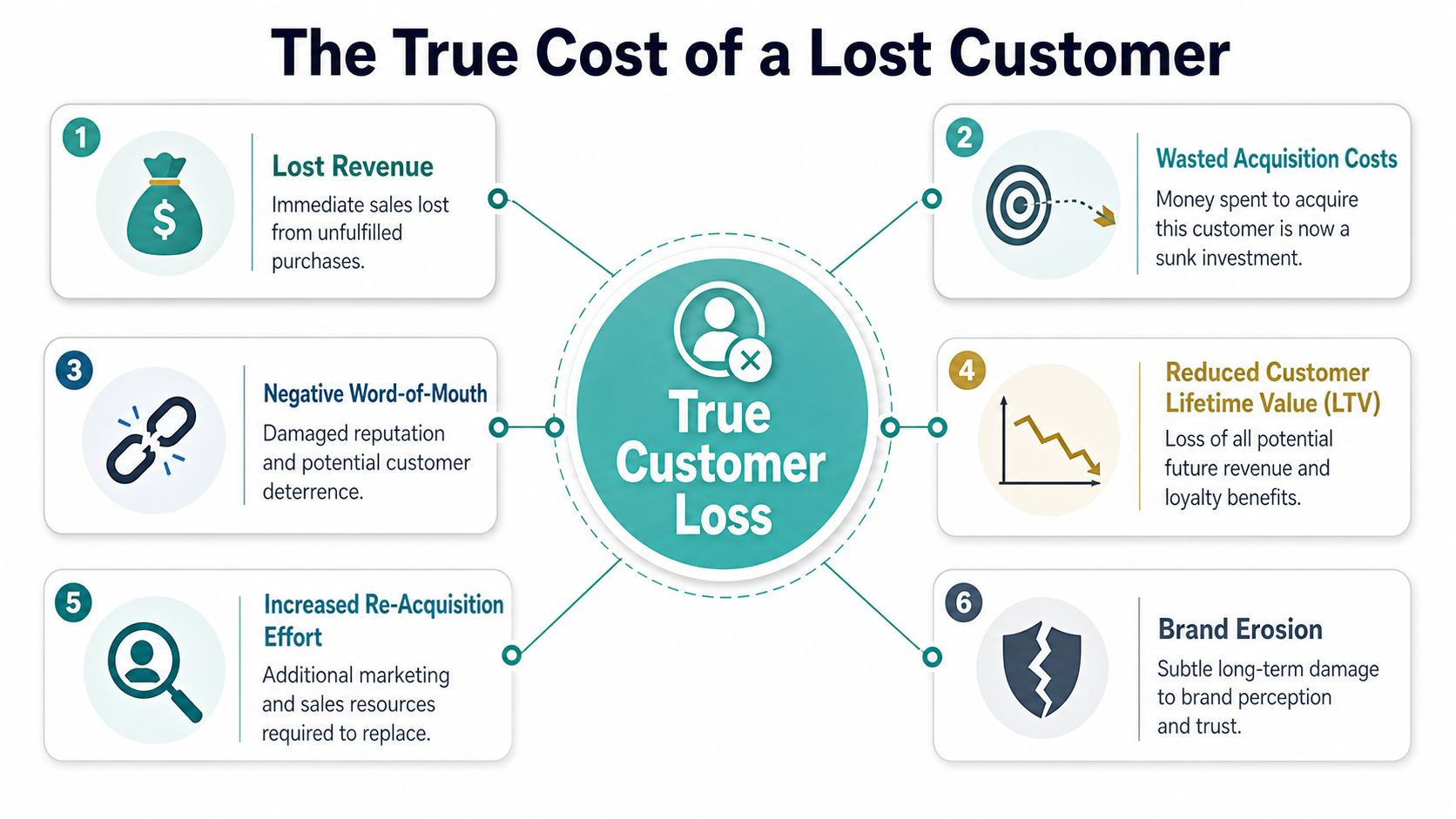
The visible loss is revenue. The hidden loss is everything attached to that relationship.
Think about customer loss in layers:
Lost revenue: The immediate purchase or recurring spend disappears.
Wasted acquisition cost: The money you spent to win that customer becomes a sunk cost.
Lost future margin: Repeat customers often become easier to serve and more valuable over time.
Referral loss: A satisfied customer can introduce your business to others. A lost one won't.
Operational drag: Your team spends time handling issues, replacing demand, and repairing gaps.
Brand erosion: Repeated churn weakens confidence in your offer, even if you don't see it in a single report.
Customer loss can affect repeat revenue, referrals, and the cost of finding a replacement customer.
A simple framework for SMBs
You don't need enterprise analytics to estimate this more realistically. Start with four questions:
What revenue did this customer still have left to spend?
What did it cost to acquire them in the first place?
What replacement effort will your team now have to fund or perform?
What secondary value disappeared with them, such as referrals, reviews, or repeat service work?
If you only answer the first question, you'll understate the damage. That's why churn can feel manageable on paper while profitability still slips.
Lost customers don't just reduce sales. They force you to spend energy replacing trust you already earned once.
A practical next step is to collect better exit signals before accounts disappear completely. Even a modest process for understanding cancellation reasons can surface patterns in service, pricing, communication, or expectations. Adwave's guide to exit surveys and learning why customers leave gives SMB teams a sensible framework for that work.
How Retention Fuels Profitable Growth
Retention isn't only defensive. It's one of the cleanest growth strategies a business can run because it improves the economics of every customer you've already paid to win.
The most useful way to understand this is through two ideas. Customer lifetime value tells you what a customer is worth across the relationship. CAC payback period tells you how long it takes to earn back what you spent to acquire that customer. When retention improves, both metrics move in your favor.
What changes when customers stay longer
According to Vendaq, acquiring a new customer costs 5 to 25 times more than retaining an existing one. The same source notes that when a customer leaves, you lose future revenue, waste the original acquisition investment, and must spend again to replace them.
That changes the way growth should be managed.
If a customer stays longer, your acquisition cost gets spread across a larger revenue base. If a customer buys again, the next purchase usually arrives with less friction. If a customer trusts you, follow-on offers become easier to present.
Acquisition vs. Retention The Financial Reality
This is why retention improves more than one KPI at a time. It lowers the pressure on sales, improves marketing efficiency, and gives finance a more stable base to plan against.
Why this matters in relationship-driven sectors
For businesses with infrequent purchases, staying in contact can support referrals and repeat work. Include the time and cost of maintaining those relationships in your retention planning. (CRM for better real estate account management)
Key takeaway: Retention doesn't just preserve revenue. It improves the return on revenue you already worked hard to acquire.
Calculate Your Customer Churn Rate and Its Cost
If retention feels abstract, calculate churn. Once you put a number on customer loss, you stop treating it like a soft issue.
According to Outsource Accelerator, healthy churn should be 5% or below, and once churn rises above 10%, a business should re-evaluate its retention strategy. The same source reports that existing customers convert at 60% to 70%, while new prospects convert at 5% to 20%. That gap matters because replacing lost customers usually means selling to a colder audience.
The basic churn formula
Use this simple calculation:
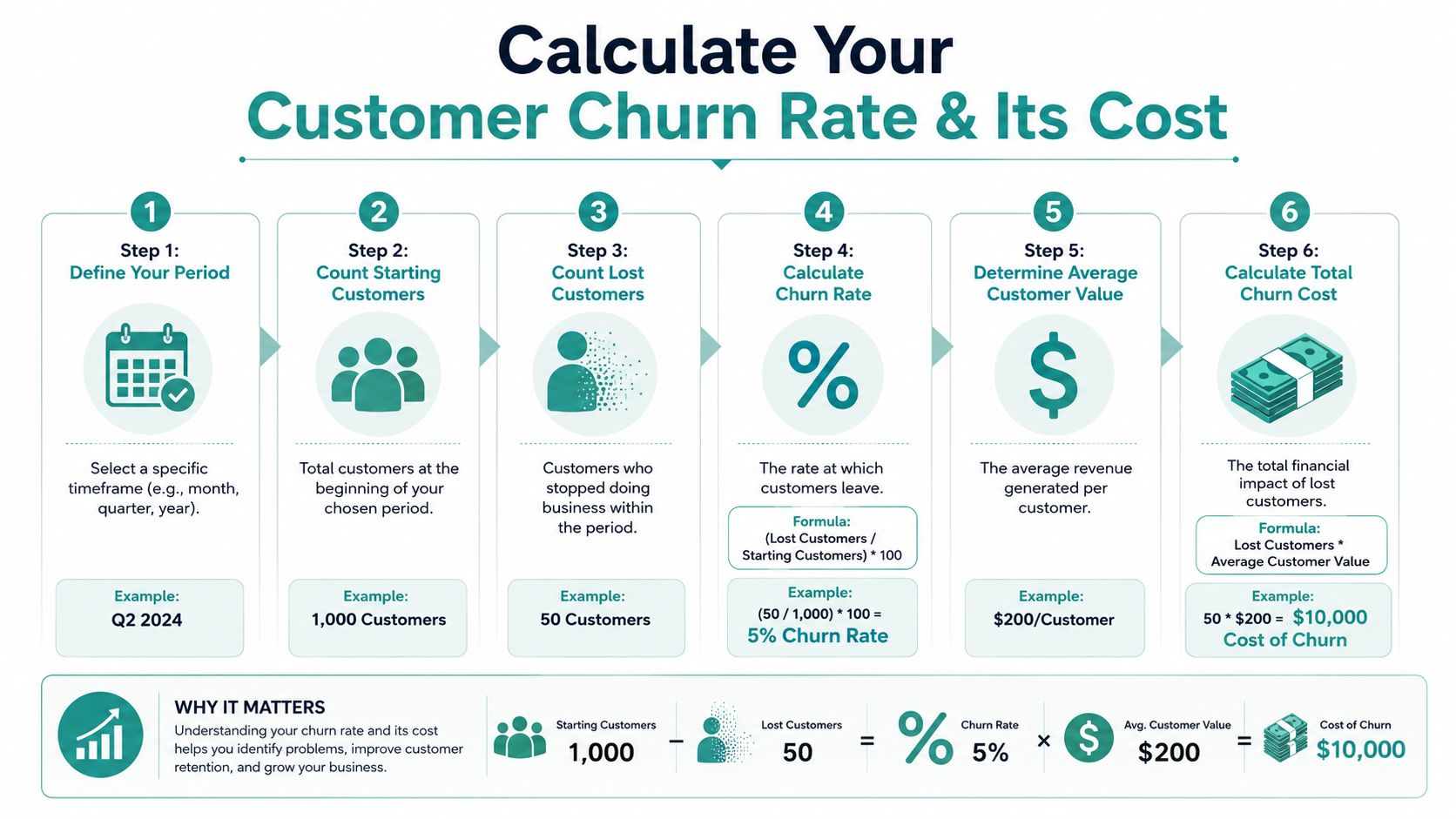
Churn rate = (Customers lost during a period / Customers at the start of that period) × 100
Pick one time period and stay consistent. Month, quarter, or year all work. For most SMBs, monthly or quarterly is easier to act on.
Then estimate direct revenue leakage:
Cost of churn = Lost customers × average customer value
That won't capture every hidden cost, but it gives you an usable baseline.
A simple worked example
Use the example shown in the infographic:
Starting customers: 1,000
Lost customers: 50
Churn rate: 5%
Average customer value: $200
Direct churn cost: $10,000
That's only the first layer. It doesn't include wasted acquisition cost, lost future purchases, or referral value. But it immediately tells you whether churn is a minor issue or a significant revenue leak.
Make the number operational
Once you have your churn figure, break it down by segment:
By channel: Are customers from one source leaving faster?
By offer: Does one product create weak-fit buyers?
By timing: Do customers leave early or after a service issue?
By owner: Which accounts need personal follow-up?
Review customer acquisition cost alongside churn to estimate what replacing lost customers may cost.
For teams tightening client relationships, this piece on understanding client engagement is a useful complement because it helps you spot weakening engagement before churn shows up in your numbers.
Actionable Strategies to Improve Customer Retention
Retention improves when a business removes reasons to leave and adds reasons to stay. SMBs don't need a large customer success team to do that. They need a few repeatable habits.
Build a simple retention system
Start with communication. Most churn doesn't begin with a cancellation. It begins with silence, confusion, or fading relevance.
A practical retention system usually includes:
Post-purchase follow-up: Send a check-in after the first transaction or service completion. Ask whether the customer got what they expected and whether anything needs attention.
Service recovery outreach: When something goes wrong, contact the customer directly. Don't rely on passive waiting.
Timed reminders: If your service has a natural repurchase cycle, remind customers before they drift.
Loyalty recognition: Thank returning customers in a visible way. That can be early access, a small perk, or a priority slot.
These actions work because they reduce customer effort. People stay with businesses that feel easy to buy from and easy to resolve issues with.
Use feedback before customers disappear
Many SMBs collect reviews but not useful retention feedback. Those are different things. Reviews help marketing. Feedback helps operations.
Try this approach:
Ask recent customers what nearly prevented them from buying again.
Ask departing customers why they left.
Track repeated complaints by category.
Assign one owner to fix the top issue first.
That process doesn't require advanced software. A shared spreadsheet, a standard survey, and one monthly review meeting can do a lot.
A business rarely has a churn problem in the abstract. It has specific friction points that keep recurring until someone names them and fixes them.
Create reasons to return
Retention also depends on staying relevant after the initial sale. That can be as simple as useful communication and light-touch offers.
Consider a few low-cost options:
Seasonal reactivation: Reach out when demand is naturally returning.
Customer education: Share tips that help buyers get more value from what they purchased.
Referral prompts: Ask satisfied customers to introduce someone only after a positive experience.
Segmented offers: Tailor messages by prior purchase, location, or service history.
The strongest retention strategy is often boring in the best way. Consistent follow-up. Fast issue resolution. Useful reminders. Clear value.
Re-Engage Customers with Targeted Local TV
Many SMBs think of TV as an acquisition channel only. That's too narrow. Local TV can also support retention by helping your brand stay familiar, credible, and visible to customers who already know you but haven't acted recently.
That matters in low-frequency industries. According to Churnkey, for businesses such as real estate and auto sales, the replacement cost for a lost client can range from $200 to $1,500 or more. In those sectors, retention ROI looks different because the core asset is the relationship itself.
Why TV works for re-engagement
A lapsed customer often doesn't need a long sales pitch. They need a reminder. A new offer. A service update. A reason to remember your business when the next buying moment arrives.
That's where targeted local TV fits well. Instead of treating advertising only as top-of-funnel prospecting, SMBs can use it to:
Announce new services: Give past buyers a reason to look again.
Reinforce trust: Use testimonial-led creative or brand-led reminders.
Support seasonal demand: Stay visible ahead of renewal, maintenance, or purchase cycles.
Wake up dormant segments: Reach prior customers who may not respond to email or direct mail.
Where Adwave fits
For SMBs that want to test this channel without traditional TV complexity, Adwave's local TV advertising platform is a practical option. Adwave is an AI-powered TV advertising platform that lets small businesses create and launch ads across premium channels such as NBC, Hulu, and ESPN without the usual production process. That makes local TV more accessible for retention and re-engagement campaigns, especially for businesses that need to stay familiar in a defined market.
For example, a dealership can run messaging about service specials or certified inventory. A real estate agent can promote local market visibility and recent activity. A home services company can remind past customers when seasonal maintenance comes due. The point isn't mass awareness alone. It's maintaining mental availability among people who already have some familiarity with your brand.
The hidden advantage is strategic. If email open rates soften and paid search gets more expensive, a channel that reinforces recognition can reduce the effort required to bring past customers back into motion.
If your business keeps spending to replace customers it could have retained, your growth engine is leaking. Adwave gives SMBs a way to stay visible with local audiences through AI-powered TV campaigns that are fast to launch and easier to manage than traditional broadcast buying. For brands looking to protect customer relationships, re-engage dormant buyers, and support retention with broader local visibility, it's a sensible channel to evaluate.


