

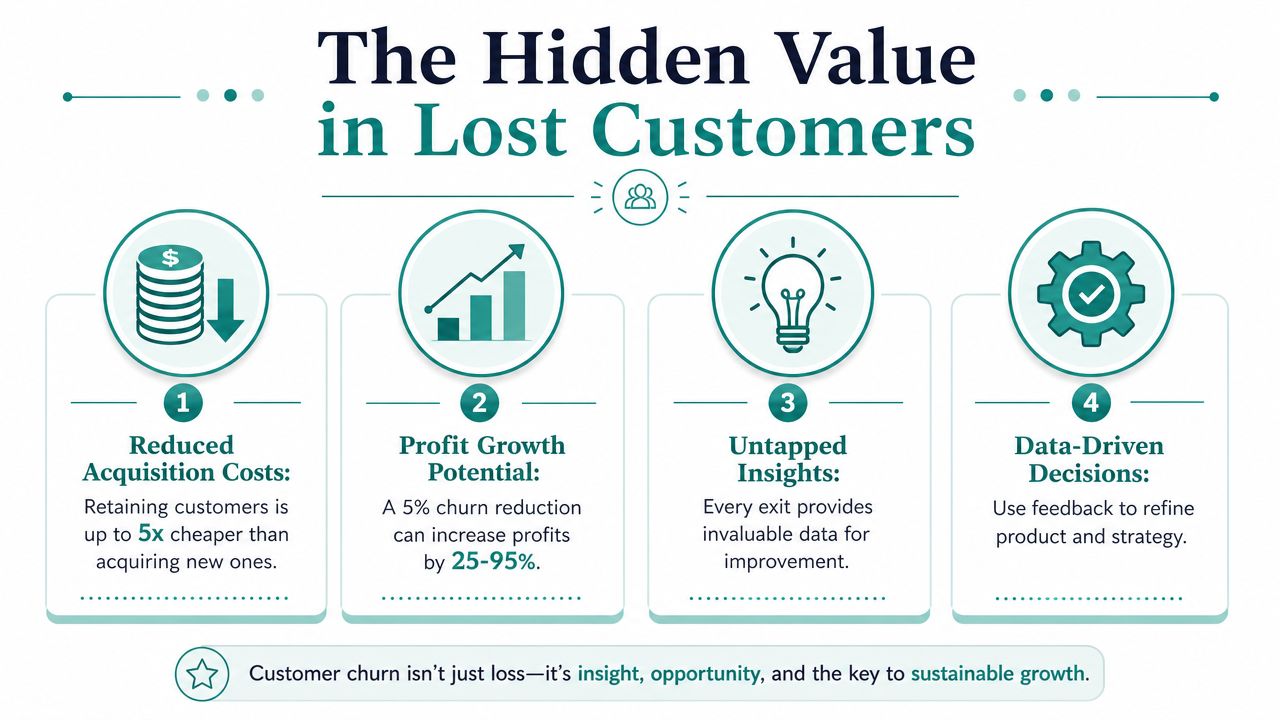
Customer churn costs U.S. businesses about $168 billion annually, and the average churn rate in the United States is 21%, according to Qualtrics on customer churn statistics. For a local business owner, that number stops being abstract fast. It shows up as empty appointment slots, thinner repeat traffic, quieter phones, and ad dollars spent replacing customers who already knew your name.
Exit surveys help you learn why customers leave. Ask specific questions about their experience and look for recurring problems you can fix.
For local, service-based, and retail SMBs, that honesty is useful in a very specific way. It doesn't just help you improve operations. It helps you fix your offer, your follow-up, and your advertising so the next customer walks in with the right expectations.
Why Every Lost Customer Is a Goldmine of Information
Every customer who leaves gives you a clearer audit of your business than many customers who stay.
Ask departing customers what prompted the change. Specific feedback about delays, pricing, or service problems is more useful than a satisfaction score alone.
When local businesses miss that feedback, they guess. They blame price when the underlying problem was slow follow-up. They assume a competitor undercut them when the customer desired clearer options, faster scheduling, or more updates during the job. In my experience, that guesswork is where small businesses waste money. They change the wrong thing, then spend more on ads to replace customers they could have kept.
What makes exit feedback different
Exit feedback is more useful than general satisfaction feedback because the decision has already been made. The customer is no longer trying to be polite, preserve the relationship, or avoid an awkward conversation with your team.
A real estate client might say very little during the listing process, then admit after leaving that your communication felt reactive and they never knew what happened next. An auto repair customer may tell the front desk they found a better price, then explain in an exit survey that the underlying issue was going two days without a status update. A local cleaning company may hear that a household is cutting expenses, then learn the customer would have stayed if rescheduling had been easier.
Treat those responses as operating evidence.
Why this matters for small local businesses
For a neighborhood business, a lost customer rarely means one sale. It often means the next appointment, the referral to a friend, the review that never got posted, and the repeat business your ads now have to replace.
That is why exit surveys should connect directly to both operations and marketing. The pattern in your responses tells you where the leak starts. If customers keep mentioning unclear pricing, your offer needs work. If they mention missed callbacks, the issue is follow-up. If they say the service was not what they expected, your ads, website, or sales conversation may be attracting the wrong fit.
Three questions usually matter most:
What broke first? Price, responsiveness, convenience, trust, or service quality.
Which customers are leaving? New customers, long-time regulars, or a specific service segment.
What should change first? Intake, scheduling, staff communication, the offer itself, or your local ad messaging.
Local businesses gain an advantage. Exit feedback can improve more than retention. A real estate office can use it to rewrite listing consultation messaging around communication and guidance. An auto shop can shift ad copy away from generic “best prices” claims and toward updates, turnaround time, and transparency. A home service company can stop promoting broad convenience if survey comments show the primary buying trigger is flexible scheduling in a specific part of town.
If retention is part of the plan, this guide on turning one-time buyers into lifelong repeat customers pairs well with exit survey work.
Designing a Survey That Gets Answers
Bad exit surveys ask too much, too late, in language customers don't want to decode. Good ones feel quick, respectful, and specific.
The core design principle is simple. Keep the survey short, and make it easy for the customer to tell you the single biggest reason they left. Lean B2B's guidance on customer exit surveys recommends forcing a customer to pick the main reason for churning from 4 to 6 options, and applying the 20% / 3% rule: if an answer gets over 20% of responses, split it into more specific answers; if it gets under 3%, remove it.
Start with one question that does the heavy lifting
The most important question is direct:
What is your primary reason for leaving?
That question works because it forces prioritization. Customers often have several frustrations, but the one they choose first is usually the issue with the biggest business value.
For a local business, your answer list should reflect reality on the ground. Don't copy a software template if you run a salon, a repair shop, or a real estate office. Build options that match how customers buy from you.
Examples that fit local SMBs better:
Price no longer worked for me
I chose a competitor
I didn't get the level of service I expected
The timing or scheduling didn't fit
I didn't need the service anymore
Other
Add one open-ended follow-up
Once the customer chooses the main reason, ask a short free-text question:
Can you tell us a little more?
That's where you learn whether “price” means too expensive, poor explanation of value, surprise fees, or a mismatch between the service package and the customer's need.
Short surveys get completed. Long surveys get postponed, skimmed, or abandoned.
Keep the tone human
Exit surveys work better when they don't sound defensive. If the copy reads like a legal intake form, response quality drops. If it sounds like a genuine attempt to learn, people are more willing to answer.
Use plain prompts such as:
We're sorry to see you go
Your answer helps us improve
This will only take a minute
Avoid terms like “service dissatisfaction vector” or “rate value perception.” Local customers don't talk that way, and they won't respond well to it.
Exit Survey Question Templates for SMBs
Tailor the survey to the business model
A real estate team should ask whether communication, market guidance, or trust drove the departure. An auto shop should test for speed, pricing clarity, wait-time updates, and confidence in recommendations. A local retailer should ask whether the issue was selection, pricing, convenience, or staff experience.
That's where good feedback design overlaps with broader survey strategy. This article on customer feedback surveys that get honest answers is useful if you want to tighten your wording before launch.
Launching Your Survey and Collecting Feedback
Timing matters more than most owners think. Ask too early, and the customer hasn't finished deciding. Ask too late, and the reason has gone fuzzy.
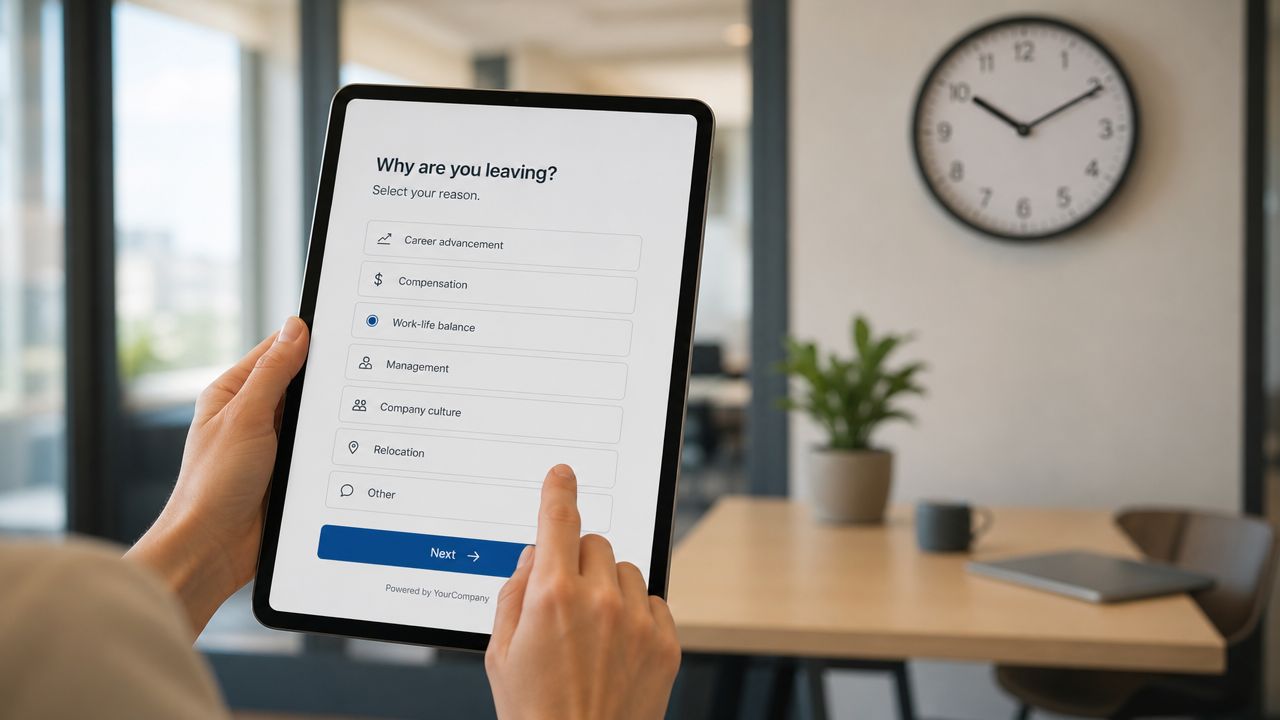
The best moment is close to the cancellation or break point. For a membership-based local service, that could be built into the cancellation flow. For a real estate lead that went cold, it may be a follow-up email right after the client chooses another agent. For an auto or home service customer who says they won't return, it could be a short text or email sent the same day.
Pick the channel your customers already use
The cheapest deployment options are usually enough. Many SMBs can run exit surveys through Google Forms, Typeform, Jotform, or built-in forms in email platforms they already use. The tool matters less than the delivery method.
A few practical fits:
Cancellation page form: Best for subscriptions, recurring services, and memberships.
Email follow-up: Good when the relationship ends by message or after a service cycle.
SMS link: Useful for local services where customers already communicate by text.
Front-desk tablet or QR code: Works for gyms, clinics, salons, and retail counters when a customer closes an account in person.
Segment from day one
Chargebee's customer exit survey guidance notes that response rates can be low because of mental disengagement, and recommends avoiding jargon and segmenting responses by customer group because different segments have different values and goals. That advice matters even more for local businesses, where one broad average can hide the underlying issue.
A long-time maintenance customer who leaves your auto shop is not the same as a first-time oil change customer who never came back. A seller who leaves your real estate brokerage after months of contact is not the same as an internet lead who dropped out after one call.
Capture tags such as:
Customer type: new, repeat, long-term
Service line: repair, maintenance, emergency, listing, consultation
Location or neighborhood: especially useful for multi-location businesses
Offer or package selected: basic, premium, recurring, one-time
Segment first. Otherwise you'll average together completely different problems and fix the wrong one.
If you want ideas for customer-friendly prompts at when someone is about to leave, this piece on exit-intent pop-ups that capture leaving visitors without being annoying offers some useful patterns.
Analyzing the Feedback to Find Your Why
Most owners stop at collection. They gather answers, skim the comments, nod at the obvious ones, and move on. True value comes when you combine the hard count with the human explanation.
Start with the basic measurement. To calculate customer churn rate, divide the number of customers who left during a period by the total number at the start, then multiply by 100. Contentsquare's retention metrics guide gives the example that if 100 customers started and 15 left, the churn rate is 15%.
That number tells you what happened. Your exit survey tells you why.
Read the multiple-choice answers like an operator
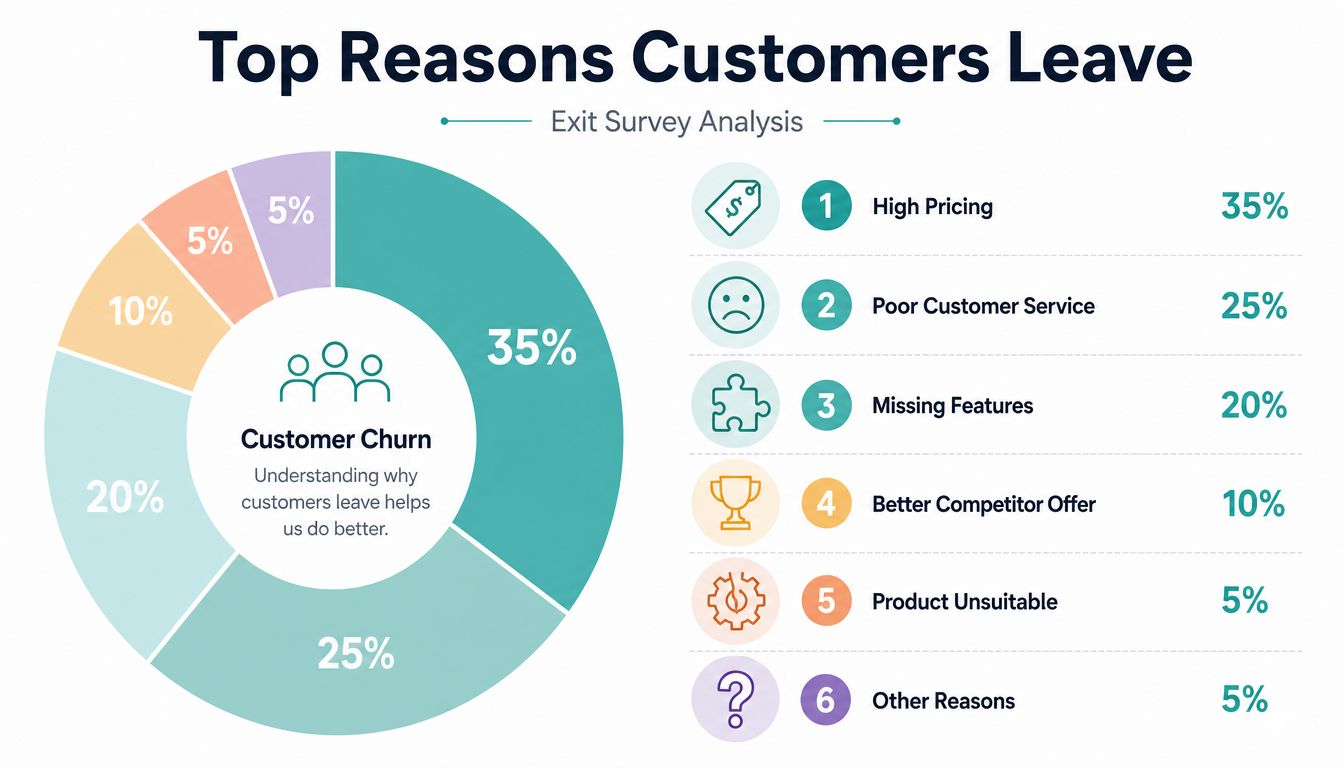
The first pass is simple. Rank the most selected reasons for leaving. Then compare them across customer segments.
If “price” dominates among new customers but not long-term ones, your issue may be positioning or expectation-setting. If “poor communication” appears mostly in one location or service team, you probably have a staffing or process problem. If “chose competitor” spikes for a specific service line, compare your offer against what customers think they're getting elsewhere.
A useful weekly review looks like this:
Count top reasons by volume
Break them out by customer type
Flag any reason that appears repeatedly in the same segment
Pull comments attached to that reason
Write the likely root cause in plain English
Free-text comments are where the real story lives
Open-ended feedback is messy, but it's usually where the pattern becomes obvious. Don't overcomplicate it. You don't need advanced analytics software to start. A spreadsheet and disciplined tagging will do the job.
Create a few comment buckets such as:
Price confusion
Slow response
Scheduling friction
Service quality
Expectation mismatch
Competitor advantage
No longer needed
Then read every open response and assign one primary tag, plus a secondary tag if needed. Over time, the wording starts to repeat. That repetition is useful. Customers often describe the same failure in different words.
When customers keep saying versions of the same sentence, believe the pattern before you debate the wording.
Match the numbers to the language
Small businesses gain an edge in this regard. Large companies often drown in dashboards. A local operator can often spot the issue faster because the business is close enough to the customer to recognize the context.
Here's what that looks like in practice:
That's also where broader loyalty metrics can support your picture. If you want another lens on customer sentiment and referral intent, this overview of whether small businesses should track Net Promoter Score can help frame the bigger retention conversation.
Turning Insights into Action and Smarter Ads
Exit survey insight has no value until someone changes behavior because of it. That's the dividing line between businesses that study churn and businesses that reduce it.
The first move is prioritization. Don't try to fix everything at once. Pick the issue that shows up most often, affects the most valuable customers, and can be changed without a major rebuild. For many SMBs, that's not the product itself. It's communication, packaging, scheduling, follow-up, or the promise made in the ad.
Fix the leak before you pour in more leads
If customers leave because they felt misled, your marketing message needs work. If they leave because response times were slow, your intake process needs work. If they leave because the service didn't fit what they thought they were buying, both teams have a job to do.
Common examples:
Real estate: Clients say they expected more proactive guidance. The fix may be a clearer onboarding sequence, better weekly updates, and ad copy that promises the actual experience instead of vague “white-glove service.”
Auto shops: Customers complain about pricing surprise. The fix may be estimate transparency, technician explanation, and ads that emphasize clear approvals before work begins.
Local home services: Customers mention scheduling frustration. The fix may be shorter booking windows, text confirmations, and landing pages that explain availability clearly.
Close the loop with selected former customers
Not every lost customer should get a win-back message. Some should. If the issue was fixable, and the relationship ended without hostility, reach out.
A short note works:
We reviewed your feedback and made a change based on it. Thanks for helping us improve.
That message does two things. It shows you listened, and it gives you a chance to recover business when the problem was practical rather than permanent.
Use retention metrics to judge whether the fix worked
You can't improve what you don't measure after the change. Customer retention rate helps here. QuestionPro explains that CRR is calculated as ((E, N) / S) × 100, where E is customers at the end of the period, N is new customers acquired during the period, and S is customers at the start. That formula matters because it isolates how well you kept existing customers instead of flattering the result with fresh acquisitions.
If you changed your booking workflow, pricing explanation, or follow-up scripts, track whether CRR improves in the next period. Then compare the exit reasons again. If “slow communication” drops and another issue rises, you've solved one bottleneck and exposed the next one.
Smarter ads start with clearer customer fit
This is the part many local businesses miss. Exit surveys don't just improve retention. They improve acquisition quality.
If customers regularly say “this wasn't what I expected,” your ads are attracting the wrong people or setting the wrong expectations. If they leave because of price, but your ideal customers are willing to pay for expertise, your message may be attracting shoppers who were never a fit. If they wanted one thing and you deliver another, the problem starts before the first call.
That's why churn analysis should influence your local advertising:
Rewrite the value proposition so it matches what you deliver.
Remove vague promises that create disappointment later.
Feature the service details that your best customers care about most.
Target local audiences who are more likely to match the offer and budget.
For SMBs that want to turn those insights into stronger local campaigns, Adwave fits well because it helps businesses create, launch, and measure broadcast-ready TV ads quickly without the usual production burden. That's useful when your exit data has already told you what needs to change in the message. Instead of guessing, you can sharpen the offer, clarify the audience, and put a cleaner promise in front of local viewers.
Start Listening Today Your Business Will Thank You
Most small businesses don't need a research department to learn why customers leave. They need a short form, a consistent process, and the discipline to act on what they hear.
The basic system is straightforward. Ask at the moment of exit. Keep the survey short. Make customers choose the main reason. Add one open-ended follow-up. Segment the answers. Review them on a schedule. Change one thing that matters.
A practical weekly checklist
Use this as your first operating version:
Set the trigger: Cancellation page, post-service email, or text follow-up.
Write the survey: One primary reason question, one comment box, one return-intent question if useful.
Tag each response: Customer type, service line, location, and offer.
Review every week: Count reasons, read comments, note patterns.
Assign one owner: Someone has to make the change, not just report the issue.
Track the result: Watch retention after each fix.
What good operators do differently
They don't treat churn as bad luck. They treat it as feedback with timing attached.
They also don't chase perfection. The first version of your exit survey won't be perfect, and that's fine. What matters is that you start hearing the truth in a structured way. Once the answers come in, the business gets easier to diagnose.
The customer who leaves can still help you grow, if you make it easy for them to tell you what went wrong.
Exit Surveys: Learning Why Customers Leave (and How to Stop It) isn't a one-time cleanup project. It's an operating habit. For local retailers, real estate teams, auto shops, salons, clinics, and service businesses, that habit can sharpen customer experience and make your advertising more accurate at the same time.
The worst churn is silent churn. Start listening, and your next round of decisions will be better than your last.
If your exit survey data shows your message needs work, Adwave is a strong next step. It helps local businesses turn clearer customer insights into polished TV ads built for the right audience, without the usual time and cost barriers that keep SMBs out of premium channels.


