
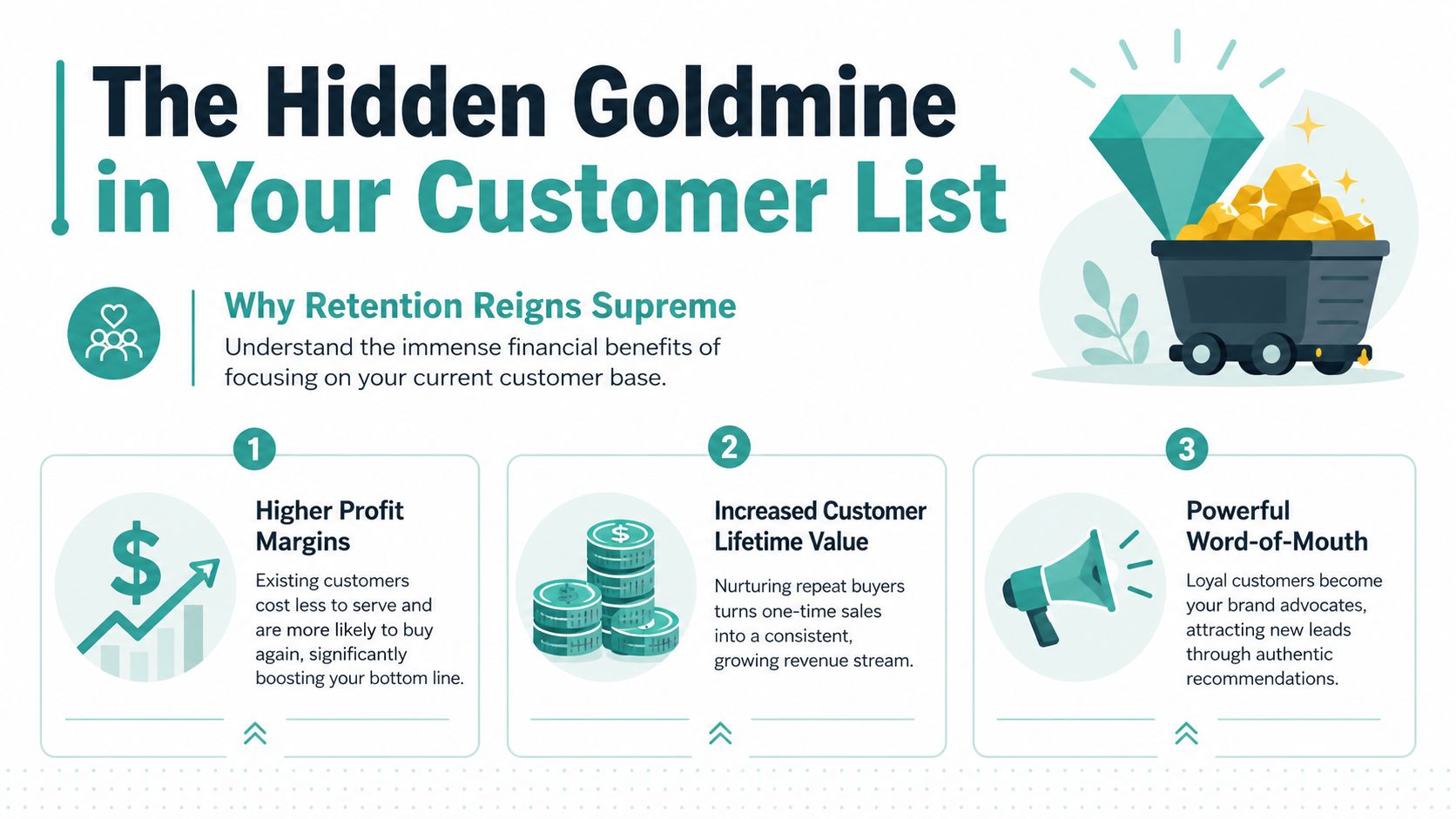
Acquiring a new customer can cost 5 to 25 times more than retaining an existing one, and increasing retention by 5% can lift profits by 25% to 95% according to Endear's retention breakdown. That changes the whole growth conversation for an SMB.
Most owners still spend the bulk of their energy trying to replace the customers they already worked hard to win. That's backwards. The fastest path to healthier margins often isn't more acquisition. It's turning one-time buyers into lifelong repeat customers through better follow-up, better timing, and stronger brand recall.
A first purchase is not proof of loyalty. It's proof that a buyer gave you one shot. What happens next decides whether that sale becomes a habit, a relationship, or a dead end.
The Hidden Goldmine in Your Customer List
A first purchase is only the start. For an SMB, the customer list often holds the fastest path to more revenue because these buyers have already trusted you once.
Your customer list should be managed like an active pipeline, not archived like old revenue. When an owner says they need more leads, I usually look at post-purchase follow-up first. That is where margin often slips away. The business already paid to get the sale. If there is no system to bring that buyer back, the acquisition spend keeps resetting to zero.
Why retention changes the math
Acquisition gets attention because it is easy to see. Leads come in. Ads launch. Clicks show up in a dashboard. Retention work feels quieter, but it usually produces better economics because you are marketing to people who already know your brand and have fewer objections.
That changes how you spend.
Acquisition requires fresh attention and trust: Every new buyer starts with more skepticism and a higher cost to convert.
Retention uses momentum you already earned: The buyer knows your product, your service quality, and whether you delivered on the first order.
Repeat purchases make revenue less volatile: A business with returning customers depends less on constantly replacing churn with new leads.
I see this all the time with smaller brands. They keep pouring money into Meta, Google, or direct mail while their one-time buyers sit untouched in Shopify, Square, or the POS. That is wasted demand.
What many SMBs miss
Treat your one-time buyer list as a group of people who already raised their hands once, rather than a static “past customers” file. That audience is usually your best short-term growth segment, especially if you segment by product bought, purchase date, and average order value.
Consider how customers prefer to hear from you. Email, SMS, social, and TV reach people in different settings; choose channels you can use and measure consistently.
Programmatic TV is a good example. Used well, it helps a local or growing brand stay visible to recent buyers without paying for broad, wasteful reach. Platforms like Adwave make this channel more accessible for SMBs, which means retention is no longer limited to coupons and batch emails. You can support repeat purchase behavior with simple CRM follow-up, paid social retargeting, and connected TV campaigns aimed at prior buyers or loyalty members.
That's why a simple loyalty structure and a clear re-engagement rhythm matter so much. If you need a practical starting point, this guide on building a customer loyalty program on any budget shows how to set up offers that drive return visits without creating a bloated rewards program.
The core idea is simple. Before spending more to fill the top of the funnel, build a better system for turning customer number one into customer number two.
Mastering the First 30 Days Post-Purchase
Most businesses waste the best retention window they have. They send a receipt, maybe a shipping update, then go silent until they want another sale. That gap kills momentum.
The strongest second-purchase programs are timed around the period when interest is still warm and product usage is becoming real. According to SnapMint Business, the average product recency window for triggering a second purchase is 30 to 90 days, and existing customers show a 70% repeat purchase probability compared with 5% to 20% for new prospects. In plain English, your first month matters because it sets up that second order window.
A better first-month sequence
Don't think of post-purchase as customer service. Think of it as onboarding.
Here's a practical flow that works across many SMB categories:
Day 1, confirm and reassure Send the order confirmation quickly. Add one useful detail beyond the transaction itself. That could be setup guidance, care instructions, what to expect next, or a short note on how to get the best result.
Day 3 to Day 7, help them succeed During this window, many brands jump to an upsell too early. Don't. Send education first. If you sell skincare, explain usage order. If you run a home service company, explain maintenance habits. If you sell apparel, share fit and care tips.
Day 10 to Day 21, ask about the experience Ask one simple question. “How's it going so far?” works better than a polished corporate template. The goal is to surface friction before silence turns into churn.
Before the likely reorder moment, make the next step easy If the product is consumable or replenishable, remind them before they run out. If it's not, suggest the next logical complementary purchase or service.
What the message should sound like
The wrong tone is “Buy again now.” The right tone is “We want you to get value from what you already bought.”
A good thank-you email usually includes three things:
Recognition: Thank them like a person, not a transaction ID.
Confidence: Reinforce that they made a good choice.
Help: Give one clear next step.
For example, a warm post-purchase note might sound like this:
Thanks for your order. We're glad you chose us. If you want to get the best result from your purchase, start with this quick guide. If anything feels off, reply directly and we'll help.
That kind of message lowers anxiety, increases usage, and creates a reason to reply.
What doesn't work
A lot of retention damage comes from impatience. These are the common misses:
Generic promos too early: Buyers haven't even experienced the product yet.
Review requests before value is felt: That creates annoyance, not advocacy.
No educational content: Customers can't become repeat buyers if they never fully use what they purchased.
A single-channel mindset: Email alone is rarely enough.
One of the easiest ways to improve this sequence is to map your welcome and post-purchase communication together instead of treating them separately. This walkthrough on welcome email sequences that turn subscribers into buyers is helpful because the same logic applies after checkout. Right message, right timing, low friction.
Your first 30 days after purchase should make the customer feel smart, supported, and remembered. If you do that well, the next purchase feels like a continuation, not a new sale.
From Generic Blasts to Personalized Conversations

Personalization sounds complicated until you strip it down to what it means. It means using what the customer already told you through their behavior.
That effort pays. Returning customers spend 67% more than new customers on average, and 41% of an online store's revenue comes from just 8% of customers according to Business.com's overview of returning customer value. That's why generic batch emails underperform. They ignore the small group driving outsized value.
The difference between talking at customers and talking to them
A generic blast says, “Weekend sale. Shop now.”
A personalized message says, “You bought our dark roast last month. We just released a grinder that pairs well with it.”
Those are not small differences. One forces the customer to do the work of connecting the dots. The other does the work for them.
Here's a simple comparison:
Segments that most SMBs can build fast
You don't need a data team to do useful segmentation. Start with the customer data you already have in Shopify, Klaviyo, Mailchimp, Square, or your CRM.
Build segments like these:
Bought a specific product: Send care tips, accessories, or a related service.
High-value repeat buyers: Offer early access, private bundles, or loyalty perks.
Hasn't purchased in a while: Send a check-in, not just a discount.
Recent first-time buyers: Keep them in the onboarding flow until they either repeat or go inactive.
Send fewer campaigns. Make each one easier to say yes to.
A coffee shop is a good example. If someone bought whole-bean espresso, don't send them the same campaign you send to a customer who buys bottled cold brew. Recommend a complementary item, a tasting set, or a subscriber perk that fits the original purchase. Relevance is what makes a message feel personal, even when it's automated.
Keep it achievable
Many SMBs stall here because they assume personalization means expensive software and complex AI models. It doesn't. Basic segmentation already puts you ahead of most businesses still sending one list, one message, one offer.
If you want a straightforward place to start, this guide on email list segmentation and sending the right message to the right people lays out the operational side well.
The goal isn't to sound clever. It's to sound useful. Customers come back when your communication matches what they bought, what they need next, and where they are in the relationship.
Build Loyalty and familiar Brand Awareness
A loyalty strategy without brand awareness is fragile. Brand awareness without a loyalty strategy is wasteful. You need both.
Most retention advice stops at email, SMS, and points programs. Those matter. But they don't solve a real problem many SMBs face. Customers don't live in their inbox. They forget brands in between purchases, especially if the buying cycle is longer or competitive.
Loyalty should be simple enough to explain in one sentence
If customers can't understand the value quickly, they won't care. The best loyalty ideas for SMBs are usually the least complicated:
Early access: Let repeat buyers shop or book before the public.
Member-only bundles: Package products or services in a way that feels exclusive.
Perk-based rewards: Free add-ons, surprise gifts, or priority scheduling.
Recognition: Thank-you notes, anniversary touches, or VIP treatment for best customers.
A local food business is a strong example. Packaging, presentation, and repeat visibility all shape memory. For owners thinking about how physical brand cues support repeat ordering, Afida's piece on effective branding for takeaway food is a worthwhile read because it shows how branding carries into the customer's home, not just the point of sale.
Retention needs off-platform visibility too
If your entire retention plan depends on whether someone opens an email, you're leaving too much to chance. Customers need to see your brand when they're not actively shopping.
That's where accessible programmatic TV earns a place in a modern retention playbook. It helps small businesses stay familiar, credible, and familiar between purchases. That matters for restaurants, dental practices, home services, local retail, real estate, and service businesses where repeat decisions are often triggered by memory and trust.
Why programmatic TV belongs in the retention mix
This is the part most guides miss. Retention is not only direct response. It's also recall.
Adwave fits that need well because it makes TV advertising accessible for smaller businesses. According to Adwave's overview of programmatic advertising platforms, Adwave combines an AI-powered creative engine with programmatic media buying and allows local businesses to launch professional commercials starting at $50. That matters because many SMBs have never considered TV a realistic option for keeping their brand in front of past buyers.
TV won't replace email, SMS, loyalty rewards, or customer service. It strengthens them. A customer who sees your brand on premium channels later opens your email with more recognition. A past buyer who remembers your name is easier to win back than one who forgot you existed.
Field observation: Direct response channels capture intent. Brand channels protect future demand.
If you're serious about turning one-time buyers into lifelong repeat customers, don't limit retention to inbox tactics. Build habits through direct communication, then reinforce memory through broader brand presence.
Measure What Matters for Customer Retention
Retention work gets ignored when nobody can see whether it's working. The fix is not more dashboards. It's a short list of metrics that tell you where the customer journey is breaking.
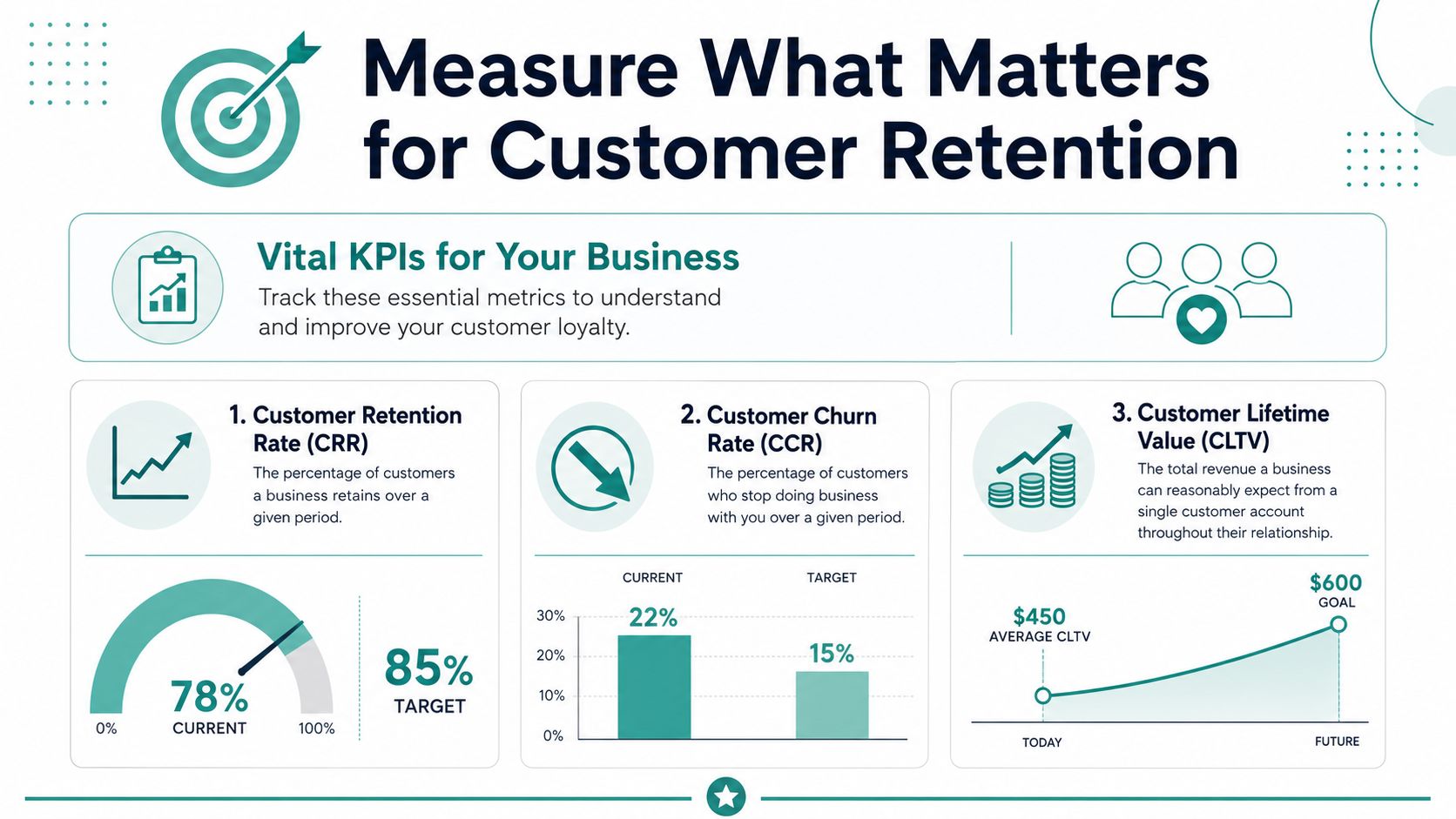
One of the most useful measures is Repeat Customer Rate (RCR). Sheetventure's retention benchmark notes that a high RCR points to compelling product value and smooth onboarding, while a low RCR usually signals friction in the buying experience or weak post-purchase follow-up. The same source recommends a second-purchase flow timed to the buyer's repurchase pattern, with outreach at 2 days, 2 weeks, and 2 months after the first purchase.
Three numbers worth tracking
You don't need advanced analytics to start. Use plain reporting from your commerce platform, POS, CRM, or spreadsheet.
Repeat Customer Rate This tells you how many customers come back for another purchase. If the number is weak, look first at onboarding, product experience, and follow-up timing.
Customer Lifetime Value Think of this as the total value a customer generates across the relationship. You don't need a perfect finance model to use it. Start by comparing customer groups. Which first product, channel, or campaign produces customers who buy again?
Purchase Frequency This shows how often customers come back. If it's lower than expected, the issue is often relevance, reminder timing, or a lack of compelling next-step offers.
A back-of-the-napkin scorecard
Use a simple decision table like this:
Use cadence as a diagnostic tool
The 2-day, 2-week, 2-month cadence is useful because it lines up with how retention progresses. You reassure early, support usage while the product experience is fresh, and re-engage before attention fades.
That same rhythm also gives you feedback points. Did customers respond to the early help message? Did they leave ratings or answer a micro-survey? Did they repurchase or go quiet? Those signals tell you where the process is failing.
A business with a membership or recurring model can apply the same thinking in a different context. Golf clubs, for example, often rely on consistent communication and visible value to reduce member drift. GolfRep's piece on predictable membership growth strategies is a useful adjacent example of how retention becomes measurable when you track relationship health, not just lead flow.
Don't confuse activity with proof
Open rates and clicks can be helpful, but they are not the finish line. Retention performance shows up in behavior.
If you want one additional feedback layer, tracking Net Promoter Score for small businesses can help surface sentiment between purchases. Just don't treat sentiment as a substitute for repeat buying. Ultimately, the test is whether customers return, stay engaged, and become easier to sell to over time.
The point of measurement is simple. Keep what moves customers toward a second purchase. Fix what creates silence.
Your Action Plan for Lasting Customer Loyalty
You don't need a giant retention program to get moving. You need a disciplined first set of actions. Most SMBs can make real progress by tightening follow-up, improving segmentation, and creating one reason to come back.
What to do this week
Start with the highest-impact basics:
Pull your one-time buyer list: Separate first-time customers from repeat buyers. That list is your retention pipeline.
Audit the post-purchase gap: Look at what happens after checkout. If the customer gets only a receipt and silence, fix that first.
Write one useful follow-up message: Not a promo. A help message tied to the product or service they already bought.
Choose one repeat trigger: Reorder reminder, complementary product, seasonal revisit, maintenance check, or loyalty invitation.
What to do in the next month
Once the basics are running, make your communication more relevant.
Create a few simple segments based on what customers bought and when they bought it. Then build one follow-up path for each major buyer type. A customer who bought entry-level service should not get the same message as a customer who already showed high intent or made a premium purchase.
This is also the right time to clean up your CRM habits. If you want a practical cross-industry example, these carBoost CRM strategies are useful because they show how structured follow-up and customer history can improve retention without overcomplicating operations.
What to do over the next 90 days
By this point, you should be able to answer a few simple questions. Which customers come back fastest? Which first purchase leads to the best long-term value? Which messages get replies, reviews, or repeat orders?
Use those answers to sharpen your offers and your timing. Add a simple loyalty perk. Build a win-back flow for customers who go inactive. Keep your best buyers close with recognition, not just discounts.
The businesses that win retention usually aren't louder. They're more consistent.
Turning one-time buyers into lifelong repeat customers isn't about one clever campaign. It's about building a buying experience that continues after checkout. Support the customer early. Personalize the next conversation. Give them a reason to come back. Measure the behavior that matters.
Do that well, and your customer list stops being a record of past transactions. It becomes the most reliable growth asset in your business.
If you want a practical way to stay visible between purchases, Adwave is worth a look. It gives small businesses an accessible path to professional TV advertising, so you can reinforce brand recall alongside your email, SMS, loyalty, and CRM efforts. That combination is often what helps a first-time buyer remember you when it's time to buy again.


