92% of consumers want ads that feel like a story, and storytelling can increase conversion rates by about 30%. Yet most small businesses still lead with plain facts, so narrative is often the highest-return lever available in a local TV ad.
Why does a business with a better offer often lose to one with a better story? The answer usually isn’t budget. It’s that price, location, services, and opening hours rarely give viewers a reason to care before the spot ends. A local ad has to make the audience recognize a problem, feel its importance, and see your business as the useful next step.
A good story does that quickly. It gives the viewer a person to follow, a tension to understand, and a change to remember. On local TV and streaming, that emotional clarity matters because the audience may know nothing about your company when the ad begins.
Why Small Businesses Need to Tell a Story
People are 22 times more likely to remember information when it’s delivered as a story, while recall for statistics alone can fall into the 5% to 10% range, according to storytelling retention data. That difference explains why a list of services can sound sensible in the edit suite and disappear from memory after the spot runs.
A business owner often knows exactly what should be included: the family history, the service area, the product range, the special offer, the phone number, and a statement about quality. The viewer doesn’t experience that information as a business plan. They experience it as a stream of competing messages. Without a character or problem to organize the details, even accurate claims become difficult to retain.

Facts need a human frame
Storytelling gives facts a job. A restaurant’s menu matters because a parent needs a reliable dinner after a long day. A roofer’s credentials matter because a homeowner wants confidence that a leak won’t return. A realtor’s market knowledge matters because a family needs help making a consequential move.
This is narrative transportation in practical terms. The audience follows a situation rather than evaluating an abstract claim. The message becomes easier to process because the viewer can connect it to a familiar decision.
Practical rule: Lead with the customer’s tension, not the company’s résumé.
That doesn’t mean facts have no place in an ad. They provide proof and remove doubt after the audience understands the problem. The mistake is presenting proof before the viewer has a reason to listen. For a small business, story structure isn’t decoration. It’s a retention tool that helps a limited media budget create a lasting association.
Discovering Your Authentic Brand Narrative
The first task in learning how to tell your story is deciding whose story the audience should follow. In most local ads, the customer is the protagonist. Your business is the guide that helps the protagonist overcome a specific obstacle.
Start by writing three plain sentences:
- The customer: Who needs help, and what situation are they in?
- The enemy: What frustration, risk, delay, confusion, or inconvenience stands in their way?
- The change: What becomes easier or better after your business enters the picture?
A flooring company might identify a homeowner embarrassed by worn floors before selling a product. An independent mechanic might focus on the driver who can’t trust a warning light. A café might speak to the commuter who wants a familiar, welcoming start to the day. These are stronger narrative beginnings than “we offer quality products at competitive prices.”
Find the turning point in real customer language
Interview customers who chose you and ask what happened immediately before they contacted the business. Ask what they tried first, what worried them, and what made them feel confident. Listen for repeated phrases. Those phrases often reveal the story your brand can tell without inventing drama.
Your origin story can support the narrative, but it shouldn’t replace the customer’s need. “We started this company because we care” is a value statement. “We saw local homeowners struggle to get clear repair advice, so we built a service around straightforward recommendations” connects the value to a useful outcome.
Research on SME branding distinguishes brand identity, how a company defines itself, from brand image, how stakeholders perceive and trust it. That distinction is central to writing a brand story that connects with customers. The story isn’t complete when it feels honest to the owner. It has to make the intended audience see the business as credible and relevant.
Test the narrative before production
Read the story to someone who doesn’t know the business. Ask them to identify the customer, problem, solution, and reason to believe. If they repeat your slogan but can’t explain the customer’s problem, the story is probably too company-centered.
Keep the details that reveal character or stakes. Cut background that doesn’t change the viewer’s understanding. Authenticity comes from recognizable truth, not from including every fact about the business.
Structuring Stories for 15-Second Spots
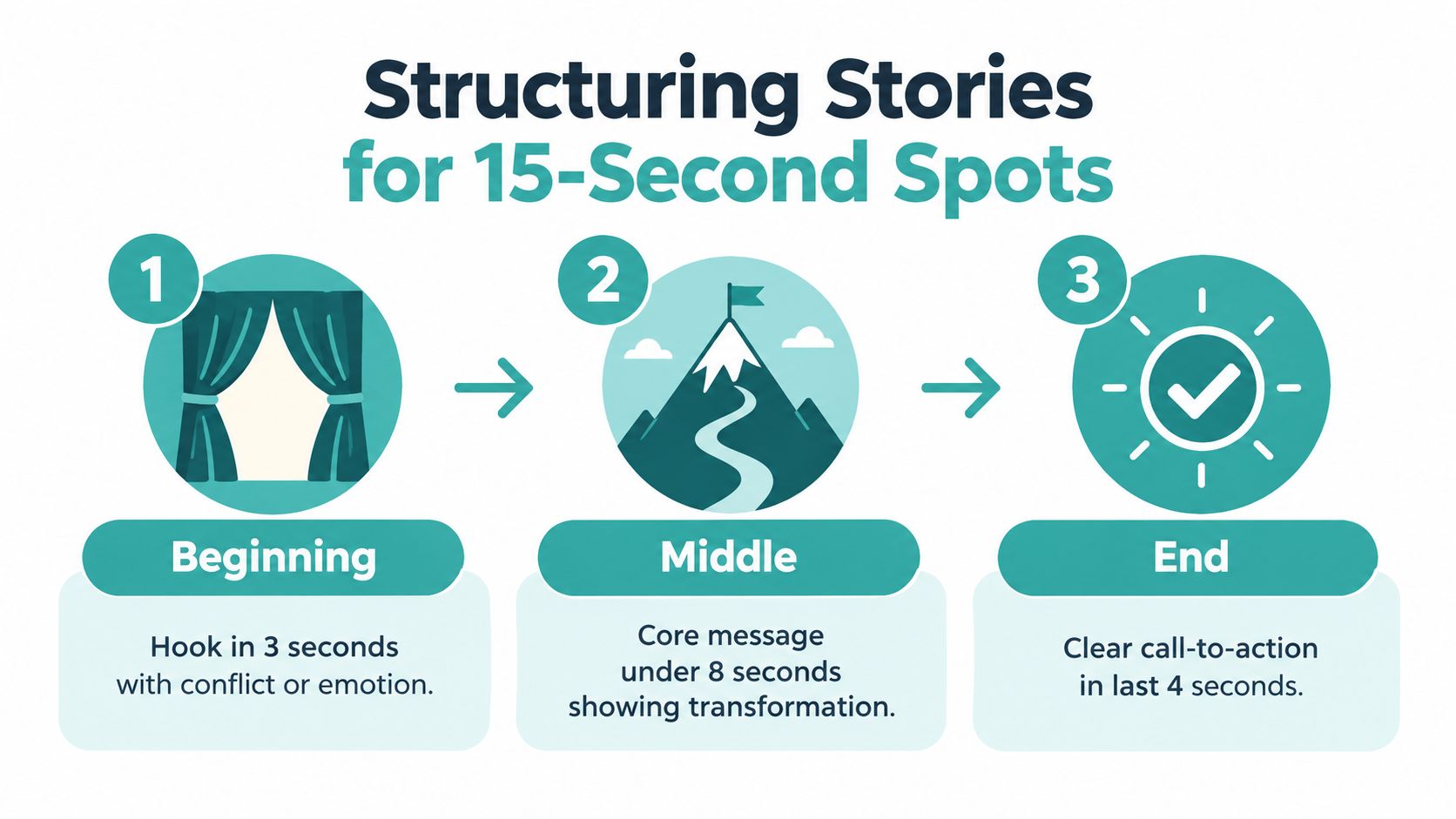
A three-part structure, beginning, middle, and end, gives a short ad enough shape to feel complete. Practical storytelling guidance recommends adding a clear moral or call to action, because context, emotion, and meaning help people retain the message, as explained in this guide to telling effective stories.
For a 15-second spot, the structure has to operate like a compressed edit rather than a miniature film. The beginning establishes the problem, the middle shows the useful change, and the end tells the viewer what to do next.
Build every frame around one job
The opening needs immediate recognition. Show the dripping ceiling, the stalled car, the empty storefront, or the customer scanning an unfamiliar menu. Don’t spend the first moments on a logo animation unless the brand itself is already the reason people are watching.
The middle should demonstrate the turn. Show the technician identifying the fault, the agent opening the right property, or the barista handing over the order. Dialogue and visuals should point in the same direction. If the voiceover says “fast help” while the image shows a slow consultation, the audience receives two different stories.
The final beat carries the action. A viewer should know whether to call, visit, book, request a quote, or go online. A short advertising video framework can help turn that structure into a script that stays focused.
Use the 15-second compression test
Write the full version first, then remove anything that doesn’t advance the customer’s problem or transformation. A workable draft usually needs:
- A visible tension: Give the viewer a situation they recognize.
- A single promise: Show the specific change your business delivers.
- A reason to believe: Use a real person, place, process, or result.
- One action: Make the next step unmistakable.
Pacing matters. Let the setup land clearly, then increase energy through the solution and finish with a clean call to action. If the spot needs a paragraph of explanation, the narrative hasn’t been simplified enough.
Scripting Real-World Scenarios
A generic script says a business is dependable. A useful script shows the moment when dependability matters.
Consider a homeowner hearing water during a storm. The first shot can show a bucket under a ceiling stain, followed by a direct line such as, “The rain shouldn’t decide when you call for help.” The turning point is a local technician assessing the issue and explaining the repair. The ending gives the homeowner a clear way to request service.
A real estate ad works differently. The tension might be a buyer walking through listings that don’t fit, while the turning point comes when an agent asks better questions and presents a home aligned with the buyer’s priorities. The story isn’t “we sell homes.” It’s “this buyer was stuck, then received useful guidance.”
An automotive spot can begin with a driver ignoring an unfamiliar dashboard light. The middle shows a service advisor diagnosing the issue without jargon. The close invites the driver to schedule an inspection. Each scene gives the audience a practical reason to identify with the character.
Map the scenario before writing dialogue
| Industry | The Problem | The Turning Point |
|---|---|---|
| Home services | A homeowner faces a leak and doesn’t know whether the damage is getting worse. | A local professional explains the problem and presents a clear repair path. |
| Real estate | A buyer sees properties but can’t connect listings to a real decision. | An agent translates the buyer’s needs into a focused search. |
| Automotive | A driver notices a warning sign and worries about an expensive surprise. | A service team provides a straightforward inspection and next step. |
These scenarios work because the audience doesn’t need a detailed explanation of the entire business. They only need to recognize the situation and understand why the company belongs in it. Commercial script guidance can help convert that recognition into concise scenes and spoken lines.
Academic research offers an important warning. Storytelling can reduce positive brand attitude when viewers become absorbed in the narrative but don’t identify with the characters, as summarized in research on storytelling advertising. A dramatic plot isn’t enough. The protagonist must look, sound, and behave like someone the local audience could know.
A polished story that feels unrelated to the viewer is still a failed advertisement.
Use local details carefully. A recognizable street, weather pattern, neighborhood concern, or customer routine can create relevance, but only if it supports the central problem. Don’t add regional decoration that distracts from the decision you want the viewer to make.
Producing with Adwave for Local Reach
Can a small business produce a credible local TV story without hiring a full production crew? The practical answer depends on choosing a workflow that protects the narrative while limiting unnecessary production work.
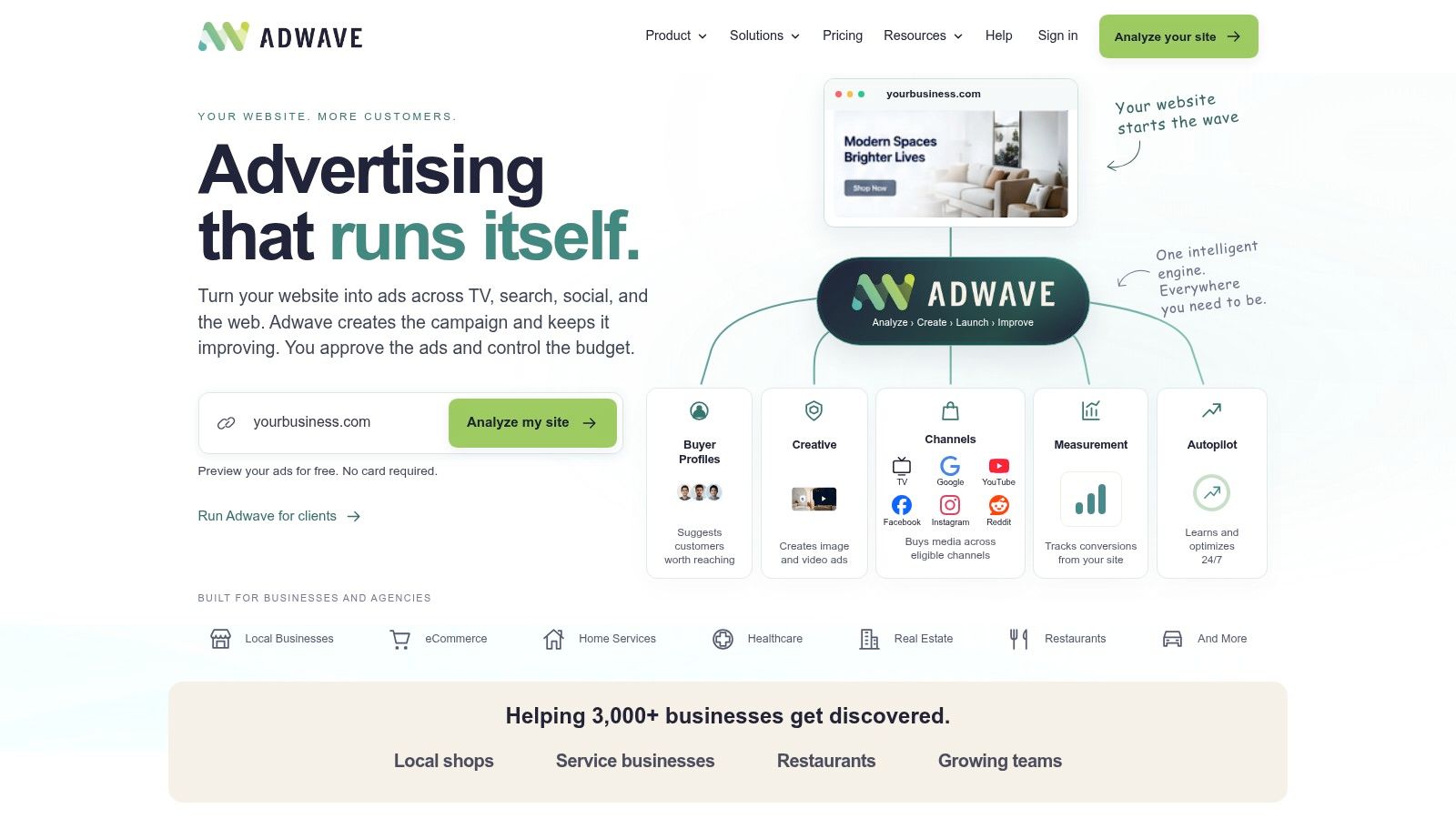
Adwave is an AI-powered TV advertising platform. A business can enter its website URL and generate a polished, broadcast-ready spot from existing content. The workflow allows the team to refine the message before approval and place the finished ad across 100+ premium channels, including NBC, Hulu, and ESPN, without a traditional crew or six-figure budget.
Start with the story inputs
Give the system clear material before entering the URL:
- The customer problem: Describe the situation in the language customers use.
- The transformation: Show what changes after the business helps.
- The proof: Include locations, processes, people, or offers that support the promise.
- The action: Choose whether viewers should call, visit, book, or learn more.
A website supplies raw material, but service lists rarely reveal the strongest emotional angle. Add a short description of the customer tension and intended tone when the site lacks that context. Then review the generated script like a producer. Does the first image create recognition? Does the middle show a meaningful change? Does the ending make the next action clear?
The production tool reduces setup time, not the need for judgment. A polished-looking spot can still fail if the opening lacks a recognizable problem, the visuals do not match the voiceover, or the call to action arrives too late. For a 15 to 30 second local spot, every scene must earn its place.
The Adwave’s SMB TV advertising report describes a more accessible buying environment for small businesses. That access makes disciplined creative more important, not less. A simpler production process still needs a precise story and a realistic distribution plan.
Targeting should follow the customer shown in the script. A local dental office may prioritize nearby households, while a dealership may need a broader regional audience. Use viewing patterns and audience data to place the finished spot where that customer is likely to see it.
Choosing Between 15 and 30 Second Formats
Choose the format based on the job the ad has to perform, not on a general preference for shorter or longer video.
A 15-second spot works well when the audience already understands the category and the business needs a fast reminder. It can show one recognizable problem, one solution, and one action. This format suits a restaurant promoting a visit, a service company driving calls, or a retailer reinforcing a simple offer.
A 30-second spot gives the narrative more breathing room. It can establish the character, reveal a meaningful obstacle, include proof, and make the business’s role clearer. That extra room is useful when the service requires trust, the offer is unfamiliar, or the emotional change is central to the brand.
Match duration to the decision
| Campaign need | More suitable format | Creative priority |
|---|---|---|
| Immediate foot traffic | 15 seconds | Recognition, offer, location, action |
| Simple service reminder | 15 seconds | One problem and one clear solution |
| Trust in a complex service | 30 seconds | Character, conflict, proof, reassurance |
| Brand familiarity | Either, depending on creative | A repeatable story people can recognize |
A 30-second script can fail if it repeats the same point for longer. A 15-second script can fail if it tries to explain a complicated service without giving the viewer enough context. The choice is a trade-off between narrative depth and efficient repetition.
A neutral benchmark offers a useful scale reference: a typical 4-week small-business streaming TV campaign earns about 9,100 views, reaches approximately 5,900 people, and has an all-in CPM of around $42.50 per 1,000 views, according to this small-business streaming TV benchmark. Treat those figures as a planning reference, not a promise for every campaign.
Start with the shortest version that can tell the truth clearly. If viewers need a meaningful setup to understand the value, use 30 seconds. If the audience already knows the problem and only needs a prompt, 15 seconds may carry the message more efficiently.
Measuring Story Impact and Optimizing
How do you know whether a short story made viewers act? Track the point where attention should become a visit, call, booking, or search. Completion rate shows whether viewers stayed through the narrative. Response metrics show whether the ending gave them a clear reason to continue.
CTV video completion rates average 92%, compared with 65% on mobile, according to Adwave’s TV advertising report. Use that difference when comparing placements. A completed view does not prove the story worked, but an early drop-off can signal an irrelevant opening or a setup that takes too long.
Diagnose the weak beat
Strong completion with weak response usually points to the close. Viewers may understand the business but still lack a clear next step. Early exits call for a more recognizable problem, a faster opening image, or dialogue closer to local customer language.
Change one element at a time after a creative revision. Test the opening, offer, voiceover, or call to action while keeping the underlying story intact. This makes results easier to interpret and protects useful learning from disappearing inside a completely new edit.
Storytelling can increase conversion rates by about 30%, while strong brand stories make 55% of consumers more likely to buy in the future, according to this compilation of storytelling marketing effectiveness data. Test narrative quality alongside media delivery. Adwave’s advertising measurement guidance helps connect completion, reach, response, and spend in one campaign view.
Adwave helps small businesses turn website content into broadcast-ready TV and streaming ads, refine scripts with AI-powered tools, and track performance across local-reach channels. Compare the 15-second and 30-second versions, then visit Adwave to create and launch the spot.